
2nd 392
Well-Known Member
No, but the off idle throttle sux, Torque Management, set for CAFE standards ?? Dunno. At least it can be remedied. At a price of course.But should you have to
Sponsored
No, but the off idle throttle sux, Torque Management, set for CAFE standards ?? Dunno. At least it can be remedied. At a price of course.But should you have to
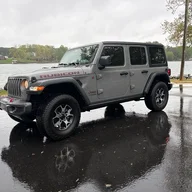
Because it’s retarded to drop any more than 40k on any rubicon. Let alone 65+ lol. If I’m paying 50k for a NEW rubicon, I’m definitely not adding another 15 on top of that for leather seats, adaptive cruise and butt warmers.Our 2022 XR was ~$65k, fully loaded. Stitched leather, adaptive cruise, etc. Gets wheeled all over the country. At that time the 392 would have added another $15k+ and the few"luxury" items we didn't want (paint matched fenders and top). Cloth seats are impossible to keep clean with the dogs. Seat heaters are mandatory for both long road trips and crawling out of the tent when it's 20-30⁰ outside. Adaptive cruise is great on roadtrips too. I wouldn't assume that choosing a loaded Jeep means it's a mall crawler by any means. If you're paying $50k+ for a base Rubicon, why not add the features that you want regardless of use?
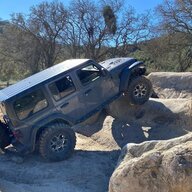
The average new vehicle is over $50k now. Look around and tell me which ones you see as a better value? Maybe you're a used car guy and every new vehicle is overpriced to you? As far as body on frame, 4wd vehicles they pretty much all cost the same. Stripped base models in the 30s, loaded models pushing past $60-70-or even $100k. I'll take the rubicon we have over anything else in its price range period. You get the most capable off road vehicle from the factory ever built AND all the creature comforts and modern conveniences you could want. Simply adjusted for inflation the base rubicon is the same price as a loaded TJ rubicon, which wasn't half as good on road and was still worse off-road. You say over priced, I'd argue it's a value vs modern competition and it's predecessors.Because it’s retarded to drop any more than 40k on any rubicon. Let alone 65+ lol. If I’m paying 50k for a NEW rubicon, I’m definitely not adding another 15 on top of that for leather seats, adaptive cruise and butt warmers.
if you have the money, more power to you. But not a single wrangler made by FCA currently is worth the price tag new, but people keep buying them so they’ll never get the memo.
Also adaptive cruise is cool but murders your rear brakes with extended use.
that being said. I’m glad you enjoy AND use your rig to its potential. That’s all that matters
TJ rubicon was also a much better built vehicle with longevity in mind IMO. My 06 TJ was great.The average new vehicle is over $50k now. Look around and tell me which ones you see as a better value? Maybe you're a used car guy and every new vehicle is overpriced to you? As far as body on frame, 4wd vehicles they pretty much all cost the same. Stripped base models in the 30s, loaded models pushing past $60-70-or even $100k. I'll take the rubicon we have over anything else in its price range period. You get the most capable off road vehicle from the factory ever built AND all the creature comforts and modern conveniences you could want. Simply adjusted for inflation the base rubicon is the same price as a loaded TJ rubicon, which wasn't half as good on road and was still worse off-road. You say over priced, I'd argue it's a value vs modern competition and it's predecessors.
Build quality is debatable. The TJ was incredible basic fully loaded. I don't know if being built less makes it better. How did TJ axles hold up to big tires? Far worse than JL axles. You needed more lift than the 3.5" on our JLUR just to run the 35s that came on ours stock. Conversely our axles have held up to 39s for 50k+ miles. For apples to apples, the TJ auto had a 2.86 1st gear and a terrible 4 speed. That resulted in a 47-1 crawl ratio in the rubicon. Far cry from the 87-1 stock in our JLUR. Sure the 4.0L was known to last forever. In my opinion that was simply because it was underpowered and redlined at 5k. Slow and boring better last forever. Maybe you want a tractor with a tub. We've been wheeling for 3 decades and never made the 1100 mile trip to Moab before the JL because built TJs could barely maintain western freeway speeds. Meanwhile a moderate lift will clear 39s and the JL will still cruise 90mph all day. And it will outcrawl the TJ thanks to the massive gearing advantage. Better frame, better body, better engine, better trans, better axles, better radio, better seats, better suspension, better everything. Therefore better built in my opinion.TJ rubicon was also a much better built vehicle with longevity in mind IMO. My 06 TJ was great.
New wranglers are built just for people to make it through warranty it seems and made repairing on your own much more complicated. . I’ve bought all of my cars new, my JLUR is the first used vehicle I’ve bought in probably 15 years. 21 with 50k on it. Paid 25k before my trade in. Sticker showed 55. I don’t see 55k in this thing. The 23 civic I traded in for I think I paid 24 for new off the lot with 8 miles. got 20 for it on trade in with 60k on it. Never felt like that car was overpriced whatsoever.
we can talk about inflation all day long but quality has gotten worse with prices going up. That automatically makes any new wrangler not worth what Jeep is asking for them. Now, I LOVE my JLUR, for all of the reasons you listed. I just disagree on the value of it new off the lot
You're usually using adaptive cruise on the highway.Also adaptive cruise is cool but murders your rear brakes with extended use.
how do you think adaptive cruise works? It uses the brakes, mostly the rear brakes to modulate speed comfortably so you’re not getting jerked around. Honda, Toyota, ford all do this for example. Yes it is used on the highway, to which you see speed variances caused by cars around you resulting in your brakes needing to be used to modulate speed, which wears on the rear brakes. Light adjustments the system may use engine braking but for the most part it uses your brakes. Can’t tell you how many Hondas and Toyotas I’ve worked on where the rear pads are cooked and as soon as I ask, the owner says yeah I use adaptive cruise a lot.You're usually using adaptive cruise on the highway.
I call bullshit that it murders your rear brakes with extended use. What's that claim based on?
You shouldn't be using adaptive cruise coming out of steep mountains, but that wouldn't be impacting the rears as you're claiming.
Why would it focus on the rear brakes? That makes no sense. Brakes are still biased to the front.how do you think adaptive cruise works? It uses the brakes, mostly the rear brakes to modulate speed comfortably so you’re not getting jerked around. Honda, Toyota, ford all do this for example. Yes it is used on the highway, to which you see speed variances caused by cars around you resulting in your brakes needing to be used to modulate speed, which wears on the rear brakes. Light adjustments the system may use engine braking but for the most part it uses your brakes. Can’t tell you how many Hondas and Toyotas I’ve worked on where the rear pads are cooked and as soon as I ask, the owner says yeah I use adaptive cruise a lot.
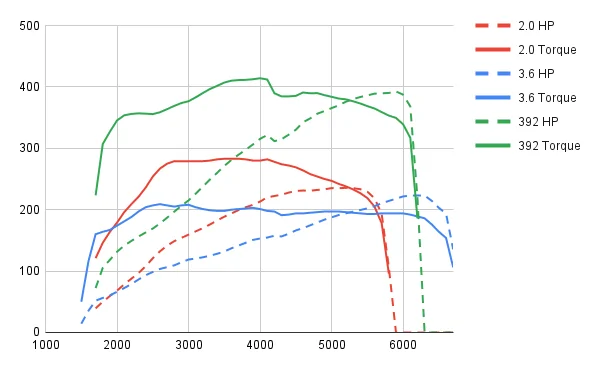
I know that it's been discontinued, but it would be nice to see the EcoDiesel's engine's output overlayed as well.Sounds like someone trying to talk themselves out of buying a 392 to me. Not only does the 33% quicker 0-60 show there's a substantially higher low end in the 392, but the dyno doesn't lie. The 392 makes more torque at any rpm you can measure and it's not even close. Not only are numbers at 1k rpm nearly impossible to measure, the turbo is doing nothing that low and you're well past 2k rpms the second you blip the throttle in any new Jeep thanks to the 4.7-1 1st gear. Sure the 2.0t might feel a little more nimble thanks to the lighter weight, but unless your test drive was well above 10k feet the turbo has no power advantage at any rpm. The 392 has a 150ftlb advantage at 2k rpms. No the FBOs aren't nearly doubling the torque of the 2.0t and especially not at low rpm as most of them improve airflow which mostly benefits peak numbers.
I'm thinking @AnnDee4444 posted that somewhere a while back.I know that it's been discontinued, but it would be nice to see the EcoDiesel's engine's output overlayed as well.
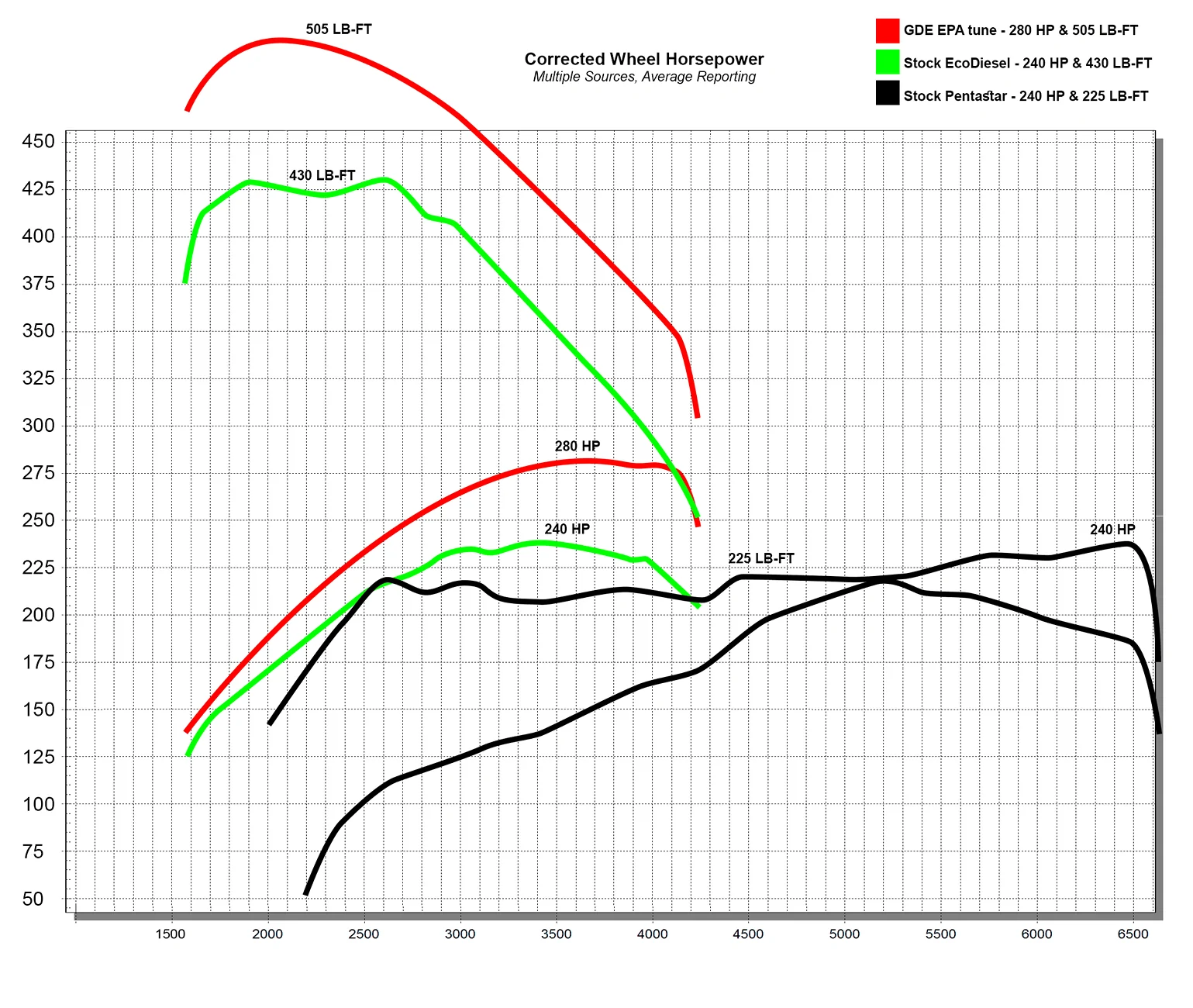
I don't have the overlay skills, but here's a stock and a tuned ecodiesel dyno graph for comparison. Stock it comes on a little lower than the 392 does, but the torque starts to drop just above 3k rpms and the hp is terrible which is why they are slow by comparison.I know that it's been discontinued, but it would be nice to see the EcoDiesel's engine's output overlayed as well.
FWIW: I never got multiple sources for the 3.0 & 392 dyno charts like I did with the 2.0 & 3.6. Be skeptical about their accuracy.I'm thinking @AnnDee4444 posted that somewhere a while back.
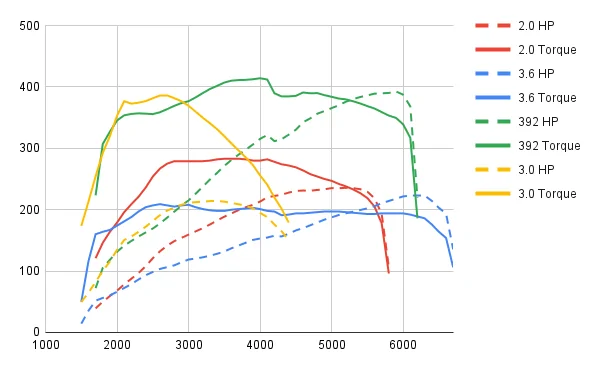
Thanks! It's really interesting that the 392 and the 3.0TD are almost perfectly aligned, in both torque and horsepower, from idle to 3,000rpms.FWIW: I never got multiple sources for the 3.0 & 392 dyno charts like I did with the 2.0 & 3.6. Be skeptical about their accuracy.
If the Wrangler was used as a low speed, off road only, crawler I'd agree. Unless it's trailered, it's still going to have more highway/ freeway miles than off road. I'll take the one that has 3x the area under the curve as the power doesn't start rolling off just above cruising rpms. Hell the 2.0t even has more area under the curve than the 3.0t. The diesel was discontinued for a reason. It wasn't as perfect as people hoped it would be in my opinon.Thanks! It's really interesting that the 392 and the 3.0TD are almost perfectly aligned, in both torque and horsepower, from idle to 3,000rpms.
Note that the 3.0TD delivers the most power of any Wrangler engine in the rpm range where we drive the vast majority of the time. It was really the absolute perfect engine for a Wrangler: power, where it's needed, and fuel economy. And...it did both effortlessly.
Unfortunately my short-hop driving patterns took me through a DPF every 24 months - under warranty of course.