

tomd
Well-Known Member
Good idea. My buddy had his winch short and turn on while he was in his kitchen. It kept winding, eventually cracking winch housing and actually bending bumper.
YES it happens. Not often.
YES it happens. Not often.
Sponsored

Does his wife make him make his own sandwiches or something? JKGood idea. My buddy had his winch short and turn on while he was in his kitchen. It kept winding, eventually cracking winch housing and actually bending bumper.
YES it happens. Not often.
I don't think so. Small boat manufacturers, including those making jet skis, got in the act and so small starting batteries were let out. At least that's what some ABYC dissenters seem to think. There are dissenters going both ways though.Even if my Jeep was a boat... the 660 CCA puts it well below the 800 CCA and up battery sources. It's almost like they even realize the available fault current from batteries smaller than that isn't sufficient for main over-current protection to be functional.
Not really. Many larger boats, say above 40 feet, are very common and nearly all have huge anchor windlasses. These are just winches with marine configuration (and special marine pricing).The exclusion of the starter motor is probably the most apples to apples comparison, also. The only device getting anywhere near the amperage of a winch.

I need to check, but I'm thought my Warn Zeon 10s was more like 2/0 copper (unsure of the insulation rating, but it's probably 125°C). For a non-continuous load and 5' circuit length, 2/0 should be ok for it's 409A @ 12V for 10,000 pounds (would be closer to 364A @ 13.5V with the engine running). I'd probably choose something like a 350A ANL fuse. But #2 just seems unsafe, even if it was 150°C XLPE... 409A is like 15% run time @ full load just to keep the wire from overheating.Because your winch wouldn't run? Most winches come with #2 gauge wire....rated at 130A continuous. No, that fuse won't let you pull anywhere near the full load. If I'm getting unstuck I don't care about wire heating, winch overheating to the point the motor stalls or even melting the insulation off the damn wire. It's like a fire pump install in a building. You don't size the overcurrent protection for the fla or the wire size like a normal application. You size it above the locked rotor current because you'd rather melt the wires and burn up the motor than have it trip during an emergency. RUN IT TO FAILURE. And a circuit isn't complete until it has a path to ground. Otherwise its just a hot wire not a circuit. Some DC lighting controls switch the ground wire, the circuit isn't hot and the light isn't on until the switch completes the ground path despite the 12+ wire being wired directly to the light. And for 400A you'd need 600kcmil. Good luck routing that, let alone finding ring terminals for the winch connections and battery.

Bingo, no fuse needed.The exclusion of the starter motor is probably the most apples to apples comparison, also. The only device getting anywhere near the amperage of a winch.
Nothing needs a fuse.Bingo, no fuse needed.

The part you don't seem to understand or simply won't acknowledge is that you don't NEED 300-500% to pop a 400A fuse...a short to chassis would cause an instantaneous jump to the max output of the source which WOULD trip a 400A fuse, quickly....assuming the source is capable of significantly more than 400A.The amperage generates the heat. You're slightly correct, look at the right side of the graph. Most fuses will hold 150% of there rating almost indefinitely. The part you don't seem to understand or simply won't acknowledge is your source even in a dead short isn't capable of the 300%-500% necessary to pop a 400A fuse in under a second. The left part of the chart basically doesn't exist when discussing winch fusing... which is why nobody who knows what they are talking about recommends fusing the winch in the first place.
The starter on my Silverado is fused at 400A. My CTS is fused at 250A.The exclusion of the starter motor is probably the most apples to apples comparison, also. The only device getting anywhere near the amperage of a winch.

No it wouldn't, that's not how the trip curve works. Jumping from 0 to 150% of rated won't cause tripping of the fuse. Have you seen the startup spike of a large electric motor? It's massive and in that application with the current available can trip properly rated fuses sized for the FLA of the motor. Which is why the code allows oversized the fuses up to 300%. And if you still get nuisance tripping you're allowed to go to 1000%. That's like putting a #10 gauge wire rated for 30A on a 300A breaker. You still need the high amps to trip a breaker period and your battery won't get there on a 400A fuse. Probably not on a 300A either. But keep walnut it back until you tell us that proper fusing is now 50% of the FLA, so the battery has enough power to trip it?The part you don't seem to understand or simply won't acknowledge is that you don't NEED 300-500% to pop a 400A fuse...a short to chassis would cause an instantaneous jump to the max output of the source which WOULD trip a 400A fuse, quickly....assuming the source is capable of significantly more than 400A.
Furthermore, ain't nobody putting a 400A fuse on their winch. 200A will work perfectly.
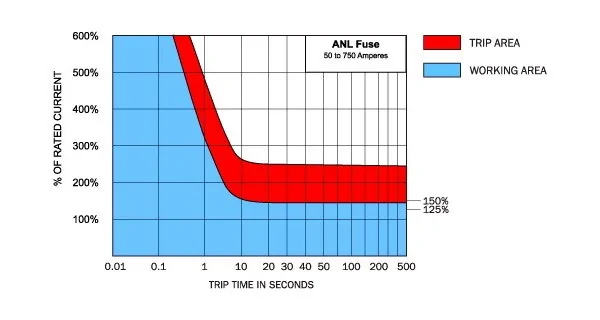
Looks familiar? So at 200% it will take 5 seconds to trip, but the battery can't even output 200% of 400A. At 150% it will run almost indefinitely. But he keeps telling us the battery will trip a 400A fuse...it simply won't. Your 300A fuse would likely work, but I still don't see the value. If you want short circuit protection when not in use a switch makes sense. Again the only winch manufacturer I could find that even sells a winch fuse is sherpa 4x4 and it's a 500A. That's the illusion of protection at best.
I have - I used to design systems using AC drives. Startup inrush looks NOTHING like a ground event.No it wouldn't, that's not how the trip curve works. Jumping from 0 to 150% of rated won't cause tripping of the fuse. Have you seen the startup spike of a large electric motor?
Well...it depends. 150% caused by a sudden short DEFINITELY would trip the fuse. But 150% dialed up slowly? Might not.If I'm reading this right, 150% load should trip an ANL fuse in about 10 seconds.

You're flat wing and the graphs prove it. That's not made up information it's real world testing period. And startup current looks a lot like fault current in fact. You can't have a current spike of higher than the available current period. No fuse trips at less than 200% which is what we are talking about here. That's not how it works. The only reason the inrush doesn't look exactly like a fault is the fault has a much higher current draw. If you limit that maximum current because your source is a tiny battery then inrush and a fault won't look any different period. The available fault current is extremely limited in a vehicle.I have - I used to design drive systems. Startup inrush looks NOTHING like a ground event.
Sorry man you are just wrong about this.
Well...it depends. 150% caused by a sudden short DEFINITELY would trip the fuse. But 150% dialed up slowly? Might not.


