
Sponsored

2021 Sahara Overheating on freeway

Remorseless

Well-Known Member
Joined
May 10, 2022
Threads
4
Messages
34,487
Reaction score
193,251
Location
NC
Vehicle(s)
'22 JLR 2.0T, '24 JTR, '19 Charger R/T
Build Thread
Link
Occupation
Holier Than Thou Internet Bully, Part-Time Online Boy Scout, Full-Time Arson Enthusiast, Napalm Compatible, Guy Who Defines What A Jeep Guy Is
Someone will probably immediately disagree with me...

No, a larger tire size will actually have less rolling resistance and gearing isn't an issue because the transmission will be in a lower gear. However wheel offset and/or lift height can add to additional wind resistance.
Trans being in a lower gear here I think is the issue though - as RPMs go up, the amount of heat produced by the engine and turbo go up. So, goal is less RPM or increasing cooling overhead.
Sponsored


AnnDee4444

Well-Known Member
Joined
Jan 14, 2019
Threads
54
Messages
5,529
Reaction score
7,948
Location
‎
Vehicle(s)
'18 JLR 2.0
Trans being in a lower gear here I think is the issue though - as RPMs go up, the amount of heat produced by the engine and turbo go up. So, goal is less RPM or increasing cooling overhead.
I actually found the other limit: too low RPM uses more fuel and likely makes more heat.

At 75 MPH on flat ground, my JLR with stock-height & wheels with 315s is right around 2000 RPM in 8th gear. Downshifting to 7th brings the RPM closer to 2500 RPM, and the fuel mileage up 1-2 MPG. Temperatures also seem to drop 1-2 degrees, which could be negligible but would make sense as less fuel is being burnt (or since coolant flow is increased). Does this mean that MPG could be an indicator for heat output when holding a steady speed?

Ultimately you need X amount of horsepower for a specific load, which is achievable either high-torque/low RPM, or lower-torque/higher RPM. Heat generation is definitely not linear for a static power output, and likely downward sloping between 2000 & 2500 RPM.
 

azjl#3

Well-Known Member
First Name
Scott
Joined
Sep 24, 2022
Threads
17
Messages
3,050
Reaction score
3,696
Location
North AZ
Vehicle(s)
2024 silver zenith or atomic silver. JLUR Extreme Recon-ish
Occupation
retired, grumpy, yet, friendly
have you verified the cooling fan works? Mine hits 231, then fan kicks on and immediately cools down to 215.
 

AnnDee4444

Well-Known Member
Joined
Jan 14, 2019
Threads
54
Messages
5,529
Reaction score
7,948
Location
‎
Vehicle(s)
'18 JLR 2.0
I actually found the other limit: too low RPM uses more fuel and likely makes more heat.

At 75 MPH on flat ground, my JLR with stock-height & wheels with 315s is right around 2000 RPM in 8th gear. Downshifting to 7th brings the RPM closer to 2500 RPM, and the fuel mileage up 1-2 MPG. Temperatures also seem to drop 1-2 degrees, which could be negligible but would make sense as less fuel is being burnt (or since coolant flow is increased). Does this mean that MPG could be an indicator for heat output when holding a steady speed?

Ultimately you need X amount of horsepower for a specific load, which is achievable either high-torque/low RPM, or lower-torque/higher RPM. Heat generation is definitely not linear for a static power output, and likely downward sloping between 2000 & 2500 RPM.
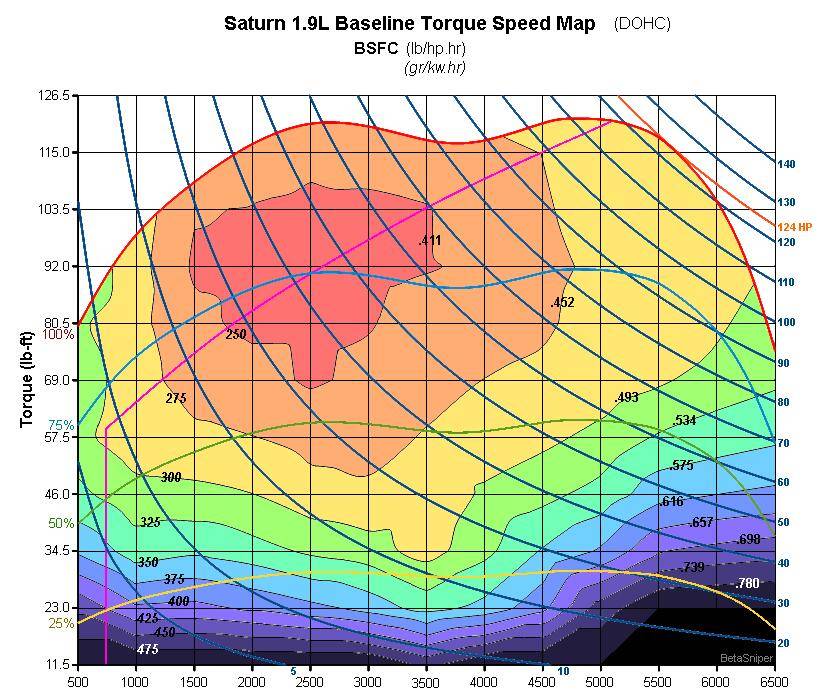
And I'm learning this is BSFC (Brake-specific fuel consumption). From Reddit:

Jeep Wrangler JL 2021 Sahara Overheating on freeway BBWi6


This map tells you how much fuel the engine burns per horsepower-hour or kW-hour it's producing. The red island is where the engine is most efficient.
What this tells you is that the engine is most efficient at about 75% load (think 75% throttle, roughly) and at medium revs. In that range it burns 250 grams of fuel per kW-hour or 0.411 lb of fuel per horsepower-hour.
At lower load levels it needs a lot more fuel. This means that an engine only runs efficiently when you're asking it to work reasonably hard. The curved blue lines tell you how much power the engine is producing, so when you look at the red island, the lowest power output that this engine can achieve while staying in its efficiency sweet spot is 30 horsepower.
So if the gearing is appropriate this engine would burn 30 * 250 = 7.5 kg grams of fuel per hour while putting out 30 horsepower. But what happens when you ask it to make half as much power? It's going to burn at least 15 * 300 = 4.5 kg of fuel to make 15 horsepower for an hour. Half the output but more than half the fuel consumption.
And that's where the problem lies with large displacement engines. The BSFC map is for a 1.9L 4-cyl engine with 120 hp or so, and its efficiency sweet spot is in the 30-70 horsepower range. If you made this into a 3.8L V8, its efficiency sweet spot would be in the 60-140 hp range. But driving on the highway at 70 mph only requires like 20 horsepower, so a large displacement engine is going to be pretty far away from its efficiency sweet spot, running at a load level that's too low.
 

Remorseless

Well-Known Member
Joined
May 10, 2022
Threads
4
Messages
34,487
Reaction score
193,251
Location
NC
Vehicle(s)
'22 JLR 2.0T, '24 JTR, '19 Charger R/T
Build Thread
Link
Occupation
Holier Than Thou Internet Bully, Part-Time Online Boy Scout, Full-Time Arson Enthusiast, Napalm Compatible, Guy Who Defines What A Jeep Guy Is
I actually found the other limit: too low RPM uses more fuel and likely makes more heat.

At 75 MPH on flat ground, my JLR with stock-height & wheels with 315s is right around 2000 RPM in 8th gear. Downshifting to 7th brings the RPM closer to 2500 RPM, and the fuel mileage up 1-2 MPG. Temperatures also seem to drop 1-2 degrees, which could be negligible but would make sense as less fuel is being burnt (or since coolant flow is increased). Does this mean that MPG could be an indicator for heat output when holding a steady speed?

Ultimately you need X amount of horsepower for a specific load, which is achievable either high-torque/low RPM, or lower-torque/higher RPM. Heat generation is definitely not linear for a static power output, and likely downward sloping between 2000 & 2500 RPM.
I'd suspect it's the higher coolant flow, but 1-2F would seem to be within margin of error. You can see that fluctuation even at a steady state speed and gear as different things happen (I tend to watch my temps like a hawk on the trip back from a wheeling day, she can bounce around on the readings by a fair margin even on a decently flat, straight highway).
 

Sponsored

Remorseless

Well-Known Member
Joined
May 10, 2022
Threads
4
Messages
34,487
Reaction score
193,251
Location
NC
Vehicle(s)
'22 JLR 2.0T, '24 JTR, '19 Charger R/T
Build Thread
Link
Occupation
Holier Than Thou Internet Bully, Part-Time Online Boy Scout, Full-Time Arson Enthusiast, Napalm Compatible, Guy Who Defines What A Jeep Guy Is
And I'm learning this is BSFC (Brake-specific fuel consumption). From Reddit:

BBWi6.jpg


This map tells you how much fuel the engine burns per horsepower-hour or kW-hour it's producing. The red island is where the engine is most efficient.
What this tells you is that the engine is most efficient at about 75% load (think 75% throttle, roughly) and at medium revs. In that range it burns 250 grams of fuel per kW-hour or 0.411 lb of fuel per horsepower-hour.
At lower load levels it needs a lot more fuel. This means that an engine only runs efficiently when you're asking it to work reasonably hard. The curved blue lines tell you how much power the engine is producing, so when you look at the red island, the lowest power output that this engine can achieve while staying in its efficiency sweet spot is 30 horsepower.
So if the gearing is appropriate this engine would burn 30 * 250 = 7.5 kg grams of fuel per hour while putting out 30 horsepower. But what happens when you ask it to make half as much power? It's going to burn at least 15 * 300 = 4.5 kg of fuel to make 15 horsepower for an hour. Half the output but more than half the fuel consumption.
And that's where the problem lies with large displacement engines. The BSFC map is for a 1.9L 4-cyl engine with 120 hp or so, and its efficiency sweet spot is in the 30-70 horsepower range. If you made this into a 3.8L V8, its efficiency sweet spot would be in the 60-140 hp range. But driving on the highway at 70 mph only requires like 20 horsepower, so a large displacement engine is going to be pretty far away from its efficiency sweet spot, running at a load level that's too low.
Wonder if and how forced induction changes that, since the torque curve is generally really flat and you're putting out so much of your torque so early in the rev range.
 
OP
OP

SalmonJeeper

Member
First Name
Salvador
Joined
Jun 28, 2021
Threads
1
Messages
11
Reaction score
3
Location
92126
Vehicle(s)
Jeep Wrangler 2018 Unlimited Sport JL
Someone will probably immediately disagree with me...

No, a larger tire size will actually have less rolling resistance and gearing isn't an issue because the transmission will be in a lower gear. However wheel offset and/or lift height can add to additional wind resistance.
Thank you

What do you think about the 3 lines radiator?
 
OP
OP

SalmonJeeper

Member
First Name
Salvador
Joined
Jun 28, 2021
Threads
1
Messages
11
Reaction score
3
Location
92126
Vehicle(s)
Jeep Wrangler 2018 Unlimited Sport JL
have you verified the cooling fan works? Mine hits 231, then fan kicks on and immediately cools down to 215.

Thank you for your reply, Yes, the fan seems to be working correctly
 
OP
OP

SalmonJeeper

Member
First Name
Salvador
Joined
Jun 28, 2021
Threads
1
Messages
11
Reaction score
3
Location
92126
Vehicle(s)
Jeep Wrangler 2018 Unlimited Sport JL
I actually found the other limit: too low RPM uses more fuel and likely makes more heat.

At 75 MPH on flat ground, my JLR with stock-height & wheels with 315s is right around 2000 RPM in 8th gear. Downshifting to 7th brings the RPM closer to 2500 RPM, and the fuel mileage up 1-2 MPG. Temperatures also seem to drop 1-2 degrees, which could be negligible but would make sense as less fuel is being burnt (or since coolant flow is increased). Does this mean that MPG could be an indicator for heat output when holding a steady speed?

Ultimately you need X amount of horsepower for a specific load, which is achievable either high-torque/low RPM, or lower-torque/higher RPM. Heat generation is definitely not linear for a static power output, and likely downward sloping between 2000 & 2500 RPM.

Thank you for your feedback, I noticed no more than 3k rpms which is far from the indicated limit in the dash. I think I just reached working in the boundaries conditions for the system
 

Sponsored

OP
OP

SalmonJeeper

Member
First Name
Salvador
Joined
Jun 28, 2021
Threads
1
Messages
11
Reaction score
3
Location
92126
Vehicle(s)
Jeep Wrangler 2018 Unlimited Sport JL
And I'm learning this is BSFC (Brake-specific fuel consumption). From Reddit:

BBWi6.jpg


This map tells you how much fuel the engine burns per horsepower-hour or kW-hour it's producing. The red island is where the engine is most efficient.
What this tells you is that the engine is most efficient at about 75% load (think 75% throttle, roughly) and at medium revs. In that range it burns 250 grams of fuel per kW-hour or 0.411 lb of fuel per horsepower-hour.
At lower load levels it needs a lot more fuel. This means that an engine only runs efficiently when you're asking it to work reasonably hard. The curved blue lines tell you how much power the engine is producing, so when you look at the red island, the lowest power output that this engine can achieve while staying in its efficiency sweet spot is 30 horsepower.
So if the gearing is appropriate this engine would burn 30 * 250 = 7.5 kg grams of fuel per hour while putting out 30 horsepower. But what happens when you ask it to make half as much power? It's going to burn at least 15 * 300 = 4.5 kg of fuel to make 15 horsepower for an hour. Half the output but more than half the fuel consumption.
And that's where the problem lies with large displacement engines. The BSFC map is for a 1.9L 4-cyl engine with 120 hp or so, and its efficiency sweet spot is in the 30-70 horsepower range. If you made this into a 3.8L V8, its efficiency sweet spot would be in the 60-140 hp range. But driving on the highway at 70 mph only requires like 20 horsepower, so a large displacement engine is going to be pretty far away from its efficiency sweet spot, running at a load level that's too low.

Thank you, this is interesting chart, first time I see this kind of analysis
 

Wkaz

Well-Known Member
Joined
Oct 25, 2020
Threads
23
Messages
497
Reaction score
916
Location
MA
Vehicle(s)
2021 Sahara
You didn't tell us how many miles on it, and what engine you have. Since you only have one overflow bottle, then you have the 3.6. The 2.0 has two, because of the turbo engine.
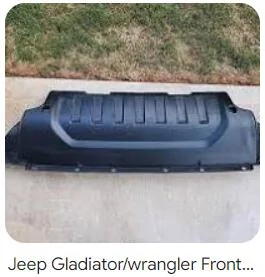
O.K., that is 242.6 degrees. That is a bit on the high side. There is many things that it could be. But you should only be using MOPAR OAT 50/50 mix Antifreeze, in your engine. I suggest that you flush the cooling system, install a new MOPAR thermostat, then refill with the correct antifreeze and bleed the air out of engine cooling system. Flush the external radiator core, with a garden hose. Then try it out. Hopefully, you still have your Air Dam on your Wrangler.
Air dam?
 

Snazzberry

Active Member
Joined
Feb 11, 2021
Threads
0
Messages
34
Reaction score
46
Location
SoCal
Vehicle(s)
Waiting for '21 JLUR, 1974 Vette
I have no recommendations but just wanted to let you know my 2021 Rubicon 4 cylinder turbo (41,000 miles) does the same thing. I regularly have to drive on a freeway with an 11% grade and it starts to get warm on me after being at 3,000 rpm for about 5 minutes. Last week, it was 100 degrees out and I was driving up the grade. Jeep started getting hotter earlier than it usually does. I had to turn off the A/C and drive 50 in the slow lane to avoid overheating. Ended up pulling over until it cooled down.

It's in the shop right now. They are putting in a new thermostat. If the doesn't work, I don't know what we are gonna do. But good luck to you!
Sponsored


Top