Sponsored

Width for 37s

roaniecowpony

Well-Known Member
Joined
Dec 4, 2018
Threads
192
Messages
12,889
Reaction score
20,362
Location
SoCal
Vehicle(s)
2018 JLUR, 14 GMC 1500 CC All TERRAIN
Occupation
Retired Engineer
Could increasing the size of the shed covering your tool over the years be an impediment! ?

I suppose, but the shed really hasn't been expanded all that much.
Sponsored


J0E

Well-Known Member
First Name
J0e
Joined
Sep 1, 2018
Threads
55
Messages
1,359
Reaction score
1,162
Location
Hawaii, MT, SLC, NYC
Website
bt39.com
Vehicle(s)
2021 JLR, 05 LJR on 43s
Build Thread
Link
Occupation
Drywall construction - reel estate
Given the same PSI (and ignoring the spring effect of the sidewalls, for simplicity, though it's not really negligible it just makes everything a lot more complicated), any two tires will have the same size contact patch, because the pressure of the ground against the outside of the tire has to equal the pressure from the air against the inside of the tire (otherwise there would be a net force on the tire patch and it would be accelerating upward or downward). The tire will deform to achieve a contact patch such that the weight of the jeep on that wheel divided by the air presssure equals the contact patch area. For a narrower tire, what this means is that the contact patch will be longer (forward and backward) to achieve the same area with less width, meaning the tire will deflect more downward to achieve this longer contact patch. Hope that makes sense.
'
Agree with every thing but ignoring the spring effect of the sidewalls, for simplicity, though it's not really negligible it just makes everything a lot more complicated- it is negligible down to 15 PSI for any tire and close enough to negligible for even bias and E rated tires. The sidewall is not a strong spring.

That's what BT39.com is based on.

And when you say patch, it's not the chalk or paint test patch touching the ground. MT's have deep lugs that are bridged over. Even past the lugs you have the cantilever effect. But if you consider patch size the area including between the lugs, it's a very good approximation.

Wider is generally better in sand, rock, dirt. Mud is a mystery so I won't comment. 98% of the interweb incorrectly believes wider, lower PSI, and bigger patch is better in snow, it's not. For snow you want good pizza cutter studded snow tires (chains the ultimate), fully aired up.

I'm currently on 37x12.5R17 KM3's but ordered Nitto 38x13.5R17 and bead locks.
 

AZ Hella

Well-Known Member
First Name
Mark
Joined
Sep 11, 2018
Threads
60
Messages
1,700
Reaction score
2,931
Location
Sonoran Desert
Vehicle(s)
JLUR
Vehicle Showcase
1
Clubs
 
I'm in the pizza cutter camp. I prefer contact pressure vs. flotation. For the type of wheeling I do and where I usually do it a skinny tire is great. My next set will be 37x11.5 Nitto's.
 

conFUcius

Well-Known Member
First Name
Stephen
Joined
Jul 10, 2020
Threads
31
Messages
959
Reaction score
1,438
Location
North Carolina
Vehicle(s)
2024 Supra MKV 3.0, 2024 392 JLUR
Occupation
Medical Affairs
Clubs
 
If you go with 13.5”, you can bump people better on the road when they try to merge into you. :rock:

Jeep Wrangler JL Width for 37s 1673528241489
 

Sponsored

c20040215

Well-Known Member
First Name
Leon
Joined
Oct 8, 2018
Threads
27
Messages
1,532
Reaction score
3,115
Location
Indiana
Vehicle(s)
2018 JLU Sport S; 2023 Honda Civic Sport Touring
Vehicle Showcase
1
Some car wash places don't take 13.5". 12.5" is the max the track would take, unless its a conveyor belt style.

Another factor to take into consideration.
 

Wicked_JL

Well-Known Member
First Name
Sam
Joined
Jul 24, 2022
Threads
9
Messages
116
Reaction score
132
Location
Arizona
Vehicle(s)
2024 Jeep Wrangler Rubicon XR
Occupation
Data Center Engineer
This thread really needs pictures ? KM3s can be had in 12.5" and 13.5"
 

AcesandEights

Well-Known Member
First Name
Aces
Joined
Aug 19, 2021
Threads
35
Messages
3,869
Reaction score
7,601
Location
So. Oregon
Vehicle(s)
2024 Toyota 4Runner
Occupation
I'm often occupied, by many things, often at the same time
More tread surface, particularly when aired down, allows the tire to conform around rocks and hard surfaces. And driving in sand is ALL about surface area.
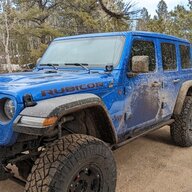
And the "longer" contact patch of the narrower tire provides that, in a better way (length, vs width).
 

Apples491

Well-Known Member
First Name
Nick
Joined
Jan 16, 2022
Threads
6
Messages
505
Reaction score
1,020
Location
Denver, CO
Vehicle(s)
2022 JLUR in Hydro Blue, 2024 Nissan Ariya
And the "longer" contact patch of the narrower tire provides that, in a better way (length, vs width).
I've slid sideways off of rocks enough that I'd far rather have that width and length-wise really doesn't matter much when your rolling in that direction.

But, I suppose in the end, the preference is entirely subjective.
 

Sponsored

AcesandEights

Well-Known Member
First Name
Aces
Joined
Aug 19, 2021
Threads
35
Messages
3,869
Reaction score
7,601
Location
So. Oregon
Vehicle(s)
2024 Toyota 4Runner
Occupation
I'm often occupied, by many things, often at the same time
You have a point; although I'd say the intended direction of travel is forward or back, even while sliding sideways off a rock, ha.
 

phageghost

Well-Known Member
Joined
Jan 6, 2022
Threads
7
Messages
274
Reaction score
582
Location
San Diego, CA
Vehicle(s)
2022 JLURD
'
Agree with every thing but ignoring the spring effect of the sidewalls, for simplicity, though it's not really negligible it just makes everything a lot more complicated- it is negligible down to 15 PSI for any tire and close enough to negligible for even bias and E rated tires. The sidewall is not a strong spring.

That's what BT39.com is based on.
Thanks, that's super helpful. In thinking about this I've been going back and forth on how much the sidewalls contribute to the downforce, and figured I'd err on the side of caution. But yeah, I can compress an empty tire by pushing on it, which, upon reflection, is going to be negligible compared to the ~1500 lbs of force the weight of the vehicle applies.

And that bt39.com website is awesome, someone really did their homework on figuring this out in quantitative detail, better than back-of-the-envelope speculation any day.

:beer:
 
  • Like
Reactions: J0E

Headbarcode

Well-Known Member
First Name
Mike
Joined
Aug 16, 2018
Threads
26
Messages
7,755
Reaction score
18,009
Location
LI, New York
Vehicle(s)
2019 JLUR Stingray 2.0 turbo
Vehicle Showcase
1
A wider tire will make better contact with obstacles offroad and provide better grip. But, that increased contact and grip means more weight and worse fuel economy.

Thinner tires are better for snow, though I doubt an inch would make much of a difference.
"A wider tire will make better contact with obstacles offroad and provide better grip". I think the opposite is true. Thinner tires can be better in snow.
Apple was pointing out an advantage for each, in its own paragraph. You seemed to have mashed them together. Yes, more surface contact from an aired down wider tire will have more grip than an equally aired down thinner tire.

And yes, a thinner tire will allow it to more easily cut through a layer of snow, to reach the ground below it. That's assuming the snow isn't deep enough to start burying the axle. At that point, a wider tire that can float on top is preferable.
 

AcesandEights

Well-Known Member
First Name
Aces
Joined
Aug 19, 2021
Threads
35
Messages
3,869
Reaction score
7,601
Location
So. Oregon
Vehicle(s)
2024 Toyota 4Runner
Occupation
I'm often occupied, by many things, often at the same time
As posted by phageghost, " any two tires will have the same size contact patch, because the pressure of the ground against the outside of the tire has to equal the pressure from the air against the inside of the tire". So, both the wider tire and narrower will have the same size contact patch.

You're right, it seems I mashed them together. That wasn't my intent, I just didn't create a new paragraph, which I should have. I meant those two sentences as independent.

I believe the narrower tire will have the same amount of tread on the ground, the same size contact patch, but it will be shaped differently. It will be longer, and I think that helps 95% of the time more than a wider patch. I think as you're driving forward or backward, the longer patch provides more traction than a wider tire does. No one has to agree with me though.

Separately, I think a narrower tire can be better in snow, as they cut through the snow; however, just as you pointed out, that's not always better in snow conditions.


Top