Sponsored

3.6 power loss at elevation

AnnDee4444

Well-Known Member
Joined
Jan 14, 2019
Threads
54
Messages
5,529
Reaction score
7,948
Location
‎
Vehicle(s)
'18 JLR 2.0
Interesting info about the JL's cooling design from https://www.theautopian.com/why-the...lle-is-actually-weirder-than-its-main-grille/

Back when I was developing the the Jeep Wrangler cooling system, we were having some issues meeting our trailer tow targets (basically, we wanted to tow 3500 pounds up Davis Dam, an ~11 mile, ~5.7-percent grade at 100F with AC on). We tried enabler after enabler to fix our capacity problem that was fundamentally caused by our limited packaging space above the front bumper and behind the seven-slotted grille — better heat exchanger-to-front end module sealing, a higher-power fan, larger grille openings, a different transmission shift schedule, and on and on. A given in all the calculations was that the front grille would be similar to the JK Wrangler’s in that it would have no texture.
Like this:
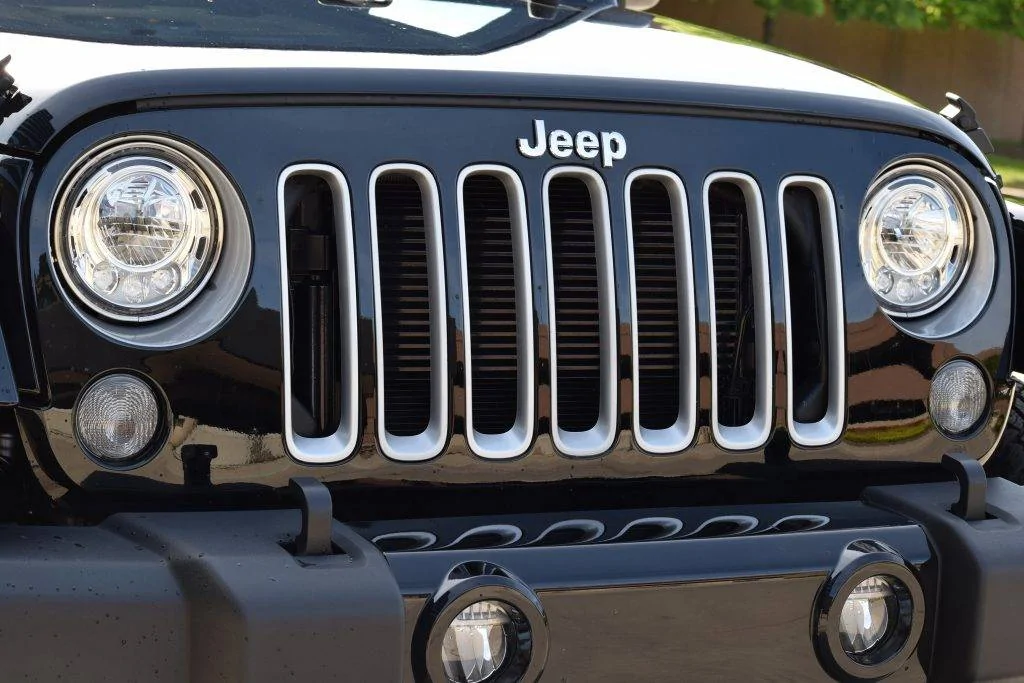
Jeep Wrangler JL 3.6 power loss at elevation ET017_002SA-1024x683
Notice how the transmission oil cooler and AC condenser are clearly visible, since there’s no grille texture in those seven slots. That’s fairly unusual for most cars, as designers typically love grille texture, which is why the the production JL Wrangler launched like this:
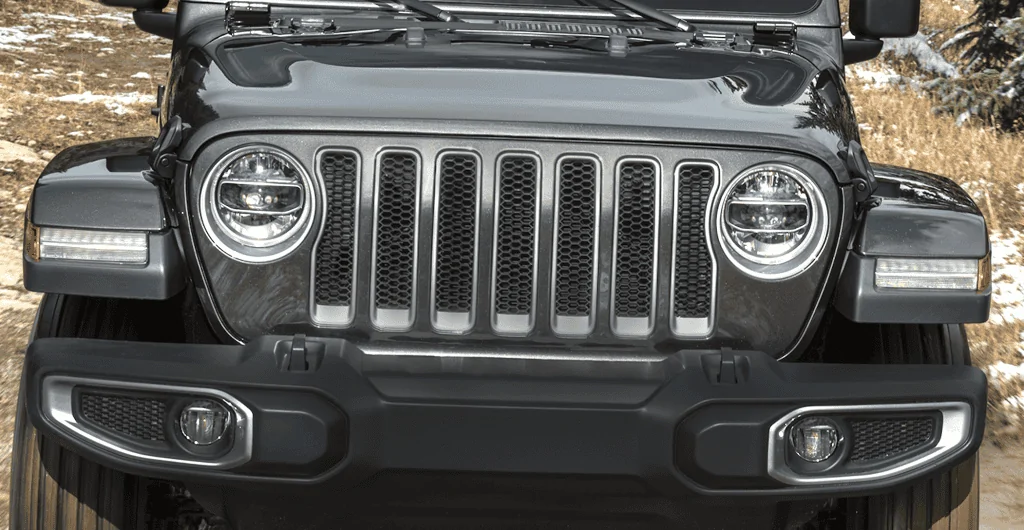
Jeep Wrangler JL 3.6 power loss at elevation Screen-Shot-2024-08-19-at-8.24.34-AM-1024x530
I have to say, I was surprised. We’d only been marginal on the J2807 towing requirement; how could we afford to reduce airflow to the cooling module by adding texture? The truth is that our simulation models probably had a bunch of safety factors baked into every level of the design (the fan airflow, the heat exchanger performance, the CFD for the front end, etc etc), and all those safety factors (or “margins”) stacked up to yield a cooling system that was overdesigned (this model fidelity issue is, in my view, part of why Chrysler products have been historically so heavy — if you can’t trust your models, you have to overbuild the car). This likely became apparent when physical mules began hitting the dyno, and then whoever replaced me realized that airflow was totally fine and that the designers who were champing at the bit to add grille textures were good to go.
Sponsored
 

Zandcwhite

Well-Known Member
First Name
Zach
Joined
Sep 4, 2019
Threads
11
Messages
8,305
Reaction score
14,198
Location
Patterson, ca
Vehicle(s)
2019 jlur
Interesting info about the JL's cooling design from https://www.theautopian.com/why-the...lle-is-actually-weirder-than-its-main-grille/

Back when I was developing the the Jeep Wrangler cooling system, we were having some issues meeting our trailer tow targets (basically, we wanted to tow 3500 pounds up Davis Dam, an ~11 mile, ~5.7-percent grade at 100F with AC on). We tried enabler after enabler to fix our capacity problem that was fundamentally caused by our limited packaging space above the front bumper and behind the seven-slotted grille — better heat exchanger-to-front end module sealing, a higher-power fan, larger grille openings, a different transmission shift schedule, and on and on. A given in all the calculations was that the front grille would be similar to the JK Wrangler’s in that it would have no texture.
Like this:
ET017_002SA-1024x683.jpg
Notice how the transmission oil cooler and AC condenser are clearly visible, since there’s no grille texture in those seven slots. That’s fairly unusual for most cars, as designers typically love grille texture, which is why the the production JL Wrangler launched like this:
Screen-Shot-2024-08-19-at-8.24.34-AM-1024x530.png
I have to say, I was surprised. We’d only been marginal on the J2807 towing requirement; how could we afford to reduce airflow to the cooling module by adding texture? The truth is that our simulation models probably had a bunch of safety factors baked into every level of the design (the fan airflow, the heat exchanger performance, the CFD for the front end, etc etc), and all those safety factors (or “margins”) stacked up to yield a cooling system that was overdesigned (this model fidelity issue is, in my view, part of why Chrysler products have been historically so heavy — if you can’t trust your models, you have to overbuild the car). This likely became apparent when physical mules began hitting the dyno, and then whoever replaced me realized that airflow was totally fine and that the designers who were champing at the bit to add grille textures were good to go.
And yet many have experienced temputure rise, even to the point of derating when climbing long grades both towing and even just on hot days at freeway speed. Would just deleting the grill inserts make a difference? Definitely the 1st person I've ever seen describe the JL cooling system as overbuilt.
 

whitechocolate

Well-Known Member
First Name
Brian
Joined
Aug 8, 2022
Threads
4
Messages
5,584
Reaction score
33,594
Location
Fl
Vehicle(s)
2021 JL 80th Edition
Have the 3.6 with eTorque and never had a drop in power while driving at higher altitudes. Anytime the gas is hit-> just goes like a rocket
 

Flip

Well-Known Member
First Name
Johnny
Joined
Mar 25, 2023
Threads
137
Messages
6,379
Reaction score
12,797
Location
Virginia
Vehicle(s)
2023 Jeep Wrangler Sport
Build Thread
Link
Occupation
Retired Power Plant Engineer
If we could only not be in such a hurry, slow down, and enjoy the drive.
Thats me 👆. I'm the slow guy in the right lane with the other herd of turtles. I seem to to get this a lot 🖕but other jeeps throw old grand dad a 👋
 

Remorseless

Well-Known Member
Joined
May 10, 2022
Threads
4
Messages
34,487
Reaction score
193,251
Location
NC
Vehicle(s)
'22 JLR 2.0T, '24 JTR, '19 Charger R/T
Build Thread
Link
Occupation
Holier Than Thou Internet Bully, Part-Time Online Boy Scout, Full-Time Arson Enthusiast, Napalm Compatible, Guy Who Defines What A Jeep Guy Is
And yet many have experienced temputure rise, even to the point of derating when climbing long grades both towing and even just on hot days at freeway speed. Would just deleting the grill inserts make a difference? Definitely the 1st person I've ever seen describe the JL cooling system as overbuilt.
A difference, yes. A meaningful difference? Maybe, maybe not. I will say, I think there's a reason there's less to the '24's grill "texture" and that reason is likely airflow.
 

Sponsored

AnnDee4444

Well-Known Member
Joined
Jan 14, 2019
Threads
54
Messages
5,529
Reaction score
7,948
Location
‎
Vehicle(s)
'18 JLR 2.0
And yet many have experienced temputure rise, even to the point of derating when climbing long grades both towing and even just on hot days at freeway speed. Would just deleting the grill inserts make a difference? Definitely the 1st person I've ever seen describe the JL cooling system as overbuilt.
I assume the grill inserts would make a difference... After all Jeep changed the spacing starting with the JT specifically for cooling.

Plus that last paragraph reads like the author is assuming his replacements did their job correctly...

I have to say, I was surprised. We’d only been marginal on the J2807 towing requirement; how could we afford to reduce airflow to the cooling module by adding texture? The truth is that our simulation models probably had a bunch of safety factors baked into every level of the design (the fan airflow, the heat exchanger performance, the CFD for the front end, etc etc), and all those safety factors (or “margins”) stacked up to yield a cooling system that was overdesigned (this model fidelity issue is, in my view, part of why Chrysler products have been historically so heavy — if you can’t trust your models, you have to overbuild the car). This likely became apparent when physical mules began hitting the dyno, and then whoever replaced me realized that airflow was totally fine and that the designers who were champing at the bit to add grille textures were good to go.
 

YBABRAT

Well-Known Member
Joined
May 12, 2024
Threads
55
Messages
1,409
Reaction score
1,355
Location
VIRGINIA
Vehicle(s)
2019 2 Door Rubicon X Wannabe
Occupation
None... but it pays well.
Just saying at 2000 feet.... I climbed from 60MPH to 100MPH up a high grade within 1/2 mile. Yes it had a power loss but I attribute it to the incline.

Throttle as responsive on texas flat land as in the VA mountains. Tranny snappy too!
 

roaniecowpony

Well-Known Member
Joined
Dec 4, 2018
Threads
194
Messages
12,921
Reaction score
20,453
Location
SoCal
Vehicle(s)
2018 JLUR, 14 GMC 1500 CC All TERRAIN
Occupation
Retired Engineer
People don't seem to understand that the only thing that makes FI better than a carb is constantly adjusting for optimal air/fuel RATIO. If there's less air it will add less fuel no matter what, and thereby make less power. A perfectly tuned carb will make the same power as the FI, the problem is changing conditions make keeping a carb perfectly tuned impossible. FI doesn't adjust for altitude by adding anything, it subtracts fuel and power to match the air available.
Exactly.

Stoichiometric (ideal) mixture for gasoline is 14.7 parts air to 1 part of gasoline, by weight. A carburetor doesn't have the ability to adequately compensate for the decay of air pressure with altitude increase. So, when you'd drive your old carbureted car to the top of Pikes Peak, it would be putting in about a 1/3rd too much fuel and smoking black. So, not only have you lost power due to the lack of ability to put as much air in the cylinder, you lost power from an excessively rich mixture. An EFI car on Pikes Peak would idealize the air fuel ratio back to that 14.7 : 1 ratio and make combustion ideal for the amount of air in the cylinder, thus gaining some power over a carburetor. You could get the same power back by re-jetting the carburetor for a given altitude.

Carburetors for airplanes simply have a mixture control with a variable "jet" that is manually controlled by the pilot.
 

Flip

Well-Known Member
First Name
Johnny
Joined
Mar 25, 2023
Threads
137
Messages
6,379
Reaction score
12,797
Location
Virginia
Vehicle(s)
2023 Jeep Wrangler Sport
Build Thread
Link
Occupation
Retired Power Plant Engineer
Just saying at 2000 feet.... I climbed from 60MPH to 100MPH up a high grade within 1/2 mile. Yes it had a power loss but I attribute it to the incline.

Throttle as responsive on texas flat land as in the VA mountains. Tranny snappy too!
Sugarbooger!
 

Zandcwhite

Well-Known Member
First Name
Zach
Joined
Sep 4, 2019
Threads
11
Messages
8,305
Reaction score
14,198
Location
Patterson, ca
Vehicle(s)
2019 jlur
Just saying at 2000 feet.... I climbed from 60MPH to 100MPH up a high grade within 1/2 mile. Yes it had a power loss but I attribute it to the incline.

Throttle as responsive on texas flat land as in the VA mountains. Tranny snappy too!
2k feet you'd be talking 6%, high ambient temperatures will cause that amount of loss. VA doesn't have mountains. The desert flatland is higher elevation out west. Make a hard climb at 10k feet and you'll notice the 30%, or at least I do every time. Those that post they don't are kidding themselves or they never use more than 70% of the power the v6 has period. It's scientifically proven. Nobody has a unicorn that magically isn't effected.
 

Sponsored

AnnDee4444

Well-Known Member
Joined
Jan 14, 2019
Threads
54
Messages
5,529
Reaction score
7,948
Location
‎
Vehicle(s)
'18 JLR 2.0
Another article by David Tracey about the changes made to the JT's cooling system. The bold text is what I find most interesting. This chart isn't for the 3.6, but I'm sure it looks similar (engine heat rejection graphed over RPM & torque)

Jeep Wrangler JL 3.6 power loss at elevation q=tbn:ANd9GcTimhTohD2ZBvjbmupvdLMnFl4yibooqI7lVQ&s


From: https://jalopnik.com/the-engineering-behind-the-jeep-gladiators-tow-rating-1833657453

You’ll notice that the Jeep Gladiator’s towing capacity varies based on trim level, gearing, tires size, and transmission type. Part of this has to do with the fact that different options can alter what’s called “Vehicle Demand Energy”—in this case, how much power is required by the engine to get the truck up the SAE J2807 Davis Dam grade given a certain vehicle load.
The 3.6-liter “Pentastar Upgrade” engine in the JT can meet this power requirement by running at a variety of different operating points (RPM, load points). In other words, let’s say the power needed to tow 7,650 pounds up Davis Dam is 200 horses—this could be achieved in third gear at a high engine RPM but low load (which relates to throttle opening) or in fourth gear at a lower RPM but a higher load on the engine.
Transmission gearing, axle ratio, tire size, and of course transmission calibration are all factors that play into which gear the vehicle can hold up the grade, and thus, which operating point the engine will run at while towing a certain load up Davis Dam.
That’s a big deal, because an engine’s heat rejection (and also the heat rejected by other components in front of the radiator, like a transmission cooler or charge air cooler) is not the same just because the engine is making the same horsepower—it is a function of engine speed and load.
So to achieve 7,650 pounds, Milo told me a major enabler was optimizing the tire size along with the gear ratio, with the team ending up choosing—for the Sport trim with the Max Trailer Tow group—a 32-inch tire and a 4.10:1 axle ratio to keep heat rejection down. (That’s the same gear ratio as the Rubicon, and while the Sport trim doesn’t get the 4:1 low range in the transfer case, that short axle ratio should still be exciting to folks interested in buying a less expensive Gladiator to build up with larger tires).

Jeep Wrangler JL 3.6 power loss at elevation yiowwylygyq4skqd3od1
Image: David Tracy
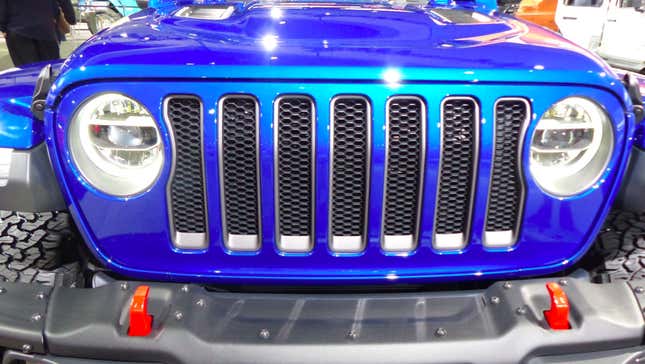
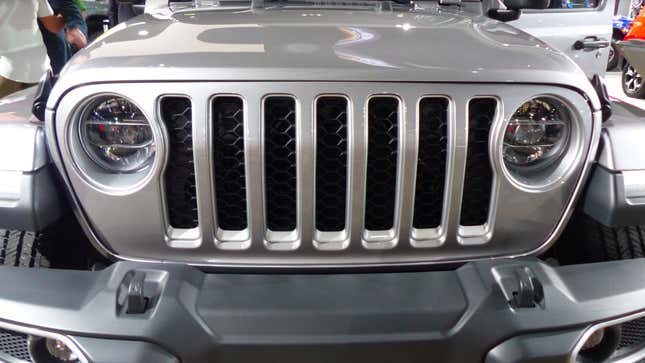
Another major factor in scoring that best-in-class tow figure was opening up the grille. In the photo above, you can see the grille slots of the JL Wrangler, and below is a look at the Gladiator’s grille openings:
Jeep Wrangler JL 3.6 power loss at elevation b0bt4icwm8vszzn7t85
Image: David Tracy
Here’s a closer look.
JL:
Jeep Wrangler JL 3.6 power loss at elevation fo5jlkdwhz8btygjypll
Image: David Tracy
JT:
Jeep Wrangler JL 3.6 power loss at elevation jgmks2ypeu1uxh45m3zc
Image: David Tracy
The actual slot widths appear to be the same, allowing Jeep to use a common grille between the two models, but the texture inserts inside the grilles are vastly different, with the JT’s being less restrictive allow for better airflow to the cooling module.
Also to help suck in air, Jeep engineers gave the JT with the Max Trailer Tow group a larger fan than the one that comes on the standard truck, and which is also shared with the JL. The JL and base JT’s fans are 600 Watts according to Milo, and per the image below, the Max Trailer Tow Gladiator appears to come with an 850 Watt unit:
Jeep Wrangler JL 3.6 power loss at elevation g3xew1behrz3cqtwsn6b
Image: David Tracy
So those were the main enablers according to Milo: the bigger fan, the big grille openings, and the optimization of heat rejection up the grade via the axle ratio and tire size.
 

AnnDee4444

Well-Known Member
Joined
Jan 14, 2019
Threads
54
Messages
5,529
Reaction score
7,948
Location
‎
Vehicle(s)
'18 JLR 2.0
Exactly.

Stoichiometric (ideal) mixture for gasoline is 14.7 parts air to 1 part of gasoline, by weight. A carburetor doesn't have the ability to adequately compensate for the decay of air pressure with altitude increase. So, when you'd drive your old carbureted car to the top of Pikes Peak, it would be putting in about a 1/3rd too much fuel and smoking black. So, not only have you lost power due to the lack of ability to put as much air in the cylinder, you lost power from an excessively rich mixture. An EFI car on Pikes Peak would idealize the air fuel ratio back to that 14.7 : 1 ratio and make combustion ideal for the amount of air in the cylinder, thus gaining some power over a carburetor. You could get the same power back by re-jetting the carburetor for a given altitude.

Carburetors for airplanes simply have a mixture control with a variable "jet" that is manually controlled by the pilot.
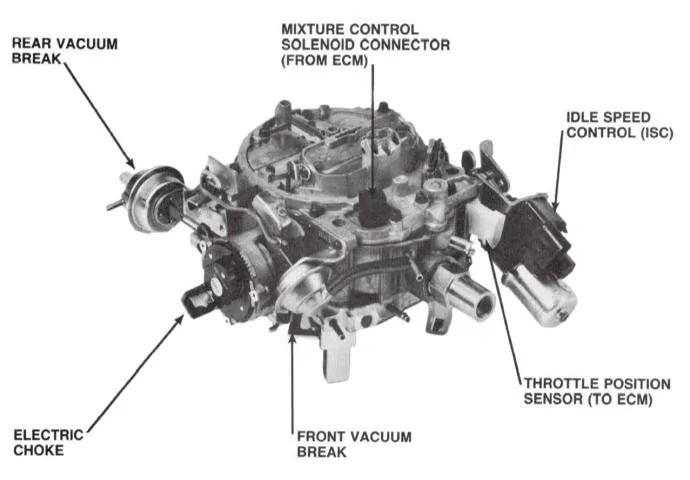
There's actually a few computer controlled carburetors
Jeep Wrangler JL 3.6 power loss at elevation elec-quad
 

Johnny B

Well-Known Member
First Name
John
Joined
May 16, 2024
Threads
4
Messages
1,188
Reaction score
5,047
Location
PA
Vehicle(s)
2021 JLU Sahara
Clubs
 
A difference, yes. A meaningful difference? Maybe, maybe not. I will say, I think there's a reason there's less to the '24's grill "texture" and that reason is likely airflow.
That new grill has a wide open mesh design. Hardly enough material to interrupt airflow.
 

jeepingib

Well-Known Member
First Name
Dusty
Joined
Jun 26, 2018
Threads
25
Messages
10,247
Reaction score
40,096
Location
College Station, TX
Vehicle(s)
18' JLUR Punk'n
Occupation
BBQ prophet
A difference, yes. A meaningful difference? Maybe, maybe not. I will say, I think there's a reason there's less to the '24's grill "texture" and that reason is likely airflow.
I still want to get the full dimensions of both grills to see if the shorter 24'+ grill is actually an improvement in volumetric airflow. To me it looks dubious at best. It's shorter for sure, so losing area there, but the slats are removed, so a gain there. But is the gain from slat removal, enough to offset the loss of height? Especially when looking at the cooling pack width vs the opening width. The finned area of the cooling pack is much narrower than the opening of the grill.
Sponsored


Top