Sponsored

TrailRecon- Engine Failure

DanW

Well-Known Member
First Name
Dan
Joined
Mar 2, 2017
Threads
179
Messages
8,863
Reaction score
11,734
Location
Indiana
Vehicle(s)
21 JLUR, 18JLUR, 08JKUR, 15 Renegade, 04 WJ
Vehicle Showcase
2
I will second that comment!
I just put my 2019 JLU R into the shop a week ago for a cam replacement! This is on a rebuilt engine replacement in December for the same problem. About 10K miles this time!
About time Jeep steps up and recalls or extends the warranty indefinitely for this problem!
It is absolutely ludicrous in this day and age for the rocker arm to have a teflon bushing!
If you want a recall, you need to complain to the NHTSA. Go to safercar.gov

There have not been nearly enough reports filed to even start an investigation, let alone get a recall. So people experiencing this need to take the time to file the complaints.

Sorry to hear about your engines. That is a shitty deal. Maybe you can talk your dealer into extended coverage.
Sponsored
 

DanW

Well-Known Member
First Name
Dan
Joined
Mar 2, 2017
Threads
179
Messages
8,863
Reaction score
11,734
Location
Indiana
Vehicle(s)
21 JLUR, 18JLUR, 08JKUR, 15 Renegade, 04 WJ
Vehicle Showcase
2
Where are all the 2.0 Turbo haters now? Ha.
I don´t hate ´em, but it ain´t trouble free....

10% in just a forum poll say they´ve had problems. While anecdotal, that´s not something I would be crowing about.

https://www.jlwranglerforums.com/forum/threads/has-your-2-0t-been-trouble-free.150247/

And could this be the 2.0 version of the 3.6 tick?

https://www.jlwranglerforums.com/forum/threads/my-2-0-rattle-journey.92468/

Looking for a trouble-free mass produced engine? Good luck.

Oh, just for the record. The 2.0 has a higher warranty cost claim rate than the 3.6. That is precisely why this great little engine did not do what it was designed and intended and hoped to do....replace and retire the 3.6. I´m not being sarcastic, btw. It IS a great engine and I would not hesitate to own one. But people in glass houses should be careful about throwing rocks.
 

Only-In-A-Jeep

Well-Known Member
First Name
David
Joined
Nov 6, 2023
Threads
7
Messages
388
Reaction score
679
Location
North Georgia Mountains
Vehicle(s)
2021 Jeep Wrangler Sport
I don´t hate ´em, but it ain´t trouble free....

10% in just a forum poll say they´ve had problems. While anecdotal, that´s not something I would be crowing about.

https://www.jlwranglerforums.com/forum/threads/has-your-2-0t-been-trouble-free.150247/

And could this be the 2.0 version of the 3.6 tick?

https://www.jlwranglerforums.com/forum/threads/my-2-0-rattle-journey.92468/

Looking for a trouble-free mass produced engine? Good luck.

Oh, just for the record. The 2.0 has a higher warranty cost claim rate than the 3.6. That is precisely why this great little engine did not do what it was designed and intended and hoped to do....replace and retire the 3.6. I´m not being sarcastic, btw. It IS a great engine and I would not hesitate to own one. But people in glass houses should be careful about throwing rocks.
I hear you and I was being somewhat facetious with my comment. Way too many people acted like the 3.6 would never fail and the 2.0 was total garbage. You are correct in saying they both have their issues. I was just trying to point that out.
 

SadRobot

Well-Known Member
Joined
Aug 31, 2019
Threads
144
Messages
7,491
Reaction score
20,071
Location
Los Angeles
Vehicle(s)
2025 Prius LE
Is this issue unique to the latest generation of the 3.6? If so, when was that gen released?
Mine is a 2019 so not really a latest gen issue that I can see. Some are failing early like Brad's at TrailRecon and others like mine just failed at 108k miles. I have a 2025 engine on the way so time will tell how long this one holds out.
 

Sponsored

Only-In-A-Jeep

Well-Known Member
First Name
David
Joined
Nov 6, 2023
Threads
7
Messages
388
Reaction score
679
Location
North Georgia Mountains
Vehicle(s)
2021 Jeep Wrangler Sport
Mine is a 2019 so not really a latest gen issue that I can see. Some are failing early like Brad's at TrailRecon and others like mine just failed at 108k miles. I have a 2025 engine on the way so time will tell how long this one holds out.
that's not good...was sort of hoping it could be linked to a more recent change in design.
 

pnut

Well-Known Member
First Name
M
Joined
Nov 19, 2020
Threads
18
Messages
514
Reaction score
749
Location
Michigan
Vehicle(s)
2022 Wrangler 392 XR
Isn't the 3.6 the same engine that has been around for years and years? I think my wife's 2015 JK has that engine.

My point is, it's strange that it's a known failure, and Jeep hasn't done anything about it despite it being known, for many years. Although look at hinge corrosion, so maybe it's not so strange.

I see JK's in the 200k range all the time, so maybe it's not that common. Maybe it was a JL specific failure.
 

mrtm1970

Well-Known Member
First Name
Marshall
Joined
Jun 30, 2022
Threads
38
Messages
1,354
Reaction score
3,006
Location
Orlando, FL
Vehicle(s)
2019 JL Unlimited Rubicon
Build Thread
Link
Occupation
Mechanical Engineer
Just curious…how could you tell your engine did not like 5W20? What were the symptoms? Drop in fuel economy? Engine vibration? Engine noise?
@Spunky @azjl#3

Sorry for taking this long to respond as I spent Saturday changing the spark plugs and yesterday, spending time with my Autistic teenagers since they sat inside while I changed the spark plugs (took my time & took 7hrs...yes I know it should only take 4hr max but I took breaks, etc.) the day before...

Ok, from what I remember, is that almost right away there was a very slight vibration (not earth shattering but noticeable to me) to the Jeep from start up. Then until my next oil change (I waited only till 3K miles), it remained & I felt VERY uncomfortable to keep the 5W20 in the engine as my JLUR is my only vehicle, daily driver and the only means to get to work & transports said Autistic teenagers to & from before care/school/aftercare as I am the ONLY parent (living) to care for them.

Found my response here when I changed the oil back to 0W20:
https://www.jlwranglerforums.com/fo...ou-do-to-your-jeep-jl-today.3033/post-2731554

So I got worse gas milage and also no reduced noise as others had relayed they experienced. Also remember, I changed to the 5W20 at around 80-90K miles.

So I changed the oil back to 0W20 and it all went away and I could tell "MY" engine was happy again. This is just my experience, no science behind it & don't doubt others have changed to 5W20 without issue.
 
Last edited:

roaniecowpony

Well-Known Member
Joined
Dec 4, 2018
Threads
193
Messages
12,897
Reaction score
20,374
Location
SoCal
Vehicle(s)
2018 JLUR, 14 GMC 1500 CC All TERRAIN
Occupation
Retired Engineer
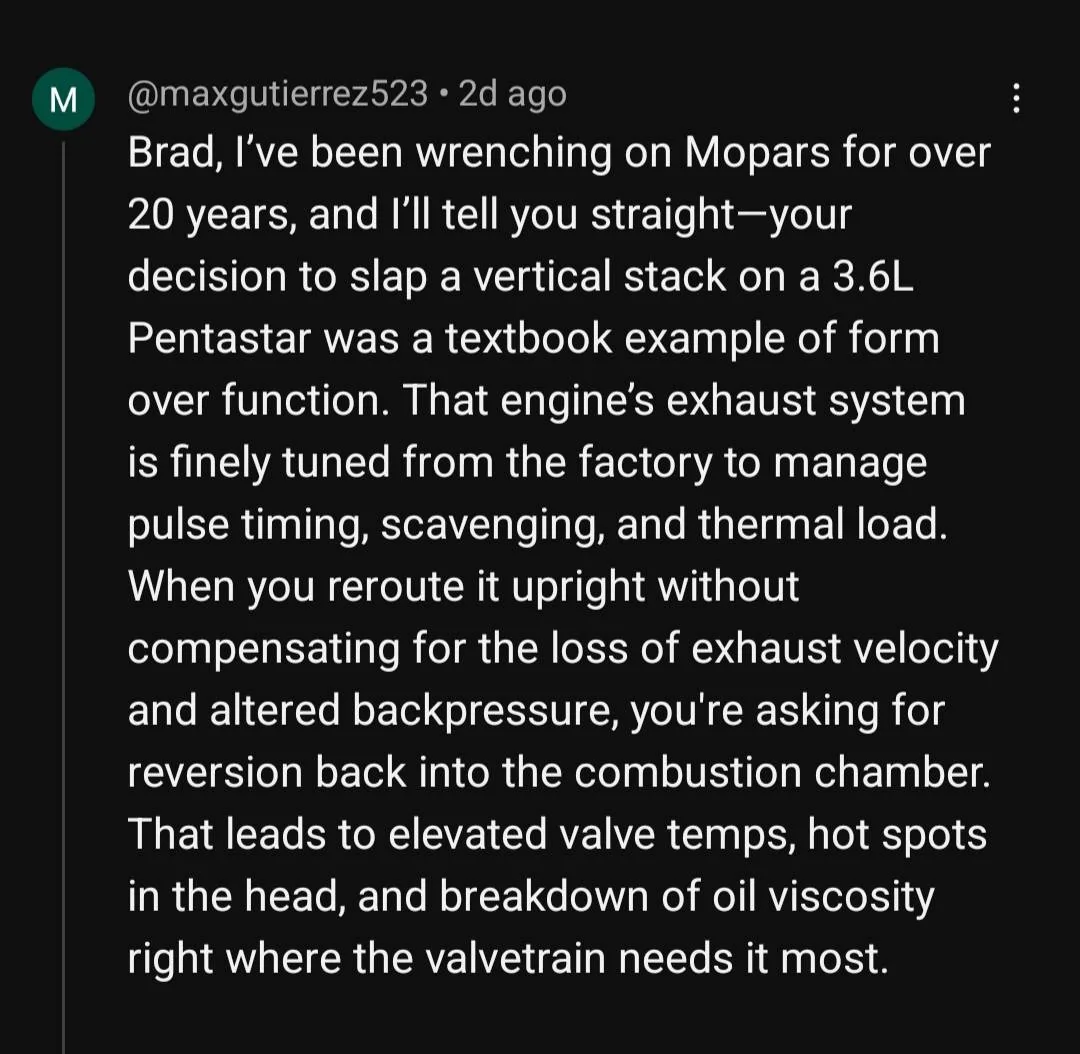
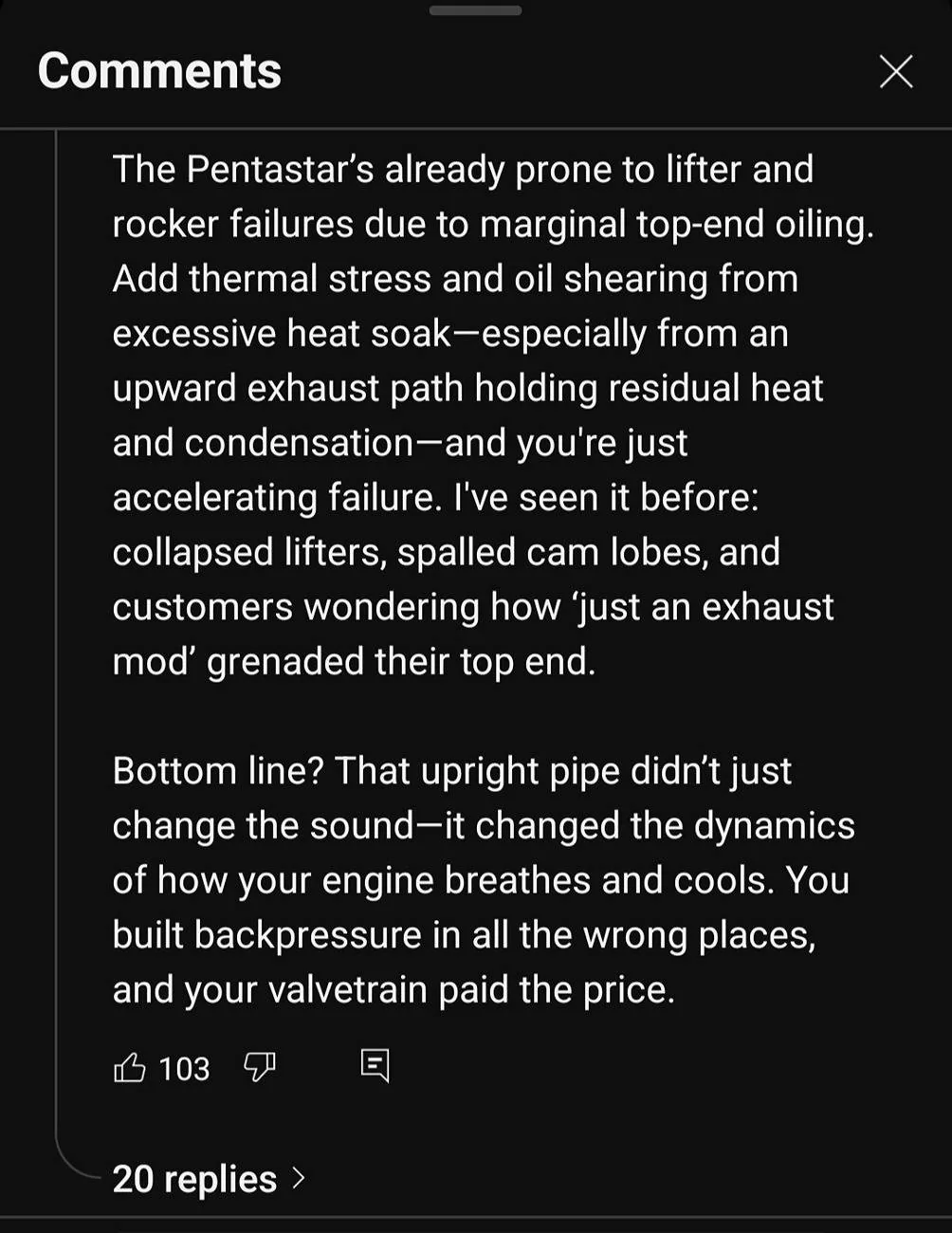
Guys, it is all about stupid heat. Don't do any mods to the engine. Keep your Pentastar cool 😃👍

Screenshot_20250526_133653_YouTube.webp
Screenshot_20250526_133659_YouTube.webp
That commentor provides no empirical data or rationale other than he's "been wrenching...". 🤪 If you think about it, the collective experience of the folks at the exhaust company (Magnaflow?) that did the modification, is an enormous amount of exhaust modification experience.

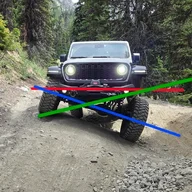
Jeep Wrangler JL TrailRecon- Engine Failure full of shit
 

Sponsored

Jeep Junkie

Well-Known Member
First Name
Muhammad
Joined
Dec 7, 2024
Threads
256
Messages
3,476
Reaction score
3,088
Location
Seattle, WA
Vehicle(s)
2024 JL Wrangler Willys
That commentor provides no empirical data or rationale other than he's "been wrenching...". 🤪 If you think about it, the collective experience of the folks at the exhaust company (Magnaflow?) that did the modification, is an enormous amount of exhaust modification experience.
full of shit.gif
"been wrenching" thank you for giving me this idea, next time I will use this phrase as well when going back and forth on social media 😃👍
 

Nokones

Well-Known Member
First Name
Kenny
Joined
Dec 31, 2023
Threads
19
Messages
1,030
Reaction score
1,119
Location
Sun City West, AZ
Vehicle(s)
23 Rubi, 21 Silverado, 13 Grand Sport, Cayman GTS,
Occupation
Unemployed For The Rest Of My Life from a career of spreading love, cheer, and joy to lots of special individuals that were asking for attention..
Clubs
 
People need to weigh all the facts on this issue from the various reports available on-line. Some are very good and some have no business being posted at all. It is up to the reader to weigh-in on the facts in order to determine what are factual and creditable and what are pure bunk. The forums, especially this forum are nothing but opinions, good and poor, with no substantiated facts. You need to read the various reports and see how and who cited the facts.

Most of the reports will state there is a multitude of contributing factors and some are people/owner caused by the choice of the fuels and oils they used. It is definitely not the thin oil viscosity and the 30w oil is not a correction, it is a weak bandaid.

The valve train design is a factor along with the valve train parts material types being used in the 3.6 engines, and you have wonder why only the Jeep 3.6 engines and not the other engines are having similar problems.

The GM 6.2 engine saga was identified as a problem with the poor machining of the crankshaft journal and/or the bearing. By going to a thicker oil viscosity is just a weak bandaid only to help to slow down the wear factor, and it will not eliminate it. And ignorant people right away blamed the cause on the use of 20 weight oil.

There is no method to prevent/eliminate the wear factors. You can only slow down the wear by using quality lubricants and fuels. The cheaper fuels can and will accelerate the wear factors even if you are using the best oil with the best wear protection properties because of the oil being diluted by the fuel which will counteract the various oil additives.

The Chevrons, Shells, and Mobils put in compatible additives in their fuels that will be compatible with the additive properties of the top oils for the newer engines. You can and will not get those compatible additives in the fuels at discounted gas stations such as the Costos and Sam's Clubs because of the cost for those additives.

The best oils to use to minimize the wear and increase the protection factors in the newer engines require a lot of ester properties being added to the oil. Not all oils have a large amount of Ester or any at all added because Ester is not cheap and most consumers are way too cheap and won't pay that cost. It has also been reported recently, by adding a lot of Zinc will accelerate the wear on some engine components because zinc is corrosive. You get what you pay for.

It would be interesting to know from the owners who have been fortunate in not having any premature failures, which oil and fuel products they were using.
 

SadRobot

Well-Known Member
Joined
Aug 31, 2019
Threads
144
Messages
7,491
Reaction score
20,071
Location
Los Angeles
Vehicle(s)
2025 Prius LE
People need to weigh all the facts on this issue from the various reports available on-line. Some are very good and some have no business being posted at all. It is up to the reader to weigh-in on the facts in order to determine what are factual and creditable and what are pure bunk. The forums, especially this forum are nothing but opinions, good and poor, with no substantiated facts. You need to read the various reports and see how and who cited the facts.

Most of the reports will state there is a multitude of contributing factors and some are people/owner caused by the choice of the fuels and oils they used. It is definitely not the thin oil viscosity and the 30w oil is not a correction, it is a weak bandaid.

The valve train design is a factor along with the valve train parts material types being used in the 3.6 engines, and you have wonder why only the Jeep 3.6 engines and not the other engines are having similar problems.

The GM 6.2 engine saga was identified as a problem with the poor machining of the crankshaft journal and/or the bearing. By going to a thicker oil viscosity is just a weak bandaid only to help to slow down the wear factor, and it will not eliminate it. And ignorant people right away blamed the cause on the use of 20 weight oil.

There is no method to prevent/eliminate the wear factors. You can only slow down the wear by using quality lubricants and fuels. The cheaper fuels can and will accelerate the wear factors even if you are using the best oil with the best wear protection properties because of the oil being diluted by the fuel which will counteract the various oil additives.

The Chevrons, Shells, and Mobils put in compatible additives in their fuels that will be compatible with the additive properties of the top oils for the newer engines. You can and will not get those compatible additives in the fuels at discounted gas stations such as the Costos and Sam's Clubs because of the cost for those additives.

The best oils to use to minimize the wear and increase the protection factors in the newer engines require a lot of ester properties being added to the oil. Not all oils have a large amount of Ester or any at all added because Ester is not cheap and most consumers are way too cheap and won't pay that cost. It has also been reported recently, by adding a lot of Zinc will accelerate the wear on some engine components because zinc is corrosive. You get what you pay for.

It would be interesting to know from the owners who have been fortunate in not having any premature failures, which oil and fuel products they were using.
Well I usually fill up at the same Shell every week. Only times I don't are roadtrips and then sometimes it has to be what is available when I'm running out of gas.

I've used Pennzoil oW-20 since my first oil change back in 2019. Changed it every 5000 miles.

The tick started in mine about 2.5 weeks ago. It got louder over the course of a few days then I stopped driving it. I won't know until I open up the engine what rockers went bad and how bad the camshafts are and if any are salvageable. I'm not sure when the head gasket starting leaking but I've been losing very small amounts of coolant for a long time. I went rock crawling on a hot day a couple weekends ago and that must have been the final straw and the coolant just starting pouring into the cylinders.
 

Ratbert

Well-Known Member
First Name
John
Joined
Jun 20, 2020
Threads
158
Messages
15,974
Reaction score
24,884
Location
PNW
Vehicle(s)
2022 AEV JL370 JLURD
Build Thread
Link
Occupation
Software Engineer
Clubs
 
"been wrenching" thank you for giving me this idea, next time I will use this phrase as well when going back and forth on social media 😃👍
Note that your wrenching cred goes up dramatically by using precise terms like "thingy".
 

roaniecowpony

Well-Known Member
Joined
Dec 4, 2018
Threads
193
Messages
12,897
Reaction score
20,374
Location
SoCal
Vehicle(s)
2018 JLUR, 14 GMC 1500 CC All TERRAIN
Occupation
Retired Engineer
People need to weigh all the facts on this issue from the various reports available on-line. Some are very good and some have no business being posted at all. It is up to the reader to weigh-in on the facts in order to determine what are factual and creditable and what are pure bunk. The forums, especially this forum are nothing but opinions, good and poor, with no substantiated facts. You need to read the various reports and see how and who cited the facts.

Most of the reports will state there is a multitude of contributing factors and some are people/owner caused by the choice of the fuels and oils they used. It is definitely not the thin oil viscosity and the 30w oil is not a correction, it is a weak bandaid.

The valve train design is a factor along with the valve train parts material types being used in the 3.6 engines, and you have wonder why only the Jeep 3.6 engines and not the other engines are having similar problems.

The GM 6.2 engine saga was identified as a problem with the poor machining of the crankshaft journal and/or the bearing. By going to a thicker oil viscosity is just a weak bandaid only to help to slow down the wear factor, and it will not eliminate it. And ignorant people right away blamed the cause on the use of 20 weight oil.

There is no method to prevent/eliminate the wear factors. You can only slow down the wear by using quality lubricants and fuels. The cheaper fuels can and will accelerate the wear factors even if you are using the best oil with the best wear protection properties because of the oil being diluted by the fuel which will counteract the various oil additives.

The Chevrons, Shells, and Mobils put in compatible additives in their fuels that will be compatible with the additive properties of the top oils for the newer engines. You can and will not get those compatible additives in the fuels at discounted gas stations such as the Costos and Sam's Clubs because of the cost for those additives.

The best oils to use to minimize the wear and increase the protection factors in the newer engines require a lot of ester properties being added to the oil. Not all oils have a large amount of Ester or any at all added because Ester is not cheap and most consumers are way too cheap and won't pay that cost. It has also been reported recently, by adding a lot of Zinc will accelerate the wear on some engine components because zinc is corrosive. You get what you pay for.

It would be interesting to know from the owners who have been fortunate in not having any premature failures, which oil and fuel products they were using.
Just an anecdotal observation, but it seems like those that have long trips/low number of startups per mile have better luck. No surprise.
Sponsored


Top