Sponsored

87 or 91+ octane?

Herson

Well-Known Member
First Name
Herson
Joined
Aug 4, 2020
Threads
7
Messages
483
Reaction score
655
Location
Michigan
Vehicle(s)
2020 JL Wrangler unlimited rubicon
I don't have an answer but a small history lesson:
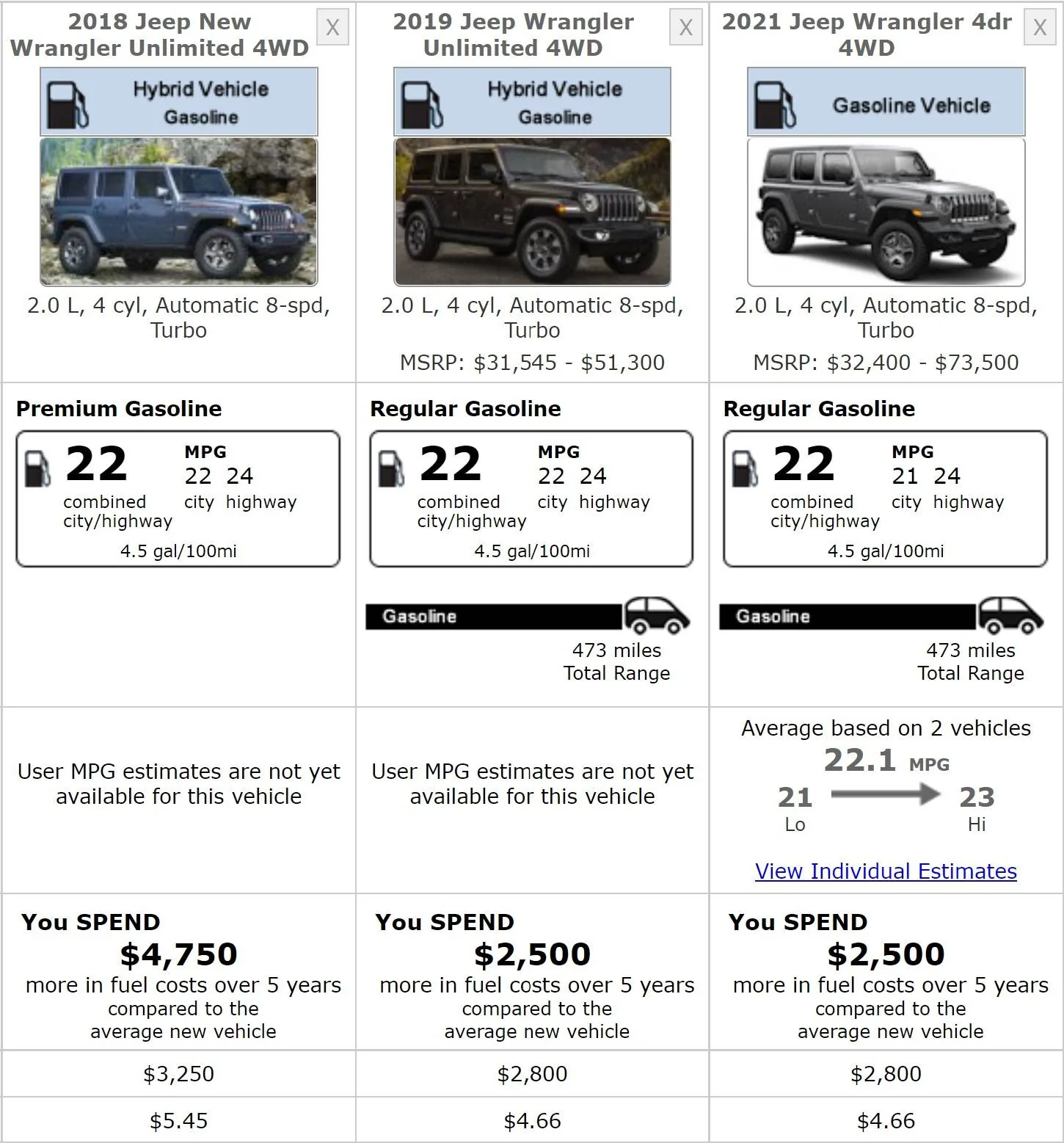
Originally the 2.0 demanded premium per the manual which was a huge turn off at 80 cents extra per gallon for an engine that was supposed to be more efficient, they also came mostly with the now defunct 2.0 E-Torque system which was a really fancy start/stop ploy which actually did start the Jeep instantly with the engine off and may have actually (at a price you could never get back through fuel savings) saved a very tiny bit more gas than the regular start/stop ploy.
Obvious complaints about somehow costing more to drive a more fuel efficient Jeep had Jeep change the print to tell us we could use 87 octane, I can't find anything showing they actually changed the engine itself though. The numbers for fuel cost dropped and folks like me questioned this but were less skeptical of buying the 2.0 which suddenly actually showed for the first time that you would indeed spend less for fuel than the less efficient 3.6.
Who's statements are correct in this thread ? - probably all of them as hard to believe as that is.
Economy does not seem to change with octane on this engine but actual performance may.
We need some hero to do quarter miles on each octane to show us but as far as I'm concerned my 2021 2.0 is slower than my 2015 3.6 and I run 87 octane but that may be why
If I were hauling a heavy trailer I would definitely use 93 octane as my Ram Hemi clearly showed me while trailering my '10 JK for sale that 87 was anemically weak and thirsty and then 93 suddenly fixed all and the legendary Hemi was back trailering my Jeep and passing slow-pokes at the same time, and yet, without that trailer there is no difference on that truck.
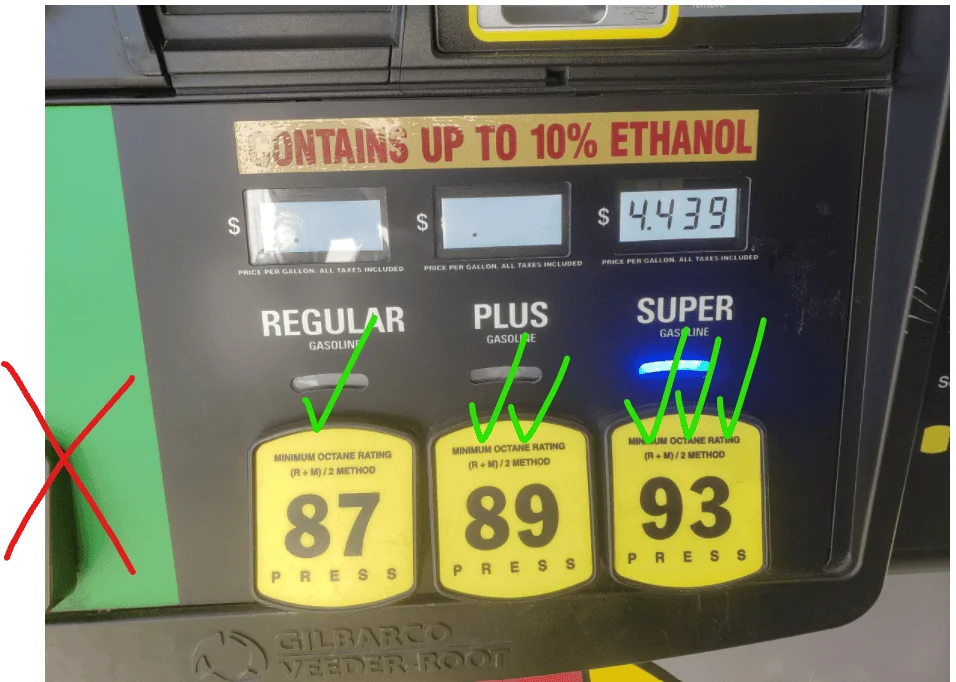
Screenshot 2022-03-12 083711.jpg
Very interesting that your 3.6 JK is faster than your 2.0 JL.
Sponsored


Jim1964

Well-Known Member
First Name
Jim
Joined
Mar 16, 2022
Threads
5
Messages
582
Reaction score
1,109
Location
Traveling the US of A
Vehicle(s)
2022 JLUR
Unless someone has knock sensor log data from a tool like HPTuners, in my opinion it’s an unsupported assumption that 91 knocks less than 87. For all we know the programming is designed to trim the timing, fuel, and boost to operate on the edge of lean spark knock to achieve the best possible fuel economy or lowest emissions.

The EPA has the biggest voice when it comes to vehicle design. And they (and Jeep) don’t want your vehicle to last forever. They want you in an electric car as soon as possible.
 

Initial-Jeep

Well-Known Member
First Name
Julian
Joined
Oct 23, 2021
Threads
0
Messages
352
Reaction score
489
Location
. Greensboro, North Carolina
Vehicle(s)
'22 392XR Tuscadero, PT Cruiser Dream Cruisers 2&4
Occupation
Data Engineer, Retired Air Force
Without any data or knowledge of design, any assertion (knocks more or does not knock more) is an assumption.

(It's also an assumption to think that everyone here is speaking from that position.) ?
 

Zandcwhite

Well-Known Member
First Name
Zach
Joined
Sep 4, 2019
Threads
11
Messages
8,293
Reaction score
14,184
Location
Patterson, ca
Vehicle(s)
2019 jlur
Without any data or knowledge of design, any assertion (knocks more or does not knock more) is an assumption.

(It's also an assumption to think that everyone here is speaking from that position.) ?
It's scientific fact that higher octane fuels are more resistant to knock. It's also a fact that every grade of gas has the same energy. The only way that premium fuel works "for optimum performance" is by advancing the timing. Timed the same 87 makes the same power as 91. The resistance to knock allows more timing which is where the added power comes from. The only way the computer can "see" the added octane is by the knock sensor, aka it only knows when it's advanced the timing too far and senses knock. It shouldn't advance the timing so far that it causes damage, nor should it allow knock to persist long enough for damage to occur. I'm still more comfortable running premium on any forced air vehicle A. Because I want all the power I can get B. It can't hurt to have better detonation resistance.
 

Shibadog

Well-Known Member
Joined
Dec 28, 2021
Threads
23
Messages
2,149
Reaction score
3,535
Location
Bowling Green, Ky
Vehicle(s)
2020 Wrangler Sport S hardtop
Occupation
Safety &Fire Protection Engineer (Retired)
While I agree with most of the above I am fundamentally opposed to paying an extra 20% (local prices today) to the oil company. The owners manual I. My 20 clearly state that the 2.0 is designed to run on 87, and that is what mine has always got and what it will get in the future. I believe the engineers who designed the engine know at least as much about fuel requirements for it as anyone else. Are there ANY “proven” long term advantages to running premium? At this point the answer appears to be “No”. Could an engine last longer running premium vs regular? Possible yes, possibly no. Ya pays your money and ya makes your choice. IF the engine said “premium fuel required” that’s what it would get, been there, done that. However, this old man has bought his last new vehicle that requires premium fuel. There are simply too many other options out there that don’t require it, If it makes you feel warm and fuzzy to run premium, then by all means proceed. IMHO the oil company is making quite enough off of me as it is-I cringe every time I stop my motorhome at the gas station?
 

Sponsored

Pinky Tuscadero

Well-Known Member
First Name
Brian
Joined
Aug 25, 2021
Threads
2
Messages
694
Reaction score
915
Location
Kenosha Wi
Vehicle(s)
2021 Pink RHD Wrangler 2015 RHD Wrangler
Very interesting that your 3.6 JK is faster than your 2.0 JL.
Like I said, could be the non premium fuel in the 2.0, haven't even tried premium at 80 cents more per gallon here and the last 3 tanks averaged 25.8 mpg with the wife literally all city driving, 2.0 is certainly not pokey, just not as quick although that premium might change that game for sure. ;)
If someone wants to do an unbiased test on the 2 octanes for actual speed that would be awesome, not a dyno as we never ever drive on those. quarter mile times would be fun.
Think of the adventure, 2 trips to the track to find out once and for all... real numbers !!!
Part Scientist, part Super-Hero all Jeeper :flag:
 

Herson

Well-Known Member
First Name
Herson
Joined
Aug 4, 2020
Threads
7
Messages
483
Reaction score
655
Location
Michigan
Vehicle(s)
2020 JL Wrangler unlimited rubicon
Like I said, could be the non premium fuel in the 2.0, haven't even tried premium at 80 cents more per gallon here and the last 3 tanks averaged 25.8 mpg with the wife literally all city driving, 2.0 is certainly not pokey, just not as quick although that premium might change that game for sure. ;)
If someone wants to do an unbiased test on the 2 octanes for actual speed that would be awesome, not a dyno as we never ever drive on those. quarter mile times would be fun.
Think of the adventure, 2 trips to the track to find out once and for all... real numbers !!!
Part Scientist, part Super-Hero all Jeeper :flag:
I find this very interesting because everywhere in this forum and videos I have seen, the 2.0 is way quicker than the 3.6. You are the first one I hear saying this and even more with the 5 speed auto JK.
 
  • Like
Reactions: J0E

BigFeet

Well-Known Member
Joined
Dec 3, 2021
Threads
6
Messages
200
Reaction score
530
Location
Texas
Vehicle(s)
2021 Rubicon 2dr
If I remember correctly, the octane rating is giving you an indication of burn time. The lower the octane rating number the faster the burn, and the higher the octane rating number the slower the burn.

Higher octane is specified for high compression/performance engines because the flame front needs a bit more time with the "push" across the piston head. With turbos, due to the higher heat and boost created, a pre-ignition issue can arise, and a higher octane will resist this.

Now that computer controlled environments can be established the engine can be adjusted on-the-fly to compensate for certain issues/needs.

As a result of control modules being an established component of the ignition system, for the 2.0 turbo engine you have a choice, as shown below.

Jeep Wrangler JL 87 or 91+ octane? Screenshot 2022-03-17 111553
 

jeepoch

Well-Known Member
First Name
Jay
Joined
Nov 13, 2019
Threads
1
Messages
1,052
Reaction score
2,941
Location
Longmont, CO
Vehicle(s)
2019 JL Wrangler Sport S 3.6L Auto 2 door, 2.5" lift, 35s
Once again, octane is a measure of the fuel's flashpoint. This is the point of both the temperature and pressure conditions where the fuel will ignite. Low octane results in ignition points with a wider degree of temperature and pressure fluctuations. Higher octane fuel ignites at a much more consistent and even set of conditions.

The energy and explosive power are identically the same.

With higher octane fuel, the ECU can better predict exactly where during the piston's position in relation to top-dead-center where the combustion (ignition) will actually occur.
 

Sponsored

Zandcwhite

Well-Known Member
First Name
Zach
Joined
Sep 4, 2019
Threads
11
Messages
8,293
Reaction score
14,184
Location
Patterson, ca
Vehicle(s)
2019 jlur
Maybe this might help. Octane doesn’t add power…

Perfectly tuned under perfect conditions on the dyno, of course it doesn't. Under varied loads, even the guys in the video say they wouldn't run 87 na under street conditions and would absolutely never run it under boosted applications. The computer pulls timing to compensate for low octane fuel. Even in the dyno, any engine will lose power when you pull timing. Pull 5⁰ and run the same test.
 

stumblinhorse

Well-Known Member
Joined
Dec 17, 2021
Threads
24
Messages
1,007
Reaction score
1,189
Location
Colorado
Vehicle(s)
2021 392
Perfectly tuned under perfect conditions on the dyno, of course it doesn't. Under varied loads, even the guys in the video say they wouldn't run 87 na under street conditions and would absolutely never run it under boosted applications. The computer pulls timing to compensate for low octane fuel. Even in the dyno, any engine will lose power when you pull timing. Pull 5⁰ and run the same test.
Sorry, the computer has no idea what octane the fuel is…. The computer protects the engine from detonation… in the video the engine was higher compression than any of the engines in a Jl, they are at pretty much sea level and the engine took the exact same amount of timing to make the same exact amount of horsepower.

The point of the video is to indicate that octane doesn’t make power. Not to say you shouldn’t run 91 vs 87. For a 2.0 turbo JL, by all means runs 91, If you don’t ping with 89 or 87 then run that… But it is not giving you more HP or MPG…. It s making sure you don’t damage your pistons….
 

J0E

Well-Known Member
First Name
J0e
Joined
Sep 1, 2018
Threads
55
Messages
1,359
Reaction score
1,162
Location
Hawaii, MT, SLC, NYC
Website
bt39.com
Vehicle(s)
2021 JLR, 05 LJR on 43s
Build Thread
Link
Occupation
Drywall construction - reel estate
Sorry, the computer has no idea what octane the fuel is…. The computer protects the engine from detonation…
I think you and other have detonation confused with knocking. The computer backs off the timing when it detects knocking.

There's a good reason the hellcat was tested with 100 octane. Anyone who races or used to race knows the HP advantages of higher octane. With higher octane the timing can be advanced more to yield more HP.

My high compression 72 big block corvette makes significantly more HP with 3 gallons of leaded 112 octane racing fuel and 12 gal of 92 pump vs 87.

Reread what the expert states:

Once again, octane is a measure of the fuel's flashpoint. This is the point of both the temperature and pressure conditions where the fuel will ignite. Low octane results in ignition points with a wider degree of temperature and pressure fluctuations. Higher octane fuel ignites at a much more consistent and even set of conditions.

The energy and explosive power are identically the same.

With higher octane fuel, the ECU can better predict exactly where during the piston's position in relation to top-dead-center where the combustion (ignition) will actually occur.
 

RubyRecon

Well-Known Member
First Name
Rick
Joined
Nov 2, 2020
Threads
19
Messages
104
Reaction score
78
Location
The OC
Vehicle(s)
2020 Rubicon Recon
After installing a Tazzer and reading that the boost is as high as 22psi, it confirmed my thoughts that more octane is probably better than less on a turbo motor. I plan on keeping this Jeep for a long time, so the few extra dollars at fill up should be worth it in the long run. I am also running 37s and haven’t regeared yet So there is a little more stress always on the engine.
 

Xspurt

Well-Known Member
Joined
Jan 22, 2022
Threads
0
Messages
198
Reaction score
287
Location
North of Charlotte
Vehicle(s)
Juliet Lima
Your post is spot on for all gasoline powered vehicles where the owner's manual recommends ONE octane to use. Vehicles designed for 87 octane will see no benefit going above that. However, it is my understanding that the manual for the 2.0 says more about this subject than you are quoting. Yes, it says you can use 87 but talked about times when it would be a good idea to go over that and that benefits would be realized with the higher octane fuel. The manual for my F150 with the 3.5 liter Ecoboost says that too (higher octane is recommended when towing and when more performance is desired). This is telling me that on some vehicles (probably these turbo ones) the system that retards the timing when knock is detected has moved from an engine saving fail-safe to a passive, continually working performance and operations system.


While I agree with most of the above I am fundamentally opposed to paying an extra 20% (local prices today) to the oil company. The owners manual I. My 20 clearly state that the 2.0 is designed to run on 87, and that is what mine has always got and what it will get in the future. I believe the engineers who designed the engine know at least as much about fuel requirements for it as anyone else. Are there ANY “proven” long term advantages to running premium? At this point the answer appears to be “No”. Could an engine last longer running premium vs regular? Possible yes, possibly no. Ya pays your money and ya makes your choice. IF the engine said “premium fuel required” that’s what it would get, been there, done that. However, this old man has bought his last new vehicle that requires premium fuel. There are simply too many other options out there that don’t require it, If it makes you feel warm and fuzzy to run premium, then by all means proceed. IMHO the oil company is making quite enough off of me as it is-I cringe every time I stop my motorhome at the gas station?
Sponsored

 
Last edited:


Top