Sponsored

0w20 more engine wear?

roaniecowpony

Well-Known Member
Joined
Dec 4, 2018
Threads
194
Messages
12,944
Reaction score
20,493
Location
SoCal
Vehicle(s)
2018 JLUR, 14 GMC 1500 CC All TERRAIN
Occupation
Retired Engineer
For real? Probably a good oil, like the rest of their stuff. Let us know if your fuel economy and horsepower improve! ;)

"Enhanced frictional properties help enable improved fuel economy, higher horsepower and reduced engine wear"

And $27/gallon isn't a bad price at all..

https://www.evolubesupply.com/mobil-1-supercar-0-40-55-gal-208-2-liter-drum-126871/
By my calculations, I'll get a 150% increase in fuel economy and at least a 75% increase in horsepower. YMMV
Sponsored


UncleJimmy

Well-Known Member
First Name
James
Joined
Mar 22, 2019
Threads
9
Messages
691
Reaction score
671
Location
AZ
Vehicle(s)
2020 JLUR; 2016 Toyota Tundra
For those of you running higher viscosity motor oils, is it safe for the engine at cold start temps of 10F-32F?
(0W vs. 5W)
 

roaniecowpony

Well-Known Member
Joined
Dec 4, 2018
Threads
194
Messages
12,944
Reaction score
20,493
Location
SoCal
Vehicle(s)
2018 JLUR, 14 GMC 1500 CC All TERRAIN
Occupation
Retired Engineer

CarbonSteel

Well-Known Member
Joined
Jul 21, 2019
Threads
305
Messages
5,795
Reaction score
8,216
Location
Colorado
Vehicle(s)
2001 Cherokee; 2023 Bronco Wildtrak; 2024 Grand Cherokee 4xe
Vehicle Showcase
1
For those of you running higher viscosity motor oils, is it safe for the engine at cold start temps of 10F-32F?
(0W vs. 5W)
It can depend on the brand and formulation, but most 5W-xx oils are good down to -30 to -35°F and likewise 0W-xx oils are good down to -40 to -45°F.

Mobil 1 ESP 0W-30 is the most robust off the shelf 0W-30 oil that I could find.
 
Last edited:

UncleJimmy

Well-Known Member
First Name
James
Joined
Mar 22, 2019
Threads
9
Messages
691
Reaction score
671
Location
AZ
Vehicle(s)
2020 JLUR; 2016 Toyota Tundra
Ok great to know. So sounds like no real downsides to switching to the higher viscosity 5W-30, just positives.
 

Sponsored

Dusty Dude

Well-Known Member
Joined
Apr 16, 2023
Threads
57
Messages
1,692
Reaction score
3,807
Location
Colorado Springs, CO
Vehicle(s)
1970 Ply Roadrunner, 2010 Challenger SRT
For those of you running higher viscosity motor oils, is it safe for the engine at cold start temps of 10F-32F?
(0W vs. 5W)
As someone who grew up using 10W-40 oils in bitter Minnesota winters year after year with no problems, you’ll be fine in those mild temps.
 

roaniecowpony

Well-Known Member
Joined
Dec 4, 2018
Threads
194
Messages
12,944
Reaction score
20,493
Location
SoCal
Vehicle(s)
2018 JLUR, 14 GMC 1500 CC All TERRAIN
Occupation
Retired Engineer
Ok great to know. So sounds like no real downsides to switching to the higher viscosity 5W-30, just positives.
Where you're at, you might consider a 0w40 or 10w40.
 

UncleJimmy

Well-Known Member
First Name
James
Joined
Mar 22, 2019
Threads
9
Messages
691
Reaction score
671
Location
AZ
Vehicle(s)
2020 JLUR; 2016 Toyota Tundra
As someone who grew up using 10W-40 oils in bitter Minnesota winters year after year with no problems, you’ll be fine in those mild temps.
Where you're at, you might consider a 0w40 or 10w40.
I have to be honest, going from 0W-20 to 10W-40 (for the 3.6) seemed a little much, but after doing more research, and realizing I'm just barley scratching the surface, I am seriously considering it.

I'm seeing a lot more people on different forums, switching from the light weight oils to 5w30 or 10w or 15w-40 and getting excellent results. Many of these have pointed out that the heavier viscosities are listed in the foreign markets, or when adding forced induction, etc.

I initially went down this rabbit hole after noticing some weeping coming from the top of the valve covers, which led me to really think about what's going on with this motor and how it could be improved (upping oil viscosity, fuel/oil additives, catch cans, fan control modules etc.).

Speaking just on oil for the moment, I realize this is old news for many of you, but the more I look into it, it seems like the W rating is more important than just considering it for "winter" and cold starts. I'm seeing possible benefits from upping that W rating as well [mainly on the topic of thicker base stock vs. VII that may (or may not) shear, particularly with the upper engine which is where this engine has the majority of it's issues]. Here's one interesting read I came across:

https://bobistheoilguy.com/forums/threads/do-you-think-thats-thick-oil-think-again.286877/

After watching Project Farm Pennzoil Platinum viscosity comparison, the least wear was in the higher W rating, and this test is performed at room temps. So, when they say "most engine wear is on cold starts" to me I would rather have a heavier W to prevent the wear for the time it takes to drive the vehicle up to operating temp PROVIDED of course the viscosity is NOT so high that the engine has difficulty starting. And I think good wear additives might be more important than lower W viscosity for that initial start (which BTW, is why I've ruled out the Baxter oil filter adapter, for that reason and the worry of extra stress on the oil cooler). But from what I can see, 5W, 10W and 15W should be fine for the cold starts I typically experience.

I was also having slight pinging at low RPMs, nothing major but it was getting more noticeable, and after two cans of Seafoam in the fuel, one on full tank and one with just the reserve (3 gallons) and doing some WOT driving, it took care of that pinging.

So, in conclusion, I will most likely be going up to 5W-30 and maybe 10w or 15W-40, in addition to a UPR catch can with extension drain hose as well as a fan controller. I got those ideas from @Willys41.

My thinking is I can extend the life of this engine by reducing wear though higher viscosity, lower carbon build up with less vaporization with thicker oil, occasional Seafoam and catch can, and by lowering overall engine temps.
 

Sponsored

roaniecowpony

Well-Known Member
Joined
Dec 4, 2018
Threads
194
Messages
12,944
Reaction score
20,493
Location
SoCal
Vehicle(s)
2018 JLUR, 14 GMC 1500 CC All TERRAIN
Occupation
Retired Engineer
I have to be honest, going from 0W-20 to 10W-40 (for the 3.6) seemed a little much, but after doing more research, and realizing I'm just barley scratching the surface, I am seriously considering it.

I'm seeing a lot more people on different forums, switching from the light weight oils to 5w30 or 10w or 15w-40 and getting excellent results. Many of these have pointed out that the heavier viscosities are listed in the foreign markets, or when adding forced induction, etc.

I initially went down this rabbit hole after noticing some weeping coming from the top of the valve covers, which led me to really think about what's going on with this motor and how it could be improved (upping oil viscosity, fuel/oil additives, catch cans, fan control modules etc.).

Speaking just on oil for the moment, I realize this is old news for many of you, but the more I look into it, it seems like the W rating is more important than just considering it for "winter" and cold starts. I'm seeing possible benefits from upping that W rating as well [mainly on the topic of thicker base stock vs. VII that may (or may not) shear, particularly with the upper engine which is where this engine has the majority of it's issues]. Here's one interesting read I came across:

https://bobistheoilguy.com/forums/threads/do-you-think-thats-thick-oil-think-again.286877/

After watching Project Farm Pennzoil Platinum viscosity comparison, the least wear was in the higher W rating, and this test is performed at room temps. So, when they say "most engine wear is on cold starts" to me I would rather have a heavier W to prevent the wear for the time it takes to drive the vehicle up to operating temp PROVIDED of course the viscosity is NOT so high that the engine has difficulty starting. And I think good wear additives might be more important than lower W viscosity for that initial start (which BTW, is why I've ruled out the Baxter oil filter adapter, for that reason and the worry of extra stress on the oil cooler). But from what I can see, 5W, 10W and 15W should be fine for the cold starts I typically experience.

I was also having slight pinging at low RPMs, nothing major but it was getting more noticeable, and after two cans of Seafoam in the fuel, one on full tank and one with just the reserve (3 gallons) and doing some WOT driving, it took care of that pinging.

So, in conclusion, I will most likely be going up to 5W-30 and maybe 10w or 15W-40, in addition to a UPR catch can with extension drain hose as well as a fan controller. I got those ideas from @Willys41.

My thinking is I can extend the life of this engine by reducing wear though higher viscosity, lower carbon build up with less vaporization with thicker oil, occasional Seafoam and catch can, and by lowering overall engine temps.
On the Pentastar oil filter housing and cooler, I've contacted a company that makes a lot of machined adapters for oil systems about making an adapter that would bolt directly to the block and have AN hose fittings for a remote filter and cooler, thus eliminating the terribly designed OEM system that has coolant and oil adjacent to each other at a siamese figure 8 seal, in not just one, but two locations.
 

jjvincent

Well-Known Member
First Name
John
Joined
May 31, 2021
Threads
6
Messages
973
Reaction score
1,411
Location
Bethlehem, PA
Vehicle(s)
2021 Wrangler, 2017 VW Alltrack, 2003 VW Eurovan
Occupation
Mechanical Engineer
I'd also look into making sure you are properly warmed up and the same for the transmission and axles. For example, on an Audi R8 LMS, you need to put it on the airjacks, turn the TC to zero and then turn the dash to warmup. After that, start it and shift it to 6th gear. After that, watch the dash and when it gets to 70 C for the gearbox, you can shut it down.

For some reason, Porsche doesn't care about that and you just fire it up for about a half hour.

We need to look at a starting procedure for Jeeps and make sure we do it right. I like the Audi method. That way, we can decrease the engine and driveline wear no matter what oil we run.
 

UncleJimmy

Well-Known Member
First Name
James
Joined
Mar 22, 2019
Threads
9
Messages
691
Reaction score
671
Location
AZ
Vehicle(s)
2020 JLUR; 2016 Toyota Tundra
On the Pentastar oil filter housing and cooler, I've contacted a company that makes a lot of machined adapters for oil systems about making an adapter that would bolt directly to the block and have AN hose fittings for a remote filter and cooler, thus eliminating the terribly designed OEM system that has coolant and oil adjacent to each other at a siamese figure 8 seal, in not just one, but two locations.
Seems like a good idea.

I am hoping installing the fan module will help with reducing the cold/hot heat cycling and help preserve the OC.
 

Willys41

Well-Known Member
First Name
Larry
Joined
Nov 2, 2021
Threads
3
Messages
1,171
Reaction score
1,314
Location
Pleasanton Ca.
Vehicle(s)
2020 Jeep Willys
UncleJimmy
I can see you came to the same conclusion I have
Two more things to consider ( can't remember if I told you about these )
About 4 months ago I installed the RPM Extreme JL fan controller. This is a game changer
It has lowered my coolant and oil temps about 25 to 30 degrees and reduced the amount of oil that my oil catch can collects
I used to see temps up HW80 to Lake Tahoe pushing 235 degrees
After fan controller same trip topped out at 212
With the fan controller average driving I am run about 188 to 195 degrees
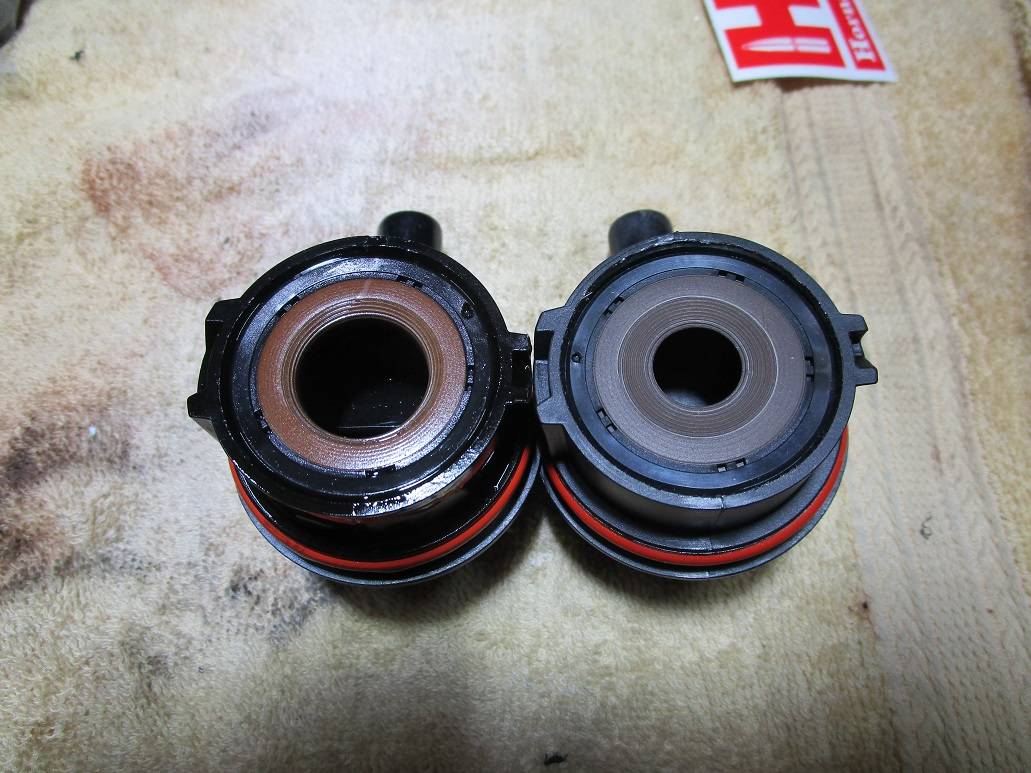
I just installed the updated PCV valve and have another 500 miles to go before I drain and check to see if it reduced the amount of oil in my catch can ( see pictures. New one on right )
I will keep you updated

Jeep Wrangler JL 0w20 more engine wear? IMG_1897 - Copy.JPG
 

roaniecowpony

Well-Known Member
Joined
Dec 4, 2018
Threads
194
Messages
12,944
Reaction score
20,493
Location
SoCal
Vehicle(s)
2018 JLUR, 14 GMC 1500 CC All TERRAIN
Occupation
Retired Engineer
Seems like a good idea.

I am hoping installing the fan module will help with reducing the cold/hot heat cycling and help preserve the OC.
The Pentastar uses coolant to moderate the oil temperature in that heat exchanger we are all calling a "cooler". The fact is, it acts like a pre-heater during warm up of the engine. The coolant heats much faster than oil in an unassisted system. Chrysler routed the coolant through this heat exchanger and it warms the oil very quickly and, as we all know, coolant temps can be at or near stable operating temps in a few minutes of driving. That's a good thing. However, when the coolant system is pushed to its limits, the oil temperatures are also heated right along with the coolant.

In aircraft systems, I've seen this type of design and it often is called a pre-heater and includes a thermostat to bypass it when heating is no longer desired. Chrysler seems to have shortcutted this and left out a true air-oil cooler and bypass thermostat.
Sponsored


Top