
Sponsored

0w20 more engine wear?

Willys41

Well-Known Member
First Name
Larry
Joined
Nov 2, 2021
Threads
3
Messages
1,170
Reaction score
1,312
Location
Pleasanton Ca.
Vehicle(s)
2020 Jeep Willys
Is what you are saying is
A 5/40 has a higher viscosity than a 0/20 at higher temperature?
Sponsored

 

UncleJimmy

Well-Known Member
First Name
James
Joined
Mar 22, 2019
Threads
9
Messages
691
Reaction score
671
Location
AZ
Vehicle(s)
2020 JLUR; 2016 Toyota Tundra
Is what you are saying is
A 5/40 has a higher viscosity than a 0/20 at higher temperature?
To simplify it, yes. But to unpack it:

1. the engine at operating temp is not seeing any viscosity at 5w50 it hasn't seen with 0w20, so the 5w50 is not going to blow up the engine at operating temps.
2. the difference in viscosity at temperatures at high loads of 240 F is significant. If crawling or towing, 5w30 is still half the viscosity of 5w50 and barely better than 0w20 (6.6, 7.7, and 14.2 cSt respectively).
3. The limit on oil grade viscosity is not how heavy it is but how low the ambient temp is.
4. Suggesting a different way to think about it. Someone only driving around town with oil temps steady at 192 F is "seeing" a different viscosity grade than someone crawling/towing at 240 F.
 

m3reno

Well-Known Member
First Name
Sal
Joined
Jul 21, 2018
Threads
62
Messages
1,499
Reaction score
1,403
Location
caldwell
Vehicle(s)
2022 Jeep Wrangler JLU
If the rockers were perfectly machined I would say 0w 20 is fine for their tight tolerances, but from what I hear on this board many of the new rocker/needle bearings have play so maybe the thicker oil would be a better choice for protection.
 

Gangplank

Well-Known Member
Joined
Sep 15, 2019
Threads
25
Messages
1,118
Reaction score
1,442
Location
Vero Beach, FL
Vehicle(s)
2021 JLU Willys 3.6 eTorque w/ Mopar lift. 2022 JLU Rubicon 2.0T still stock
Build Thread
Link
Is what you are saying is
A 5/40 has a higher viscosity than a 0/20 at higher temperature?
it should

The higher number to the right of the “W” represents oil viscosity at operating temperatures. Higher numbers reflect thicker oil viscosity.

So yes a higher number is thicker oil that has a higher viscosity at higher temp.

“But, you don’t want an oil that’s too thick because it creates too much frictional drag within the oil itself. This creates extra heat. The added heat causes the oil to thicken (oxidation). It can also rob engine performance by reducing horsepower”

https://vpracingfuels.com/tech-talk-insider-articles/oil-viscosity-explained/
 

roaniecowpony

Well-Known Member
Joined
Dec 4, 2018
Threads
194
Messages
12,943
Reaction score
20,486
Location
SoCal
Vehicle(s)
2018 JLUR, 14 GMC 1500 CC All TERRAIN
Occupation
Retired Engineer
Jimmy,
Your analogy aligns (parallels?) with some of the literature published in the links I provided earlier, which discuss the ultra low viscosity oils developed for hybrid powertrains. A hybrid engine may be called upon to start and run most of its life within a much lower average oil temperature range than a non-hybrid engine. Therefore the very low viscosity oils, when used in hybrids, are replicating average operating temperature viscosities of higher viscosity oils, when used in non-hybrid engines.
 
Last edited:

Sponsored

CarbonSteel

Well-Known Member
Joined
Jul 21, 2019
Threads
305
Messages
5,795
Reaction score
8,216
Location
Colorado
Vehicle(s)
2001 Cherokee; 2023 Bronco Wildtrak; 2024 Grand Cherokee 4xe
Vehicle Showcase
1
Yes
Do you think it is credible. The guy spends a lot on oils and testing. Any negative reviews?
He has gone down in flames on Bob Is The Oil Guy more times than the Red Baron.

Seriously, do you really think that Quaker State is a higher performing oil than the others on the market? If that is true, then why isn't Quaker State #1 in sales?

There so many oils out there with European specifications that are far more stringent and demanding than US ones and Quaker State meets how many of those?

A grand total of ZERO. There is nothing special about Quaker State oil...nothing wrong with it, but it is definitely not the be all end all...
 

CarbonSteel

Well-Known Member
Joined
Jul 21, 2019
Threads
305
Messages
5,795
Reaction score
8,216
Location
Colorado
Vehicle(s)
2001 Cherokee; 2023 Bronco Wildtrak; 2024 Grand Cherokee 4xe
Vehicle Showcase
1
it should

The higher number to the right of the “W” represents oil viscosity at operating temperatures. Higher numbers reflect thicker oil viscosity.

So yes a higher number is thicker oil that has a higher viscosity at higher temp.

“But, you don’t want an oil that’s too thick because it creates too much frictional drag within the oil itself. This creates extra heat. The added heat causes the oil to thicken (oxidation). It can also rob engine performance by reducing horsepower”

https://vpracingfuels.com/tech-talk-insider-articles/oil-viscosity-explained/
Jeep Wrangler JL 0w20 more engine wear? 100
 

Willys41

Well-Known Member
First Name
Larry
Joined
Nov 2, 2021
Threads
3
Messages
1,170
Reaction score
1,312
Location
Pleasanton Ca.
Vehicle(s)
2020 Jeep Willys
I cant talk about today's oils put I do know that back in my race car days late 1970 and 80 in my 350 Chey running Valvoline oil gave me 5psi more oil pressure compared to other oils we tried
From that point I have always used Valvoline in all my cars and trucks that I have put 300k to 400k miles on
My Tundra today has 400k on the odometer with no issues
I will be switching from 5/30 oil to 5/40 oil in both my 3.6 Wranglers and my Tundra
If Maserati ghibli 3.0 v6 uses 5/40 there is no reason that we can't use it in our 3.6
 

UncleJimmy

Well-Known Member
First Name
James
Joined
Mar 22, 2019
Threads
9
Messages
691
Reaction score
671
Location
AZ
Vehicle(s)
2020 JLUR; 2016 Toyota Tundra
This is an example of how one might go about deciding on a low temp limit, but I would first ask myself a few basic preliminary questions like, what are the average cold ambient temps I expect to see? Do I see heavy loads in winter? Do I need extra protection if my engine temps are in the lower range all the time? Do I intend to run one oil grade year round or am I willing to use a summer grade if that's when the majority of my HD loads are induced?

Take this hypothetical situation: What is the average lowest temp my vehicle would see with 0w20 and does it seem to start and run fine at that low temp? Let's choose 14 F (-10 C).

According to this chart, the viscosity of 0w20 at -10 C is 745.7 cSt and would be roughly equivalent to the viscosity of 0w40 at 28 F (-2 C) and 0w50 at 39 F (4 C).

Conversely, cold starts at -10 C for 0w40 would be 1320.f cSt which would be roughly equivalent to 0w20 at 1 F (-17 C), and for 5w50 at -10 C with a viscosity of 2030.80 cSt would be roughly equivalent to 0w20 at -8 F (-22 C).

For this scenario, the conclusions I would draw are:

1. If I am fine with the way my engine starts with 0w20 at 14 F, then it's only about 13 degrees F colder start for the 0w40 (14F vs. 1 F), so not a huge difference provided I didn't notice a rough start.
2. If I don't see heavy loads in winter because I do all my towing, crawling etc. in the warmer months, I would stick with a lighter grade such as 0w20 or 5w30 because I would not want my engine seeing 1 F or -8 F starts all winter if it is not necessary (or I could use supplemental heat of some sort to preheat the oil, such as a heated garage, magnetic oil pan heater etc.).
3. If I see heavy loads in the colder months as well, then I would probably see more benefit using 0w40 for winter (and/or year round).
4. For warmer months, I would see more benefit with the 5w50 for the higher viscosity under heavy loads.
5. If this was my vehicle at these temps and I did not see heavy load/high engine oil temps in winter, I would use 5w30 in winter and 0w40 in summer, in conjunction with a fan control module for overall reduced engine temps, and thus higher viscosities at operating temps.
6. I would adjust these grades up or down depending on my personal average low ambient temps and particular usage.

Caveats:

1. These conclusions are based on extrapolating data from this chart and I would want to, if possible, confirm the viscosity of my particular choice from the oil manufacturer for my particular brand and grade. If any one has this data for temps besides the typically published 40/100 C, please share it.
2. The engine should tell you if you are pushing the lower limit temp too far by hard starting, so there is that.
3. I am not telling anyone what oil to run or to deviate from the owners manual recommendations.

Jeep Wrangler JL 0w20 more engine wear? 7


Jeep Wrangler JL 0w20 more engine wear? 8


Jeep Wrangler JL 0w20 more engine wear? 9
 
Last edited:

Willys41

Well-Known Member
First Name
Larry
Joined
Nov 2, 2021
Threads
3
Messages
1,170
Reaction score
1,312
Location
Pleasanton Ca.
Vehicle(s)
2020 Jeep Willys
I agree 100%
These engineers that are designing the cars and trucks now days are told get the best MPG you can out of any giving car or truck
Low oil resistance is one way
ESS is another stupid way
The car and truck manufactures keep getting pushed to up there MPG rating and sink millions into it pushing up the car and truck prices
 

Sponsored

CarbonSteel

Well-Known Member
Joined
Jul 21, 2019
Threads
305
Messages
5,795
Reaction score
8,216
Location
Colorado
Vehicle(s)
2001 Cherokee; 2023 Bronco Wildtrak; 2024 Grand Cherokee 4xe
Vehicle Showcase
1
PaulW said:

Bob the oil guy messages are just like the messages on any forum. That means you are reading someone’s opinion, and those persons mostly have no technical background.

The specs from Mopar tell us the viscosities that they determined are correct based on the motor design with regard to the clearances and oil components like pump and jet sizes etc. IMO - Deviating from the specified oil viscosity is something uneducated lay person should not undertake.

Anyway, choosing the two oils listed in the owner’s manual is probably the correct choice. The oils mentioned are Mopar, Pennzoil, and Shell Helix.

So, once the viscosity issue is resolved in my mind, next I want the oil that will have the most wear resistance. I have done a lot of searching and cannot come up with comparable real testing. Rat does testing and is very unconventional manner but regardless his testing shows difference in wear resistance. Many of the oils he tested have more certs than Quaker state and he compares them all.

I have done a lot of searching and cannot come up with comparable real comparison testing.

About the 540rat test for the best 0w20” Quaker State Full Synthetic
No ACEA certs.
QSFS Specs.webp
Rat540 is not going to have access to any of the testing methodologies that matter unless he has a full-blown lab that no one is aware of and he has not posted that he does, but I quit looking at his site when I saw him say that Quaker State is #1 with no ASTM test results to prove it.

With that said--the oil manufacturers ALREADY perform all the testing that you need to determine the least amount of wear. Most, if not all, of the European specs far exceed the US ones given that Europe has longer oil change intervals for decades before the US started them. Pick any oil that has Mercedes, VW, or Porsche specifications and they will typically be "better" than US counterparts.

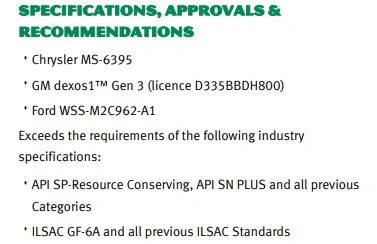
The closest to the Euro specs could be Dexos 1 Generation 3 which in my opinion is the toughest US specification because it actually lays out specific test requirements and results that must be met in order to be labeled as Dexos. Chrysler MS-6395 is nothing special--read the specification and you will see. With very rare exception (and I have not found any) any oil that meets API SN and ILSAC GL-5 can meet MS-6395 so API SP and ILSAC GF-6A absolutely will as will D1G3 oils because they exceed requirements for API SP and ILSAC GF-6A.

You are not going to find any data to support what you want because there are WAY too many variables, and the noise has to be removed from the data as a result of them in order to have valid and repeatable data. You as a lay person are not going to be able to positively determine "the perfect least wear producing oil" no matter how many brands you try--it's a fool's errand as is trying to use UOA results to determine wear. You may find an oil that has better viscosity retention or TBN retention that allows you to run it longer, but how would you determine less wear given you would have to tear down the engine to measure the wear points?

I disagree with "The specs from Mopar tell us the viscosities that they determined are correct based on the motor design with regard to the clearances and oil components like pump and jet sizes etc."

The clearances on main bearings have not changed from the 1970s until now with the exception of perhaps engines that run xW-16 or thinner oils, but even then, there is a minimum clearance that bearings MUST have (including the MOFT cushion) to prevent contact due to lower viscosity oils. Spend some time and read this - https://kingbearings.com/wp-content...dimensional-tolerances-of-engine-bearings.pdf

Curious as to what you think it going to happen when a person decides to deviate from the recommended (which is all the owner's manual is--a recommendation) viscosity? I have never--not once read anything about an engine failing by increasing viscosity, but I have heard of failures by going the other way.

At any rate...everyone is free to make their own choices...
 
Last edited:

The Last Cowboy

Well-Known Member
First Name
Joe
Joined
Jul 2, 2020
Threads
35
Messages
7,456
Reaction score
14,734
Location
San Antonio, TX
Vehicle(s)
2020 JL Willys 2 door
Occupation
Straight shooter with a crooked grin
I've hardly used 5w20 oils since they came out. In Fords, Jeeps, Mazdas and Nissans I've always replaced them with 5W30 full synthetic, mostly Pennzoil Platinum or some with Mobil1. Some of those engines went well over 100k miles during my ownership, none had any issues.

I've never bought a new vehicle that had to have any warranty work done on the engine, and I've bought dozens of new vehicles over the years. I do my own maintenance, and do it ahead of schedule.

Does that mean 5W30 is responsible for it? No. But it never did any harm, and perhaps more good. No engine in any vehicle that I bought new ever needed to have oil added between changes.

Regular and diligent service matters more than which oil weight you choose. That having been said, if you can sort through the noise and choose the oil that's right for your needs, you will have an advantage when it comes to engine wear.

Choosing an oil isn't hard. There is no magic elixir in some hard to find boutique brand that those in the know secretly horde. The best oil you can find for the rather mundane engines in Wranglers is on the shelf at you local Walmart.
 

UncleJimmy

Well-Known Member
First Name
James
Joined
Mar 22, 2019
Threads
9
Messages
691
Reaction score
671
Location
AZ
Vehicle(s)
2020 JLUR; 2016 Toyota Tundra
About 4 months ago I installed the RPM Extreme JL fan controller. This is a game changer
It has lowered my coolant and oil temps about 25 to 30 degrees and reduced the amount of oil that my oil catch can collects
I used to see temps up HW80 to Lake Tahoe pushing 235 degrees
After fan controller same trip topped out at 212
With the fan controller average driving I am run about 188 to 195 degrees
I am getting ready to order one of these. What location did you install it in? What did you use to activate the pos option? Do you use that option much or think it's necessary? I am thinking of ordering the pos/pos option and using two of the factory accessory switches for activation.
 

jav_eee

Well-Known Member
Joined
Mar 7, 2023
Threads
7
Messages
363
Reaction score
381
Location
Texas
Vehicle(s)
2021 JTR
I am getting ready to order one of these. What location did you install it in? What did you use to activate the pos option? Do you use that option much or think it's necessary? I am thinking of ordering the pos/pos option and using two of the factory accessory switches for activation.
you'd think the engineers would have made the fan come on sooner if it needed to?
 

UncleJimmy

Well-Known Member
First Name
James
Joined
Mar 22, 2019
Threads
9
Messages
691
Reaction score
671
Location
AZ
Vehicle(s)
2020 JLUR; 2016 Toyota Tundra
you'd think the engineers would have made the fan come on sooner if it needed to?
I can't say for sure. I believe the 2018s did. I'm speculating, but my guess is an FCA executive made a decision to lower the fan speed after just about every single review of the new JLs mentioned the loud fan noise. They probably didn't want it to negatively effect sales.

What I can say is I hate that the fan doesn't kick on at all (or at least significantly) until the oil temps are hotter than I would like. I would prefer it keep it low from the beginning, like my Tundra does with mechanical fan.
Sponsored


Top