Sponsored

Upgrades to a 2024

jakmobile

Active Member
Joined
Feb 12, 2023
Threads
8
Messages
43
Reaction score
13
Location
Iowa
Vehicle(s)
2023 Jeep Wrangler Sahara 4xE
Hey guys, I recently picked up at 2024 Rubi, since then I have it lifted 3.5", 37 on 17"s, front and rear bumper with a 10k winch......Also have a tazer mini. If you had ~$400 to spend, what would be the next mod you would do? I also have the SOT. Keep in mind the 2024's don't have a lot of options for intake systems as Jeep changed the layout and most, if not all, of the aftermarket air "upgrades" won't work. I really think at some point I need to change the gearing as the 4:10's and 37" 's haven't proven to be friends on my rig (i'm only getting around 13mpg....I'm trying to work with Jeep to figure out if there are other issues involved as that seems ridiculously low).

Thoughts?
Sponsored


Chekuen

Active Member
First Name
Arthur
Joined
Jan 29, 2024
Threads
1
Messages
34
Reaction score
32
Location
Las Vegas
Vehicle(s)
2020 JLR Jeep.
Revelco kill switch. You have invested a lot. Don’t let anyone steal it.
That’s my 2 cents on the next mod. Enjoy it.
 

Good jeep

Well-Known Member
First Name
Steve
Joined
Jan 14, 2023
Threads
9
Messages
102
Reaction score
253
Location
Las Vegas, NV
Vehicle(s)
Wrangler Rubicon 392
Occupation
Retired
Enjoy the ride for awhile. Then look into upgrades in that price range and decide which will be the best option for you. You have a good start so far.
 

Whaler27

Well-Known Member
First Name
Alex
Joined
Jul 1, 2020
Threads
60
Messages
2,698
Reaction score
5,374
Location
Oregon
Vehicle(s)
2019 JL, 2016 Jeep Grand Cherokee Altitude Ecodiesel, 2005 Mustang GT, 2018 Ford Raptor, 2018 BMW R1200GSA, 2020 Honda Monkeybikes (2), 1972 Honda CT-70, 1980 Honda CT-70,
Occupation
Saving the world :-)
Hey guys, I recently picked up at 2024 Rubi, since then I have it lifted 3.5", 37 on 17"s, front and rear bumper with a 10k winch......Also have a tazer mini. If you had ~$400 to spend, what would be the next mod you would do? I also have the SOT. Keep in mind the 2024's don't have a lot of options for intake systems as Jeep changed the layout and most, if not all, of the aftermarket air "upgrades" won't work. I really think at some point I need to change the gearing as the 4:10's and 37" 's haven't proven to be friends on my rig (i'm only getting around 13mpg....I'm trying to work with Jeep to figure out if there are other issues involved as that seems ridiculously low).

Thoughts?
A truckload of air intake options will be here shortly. When they arrive, skip them. They are all a waste of money. Some will increase maintenance work, others will increase engine ingestion of particulates. None will result in significant improvement of any kind.

Drive your jeep as it is. You’ll find dozens of ways to spend $400 in no time.
 
OP
OP

jakmobile

Active Member
Joined
Feb 12, 2023
Threads
8
Messages
43
Reaction score
13
Location
Iowa
Vehicle(s)
2023 Jeep Wrangler Sahara 4xE
A truckload of air intake options will be here shortly. When they arrive, skip them. They are all a waste of money. Some will increase maintenance work, others will increase engine ingestion of particulates. None will result in significant improvement of any kind.

Drive your jeep as it is. You’ll find dozens of ways to spend $400 in no time.
How is the Jeep any different in this category than any other turbo'd vehicle? I've had 2 WRX's, a Golf-R and a f250 Turbo Diesel and all of those benefited from some sort of additional air or cleaner intake path. I've read a lot of comments saying exactly what you said so I wonder how you can say that before the products are released for the 2024's. And as far as the pre-2024, I feel like a lot of info gets regurgitated without actually real world dyno graphs.
 

Sponsored

Whaler27

Well-Known Member
First Name
Alex
Joined
Jul 1, 2020
Threads
60
Messages
2,698
Reaction score
5,374
Location
Oregon
Vehicle(s)
2019 JL, 2016 Jeep Grand Cherokee Altitude Ecodiesel, 2005 Mustang GT, 2018 Ford Raptor, 2018 BMW R1200GSA, 2020 Honda Monkeybikes (2), 1972 Honda CT-70, 1980 Honda CT-70,
Occupation
Saving the world :-)
How is the Jeep any different in this category than any other turbo'd vehicle? I've had 2 WRX's, a Golf-R and a f250 Turbo Diesel and all of those benefited from some sort of additional air or cleaner intake path. I've read a lot of comments saying exactly what you said so I wonder how you can say that before the products are released for the 2024's. And as far as the pre-2024, I feel like a lot of info gets regurgitated without actually real world dyno graphs.
I don’t have personal experience with the Golf or the WRX, but I can speak to the Powerstroke and Cummins diesels, as we’ve run both for more than 35 years, and we spent a lot of time and money on tuners, cold air intakes, bigger turbos, and other mods between about 1985 and 2008. Near the end of that time Ford, GM, and Cummins diesels were developing much more power from the factory, and the diesel forums were posting extensive research on mods. An engineer on one of those forums put together a comprehensive series of tests that measured rear wheel horsepower before and after the installation of various CAI options. He also measured filter efficacy, loading, and air flow by measuring initial resistance (with new filters), resistance after loading, and the size of particulates that passed through the filters when new and at various stages of loading. The power and economy loss to filter resistance was, at best, negligible.

Most aftermarket filters allowed larger particulates through, most loaded to the point of greater than OEM restriction, and most produced negligible if any improvement in power or fuel economy. That makes sense if you think about it, as all of the big auto manufacturers have the benefit of infinitely larger R&D budgets and all the automotive engineering equipment and talent money can buy. GM could buy or sell a K&N, Banks, or AFE with it’s couch change. If one of these little companies stumbled on a magic key to improved engine longevity, fuel economy, and horsepower GM or Ford would have bought them lock, stock, and barrel long ago.

K&N has been around forever, but consider the number of comparatively recent arrivals that have inexplicably come up with other better, simpler, solutions for cheap power and improved fuel economy than the brilliant engineers at Ford, Subaru, Porsche, Cummins, Dodge, Mercedes, Toyota, and GM could design with 10,000 times the talent and R&D budgets. If it seems a little unlikely, it should.

As it turns out, the CAI game is about 98.5% hype.

The research I referenced got me about 90% of the way to overcoming my bias in favor of CAI, but I’d been installing these on our trucks since I saw the first K&N ping pong ball demonstrator in the late 70s, so I decided to test the performance of our two trucks, a Ford F-350 Powerstroke and a Ram 3500 Cummins, with their cold air intake, and after reinstalling the factory air boxes and filters. I was convinced the performance of both would decline noticeably when I reinstalled the factory parts, and I thought they had, maybe because they were noticeably quieter without being able to hear the turbos spool (which I missed). Unfortunately, any performance change was within my margin of timing error. That was pretty discouraging, because I’d spent thousands of dollars on these systems over the years.

The amount of air needed to optimize combustion efficiency/performance is well known to all of the big auto manufacturers. Even small independent race teams have that nailed. When massive amounts of fuel and boost are flowed to build massive power, more air is needed, but most of us aren’t doing that with our Jeeps, and the calculations I saw for the 7.3 Powerstroke, and 5.9 Cummins made it clear that the factory air filters wouldn’t be a limiting factor until somewhere well north of 500 hp which, at the time, was a long way off. Every modification package we built included cold air intake, but, as it turns out, it was the fueling rate and boost that drove the performance improvements, not the CAI and 4” exhaust. Those might have become relevant/useful/necessary if we had been able to double the power gain again.

Do they make sense on our little Jeeps? Clearly not. Even if they bought another 20 horsepower, and they won’t, it just wouldn’t matter, and it definitely wouldn’t be worth the cost or the maintenance hassle, but to show that I’m not above continuing to make silly decisions, I installed the S&B CAI on my Jeep. I liked the hood scoops and I thought I’d enjoy the sound. I’ve seen zero improvement in performance or fuel economy, of course.

It’s been quite a few years, but I’ll see if I can find the research I referenced above. If I find it I’ll link it below.
 
Last edited:

hemiblas

Well-Known Member
First Name
Roger
Joined
Dec 6, 2022
Threads
4
Messages
153
Reaction score
143
Location
Aurora, Co
Vehicle(s)
2018 JL Rubi, 2018 JLU Rubi, 2023 Bronco base SAS
I can’t speak to the Golf or the WRX, but I can speak to the Powerstroke and Cummins diesels, as we’ve run both for more than 35 years, and we spent a lot of time and money on tuners, cold air intakes, bigger turbos, and other mods between about 1985 and 2008. Near the end of that time Ford, GM, and Cummins diesels were developing much more power from the factory, and the diesel forums were posting extensive research on mods. An engineer on one of those forums put together a comprehensive series of tests that measured rear wheel horsepower before and after the installation of various CAI options. He also measured filter efficacy, loading, and air flow by measuring initial resistance (with new filters), resistance after loading, and the size of particulates that passed through the filters when new and at various stages of loading. The power and economy loss to filter resistance was, at best, negligible.

Most aftermarket filters allowed larger particulates through, most loaded to the point of greater than OEM restriction, and most produced negligible if any improvement in power or fuel economy. That makes sense if you think about it, as all of the larger auto manufacturers have the benefit of infinitely larger R&D budgets and all the automotive engineering equipment and talent money can buy. GM could buy or sell a K&N, Banks, or AFE with it’s couch change. If one of these little companies stumbled on a magic key to improved engine longevity, fuel economy, and horsepower GM or Ford would have bought them lock, stock, and barrel long ago.

K&N has been around forever, but consider the number of comparatively recent arrivals that have inexplicably come up with other better, simpler, solutions for cheap power and improved fuel economy than the brilliant engineers at Ford, Subaru, Porsche, Cummins, Dodge, and GM could design with 10,000 times the talent and R&D budgets. If it seems a little unlikely, it should.

As it turns out, the CAI game is about 98.5% hype.

The research I referenced got me about 90% of the way to overcoming my bias in favor of CAI, but I’d been installing these on our trucks since I saw the first K&N ping pong ball demonstrator in the late 70s, so I decided to test the performance of our two trucks, a Ford F-350 and a Ram 3500, with their cold air intake, and after reinstalling the factory air boxes and filters. I was convinced the performance of both would decline noticeably when I reinstalled the factory parts, and I thought they had, maybe because they were noticeably quieter without being able to hear the turbos spool (which I missed). Unfortunately, any performance change was within my margin of timing error. That was pretty discouraging, particularly because I’d spent thousands of dollars on these systems over the years.

The amount of air needed to optimize combustion efficiency/performance is well known to all of the big auto manufacturers. Even small independent race teams have that nailed. When massive amounts of fuel and boost are flowed to build massive power, more air is needed, but most of us aren’t doing that with our Jeeps, and the calculations I saw for the 7.3 Powerstroke, and 5.9 Cummins made it clear that the factory air filters wouldn’t be a limiting factor until somewhere well north of 500 hp which, at the time, was a long way off. Every modification package we built included cold air intake, but, as it turns out, it was the fueling rate and boost that drove the performance improvements, not the CAI and 4” exhaust. Those probably would have been useful/necessary if we doubled the power gain again.

Do they make sense on our little Jeeps. Clearly not. Even if they bought another 20 horsepower, and they won’t, it just wouldn’t matter, and it definitely wouldn’t be worth the cost or the maintenance hassle, but to show that I’m not above continuing to make silly decisions, I installed the S&B CAI on my Jeep. I liked the hood scoops and I thought I’d enjoy the sound. I’ve seen zero improvement in performance or fuel economy, of course.

It’s been quite a few years, but I’ll see if I can find the research I referenced above. If I find it I’ll link it below.
I always assumed they gave up a little hp by making them quieter which is a must for most mass produced vehicles. What you said makes sense though and it is supported by statements of the some of the better cai intake manufacturers.
 

GrayWolf.Overland

Well-Known Member
First Name
Subash
Joined
Sep 9, 2021
Threads
33
Messages
1,530
Reaction score
3,150
Location
Maple Ridge, BC, Canada
Website
www.instagram.com
Vehicle(s)
2025 JLU Rubicon (Anvil Gray)
Build Thread
Link
Vehicle Showcase
2
A through shaft steering stabilizer upgrade is right around that ball park.. if you DIY the install yourself.
 

Whaler27

Well-Known Member
First Name
Alex
Joined
Jul 1, 2020
Threads
60
Messages
2,698
Reaction score
5,374
Location
Oregon
Vehicle(s)
2019 JL, 2016 Jeep Grand Cherokee Altitude Ecodiesel, 2005 Mustang GT, 2018 Ford Raptor, 2018 BMW R1200GSA, 2020 Honda Monkeybikes (2), 1972 Honda CT-70, 1980 Honda CT-70,
Occupation
Saving the world :-)
I did a couple hour’s worth of surfing on the turbo and diesel forums to see if I could find the test I referred to above. No luck, but I did find a thread here where I quoted part of it:

Aftermarket air filters

What‘s most interesting to me is the change in the tenor of forum discussions over time. In the late 90s and early 2000s the discussions heavily favored aftermarket air filters. The basic idea — that zero-resistance engine-breathing must increase power and fuel economy — makes intuitive sense to most of us, but it’s telling that running several of these engines with no filter at all didn’t show horsepower improvement.

Independent testing and the weight of the negative feedback seems to have flipped the balance of the discussions . Now most seem to favor OEM or traditional OEM-clone replacements. That’s amazing when you consider the many millions the retailers and aftermarket filter manufacturers spend on sponsorship and advertising.

There’s also lots of discussion of the fallacy of cold air intake performance improvement for turbos, as turbos rapidly build air pressure/density and temperature, so slightly cooler initial air is irrelevant. You’ll also see considerable discussion of turbo damage and denied warranty claims due to excessive particulate pass-through “sandblasting” and damaging the turbos. You’ll find this on the Powerstroke, Ecoboost, Cummins, and Duramax discussions.

Powerstroke Forum
The Diesel Stop
 
Last edited:

Sponsored

jadmt

Well-Known Member
First Name
jeff
Joined
May 19, 2020
Threads
78
Messages
5,155
Reaction score
9,847
Location
montana
Vehicle(s)
2024 wrangler rubicon w/AEV 2.5 dualsport lift
Go on a roadtrip Or save up for the re-gear.
 
OP
OP

jakmobile

Active Member
Joined
Feb 12, 2023
Threads
8
Messages
43
Reaction score
13
Location
Iowa
Vehicle(s)
2023 Jeep Wrangler Sahara 4xE
i did a couple hour’s worth of surfing on the turbo and diesel forums to see if I could find the test I referred to above. No, luck, but I did find a thread here where I quoted part of it:

Aftermarket air filters

What‘s most interesting, to me is the change in the tenor of forum discussion over time. In the late 90s and early 2000s the discussions heavily favored aftermarket air filters. The basic idea — that zero-resistance engine-breathing must increase power and fuel economy — makes intuitive sense to most of us, but it’s telling that running several of these engines with no filter at all didn’t show horsepower improvement.

Independent testing and the weight of the negative feedback seems to have flipped the balance of the discussions . Now most seem to favor OEM or traditional OEM-clone replacements. That’s amazing when you consider the many millions the retailers and aftermarket filter manufacturers spend on sponsorship and advertising.

There’s also lots of discussion of the fallacy of cold air intake performance improvement for turbos, as turbos rapidly build air pressure/density and temperature, so the net effect of slightly cooler initial air is non-existent. You’ll also see considerable discussion of turbo damage and denied warranty claims due to excessive particulate pass-through “sandblasting” and damaging the turbos. You’ll find this on the Powerstroke, Ecoboost, Cummins, and Duramax discussions.

Powerstroke Forum
The Diesel Stop
Thanks for the info, and that's how you answer a question throughly and not just using he said/she said comments. Appreciate the effort and time you put into responding to this.
 
OP
OP

jakmobile

Active Member
Joined
Feb 12, 2023
Threads
8
Messages
43
Reaction score
13
Location
Iowa
Vehicle(s)
2023 Jeep Wrangler Sahara 4xE
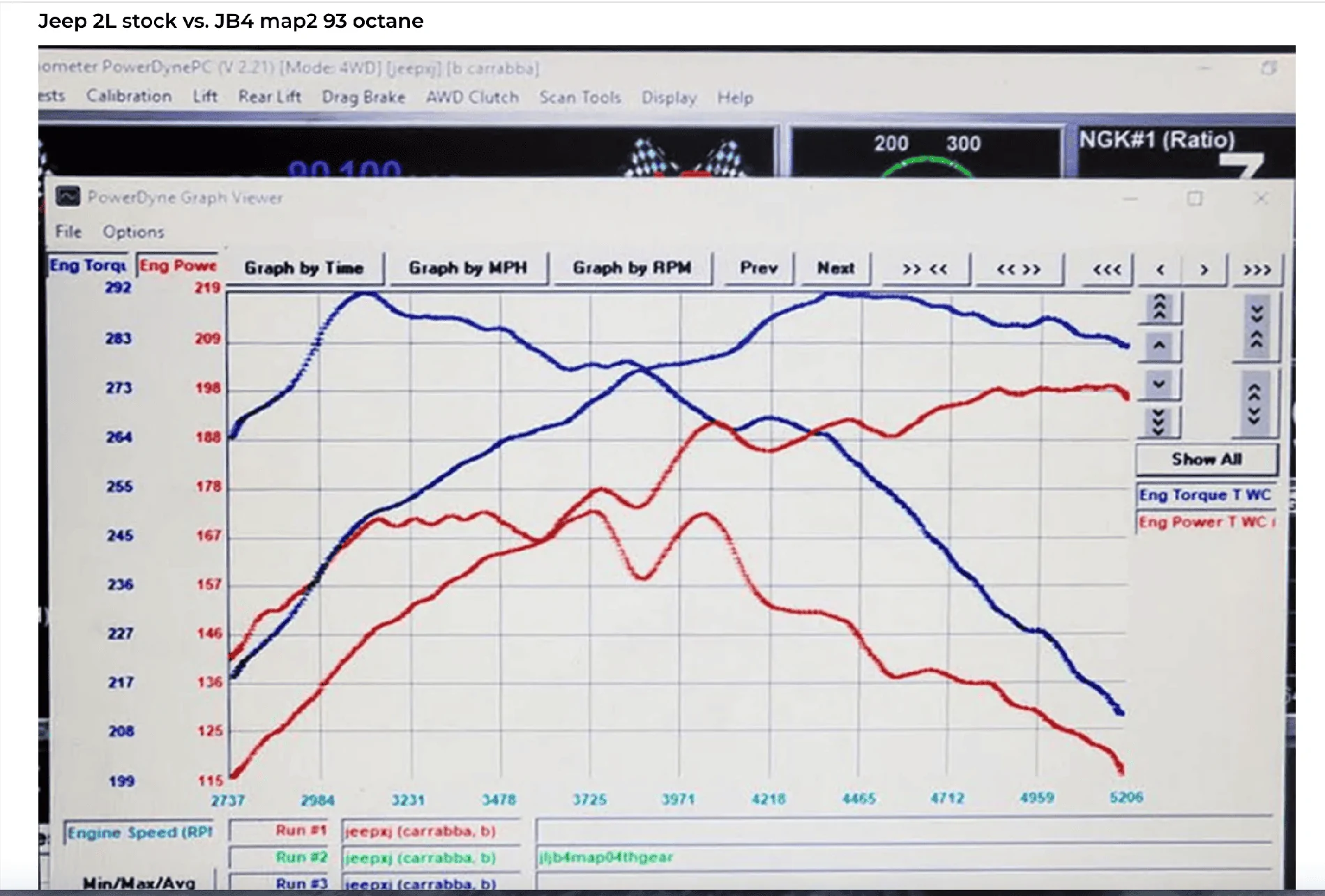
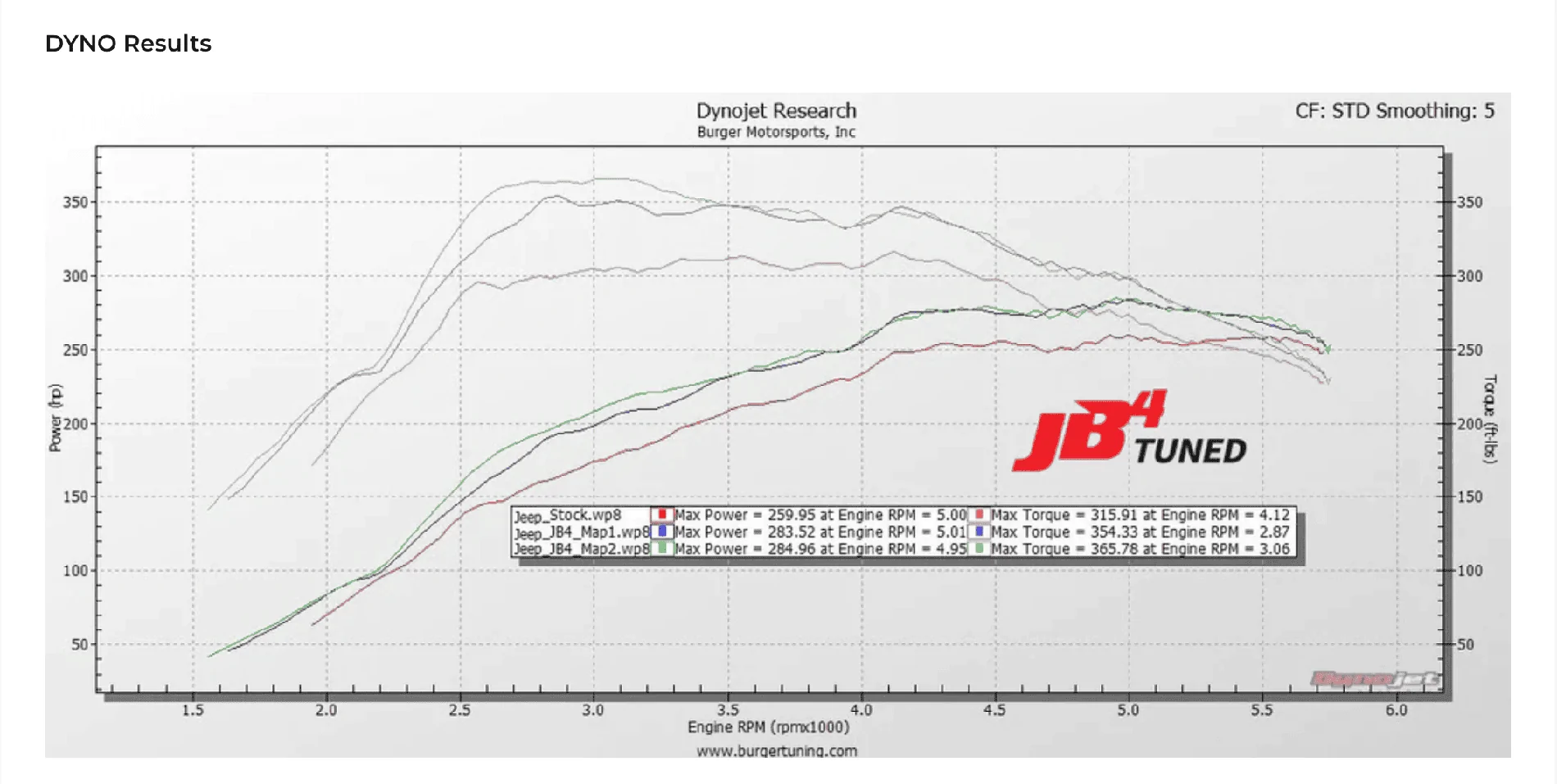
What's everyone's thoughts on the JB4 tuner? They claim some pretty serious gains and have dyno charts to back it up.
 

jludave

Well-Known Member
First Name
Dave
Joined
Feb 13, 2020
Threads
13
Messages
4,158
Reaction score
4,287
Location
The Isle of Long
Vehicle(s)
2020 Wrangler Unlimited Sport Altitude
Occupation
IT Manager
Vehicle Showcase
1
Clubs
 
OP
OP

jakmobile

Active Member
Joined
Feb 12, 2023
Threads
8
Messages
43
Reaction score
13
Location
Iowa
Vehicle(s)
2023 Jeep Wrangler Sahara 4xE
Are you looking to spend money, just for the sake of spending money?
Obviously an unhelpful rhetorical question. So I take that to mean it's not worth it? If not, why? Or did you just feel like posting a comment for no reason other than to waste your time and mine?

Jeep Wrangler JL Upgrades to a 2024 Screenshot 2024-02-26 at 2.44.46 PM


Jeep Wrangler JL Upgrades to a 2024 Screenshot 2024-02-26 at 2.46.50 PM
Sponsored


Top