
Ratbert
Well-Known Member
It's more like this:For my education, "cupping" means the center is worn out before the edges? If yes, wouldn't that happen because of over inflation?
Sponsored
It's more like this:For my education, "cupping" means the center is worn out before the edges? If yes, wouldn't that happen because of over inflation?
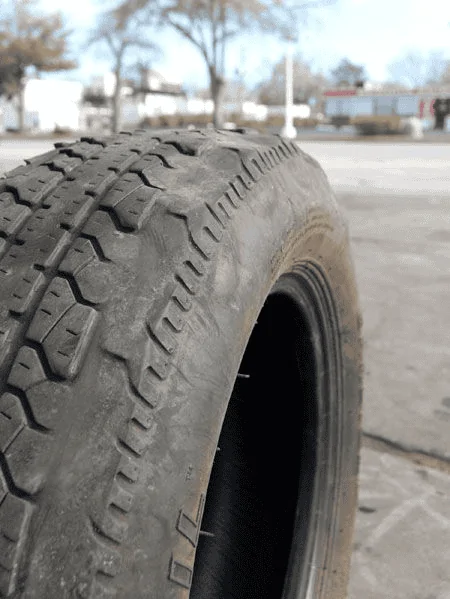
Not really, it is where blocks of tread are depressed next to ones that are not, this forms cups in the tread blocks. These are pretty severe. the above picture is the perfect illustration.For my education, "cupping" means the center is worn out before the edges? If yes, wouldn't that happen because of over inflation?
The Duroflex joints are in the control arms, not the balljoints. Two different functions.I have the full MetalCloak 2.5" GameChanger Suspension. I thought they replaced the stock ball joints with their Duroflex™ Joints
I rotate every 7500, but have always used that interval. i have to wonder if it is these tires. They also suffer from "radial draw".
THANKS!! My steering does not wonder, I don't have a clunking noise, there is no squeaking or other. Nothing on the floor boards or any other usual signs that i know of. It seems hard to believe that 27k miles of 99% highway use has cause such an early failure on such a commonly used configuration..... Doesn't it?The Duroflex joints are in the control arms, not the balljoints. Two different functions.
Factory balljoints are notorious for getting loose with very low mileage. They are expensive for good balljoints and expensive for the labor to install.THANKS!! My steering does not wonder, I don't have a clunking noise, there is no squeaking or other. Nothing on the floor boards or any other usual signs that i know of. It seems hard to believe that 27k miles of 99% highway use has cause such an early failure on such a commonly used configuration.....
I will put it in the air and have a look. Clearly better than killing another set of tires! THANKS for the tip you all.Factory balljoints are notorious for getting loose with very low mileage. They are expensive for good balljoints and expensive for the labor to install.
I see ... so rotationally (versus across the width of the tread) there is a band with a pattern of high and low spots "cups" along the outer edge?It's more like this:

SUPER informative post! Alex, i will take what is 1, 3, and 4 for all of the money.Tire cupping, also known as scalloped tires, is a type of uneven treadwear that appears as if someone took an ice cream scoop and scooped out part of the tread every three to four inches around the circumference of the tire. Here are the main causes of tire cupping:
The problem with tire cupping is that it disrupts the continuous contact between the tread and the road surface. This inconsistency reduces traction, especially in emergency situations, increasing the risk of loss of vehicle control. To prevent tire cupping, ensure proper tire maintenance, address suspension issues promptly, and have tires balanced by a certified mechanic. Remember that maintaining well-balanced tires can extend their lifespan by up to 20%.
- Misaligned Tires: When tires are misaligned, their contact with the road may be uneven, causing uneven stresses on the tread. This can result in a “sawtooth” wear pattern at the edges of the tread, known as “heel-toe wear” in engineering terms.
- Worn Suspension and Shocks: Components like shock absorbers, struts, and bushings wear out over time. When these suspension parts are in bad shape, they can’t effectively dampen the impact between the tire and the road. As a result, the tire bounces slightly, creating uneven points of pressure and leading to tire cupping.
- Unbalanced Tires: If the weight across the circumference of a tire is not evenly distributed, it can cause unbalanced tires. Severe imbalance can result in some sections of the tread meeting the road with greater force than others, leading to increased wear in those areas.
- Cheap Tires: Not all tires are equal in quality. Some lower-quality tires may be more susceptible to cupping, especially on a vehicle with a worn suspension or less-than-perfect wheel balance.


