Sponsored

Jumperless Aux Battery Bypass

STW

Well-Known Member
Joined
Oct 25, 2021
Threads
49
Messages
550
Reaction score
571
Location
Utah
Vehicle(s)
2022 JLR 2door 2.0T Rubicon stingrey
If the auxiliary was bad, it likely took out the main with it. I had this happen to me and it did not take very long for it to happen. My OE died within 3 years and 50K miles (sounds like a familiar timeframe, right?).

I would wonder about the actual health of the main battery, though most auto parts stores cannot properly test it. The other thing to check is the N3 fuse in the high amp fuse array especially if you worked on the aux battery.
agreeing here with CarbonSteel and Rhinebeck and others.
When I was getting dash warnings and ESS-not-available warnings, the Jeep would still start and I thought it was ok. When I tested the aux and main, neither would hold a charge. Still the Jeep would start. I did the jumperless bypass and "Repair mode" on the Noco 10 charger helped enough that both batteries eventually could hold a charge. But even with the aux bypassed, I was showing way low cranking voltage on the main: cranking voltage in the 8v range often but mostly in the low 9v range. That's indicative of damage to the battery, likely from the chronic drain and low charge state it had been under before the bypass. Days are numbered for a battery in that condition.
Sponsored

 

CarbonSteel

Well-Known Member
Joined
Jul 21, 2019
Threads
305
Messages
5,795
Reaction score
8,237
Location
Colorado
Vehicle(s)
2001 Cherokee; 2023 Bronco Wildtrak; 2024 Grand Cherokee 4xe
Vehicle Showcase
1
Update: after removing the fender to replace the aux battery, I found an oil leak. Happened to be above the o2 sensor attached to the exhaust manifold closest to the engine on passenger side. Sensor looks a little toasted from the burnt oil residue on it, so thats probably why I'm having this problem. Thought it was the valve cover gasket - there was oil there, but found the oil was coming from obove there.
About a year ago, i put a catch can in that attaches to a tube coming off the valve cover (I think, please correct me if I'm wrong). This tube is right above the sensor and the hose attached from the catch can was very wet from oil there, and i think is where the oil is coming from that is dripping on the sensor. So good news is valve cover gasket is ok, but sensor probably not.
Luckily, I still have the original oem tube that connects there, so removed the catch can, replaced the hose with oem, and see what happens.
Anyone know how difficult it is to replace that sensor? I still have the fender off so I can see it pretty good.
So from what I understand, the 3.6L has 4 oxygen sensors, two pre-catalytic and two post-catalytic. The post catalytic is the one that I have read has issues more than the pre catalytic.

I am pretty sure the one that you are seeing with the fender pulled back is the pre-sensor. Is the sensor itself covered in oil or the electrical connector? I have read the electrical connector is what shorts when covered in oil.
 

Rmezi190

Member
First Name
Rich
Joined
Jan 28, 2023
Threads
3
Messages
7
Reaction score
1
Location
Boise, ID
Vehicle(s)
22 Gladiator Rubicon
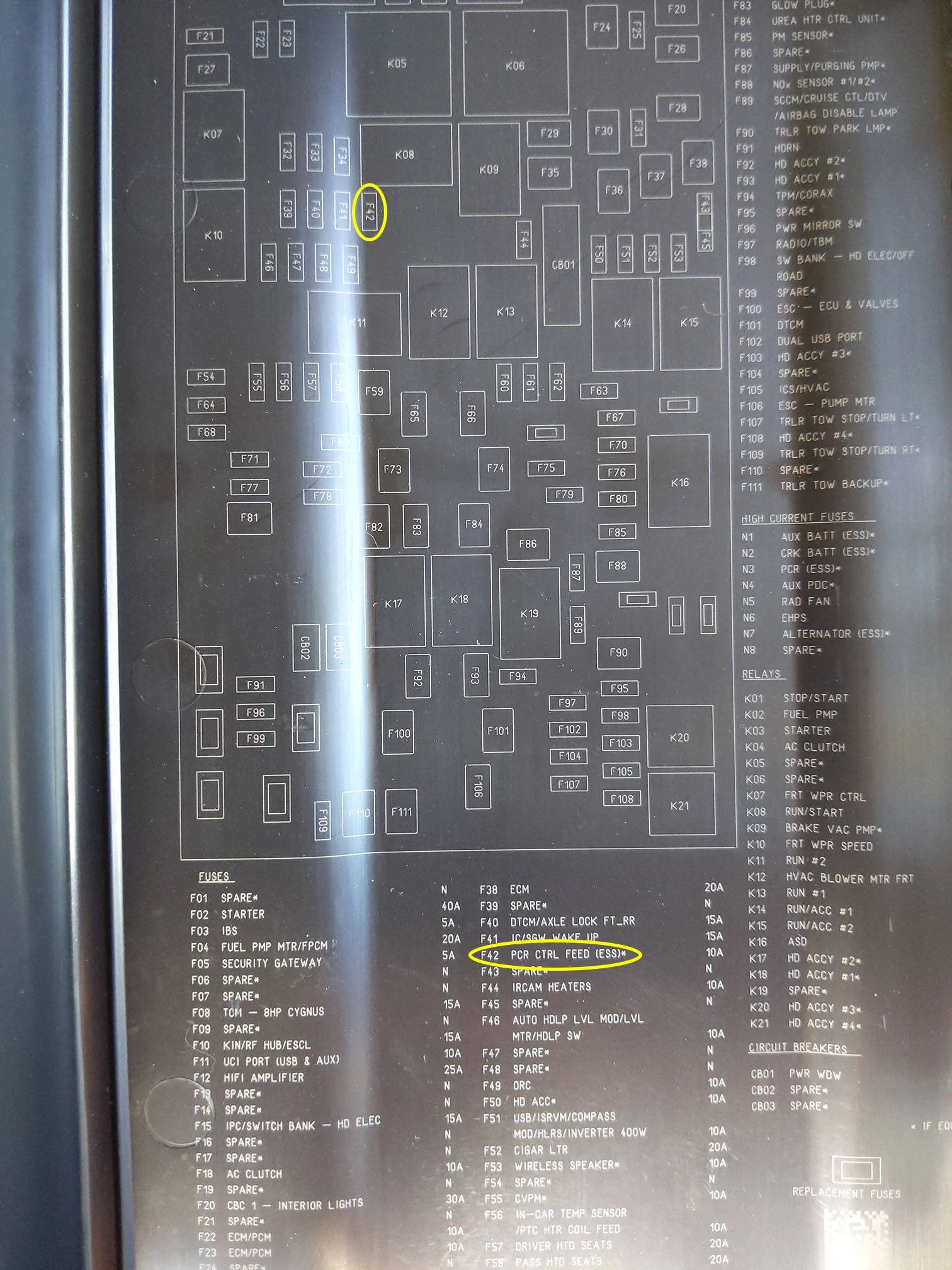
While working on another project, I was looking at the fuse descriptions on the underside of the PDC cover and saw this - F42 PCR CTRL FEED (ESS)*. Could it really be this easy? Yes it is. I pulled the fuse, disconnected the aux negative cable from the main battery negative post and it started right up without any errors.

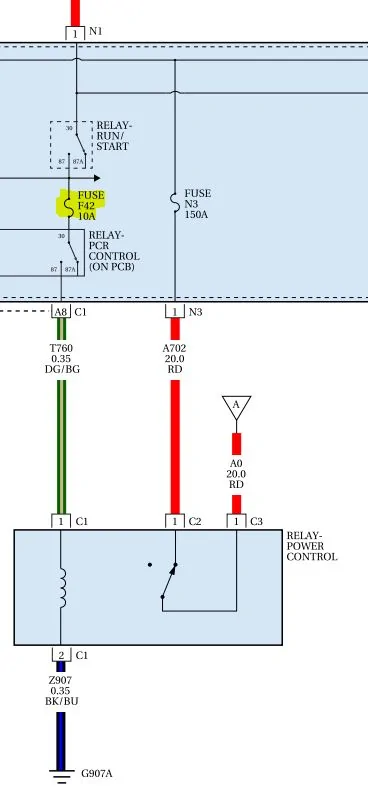
Unplugging the PCR has always been an alternative to using an N1 N2 fused jumper, both methods defeat the aux battery pass/fail test that occurs prior to a cold start. Unlike using a jumper, unplugging the PCR doesn't require any additional parts, it's just not easy to get to the PCR plug. Removing the F42 fuse accomplishes the same thing as unplugging the PCR and the fuse is easy to get to.

Other than a couple starts, I haven't had the chance for real world testing, but I did look at the schematic and verified that pulling the fuse accomplishes the same thing as unplugging the PCR, both prevent the relay from activating.

Here's the underside of the PDC cover showing the description and location of the fuse.
PCR fuse PDC.jpg


Here's the fuse location with the fuse removed.
PCR fuse PDC 2.jpg


Here's the schematic showing the fuse in the circuit.
pcr fuse 2.JPG
If I have physically removed AUX battery and taped those leads, do I still need to disconnect negative aux wire from battery terminal???
 

CarbonSteel

Well-Known Member
Joined
Jul 21, 2019
Threads
305
Messages
5,795
Reaction score
8,237
Location
Colorado
Vehicle(s)
2001 Cherokee; 2023 Bronco Wildtrak; 2024 Grand Cherokee 4xe
Vehicle Showcase
1
If I have physically removed AUX battery and taped those leads, do I still need to disconnect negative aux wire from battery terminal???
Probably not, but I would "anchor" the aux battery leads in the aux compartment so they do not flop around and have the tape come off.
 

Jlmedic

Active Member
First Name
Jonathan
Joined
Aug 31, 2020
Threads
2
Messages
25
Reaction score
30
Location
Long Island NY
Vehicle(s)
2020 Wrangler JLU Sport S
Update: after removing the fender to replace the aux battery, I found an oil leak. Happened to be above the o2 sensor attached to the exhaust manifold closest to the engine on passenger side. Sensor looks a little toasted from the burnt oil residue on it, so thats probably why I'm having this problem. Thought it was the valve cover gasket - there was oil there, but found the oil was coming from obove there.
About a year ago, i put a catch can in that attaches to a tube coming off the valve cover (I think, please correct me if I'm wrong). This tube is right above the sensor and the hose attached from the catch can was very wet from oil there, and i think is where the oil is coming from that is dripping on the sensor. So good news is valve cover gasket is ok, but sensor probably not.
Luckily, I still have the original oem tube that connects there, so removed the catch can, replaced the hose with oem, and see what happens.
Anyone know how difficult it is to replace that sensor? I still have the fender off so I can see it pretty good.
Just had the same exact issue...catch can installed and all...It was my PCV valve leaking. Replaced that (very easy) and cleaned up the oil residue. The O2 sensor that was fried in my case was the post CAT sensor bank 1 sensor 2 (passenger side) part #68224424AA. It's tight but you can reach it from underneath the Jeep in the space between the exhaust and the heat shield to the right (facing rear to front). Used an o2 sensor extension socket (the open one with the slit for the wire) and a cheater bar. One little tug and it came loose enough to unscrew it with my hand. The connector is within view and the wire is run through a plastic O ring that is fairly easy to open up.

While I was in there I did the fuse pull and tied off the aux negative battery terminal. Worked like a charm and good thing too because that little battery was failing again.
 

Sponsored

Swagger

Well-Known Member
Joined
May 13, 2019
Threads
8
Messages
182
Reaction score
106
Location
Michigan
Vehicle(s)
2018 Jeep Wrangler Unlimited Rubicon
I replaced the batteries to remove them from the equation, and hooked everything up to allow the ess to work. After clearing all the codes, the jeep ran great with no codes or cels and ess works like normal.
Did not change the o2 sensor, but after the oil stopped dripping, the o2 cels stopped and the Jeep was running great.
Until it rained, then the cels and misfiring came back. I think it was because the wiring or connector got wet on the O2 sensor which caused the errors to return.
When the weather turned dry again, the cels went away.
I havent replaced the sensor yet. I was thinking of cleaning the connector and protecting it with something like Thompson water seal to see if that works to keep the moisture out, but probably I'll just replace it because the work it takes to get to the area is the same to replace it, and replacing it is not expensive if dyi and peace of mind once done is probably worth it. If it truly is triggered my moisture, than any mudhole could trigger it, and cause problems.
Glad to hear you solved it. Btw, the engine seems to be running great without the catch can. Don't think I will put it back on.
 

CarbonSteel

Well-Known Member
Joined
Jul 21, 2019
Threads
305
Messages
5,795
Reaction score
8,237
Location
Colorado
Vehicle(s)
2001 Cherokee; 2023 Bronco Wildtrak; 2024 Grand Cherokee 4xe
Vehicle Showcase
1
Just had the same exact issue...catch can installed and all...It was my PCV valve leaking. Replaced that (very easy) and cleaned up the oil residue. The O2 sensor that was fried in my case was the post CAT sensor bank 1 sensor 2 (passenger side) part #68224424AA. It's tight but you can reach it from underneath the Jeep in the space between the exhaust and the heat shield to the right (facing rear to front). Used an o2 sensor extension socket (the open one with the slit for the wire) and a cheater bar. One little tug and it came loose enough to unscrew it with my hand. The connector is within view and the wire is run through a plastic O ring that is fairly easy to open up.

While I was in there I did the fuse pull and tied off the aux negative battery terminal. Worked like a charm and good thing too because that little battery was failing again.
What size socket was it? Did you put any anti-seize on the threads? Did you remove it with the exhaust Hot (warm) or cold?
 

Jlmedic

Active Member
First Name
Jonathan
Joined
Aug 31, 2020
Threads
2
Messages
25
Reaction score
30
Location
Long Island NY
Vehicle(s)
2020 Wrangler JLU Sport S
What size socket was it? Did you put any anti-seize on the threads? Did you remove it with the exhaust Hot (warm) or cold?
22mm (7/8") socket, put a small amount of anti-seize on the threads as not to accidentally contaminate the sensor, and exhaust was warmed up a bit.
 

Sdchrisc

Active Member
First Name
Chris
Joined
Jul 27, 2019
Threads
0
Messages
36
Reaction score
7
Location
San Diego
Vehicle(s)
2018 jeep jl sahara
Just had the same exact issue...catch can installed and all...It was my PCV valve leaking. Replaced that (very easy) and cleaned up the oil residue. The O2 sensor that was fried in my case was the post CAT sensor bank 1 sensor 2 (passenger side) part #68224424AA. It's tight but you can reach it from underneath the Jeep in the space between the exhaust and the heat shield to the right (facing rear to front). Used an o2 sensor extension socket (the open one with the slit for the wire) and a cheater bar. One little tug and it came loose enough to unscrew it with my hand. The connector is within view and the wire is run through a plastic O ring that is fairly easy to open up.

While I was in there I did the fuse pull and tied off the aux negative battery terminal. Worked like a charm and good thing too because that little battery was failing again.
Yup the faulty hoses supplied with the UPR catch can.. happend to many others including myself.. replaced with the misimoto catch can and havent had any issues in 2 years so far.. UPR failed at about 5-6 month mark.. the hose UPR supplies freqently slips off causing oil to leak.
 

mrclean35501

Member
First Name
Derric
Joined
Jun 22, 2023
Threads
1
Messages
6
Reaction score
0
Location
Alabama
Vehicle(s)
2020 jeep wrangler
While working on another project, I was looking at the fuse descriptions on the underside of the PDC cover and saw this - F42 PCR CTRL FEED (ESS)*. Could it really be this easy? Yes it is. I pulled the fuse, disconnected the aux negative cable from the main battery negative post and it started right up without any errors.

Unplugging the PCR has always been an alternative to using an N1 N2 fused jumper, both methods defeat the aux battery pass/fail test that occurs prior to a cold start. Unlike using a jumper, unplugging the PCR doesn't require any additional parts, it's just not easy to get to the PCR plug. Removing the F42 fuse accomplishes the same thing as unplugging the PCR and the fuse is easy to get to.

Other than a couple starts, I haven't had the chance for real world testing, but I did look at the schematic and verified that pulling the fuse accomplishes the same thing as unplugging the PCR, both prevent the relay from activating.

Here's the underside of the PDC cover showing the description and location of the fuse.
PCR fuse PDC.jpg


Here's the fuse location with the fuse removed.
PCR fuse PDC 2.jpg


Here's the schematic showing the fuse in the circuit.
pcr fuse 2.JPG
But mine doesn’t have that many fuses there, it looks like my f42 fuse is already gone
 

Sponsored

mrclean35501

Member
First Name
Derric
Joined
Jun 22, 2023
Threads
1
Messages
6
Reaction score
0
Location
Alabama
Vehicle(s)
2020 jeep wrangler
While working on another project, I was looking at the fuse descriptions on the underside of the PDC cover and saw this - F42 PCR CTRL FEED (ESS)*. Could it really be this easy? Yes it is. I pulled the fuse, disconnected the aux negative cable from the main battery negative post and it started right up without any errors.

Unplugging the PCR has always been an alternative to using an N1 N2 fused jumper, both methods defeat the aux battery pass/fail test that occurs prior to a cold start. Unlike using a jumper, unplugging the PCR doesn't require any additional parts, it's just not easy to get to the PCR plug. Removing the F42 fuse accomplishes the same thing as unplugging the PCR and the fuse is easy to get to.

Other than a couple starts, I haven't had the chance for real world testing, but I did look at the schematic and verified that pulling the fuse accomplishes the same thing as unplugging the PCR, both prevent the relay from activating.

Here's the underside of the PDC cover showing the description and location of the fuse.
PCR fuse PDC.jpg


Here's the fuse location with the fuse removed.
PCR fuse PDC 2.jpg


Here's the schematic showing the fuse in the circuit.
pcr fuse 2.JPG
Mine doesn’t seem to have a fuse in that slot
 

ConqSoft

Well-Known Member
First Name
Keith
Joined
May 25, 2020
Threads
56
Messages
992
Reaction score
2,176
Location
Wake Forest, NC
Vehicle(s)
2024 Gladiator Mojave
Occupation
Systems Analyst
Vehicle Showcase
1
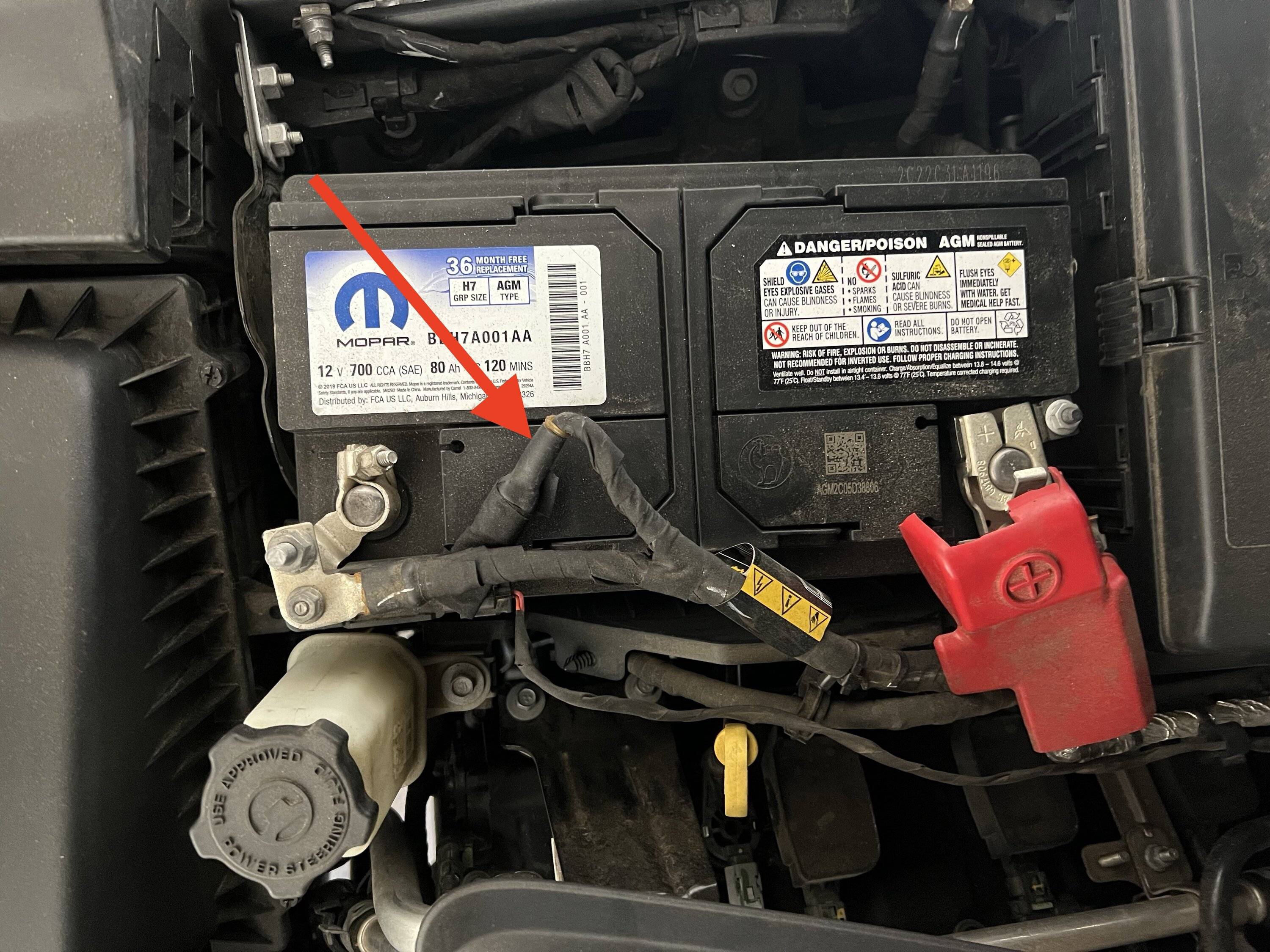
Just to confirm, this is the correct cable to disconnect, right? I disconnected it, taped it off, removed the jumper, and everything seems to be working fine with no error codes.

Jeep Wrangler JL Jumperless Aux Battery Bypass IMG_0596
 

muscleman

New Member
First Name
Mike
Joined
Jul 3, 2023
Threads
0
Messages
1
Reaction score
0
Location
Honolulu, HI
Vehicle(s)
2018 Chrysler Pacifica
Hi Jebiruph,
I came across your post regarding pulling fuse 42 out to by pass AUX battery. Thank you so much for the work. I have a 2018 pacifica. I checked my diagram and do not see a fuse called PCR CTRL. I saw a website where it says F13 is ECM (ESS only). I wonder if that's the right one for the Pacifica? https://www.startmycar.com/us/chrysler/pacifica/info/fusebox/2018
On the diagram box in my vehicle, that F13 is marked sas ECM (S), which is a little different from what's on the above website.


Thank you so much!
Mike
 

Down South

Well-Known Member
First Name
Sam
Joined
Apr 13, 2021
Threads
2
Messages
142
Reaction score
122
Location
Louisiana
Vehicle(s)
2020 JLUR
Occupation
Retired
Been planning on doing the jumperless bypass for a while. I was gone for 10 days while the Jeep was on a battery tender. When I returned, I noticed my tender light was red. Checked Jeep. Batteries completely dead.
I did the bypass ,"Pulled aux neg, remove fuse F42". I was able to charge the main and run the jeep but the main was toast too. I charged it then let it sit overnight and the voltage was down to 12.2 the next morning.

I bought an AGM H7 battery and all is well. I do not have an ESS bypass nor after reading through most of this thread again do I see the real need for an ESS bypass. I've got a 850 CCA battery cranking a 4-cylinder engine on ESS every once and awhile.
Can someone give me a technical answer for why I actually need a ESS bypass?
The only reasons for a bypass that I have seen so far it would be possible to deplete the main battery with ESS activated. That doesn't make sense to me.

My F150 truck had a slightly bigger battery and ESS is active all the time unless I get into a town with lots of red lights. I get aggravated and then disable it. I never have a problem with it running the battery down.
Sponsored


Top