
Sponsored

87 or 91+ octane?

RoadiJeff

Well-Known Member
Joined
May 24, 2020
Threads
1
Messages
551
Reaction score
777
Location
St. Louis
Vehicle(s)
2020 2.0T Recon, 2018 3.6L GC High Altitude
Manual says 91 for the 2.0 turbo but we have 87, 89, and 93 here in Texas so v-power 93 it is. Drives much better w that as well.
Using anything higher than what is recommended in the owner's manual is a complete waste of money and serves absolutely no performance gains. Of course, there's always the good old placebo effect. Some owners apparently don't mind spend a few extra dollars per tank for that.
 

Initial-Jeep

Well-Known Member
First Name
Julian
Joined
Oct 23, 2021
Threads
0
Messages
352
Reaction score
489
Location
. Greensboro, North Carolina
Vehicle(s)
'22 392XR Tuscadero, PT Cruiser Dream Cruisers 2&4
Occupation
Data Engineer, Retired Air Force
Using anything higher than what is recommended in the owner's manual is a complete waste of money and serves absolutely no performance gains. Of course, there's always the good old placebo effect. Some owners apparently don't mind spend a few extra dollars per tank for that.
Or there's using OBD-II tools to monitor timing and to compare the differences, if any, as well as drag times. My old PTs definitely notice 93 over 91--and 91 over 87 at altitude (Colorado). My Jeep requires 91.

Manufacturers can't pragmatically require 93 since it's not available everywhere.

Jeep Wrangler JL 87 or 91+ octane? Screen Shot 2022-04-24 at 09.58.55
 

jeepoch

Well-Known Member
First Name
Jay
Joined
Nov 13, 2019
Threads
1
Messages
1,052
Reaction score
2,941
Location
Longmont, CO
Vehicle(s)
2019 JL Wrangler Sport S 3.6L Auto 2 door, 2.5" lift, 35s
Using anything higher than what is recommended in the owner's manual is a complete waste of money and serves absolutely no performance gains. Of course, there's always the good old placebo effect. Some owners apparently don't mind spend a few extra dollars per tank for that.
@RoadiJeff,

It appears that you haven't read this thread. If you have you would have run across the phenomenon called 'knock'. Each and every knock event lowers performance and damages your rings and cylinder walls to some extent. Over time this will result in a gradual loss of compression.

Higher octane fuels significantly lower the probability of producing knock. Enjoy the explanation from post #53 (and others) from within this very thread.

https://www.jlwranglerforums.com/forum/threads/87-or-91-octane.89931/page-4#post-1898618

Cheers.
Jay
 

Hearhear

Well-Known Member
Joined
Jun 7, 2021
Threads
65
Messages
531
Reaction score
1,372
Location
USA
Vehicle(s)
Lexus, 392 XR Wrangler
Just use what the owners manual tells you to use, and ignore everything else. If it tells you to use 87 or higher, use 87 or higher. I have the 392 and the owners manual says use 91 or higher. That’s what I use.

One other thing to consider- higher octane fuels like 91 and above often contain special proprietary detergents, depending on fuel brand. Those detergents help keep your engine and fuel injectors cleaner, thus prolonging the life of your engine. There are real benefits to the higher octane fuels.

I go to a local Mobil station and get great 93 octane gas, which has detergents. From the Mobile website for deeper insight:

”With Synergy Supreme+ premium quality gas, you can keep your engine 2X cleaner for better gas mileage. That means it’s not just our best fuel ever – it could even be your engine’s favorite fuel ever.
Synergy Supreme+ premium gas generally has an octane level of 93, but may be blended and sold at an octane level of 91 or 92 in certain areas of the US. So what are some of the benefits of premium gas with a high octane level?
Octane ratings are a measure of fuel stability. Using a lower octane fuel than required for your vehicle may damage the engine and emissions control system over time. So when it comes to regular gas vs premium, 91-93 octane gas provides improved performance and fuel economy in vehicles designed to run on premium gasoline. Every time you fill up with top tier gasoline, you’re helping keep your engine happy.

Fuel injectors – like spray bottles – don’t work well when they’re clogged. When it comes to functionality, fuel injectors are an essential part of your car’s engine, delivering fuel at the right time to ensure efficient combustion. Some lower tier gas can leave deposits on fuel injectors, resulting in decreased performance. This is one of the big differences between premium gas vs regular that can make a big impact.

Synergy Supreme+ premium gas contains detergent that helps remove deposits – for cleaner fuel injectors, better fuel economy and smoother engine operation. Here’s how it works:

  • Deposits accumulate on port fuel injection (PFI) intake valves and gasoline direct injection (GDI) fuel injectors
  • Our Synergy Supreme+ premium gas contains significantly more cleaning agents than federal standards require leading to outstanding cleanliness
  • It keeps your engine clean by reducing deposit buildup
  • It even cleans up your engine by removing existing deposits left behind by gasoline that meets minimum government standards”
 

Sponsored

J0E

Well-Known Member
First Name
J0e
Joined
Sep 1, 2018
Threads
55
Messages
1,359
Reaction score
1,162
Location
Hawaii, MT, SLC, NYC
Website
bt39.com
Vehicle(s)
2021 JLR, 05 LJR on 43s
Build Thread
Link
Occupation
Drywall construction - reel estate
It's scientific fact that higher octane fuels are more resistant to knock. It's also a fact that every grade of gas has the same energy. The only way that premium fuel works "for optimum performance" is by advancing the timing.


Timed the same 87 makes the same power as 91.
Not with engine knock at 87.

It can't hurt to have better detonation resistance.
detonation is not the same as knock.

There's a reason Chrysler tested the new hellcat with 109 race gas, it make more HP.
 

Zandcwhite

Well-Known Member
First Name
Zach
Joined
Sep 4, 2019
Threads
11
Messages
8,287
Reaction score
14,178
Location
Patterson, ca
Vehicle(s)
2019 jlur
Not with engine knock at 87.


detonation is not the same as knock.
Yes and no, knock is any uneven or untimed or controlled burning of the air fuel mixture. Predetonation is 1 very specific type of engine knock. Low quality/low octane fuel can cause both predetonation and knocking from uneven or incomplete combustion.
 

Shibadog

Well-Known Member
Joined
Dec 28, 2021
Threads
23
Messages
2,149
Reaction score
3,535
Location
Bowling Green, Ky
Vehicle(s)
2020 Wrangler Sport S hardtop
Occupation
Safety &Fire Protection Engineer (Retired)
Just use what the owners manual tells you to use, and ignore everything else. If it tells you to use 87 or higher, use 87 or higher. I have the 392 and the owners manual says use 91 or higher. That’s what I use.

One other thing to consider- higher octane fuels like 91 and above often contain special proprietary detergents, depending on fuel brand. Those detergents help keep your engine and fuel injectors cleaner, thus prolonging the life of your engine. There are real benefits to the higher octane fuels.

I go to a local Mobil station and get great 93 octane gas, which has detergents. From the Mobile website for deeper insight:

”With Synergy Supreme+ premium quality gas, you can keep your engine 2X cleaner for better gas mileage. That means it’s not just our best fuel ever – it could even be your engine’s favorite fuel ever.
Synergy Supreme+ premium gas generally has an octane level of 93, but may be blended and sold at an octane level of 91 or 92 in certain areas of the US. So what are some of the benefits of premium gas with a high octane level?
Octane ratings are a measure of fuel stability. Using a lower octane fuel than required for your vehicle may damage the engine and emissions control system over time. So when it comes to regular gas vs premium, 91-93 octane gas provides improved performance and fuel economy in vehicles designed to run on premium gasoline. Every time you fill up with top tier gasoline, you’re helping keep your engine happy.

Fuel injectors – like spray bottles – don’t work well when they’re clogged. When it comes to functionality, fuel injectors are an essential part of your car’s engine, delivering fuel at the right time to ensure efficient combustion. Some lower tier gas can leave deposits on fuel injectors, resulting in decreased performance. This is one of the big differences between premium gas vs regular that can make a big impact.

Synergy Supreme+ premium gas contains detergent that helps remove deposits – for cleaner fuel injectors, better fuel economy and smoother engine operation. Here’s how it works:

  • Deposits accumulate on port fuel injection (PFI) intake valves and gasoline direct injection (GDI) fuel injectors
  • Our Synergy Supreme+ premium gas contains significantly more cleaning agents than federal standards require leading to outstanding cleanliness
  • It keeps your engine clean by reducing deposit buildup
  • It even cleans up your engine by removing existing deposits left behind by gasoline that meets minimum government standards”
Don’t see how any gas is going to clean a GDI engine, seeing that the fuel is injected AFTER the valve…
 

JP29

Well-Known Member
First Name
Zach
Joined
Jun 14, 2020
Threads
18
Messages
750
Reaction score
1,256
Location
Olathe
Vehicle(s)
2020 JL Sport
I've come back to this thread off and on for the past two years of ownership, I've never really settled on anything but last fill up I did go back to 91 (past year had been 87, I've done 87 or 91 depending on how tight money was in the past). I noticed that on this tank of 91, the engine has been much quieter, both at idle and under load. Quite likely just a placebo effect, but considering the direction of some of the more performance oriented mods I have planned, I think I'll stick with 91.
 

Zandcwhite

Well-Known Member
First Name
Zach
Joined
Sep 4, 2019
Threads
11
Messages
8,287
Reaction score
14,178
Location
Patterson, ca
Vehicle(s)
2019 jlur
Don’t see how any gas is going to clean a GDI engine, seeing that the fuel is injected AFTER the valve…
Cylinder walls, pistons, rings, injectors can all suffer carbon build up and that built up carbon can retain enough heat to lead to detonation issues. Obviously the fuel isn’t washing the back of the valves like port injection, but the combustion chamber is probably more crucial in my opinion.
 

Sponsored

vegasblue

Well-Known Member
First Name
Chad
Joined
Aug 10, 2021
Threads
0
Messages
293
Reaction score
725
Location
Las Vegas
Vehicle(s)
2021 JLUR
I've noticed little to no difference in daily driving months on and off between the two. If I know I'm hitting the trails I run 91, but for the day to day I get 90 gallons of free 87 octane a month. Makes my choice much easier.
 

Willys22

Well-Known Member
First Name
SK
Joined
Apr 17, 2022
Threads
7
Messages
47
Reaction score
21
Location
PA
Vehicle(s)
Wrangler Willys 22
Let me calculate, assuming that
1. There is a 2.5 mpg drop form 93 to 87 octane​
2. Price difference between two is $0.5 (COSTCO)​
3. Full tank is 17 gallons (2dr)​

The mpg drop is my personal experience (owned GTI and tested for my self and I did noticed mpg differences), I own 2D 2022 Willys with mud tires, my range after refilling the tank is 350+.

Order is 87 and 93
- MPG: 19.5 / 22 mpg
- Full tank range based on the mpg: 331.5 / 374 miles
- Full tank range difference: 42.5 miles (which means 87 needs to fill more by this amount, 42.5 gallons divide by 19.5 = 2.18 gallons)
- Gallons to be filled: 19.18 / 17 gallons

Now, lets compare them by gas price:
87 octane, $4 * 19.18 gal = $76.72​
93 octane, $4.5 * 17 gal = $76.5​

87 octane, $3.5 * 19.18 gal = $67.13​
93 octane, $4 * 17 gal = $68​

87 octane, $3 * 19.18 gal = $57.54​
93 octane, $3.5 * 17 gal = $59.5​

87 octane, $2 * 19.18 gal = $38.36​
93 octane, $2.5 * 17 gal = $42.5​

These are all by assumptions, but there is no really much difference between two. I would say with this little difference, why not going with 91+ for enjoying power and engine durability? These numbers would be more effective if you drive in "green" mode, meaning that when you making the difference in mpg! Also, the difference will be larger if you have a large tank, 4 dr.

After filling this numbers, I really want to see the $2 gas price again.
 

Xspurt

Well-Known Member
Joined
Jan 22, 2022
Threads
0
Messages
198
Reaction score
287
Location
North of Charlotte
Vehicle(s)
Juliet Lima
Let me calculate, assuming that
1. There is a 2.5 mpg drop form 93 to 87 octane​
I'm going to bet you are the rare exception, having experienced THAT HUGE a difference in MPG for a vehicle that is approved for the lower octane in your examples. 2.5 mpg is MASSIVE. Most people see NO difference. Very few report maybe .5 mpg to at most I've EVER heard of, 1 mpg. Since your data is all based off of that fairly unrealistic assumption, as good as it looks, it's flawed.
 

Willys22

Well-Known Member
First Name
SK
Joined
Apr 17, 2022
Threads
7
Messages
47
Reaction score
21
Location
PA
Vehicle(s)
Wrangler Willys 22
I'm going to bet you are the rare exception, having experienced THAT HUGE a difference in MPG for a vehicle that is approved for the lower octane in your examples. 2.5 mpg is MASSIVE. Most people see NO difference. Very few report maybe .5 mpg to at most I've EVER heard of, 1 mpg. Since your data is all based off of that fairly unrealistic assumption, as good as it looks, it's flawed.
Agreed. If there is someone who can see a real difference, then it might helpful for them. I am not sure how you say there is NO difference with no data provided.
 

BeachPilot74

Well-Known Member
First Name
Garrett
Joined
Oct 31, 2021
Threads
22
Messages
470
Reaction score
738
Location
Colorado Springs
Vehicle(s)
2022 JLUR XR, 2013 F-F150
Occupation
Airline Pilot
Either way works. If you notice the fuel economy or performance, and it's worth it to you, go for it. If not, that's just as fine too. Everyone's a special pony. Everyone's a winner unless they're spoiling for that unique fight where the world is wrong yet they know better.

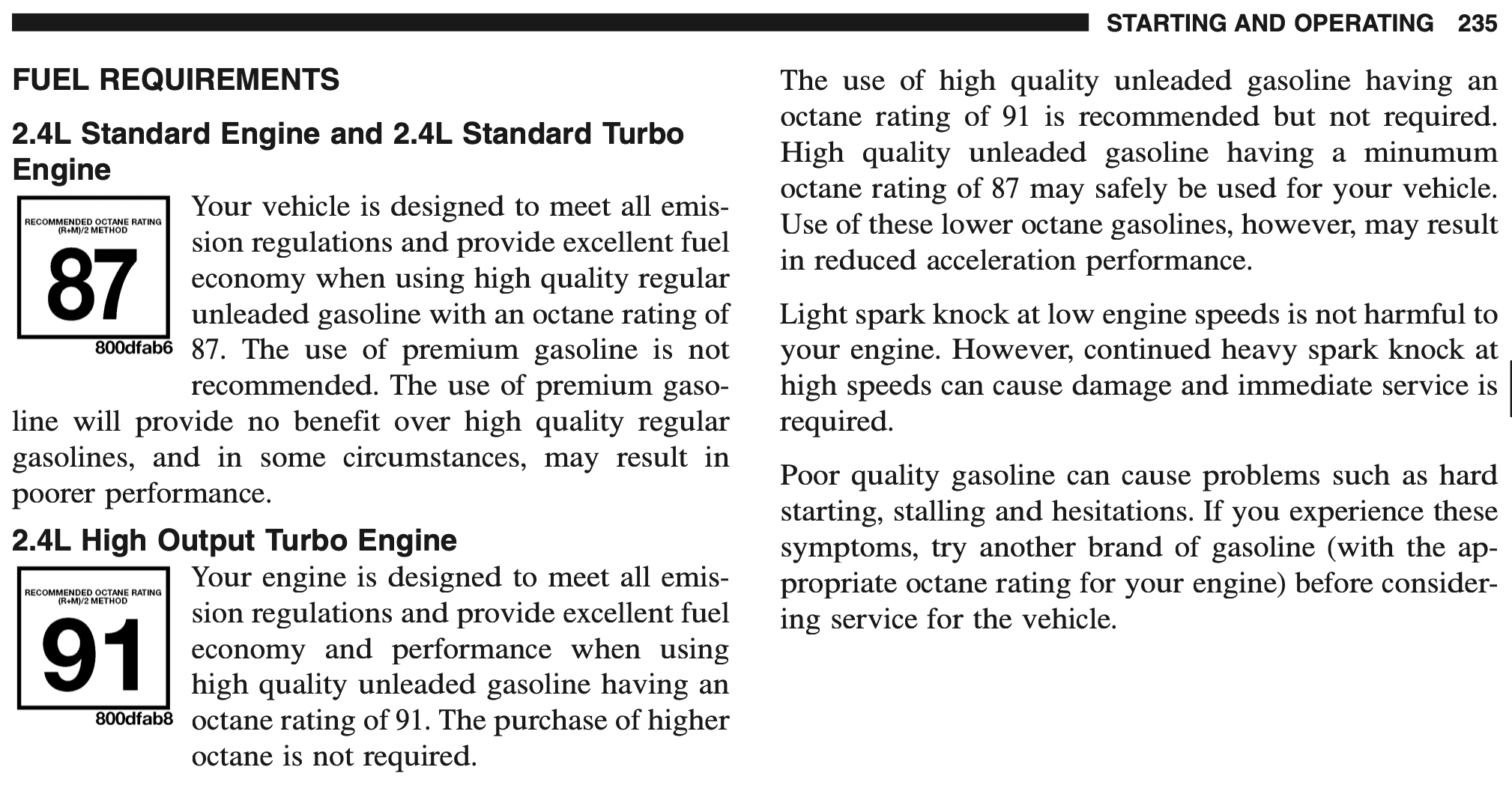
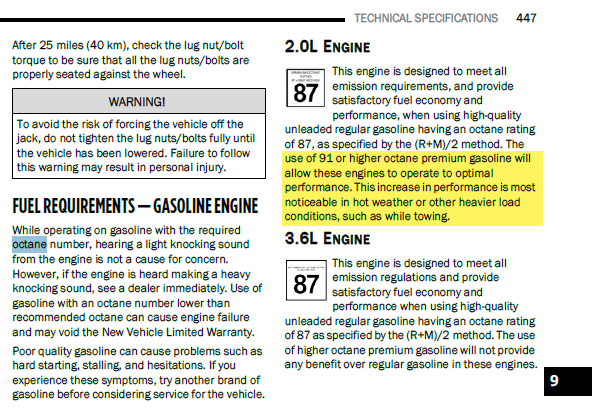
And now the obligatory cut-and-paste from the manual:

1647046571180.png
Funny how most questions are answered in that little book!!
Sponsored


Top