Sponsored

2.0 Torque Curves

OP
OP
AnnDee4444

AnnDee4444

Well-Known Member
Joined
Jan 14, 2019
Threads
54
Messages
5,529
Reaction score
7,948
Location
‎
Vehicle(s)
'18 JLR 2.0
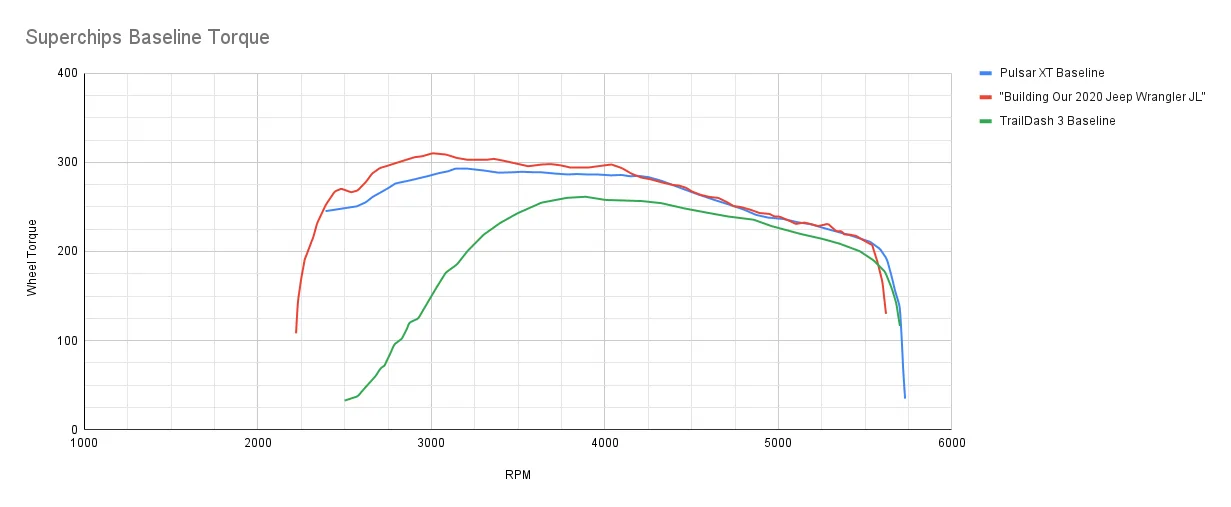
I realized I made a mistake, fixed it in the chart below. I didn't update the averages, doesn't look like they would have changed much anyway.
Jeep Wrangler JL 2.0 Torque Curves 2.0 Stock Torque Curves
Sponsored


F2F

Well-Known Member
Joined
Sep 13, 2019
Threads
5
Messages
140
Reaction score
317
Location
NC
Vehicle(s)
19 JL Sport Altitude 2.0L Turbo
Great job Compiling this data. I always thought the factory torque numbers for the 2.0T were underrated. It’s apparent it’s rocking over 300 at the crank.
 

Headbarcode

Well-Known Member
First Name
Mike
Joined
Aug 16, 2018
Threads
26
Messages
7,755
Reaction score
18,010
Location
LI, New York
Vehicle(s)
2019 JLUR Stingray 2.0 turbo
Vehicle Showcase
1
Great job Compiling this data. I always thought the factory torque numbers for the 2.0T were underrated. It’s apparent it’s rocking over 300 at the crank.
All these graphs represent hp and tq numbers at the rear wheel. Usually, only engine builders are set up for testing on engine stands.

I drove over 100 different Jeeps, to have direct comparisons of the 2.0 and 3.6 before ordering. I fully agree about the 2.0 being underrated. In a sample size of over 50, every last 2.0 felt noticeably quicker. And all of my test drive miles were racked up on long Island, just a matter of feet above sea level, so high altitude wasn't tainting my results.
 
OP
OP
AnnDee4444

AnnDee4444

Well-Known Member
Joined
Jan 14, 2019
Threads
54
Messages
5,529
Reaction score
7,948
Location
‎
Vehicle(s)
'18 JLR 2.0
OP
OP
AnnDee4444

AnnDee4444

Well-Known Member
Joined
Jan 14, 2019
Threads
54
Messages
5,529
Reaction score
7,948
Location
‎
Vehicle(s)
'18 JLR 2.0
Last edited:

Sponsored

Wabujitsu

Well-Known Member
First Name
Jeff
Joined
Jul 26, 2019
Threads
157
Messages
3,973
Reaction score
8,182
Location
Sarasota, FL
Vehicle(s)
2021 JLUR, 2020 JLU Sahara
Build Thread
Link
Occupation
Retired US Army
Vehicle Showcase
1

Wabujitsu

Well-Known Member
First Name
Jeff
Joined
Jul 26, 2019
Threads
157
Messages
3,973
Reaction score
8,182
Location
Sarasota, FL
Vehicle(s)
2021 JLUR, 2020 JLU Sahara
Build Thread
Link
Occupation
Retired US Army
Vehicle Showcase
1
OP
OP
AnnDee4444

AnnDee4444

Well-Known Member
Joined
Jan 14, 2019
Threads
54
Messages
5,529
Reaction score
7,948
Location
‎
Vehicle(s)
'18 JLR 2.0
I get that, I was just hoping you could explain, mechanically, why it happens.
I'm not 100% sure, but have always assumed it's running out of air due to the turbo sizing.

All engines will have this point, where they can't pump as much air through and torque will start to go down. Sometimes that point is so high that other components can't handle the RPM needed to see it.
 

Wabujitsu

Well-Known Member
First Name
Jeff
Joined
Jul 26, 2019
Threads
157
Messages
3,973
Reaction score
8,182
Location
Sarasota, FL
Vehicle(s)
2021 JLUR, 2020 JLU Sahara
Build Thread
Link
Occupation
Retired US Army
Vehicle Showcase
1
I'm not 100% sure, but have always assumed it's running out of air due to the turbo sizing.

All engines will have this point, where they can't pump as much air through and torque will start to go down. Sometimes that point is so high that other components can't handle the RPM needed to see it.
That makes perfect sense; thank you!
 

Sponsored

TheBirdie72

Well-Known Member
First Name
Steve
Joined
Dec 16, 2021
Threads
25
Messages
5,389
Reaction score
25,730
Location
Rhode Island
Vehicle(s)
2021 Jeep Wrangler Freedom Edition 2 Door
Great information! I understand about 25% of this stuff, but I’m trying to learn! ??

Jeep Wrangler JL 2.0 Torque Curves 1666693380518
 

oldcjguy

Well-Known Member
First Name
Jim
Joined
Aug 26, 2020
Threads
3
Messages
609
Reaction score
760
Location
Central FL
Vehicle(s)
16 Challenger Hellcat, 19 Challenger Scatpack, 20 JLUR Recon
Occupation
Software Engineer
In your original figures, why does torque decrees at the upper level RPMs?
Torque always goes down in higher RPMs. It's a function of the engines ability to breath efficiently. The faster the engine spins the more difficult it is to evacuate the spent gasses and take in fresh air/fuel. An engine builder can make an engine breath more efficiently in upper rpms, but will sacrifice low rpm breathing efficiency. Cylinder scavenging and valve overlap becomes inefficient and does not work well at low RPM and low air flow rates. Most engines are designed to make torque in the lower RPM range because that's where most people need/use it. So that's where they breath more efficiently. That's where the majority of time is spent on a normal vehicle. The cam pretty much dictates where in the RPM curve will sit. The cam controls when the intake and exhaust valves open, how long they stay open for and how much they open. That's where the breathing occurs.

In a very basic sense, the torque curve can be moved up and down in the RPM range but doesn't typically vary much in width for a given engine configuration. Moving the torque curve up in the RPM range typically gets you more horsepower (because hp is a function of rpm), but less low rpm performance, because the torque (and the rpm) will be lower down there.
Horsepower and torque are different. Torque is how much work you can do, horsepower is how fast you can do it. Horsepower is formula applied using torque and rpm. Ever notice that all dyno graphs have horsepower and torque intersecting right around 5200 rpm (5252 to be precise)? The formula for horsepower is: hp = (torque x rpm) / 5252
So even if torque is on the way down, with extra RPMs hp will continue to increase until torque drops off too much. Turbos, superchargers, and cubic inches make torque. Turbos and superchargers typically have nice broad flat torque curves, compared to naturally aspirated engines. With turbos the torque comes in early and stays relatively flat.

I'm a little all over the place there, but I hope it helps
 
OP
OP
AnnDee4444

AnnDee4444

Well-Known Member
Joined
Jan 14, 2019
Threads
54
Messages
5,529
Reaction score
7,948
Location
‎
Vehicle(s)
'18 JLR 2.0
Bumping my own old thread because I want to keep track of this for future.

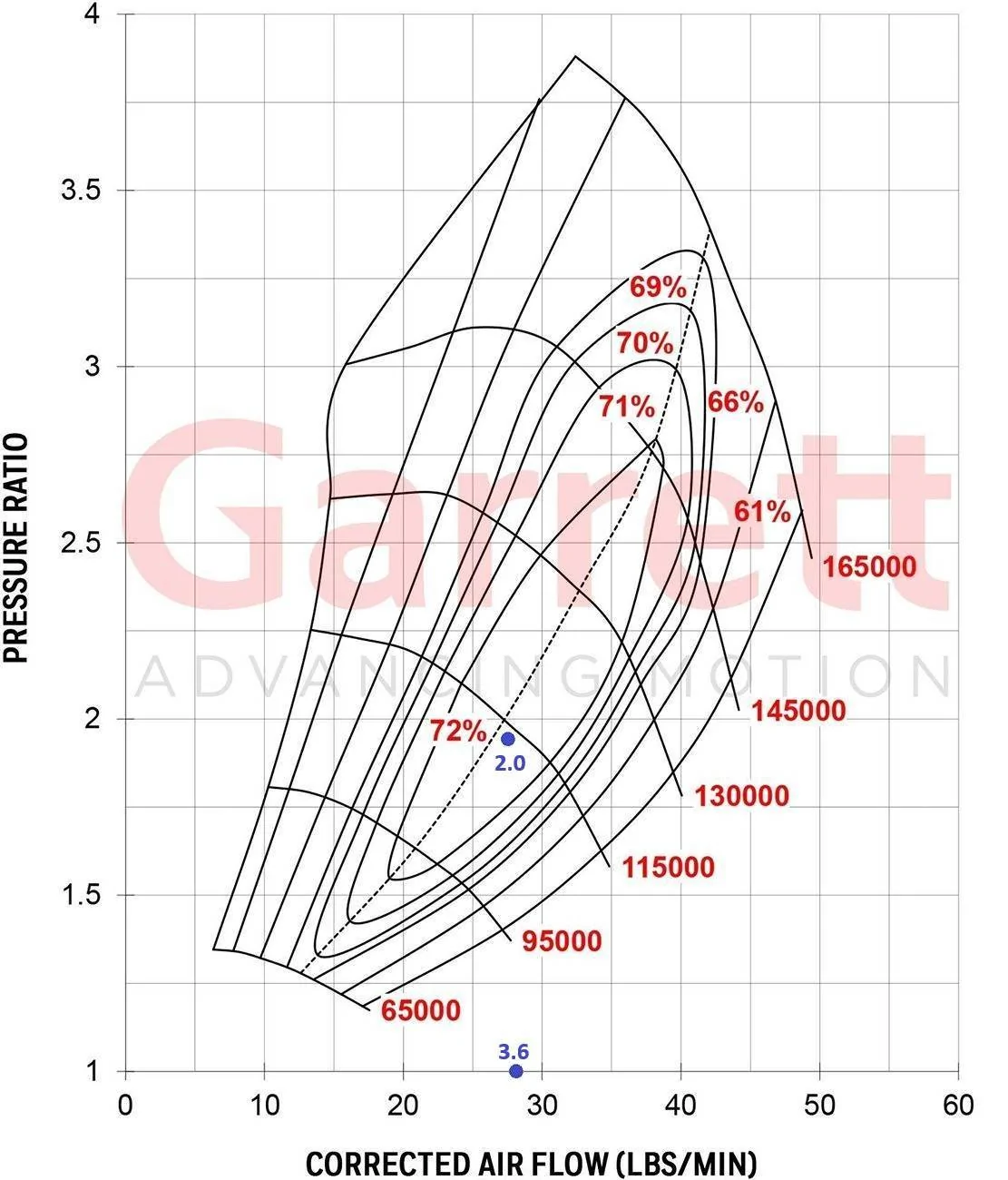
Assuming a few things: correct compressor map for the 2.0 (Garrett GTD1449VKZ?), max boost is 28ish PSI, 10 HP per lbs/min. Note the 2.0 & 3.6 shown in blue are approximate.

Jeep Wrangler JL 2.0 Torque Curves 1633456365688-png-jpg
 
OP
OP
AnnDee4444

AnnDee4444

Well-Known Member
Joined
Jan 14, 2019
Threads
54
Messages
5,529
Reaction score
7,948
Location
‎
Vehicle(s)
'18 JLR 2.0
Assuming a few things: correct compressor map for the 2.0 (Garrett GTD1449VKZ?)
I got this off of the Gulia forum, and recently found in this video that the Jeep actually has a larger turbo than the Gulia. This means the chart above is probably incorrect.

@7:27 in video below


dstevens

Well-Known Member
Joined
Apr 13, 2023
Threads
8
Messages
946
Reaction score
1,602
Location
CA
Vehicle(s)
2024 JLURX
Bumping my own old thread because I want to keep track of this for future.

Assuming a few things: correct compressor map for the 2.0 (Garrett GTD1449VKZ?), max boost is 28ish PSI, 10 HP per lbs/min. Note the 2.0 & 3.6 shown in blue are approximate.

1633456365688-png-jpg.webp
The dot on your compressor map is for a PR of 1.95 perhaps which would be around 14 psi gauge boost - did you use gauge rather than absolute boost?

I think with 22-23 lbs boost (255 kPa absolute) the PR would be in the 2.7-2.8 ball park. There's usually far more pressure loss on the suction side than people realize - about 0.1 bar drop to the compressor. There's also around 0.1 bar drop across the intercooler too but it's on the high side of the equation.

And I'd use 9 hp/lb/min so the dot would be at the end of the first r of garret.
Sponsored


Top