
Sponsored

Weight Distribution Hitch contraption basics

Yellow Cake Kid

Well-Known Member
Joined
Nov 20, 2019
Threads
107
Messages
980
Reaction score
617
Location
USA
Vehicle(s)
Jeep
Hi,
A few weeks ago a friend asked me how Trailer Weight Distribution Hitches work. I realized that I could explain the benefits, but I could not, in good conscience, explain how they actually work because the only explanations I have ever seen of how they work do not explain how they actually work.

I would like see a reasoned discussion about the recently popularized Weight Distribution Hitch contraptions.

I believe they offer benefits that can easily be appreciated.

However, I have yet to see an explanation of how they work that elevates the discussion above vapid sales speak.

For example:

from: Blue Ox ( note: all the spelling mistakes in the Blue Ox blog post are reproduced here for the sake of transparency )

Blue Ox said:
To answer the question, “how does a weight distribution hitch work” it should be said that a weight distribution hitch works, in a sense, by distributing the weight more evenly to the tow vehicle.
Kinda, Sorta. What it really does is lower the tongue weight's downward force acting on the vehicle by keeping more of the trailer's weight resting upon the trailer's axle(s).

It is just a corollary that the reduced tongue weight results in the vehicle experiencing less downward force on the rear of its suspension. It does not distribute the weight "more evenly" on the vehicles; it just applies less weight.


Blue Ox said:
So what does that mean exactly? A weight distribution hitch alters the point where the load from the trailer is transferred to the vehicle.
Yes. Why doesn't somebody explain where the new point is? This should be easy for manufacturers to describe and customers to understand.

Blue Ox said:
Rather than the weight being centered on the point where the trailer and vehicle connect, the weight distribution hitch distributes the weight across the axels of the vehicle and trailer.
Again, The Weight Distribution Hitch can be said to distribute more weight to the trailer's axle(s). Still, it is not directly involved in distributing weight on the vehicle suspension system.

While the decrease in tongue weight may restore the vehicle towards its unweighted balance of front and rear axle weight, any and all tongue weight is distributed across the front and rear axle, so any benefit that the Weight Distribution Hitch provides is only an indirect consequence of lowering the tongue weight.


Blue Ox said:
Having too much tongue weight based on the gross trailer weight can the trailer hitch and the tow vehicle’s rear axels to dive. This can be visibly seen as the front of the trailer goes toward the ground and the front of the tow vehicle raises up. If this is too extreme, your vehicle can lose the ability to get traction and brake properly, which is very dangerous.
This is easy to agree with.

If a trailer is of such poor design that its tongue weight is an unusually large percentage of its gross trailer weight, it's a bad trailer implementation.

The tongue weight your suspension can handle without egregiously shifting fore-aft weight distribution is a good indicator of the suitable gross trailer weight the vehicle can safely handle.

The Jeep charts and many tow hitch charts show that a tongue weight of 10% of GWT is a safe compromise.

The primary reason to use a Weight Distribution Hitch is to relieve the downward force on the tongue. This solution may seem desirable when the trailer's gross weight is too heavy for the towing vehicle to control effectively, but it may be a disaster waiting to happen. The Weight Distribution Hitch may also seem desirable when a trailer weighing less than the maximum GWT has been loaded improperly. That might make everything work OK until it does not.

In my mind, the sales speak that I observe when reviewing the offerings of Weight Distribution Hitches, as made by vendors and proponents, seems a bit like a shell game in which the core of the subject is sidestepped and avoided to maximize enthusiasm for a solution that should not have a problem.

I want to re-emphasize that these devices do provide benefits, but I also feel that the explanations of when and why are unsatisfactory, inaccurate, or lacking in detail.

Would anyone like to share their thoughts?

Is anyone here familiar with an accurate explanation showing how the forces and vectors are altered when Weight Distribution Hitches are deployed?

Thank you!
Sponsored

 
Last edited:
LukeDagny

Well-Known Member
Joined
Apr 20, 2024
Threads
14
Messages
466
Reaction score
446
Location
Central PA
Vehicle(s)
2021 JLUR
I thought this video explained it very well. When I was towing a 10,000# travel trailer, I could tell immediately if my weight distributing hitch was not set up corretly.

 
OP
OP
Yellow Cake Kid

Yellow Cake Kid

Well-Known Member
Joined
Nov 20, 2019
Threads
107
Messages
980
Reaction score
617
Location
USA
Vehicle(s)
Jeep
Hi @LukeDagny
Thank you for the link. I watched the video three times.

I can clearly see how the use case shown in that video would benefit from the weight distribution hitch.

After all, the fellow is driving a 5000 pound car onto a 3400 pound trailer which he plans to tow with a truck tow package rated at a maximum of 9300 pounds.

He also points out that he knows he is loading the trailer's suspension improperly as he places the heaviest part of the Jeep Cherokee as far forward as the chock blocks allow.

The maximum tongue weight for that Titan XD is 930 pounds. So, in addition to attempting to pull a trailer that weighs 90% of the vehicle's maximum rating, he overloads the tongue weight by a good margin.

It does seem clear that a load distribution hitch would be helpful in this situation.


That said, after reviewing his explanation of the physics three times, I am fairly confident that this fellow appears to have no idea what he is talking about regarding the physics behind the system.

He says, "The basic physics of what is going on here are actually pretty simple when you think about it." Then he makes it seem simple by repeating much of the nonsensical sales speak I was referring to in the original post.

The one thing he said that seemed sensible was the idea that a Truck or SUV rated with a substantial towing capacity but equipped with a suspension tailored for comfortable road manners is unlikely to feel comfortable when you try to utilize the maximum towing capacity.

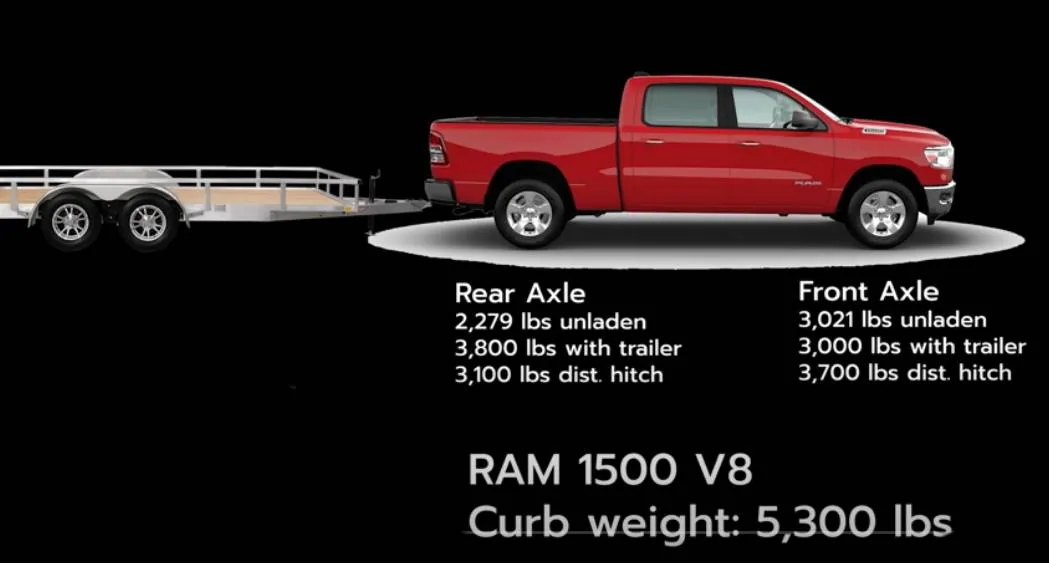
In this video, which @Jeep Wick linked to in another thread, the demonstrators use scales to document where the weight is redistributed when a weight distribution hitch is attached. The facts shown in this video contradict many of the assertions made by the Alex on Autos influencer.


In Particular, Alex claims that "a weight distribution hitch doesn't do anything to the trailer itself; it's all about the tow vehicle and the hitch" and provides this infographic, a collage of copy-pasted web brochure photographs that does not make any reference to actual measurements. I find it thought-provoking that the figures he cites do not represent the redistribution trends evidenced by the other demonstrators who used scales to document the weight changes. Did he make these numbers up?


Make believe?:

Jeep Wrangler JL Weight Distribution Hitch contraption basics Alex-on-Autos-infographic


Real life:

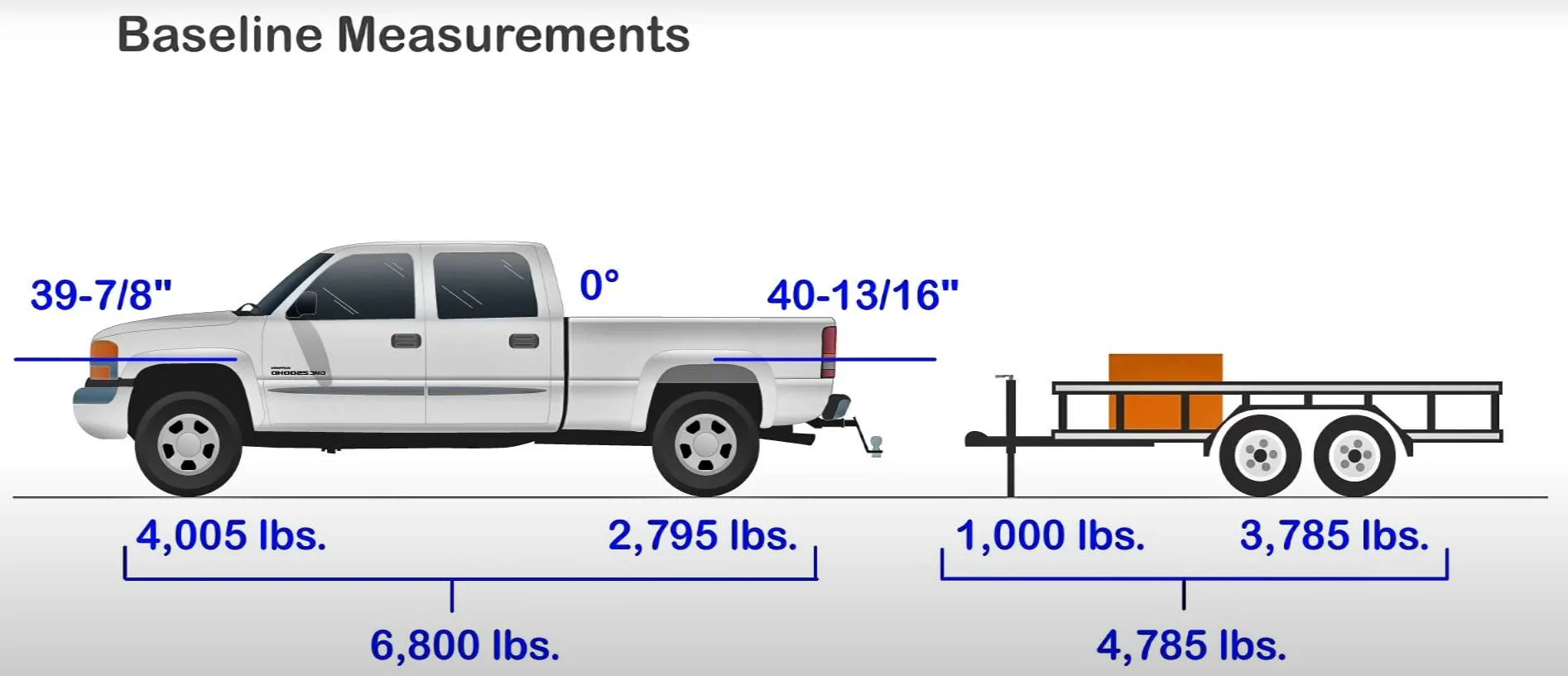
Jeep Wrangler JL Weight Distribution Hitch contraption basics Weight-Distribution-Hitch-02-basis


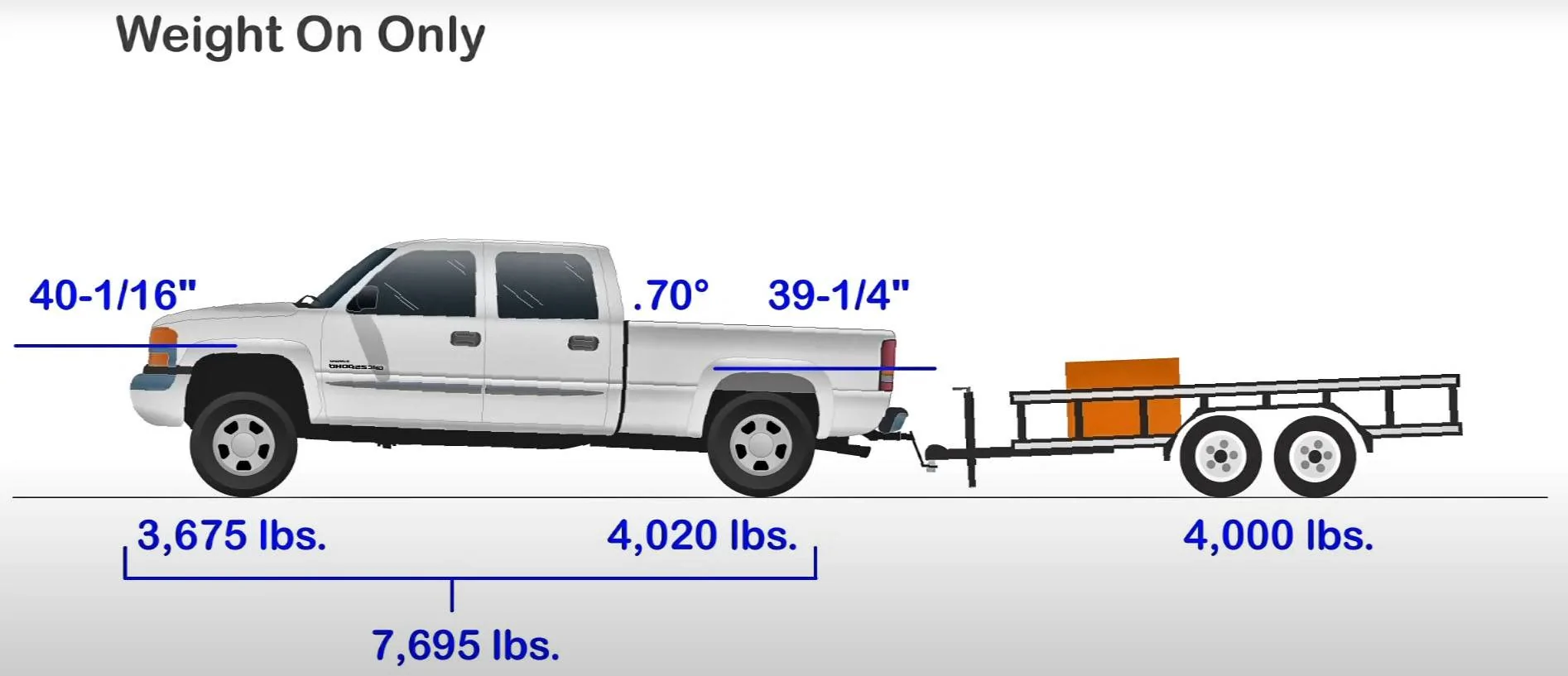
Jeep Wrangler JL Weight Distribution Hitch contraption basics Weight-Distribution-Hitch-02-regular-hitch


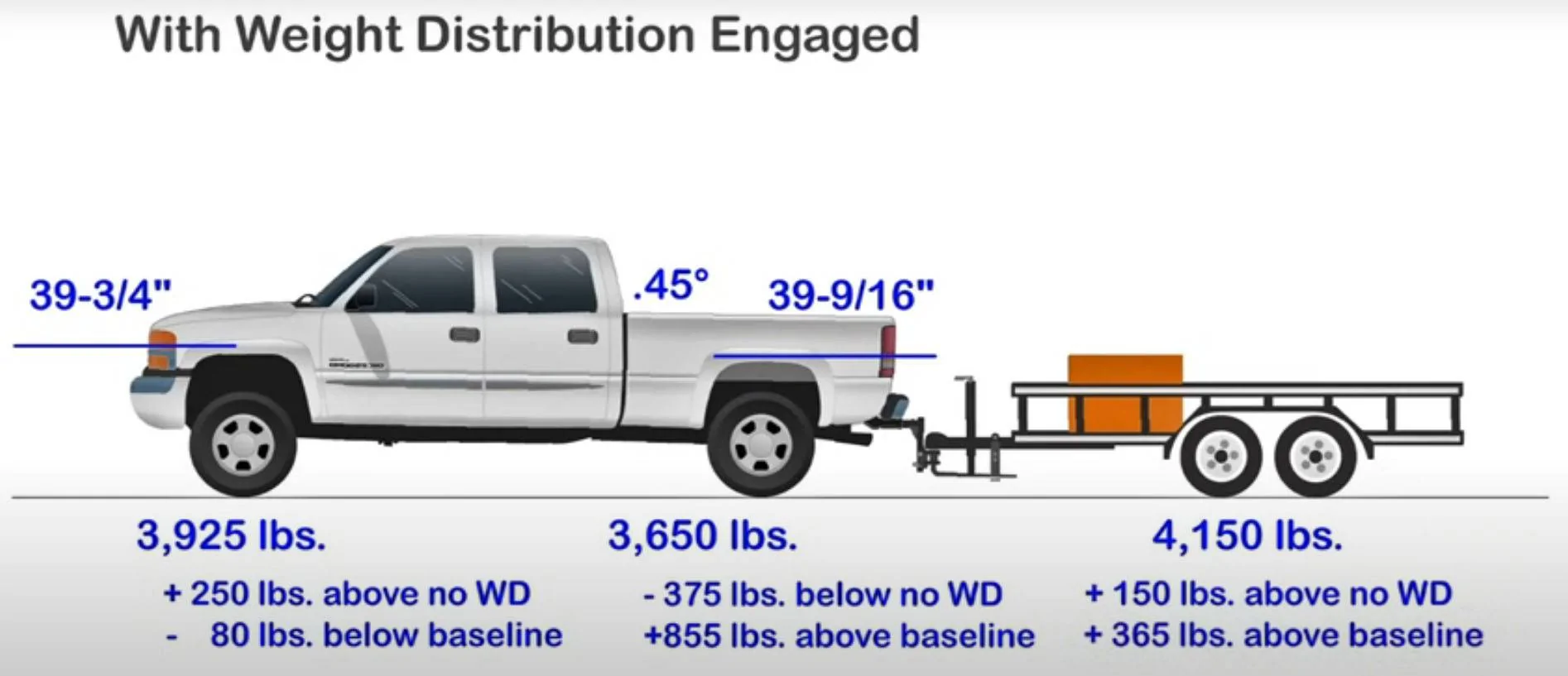
Jeep Wrangler JL Weight Distribution Hitch contraption basics Weight-Distribution-Hitch-02-WD-engaged


The details here show that the Weight Distribution Hitch distributes some of the tongue weight back to the trailer's axle(s), lowers the trailer's weight on the tow vehicle's rear axle, and lessens the lessened weight on the tow vehicle's front axle. The statistics gathered from actual testing tell a very different story than the one made up by the Alex on Autos influencer.


I would like to find a force vector analysis of what happens when the weight distribution hitch is attached.


for reference:

Nissan Titan XD owners manual see section 10-36 for Tow/Load specifications.

Nissan Towing Guide

.
 

LukeDagny

Well-Known Member
Joined
Apr 20, 2024
Threads
14
Messages
466
Reaction score
446
Location
Central PA
Vehicle(s)
2021 JLUR
I would like to find a force vector analysis of what happens when the weight distribution hitch is attached.
Good luck with that search. I know from experience, that when my front fender height increases by more than 3/4", the steering feels light. I adjust my hitch so the front fender height remains the same or 1/2" taller.
 

AnnDee4444

Well-Known Member
Joined
Jan 14, 2019
Threads
54
Messages
5,529
Reaction score
7,948
Location
‎
Vehicle(s)
'18 JLR 2.0
I don't have any experience with weight distributing hitches, but I've never encountered a situation where I couldn't adjust the load to get the desired tongue weight. I can see how these could be of benefit for poorly distributed load, but I would prefer proper weight distribution first rather than relying on proper setup & function.


Sponsored

OP
OP
Yellow Cake Kid

Yellow Cake Kid

Well-Known Member
Joined
Nov 20, 2019
Threads
107
Messages
980
Reaction score
617
Location
USA
Vehicle(s)
Jeep
Hi @AnnDee4444
Thank you for posting the link to that video it was very helpful and covered a lot of details.

It was especially helpful in explaining why people may say that weight is transferred to the front wheel. I viewed the circumstance as a net effect of less weight being removed from the front wheel. With the torque analysis in mind, I can adopt the perspective that the front axle weight is the result of the upward force at the ball hitch rather than simply attributing it to reduced tongue weight.

The explanation did seem to gloss over how the lever arms' spring action applies the torque represented by the coefficient "M," but I think I get the point.

I hoped the presenter made the follow-up video he suggested would be produced, but this video was a one-off.

At some point, I realized that hanging a big weight off a bowsprit attached to the front bumper would have the same overall effect, with the possible benefit of relieving the stress being placed on the trailer tongue's frame by the spring connections. Fingers crossed; I hope that doesn't become the next new "idea."

Thank you.

:)
 

USNvet

Well-Known Member
First Name
Bob
Joined
Mar 28, 2023
Threads
4
Messages
319
Reaction score
424
Location
SoCal
Vehicle(s)
2024 Rubicon X 4Xe, 73 Power Wagon, 2011 Sprinter
Occupation
Retired Re-Engineer (tool & die maker)
Yep, simple explanation is leverage! Think of your belt as your rear axle and ball hitch, and your finger as your front axle:
 

driventoadventure

Well-Known Member
First Name
Lrr
Joined
Aug 23, 2021
Threads
30
Messages
955
Reaction score
1,555
Location
Northern Front-Range, Colorado
Vehicle(s)
21 JLURD
Build Thread
Link
Occupation
Employed Gainfully
Clubs
 
One thing to realize is that part of the torque action which acts to redistribute the weight, is that it's adding torque/torsion to the hitch point. Think of it twisting the hitch downward (as in pushing the front of the vehicle down, the rear of the vehicle up, and the trailer axles down) where the leverage point is at the ball of the hitch.

This is how it creates torque and distributes the weight. This is also why many hitches actually aren't WD hitch capable. If the attachment point can't handle a torsional torque, then it shouldn't be used for a WD hitch.
 

driventoadventure

Well-Known Member
First Name
Lrr
Joined
Aug 23, 2021
Threads
30
Messages
955
Reaction score
1,555
Location
Northern Front-Range, Colorado
Vehicle(s)
21 JLURD
Build Thread
Link
Occupation
Employed Gainfully
Clubs
 
At some point, I realized that hanging a big weight off a bowsprit attached to the front bumper would have the same overall effect, with the possible benefit of relieving the stress being placed on the trailer tongue's frame by the spring connections. Fingers crossed; I hope that doesn't become the next new "idea."
Actually, this wouldn't provide much of the same benefit as a WD hitch. What this would do is add more total weight to the tow vehicle and shift the center of mass forward, depending on how far out the weight is attached, but wouldn't result of a transfer any of the weight from the rear of the vehicle. The WD hitch does this by (from an elementary perspective) rotating the shank of the hitch downward relative to the ball to apply torque. This generates torsion which acts to shifft the load applied to the hitch both forward and back, similar to how a leaf spring works. It's at it's most reductive level essentially a mechanical leaf spring.
 

JZK

Active Member
First Name
Jeff
Joined
Dec 13, 2021
Threads
3
Messages
37
Reaction score
87
Location
Nebraska Panhandle
Vehicle(s)
22 Rubicon 4xe
Question: I tow my Wrangler behind my RV. The hitch weight in this case is very low (pretty much the weight of the tow bar only). In this case, a weight distribution hitch is not needed. Correct? Weight distribution is needed when there is a lot of weight on the hitch.
 

Sponsored

OP
OP
Yellow Cake Kid

Yellow Cake Kid

Well-Known Member
Joined
Nov 20, 2019
Threads
107
Messages
980
Reaction score
617
Location
USA
Vehicle(s)
Jeep
Goodness, I was looking around for more info about the localized forces acting between the spring attachments and the ball hitch when I stumbled into a wormhole of YouTube videos featuring bent and broken A-frame tubes attributed to the use of Weight Distribution Hitches.

Viewing the numerous instances of damage gave me some insight into how the forces interact.

I had not anticipated learning about this, but now that I have, I feel like my farm boy logic can make sense of what is happening.

Strange days.
 
OP
OP
Yellow Cake Kid

Yellow Cake Kid

Well-Known Member
Joined
Nov 20, 2019
Threads
107
Messages
980
Reaction score
617
Location
USA
Vehicle(s)
Jeep
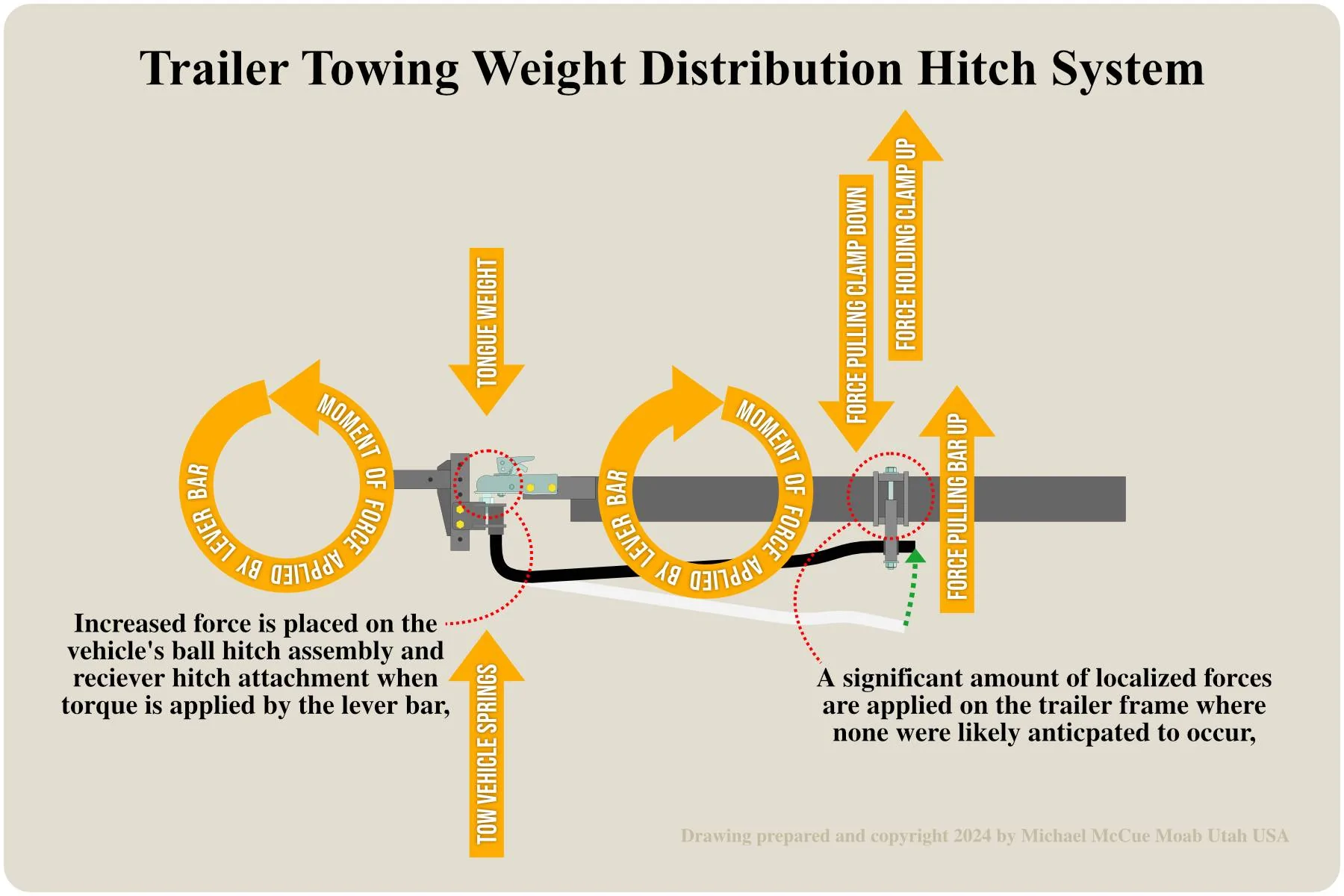
I made an illustration to help me figure out what is happening at the hitch attachments.

Comments and or especially suggestions for corrections will be welcomed and appreciated.

Jeep Wrangler JL Weight Distribution Hitch contraption basics Traile-Hitch-Details-01A
 
Last edited:

wuzwiz

Member
First Name
John
Joined
Nov 6, 2023
Threads
1
Messages
23
Reaction score
15
Location
NE Georgia
Vehicle(s)
2023 JL 2 Door
I too would like to see a force/vector diagram to explain what's really happening. My physics/statics courses were WAAAY too long ago to do this one
 
OP
OP
Yellow Cake Kid

Yellow Cake Kid

Well-Known Member
Joined
Nov 20, 2019
Threads
107
Messages
980
Reaction score
617
Location
USA
Vehicle(s)
Jeep
Hi @wuzwiz

The video @AnnDee4444, linked to in a post above, covered most of the subject.

The presenter had intended to post a follow-up to study the hitch connections.

After making the illustration I just posted, I can appreciate why the subject can seem too complicated to describe in an infotainment format.

I can also understand why the industry's salesforce and would-be influencers avoid describing the details, as the ramifications realized by a thorough analysis are not necessarily positive attributes.
 

wuzwiz

Member
First Name
John
Joined
Nov 6, 2023
Threads
1
Messages
23
Reaction score
15
Location
NE Georgia
Vehicle(s)
2023 JL 2 Door
Hmmm, "not positive attributes"...
FM perhaps?
Sponsored


Top