Sponsored

OEM Battery Replacement

OldGuyNewJeep

Well-Known Member
First Name
Don
Joined
Sep 21, 2017
Threads
93
Messages
3,993
Reaction score
7,108
Location
CT
Vehicle(s)
2018 Wrangler JL, 2016 Yukon XL
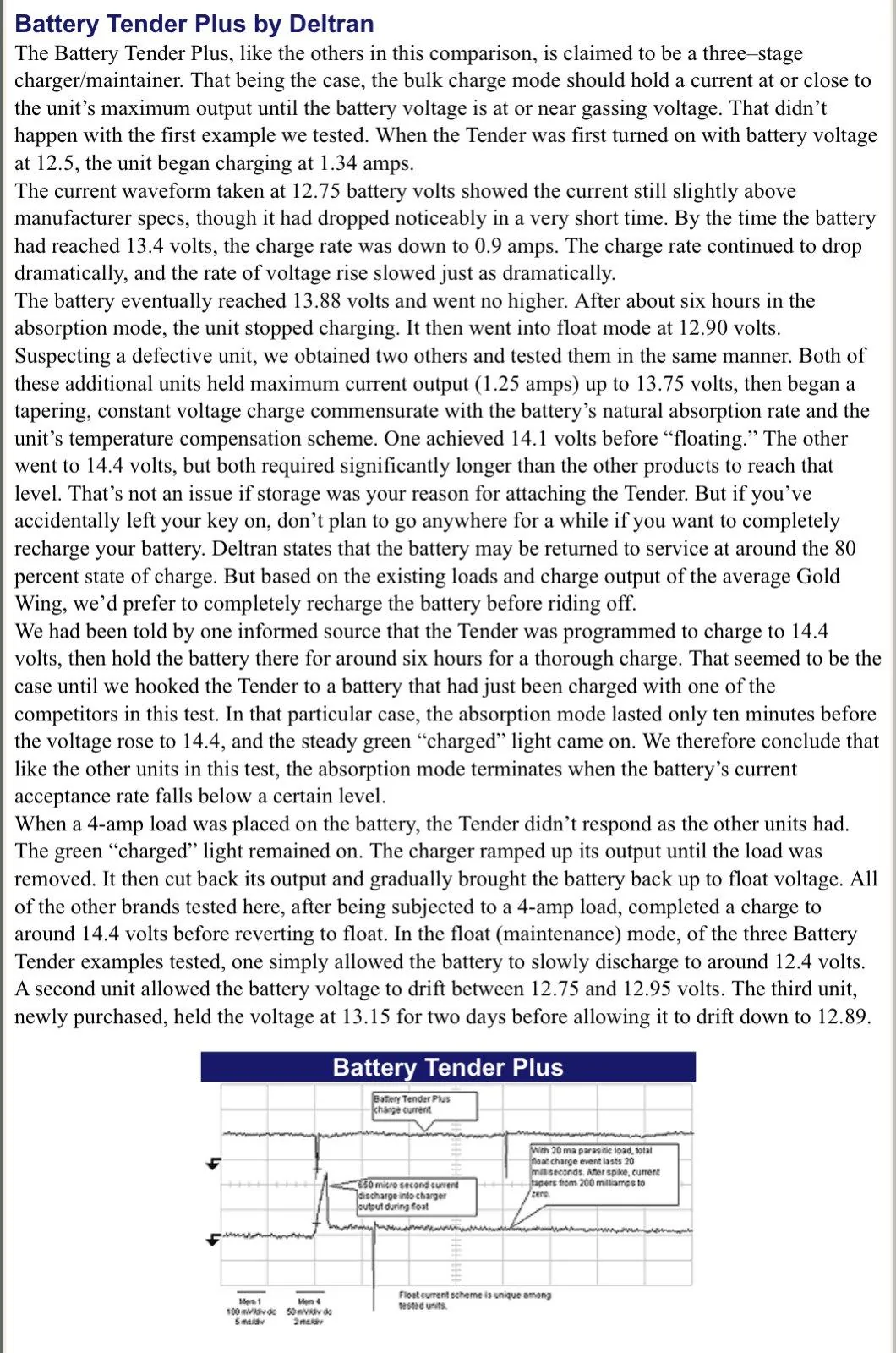
I think the biggest issues with these AGM batteries is they need to be charged in the 14.4-14.6 voltage range and I don’t believe the smaller tenders can do that, they are fine I think if connected to a fully charged system to keep the batteries topped off from the parasitic draw but I don’t think tenders like Deltran can do the job adequately if the batteries are low.
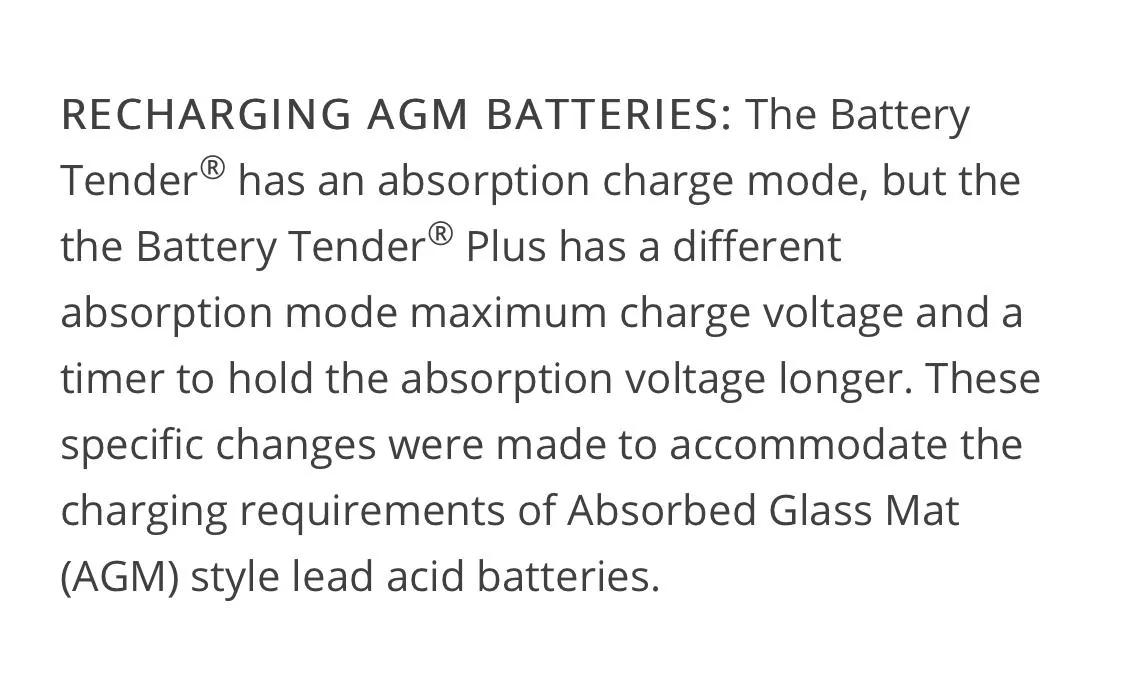
Deltran Battery Tender Plus specifically supports AGM: https://www.batterytender.com/faq

Jeep Wrangler JL OEM Battery Replacement 73E00088-4555-428C-A6D6-0AF20B2CA2AE
Sponsored


WranglerMan

Well-Known Member
First Name
Will
Joined
May 8, 2018
Threads
104
Messages
3,560
Reaction score
2,885
Location
Greenfield Indiana
Vehicle(s)
2018 Wrangler JLU Sahara
Occupation
Retired
Vehicle Showcase
1
Deltran Battery Tender Plus specifically supports AGM: https://www.batterytender.com/faq

73E00088-4555-428C-A6D6-0AF20B2CA2AE.webp
I have found out thru informal testing that the Deltran plus that I was using originally on my JL’s stock setup seemed to work but after chatting with them, Shane and Mike at Genesis, NOCO and Odyssey they all advised that the 128ah that my Full River batteries need to be charged at that the 1.25ah tender would be lacking due to the small ah output, they advised it would be fine for say using daily to keep the batteries topped off but to actually charge them from say a 40% DOD back to 100% would take possibly several days.

Full River recommends .20-.35% as their sweet spot so for me that would be a 25ah charger and the Odyssey I have is 20 amps and it holds the 14.6 volts for several hours during optimization, the NOCO ramps up to the same but then seems to come down based on temperature, I have considered charting the charging process with a Bluetooth monitor but after speaking to Full River on multiple occasions and telling them what I was using in regard to the Deltran they kinda chuckled and advised me to put that on my lawnmower

Batteries are a consumable item and the best we can hope for is maybe 3-5 years before being replaced but I will do my best by utilizing my NOCO for a overnight top off and use the Odyssey when it’s parked for days.

I used my Deltran for several years and will continue to use it on my wife's car but with the high amp hours of my current setup I will take the advice of those who made the batteries and built my dual system as these batteries were not inexpensive and I want to get the most I can from them.

Like i said I used the Deltran for several years without issue but the stock setup requires the voltage output from a charger to be a max of 14.4 I believe and the Deltran was like 14.2 but when I connected it to my new setup it was like 13.8-14.2 and I believe the reduction is due to charging two full size batteries with a load in the middle coming from the relay, the Full River ones require 14.6 and they need to see that 14.6 for several hours and the Odyssey does this, the NOCO comes in at 14.2-14.3 but does ramp up to 14.6 but does not stay there long and that may have to with the temperature compensation so in the end I gave all the info to Full River and the Deltran did not make their to use list for proper care and since these are warranted for 5 years I want to ensure if they crap out it’s not because I used the wrong charger/maintainer and am denied any warranty compensation.
 
Last edited:

txj2go

Well-Known Member
Joined
Apr 7, 2020
Threads
44
Messages
1,518
Reaction score
1,579
Location
DFW
Vehicle(s)
CTS-V, 2018 JLU Sport Firecracker Red
Over the years I've bought a lot of different brands of batteries for different applications and I've learned that buying a new battery is kinda like taking home a girl at 2 am, you never no whats going to happen the next day....lol. I've had good and bad Interstates, optima's, and oem's. Crazy but true my best luck lately has been the cheaper line batteries from O'reillys or even wally world, explain that!
I bought a lot of DieHard batteries through about 1996, and had trouble with them. By chance I bought an Interestate in 1996 and had good luck with it so I've stayed with that brand and have not had any problems with them.

In my experience with my family's vehicles since 1996- a car that is driven daily, in a hot climate, with the battery under the hood, will require a new battery every 36 months. Put the battery under the floorboard like in my daughter's Grand Cherokee, away from the heat under the hood, and it might last closer to 60 months.

On a 2020 JL, is there a benefit and/or need to bypass the ess battery?
I've been planning to visit places far off the beaten path, by myself, and I was intending to carry a small jump-starter for safety. My understanding is they don't with if you have both batteries, running a single battery might be safer.

Don't do this on a 2018 3.6L without the PCM update flash TSB 18-092-19.
Long story..it's part of the fix by the factory that you referred to in your post.
I bought a 2018 this year, have no idea if it has been flashed or not. I would like to find an easy solution to fix my vehicle. And BTW my ESS has not functioned sinde I bought it, saves me pushing the button.
 

Gee-pah

Banned
Banned
Banned
First Name
Andy
Joined
Nov 19, 2019
Threads
59
Messages
1,657
Reaction score
1,283
Location
SanFrancisco
Vehicle(s)
JL Wrangler
I bought a 2018 this year, have no idea if it has been flashed or not. I would like to find an easy solution to fix my vehicle. And BTW my ESS has not functioned sinde I bought it, saves me pushing the button.
Hi @txj2go. There is a method to my madness in reversing the order of your questions in that answering your 2nd one first yields knowledge useful in addressing your first. This is long, but it is comprehensive. Complainers need not read, or suggest what aspect of this was irrelevant and wordy (none.)

There is a harmless way to find out if your vehicle has been flashed, aside from asking the dealer. Provided it is a 3.6L:

1) Locate the negative battery terminal on the main battery.
2) Remove from it the cable NEARER to the passenger's side front quarter panel temporarily (it's a metric 10 bolt I believe.) That's the ESS/Aux battery's cable coming from its negative terminal. Leave the other terminal connected: that's the cable that leads to the body ground. You've just temporarily taken the ESS/Aux battery out of service.
3) Go into your vehicle and attempt to crank. I guarantee you that you'll fail. It's what happens next that will answer your question.
4) A second later attempt the crank again. If the engine starts and an ESS disabled light is displayed in the dash, you have this flash. If the engine continues to not be able to crank you do not have this flash.
5) Turn off the engine if you got it to crank. Reconnect that cable I had you disconnect. Crank your engine. It should start and if you have the flash, turn OFF that ESS disabled light (because it now detects a working ESS battery.) If you don't have the flash the ESS disable light, which never went on, will continue to not light up and the vehicle should successfully crank.

I've been planning to visit places far off the beaten path, by myself, and I was intending to carry a small jump-starter for safety. My understanding is they don't with if you have both batteries, running a single battery might be safer.
Okay, here's the skinny: In pretty much all jump start events, keeping energized cables on the dead battery's positive, and some ground location is advised to not only give the cranked donor vehicle's alternator some time to load up with current the donor battery, but to put a basic level of current in the dead battery.

That is true of the 3.6L as well, but its more complicated. You see, in the 3.6L 2018 JL, if the ESS/Aux battery fails to hold a basic charge, even if the main battery is in perfect condition, the vehicle will not crank.

This is because the unflashed 2018 3.6L JL isolates the ESS/Aux battery for an instant at cold crank to test it for current. And if that ESS/Aux battery lacks a sufficient amount of current, the vehicle will not attempt a crank.

Never mind that when the crank is cleared by the vehicle to occur both batteries energize it. The point is that with an ESS/Aux battery that fails this test, no attempt to crank the vehicle is even made.

The same exact thing happens on flashed 3.6L 2018 JLs and model year 2019 and greater ones, BUT upon attempting the second and subsequent cranks the vehicle will take the ESS/Aux battery out of the electrical loop and attempt to crank with the main battery alone. (In fact that's the test you tried above.)

One more fact and we'll be armed with enough information to answer your power pack question, I promise. At all times but ESS events and this instant just before a crank, the two batteries are connected in parallel, including when the engine is off.

So, the procedure for jump starting a JL has you wait with energized cables on the main battery's positive terminal and a ground. The manual would lead you to believe that this is to give the donor vehicle time to charge its battery a bit, and it is, but it's not the complete picture. FCA is being deceiving IMHO.

What's also happening during this waiting period is that the ESS/Aux battery is being charged as well (as the two batteries are connected in parallel.) You are putting basic charge into the ESS/Aux battery to pass the pre-crank test by putting your cables on the main battery connected parallel to the ESS/Aux battery, and charging the main battery as well---which may or may not be necessary.

The whole thing is stupid---which is why FCA made the flash and change in start logic in all 3.6L JL model years after the introduction. In your case you're taking a power pack, with limited power, and engineering designed around delivering lots of charge quickly, and sitting with it on two batteries, reducing its crank capacity, for the sole purposes of charging the ESS/Aux battery parallel connected to the main one--charging not the power pack's forte-- so it passes the pre-crank test.

(Why it was designed this way---a story for another post.)


What's an off roader who wants to know his power pack has a better chance of working to do?

Answer, if you own a vehicle with the flash, or are willing to get it, permanently disconnect the cable I discuss above. Wrap its end in electric tape. Crank the vehicle twice (it will fail the first time) and for ever more it will run with one battery just like the test above to see if you have the flash.

ESS will be disabled automatically and it should be when running with one battery. We don't want ESS events robbing that one battery of cranking power. That's also discussed here https://www.jlwranglerforums.com/forum/threads/oem-battery-replacement.55792/post-1310218

If you don't have a flashed 2018 3.6L JL, and don't want to pay for it, in addition to the above follow the advice here: https://www.jlwranglerforums.com/forum/threads/oem-battery-replacement.55792/post-1310358 where you trick the vehicle to tapping the main battery only, every time it attempts to reach out to the ESS/Aux battery, which is taken out of the picture (This step is not wrong if you have a flashed 2018 3.6L JL or later model year) through the introduction of a specially hooked up cable.

With this second method I want you to make sure that you don't run ESS (the vehicle won't disable it because it thinks it sees a working ESS/Aux battery)--which by the way, even though your vehicle hasn't engaged ESS up until now (probably because your ESS/Aux battery doesn't hold enough current) it might try to engage ESS under this new wiring because the vehicle thinks your ESS/Aux battery is what is now the main battery. ESS should not run with one battery as discussed.

So make sure to turn it off each time you crank, or use one of the hacks to disable ESS, or acquire tech to do so, all discussed in the second link.
 

txj2go

Well-Known Member
Joined
Apr 7, 2020
Threads
44
Messages
1,518
Reaction score
1,579
Location
DFW
Vehicle(s)
CTS-V, 2018 JLU Sport Firecracker Red
If you don't have a flashed 2018 3.6L JL, and don't want to pay for it, in addition to the above follow the advice here: https://www.jlwranglerforums.com/forum/threads/oem-battery-replacement.55792/post-1310358 where you trick the vehicle to tapping the main battery only, every time it attempts to reach out to the ESS/Aux battery, which is taken out of the picture ... through the introduction of a specially hooked up cable.

With this second method I want you to make sure that you don't run ESS... ESS should not run with one battery as discussed.
OK I understood up to the last point- why would you not run ESS with only one battery? Is it a matter of needing more cabling between the main battery and the connections for the little battery?
 

Sponsored

Gee-pah

Banned
Banned
Banned
First Name
Andy
Joined
Nov 19, 2019
Threads
59
Messages
1,657
Reaction score
1,283
Location
SanFrancisco
Vehicle(s)
JL Wrangler
OK I understood up to the last point- why would you not run ESS with only one battery? Is it a matter of needing more cabling between the main battery and the connections for the little battery?
Hi @txj2go.

It's a fair question on your part; after all many vehicles implement ESS systems with one battery.

ESS systems generally won't engage if the battery that energizes the event lacks adequate power...the 3.6L JL as well. Additionally, that battery supplying power during an ESS event is continually monitored for its voltage, and the vehicle will end the ESS event prematurely (i.e. before the driver takes their foot off the brake) if that voltage drops below a threshold, so as to preserve enough power in the battery to energize the engine crank, and get the alternator back in the business of charging that battery back up. This ESS event monitoring of battery voltage is as well part of the 3.6L JL design.

Here's the rub: It is *possible* that the threshold for ESS to end prematurely is a lower voltage in the 3.6L JL than in 1 battery ESS vehicles.

I've never tested it, but FCA may have been more aggressive about keeping an ESS event going in the 3.6L JL than in vehicles with 1 battery designs because at the termination of the ESS event in the 3.6L JL (whether prematurely or when the operator takes their foot off the brake) that ESS/Aux battery is joined in parallel with the main battery, (and that main battery has been preserved during the ESS event) to crank the engine.

FCA may allow the voltage to drop more in this 2 battery design than in vehicles with 1 battery--i.e. it may be more aggressive about allowing the ESS event to continue--because it has the "luxury" in its design to bring a 2nd untapped and larger (main) battery into the engine crank event, connected in parallel (which keeps voltage roughly constant but increases amps, as do all parallel battery connections) to bear most of the burden of effecting the engine crank.

All this said, the wiring needed if you don't have the flash, as discussed prior, "tricks" the vehicle into thinking that its communication with, and power tapping of the main battery is actually the ESS/Aux battery.

Come time for the vehicle to enter an ESS event and the computer will first check that all reasons to not engage ESS fail to exist (e.g. the steering wheel isn't turned, the engine is warm, the vehicle is not on a hill, etc.). If this test is passed the next test checks the voltage of the ESS/Aux battery to see if its adequate to start an ESS event.

For you, up to now, it sounds like your ESS/Aux battery hasn't passed that test. But with the wiring change discussed prior, the vehicle's test of the ESS/Aux battery is really a test of the main battery: a bigger more powerful battery. And that test may pass and engage ESS.

So ESS is running against with the main battery energizing it and the vehicle's computer is saying, "man, I could practically run this ESS event until the end of time with all this power," potentially running the event longer than it should, robbing the main/only battery of adequate power to energize the engine crank.

We turn off ESS in one battery implementations of the 3.6L JL for fear that the two battery design logic is too aggressive in possibly lower threshold voltages to continue the ESS event, under the false belief that system has with your wiring change, that a second untaxed battery exists to effect the crank, when in reality it doesn't.

I hope this helps.
 

txj2go

Well-Known Member
Joined
Apr 7, 2020
Threads
44
Messages
1,518
Reaction score
1,579
Location
DFW
Vehicle(s)
CTS-V, 2018 JLU Sport Firecracker Red
We turn off ESS in one battery implementations of the 3.6L JL for fear that the two battery design logic is too aggressive in possibly lower threshold voltages to continue the ESS event
Would this matter at normal stoplights where the alternator is not turning for maximum of about 2 minutes? I can understand if you stop on the side of the road to talk to the neighbor for 30 minutes it might be a different story.
 

Gee-pah

Banned
Banned
Banned
First Name
Andy
Joined
Nov 19, 2019
Threads
59
Messages
1,657
Reaction score
1,283
Location
SanFrancisco
Vehicle(s)
JL Wrangler
Would this matter at normal stoplights where the alternator is not turning for maximum of about 2 minutes? I can understand if you stop on the side of the road to talk to the neighbor for 30 minutes it might be a different story.
It would depend upon the charge the battery achieved before the ESS event I imagine, along with how many other appliances were running during the ESS event, luck, etc.

Take for example running the air conditioning on all but a slow speed. In my 3.6L, which is connected to a trickle charger when at rest, (so the batteries are topped off) the ESS event may not last more than 5 seconds before it is prematurely ended.

I'd hate to see it last longer than it should to the point where the vehicle became stranded at a stop light, unable to crank. I feel that guidance on the forum should always error on the side of caution/safety, or at least disclose the risks.

Truth is: I don't know how aggressive the 3.6L JL is in ending an ESS event. I suppose one could watch the voltage meter in the dash while say, running the air conditioning, foot braked in the middle of some parking lot and see how far the vehicle lets the voltage drop down before ending the ESS event.

Finally, I wrote prior that on the 3.6L JL with the revised engine crank methodology that if the vehicle switches to the main battery to crank that the ESS/Aux battery is taken out of the energy loop.

In fact that may not be the case (thanks Jerry @Jebiruph). And if connected in parallel with the main battery, it may, if defective, draw current from the main battery that it can't end of storing.

(It's more important to be accurate here than fail to acknowledge possible mistakes that others rely on. Jerry's forgotten more about this stuff than I know.)

Morale of the story, unless you've physically disconnected the ESS/Aux battery, a situation like this one might best involve taking the vehicle to the dealer to get a working ESS/Aux battery if you plan on keeping it in the energy loop.
 

Punk'n2doorsport

Well-Known Member
First Name
Willian
Joined
May 25, 2019
Threads
2
Messages
68
Reaction score
52
Location
Nova scotia
Vehicle(s)
2018 JL wrangler sport, 6spd manual, 3.6L
Build Thread
Link
Occupation
Trucker
Vehicle Showcase
1
So I'm quite curious to put my two cents into here because I have a 2018 JL sports with the 3.6 and I have a 6-speed
I currently have not disconnected the aux battery I have the OEM crank battery still I have a 114000 km and counting on my Jeep it is currently my daily I have never had an issue with either battery that's been the batteries fault.
I've run the battery dead three times because of my dc-to-dc charger and because I had the wrong fuse tap in but aside from that it's run flawlessly the ESS will stop the Jeep ill flick to my voltimimeter in the settings and then I'll watch a drop.
I think it cranks back at 11.8 and It'll go right up to 14.7 volts on a really dead but today I let it idle for a while just get everything really hot and make sure those battery can get the full temperature cuz I haven't been able to go on a long drive and all day because I went Wheeling fucking battery was at 12.6 volts
so the alternator was just maintaining it, i shut the jeep off today and it was at 12.6V perfect charge and havent had an issue
 

OldGuyNewJeep

Well-Known Member
First Name
Don
Joined
Sep 21, 2017
Threads
93
Messages
3,993
Reaction score
7,108
Location
CT
Vehicle(s)
2018 Wrangler JL, 2016 Yukon XL
So I'm quite curious to put my two cents into here because I have a 2018 JL sports with the 3.6 and I have a 6-speed
I currently have not disconnected the aux battery I have the OEM crank battery still I have a 114000 km and counting on my Jeep it is currently my daily I have never had an issue with either battery that's been the batteries fault.
I've run the battery dead three times because of my dc-to-dc charger and because I had the wrong fuse tap in but aside from that it's run flawlessly the ESS will stop the Jeep ill flick to my voltimimeter in the settings and then I'll watch a drop.
I think it cranks back at 11.8 and It'll go right up to 14.7 volts on a really dead but today I let it idle for a while just get everything really hot and make sure those battery can get the full temperature cuz I haven't been able to go on a long drive and all day because I went Wheeling fucking battery was at 12.6 volts
so the alternator was just maintaining it, i shut the jeep off today and it was at 12.6V perfect charge and havent had an issue
Jeep Wrangler JL OEM Battery Replacement D1C1A33B-66BC-40D1-9D21-E1F5ABCD436C
 

Sponsored

Gee-pah

Banned
Banned
Banned
First Name
Andy
Joined
Nov 19, 2019
Threads
59
Messages
1,657
Reaction score
1,283
Location
SanFrancisco
Vehicle(s)
JL Wrangler
So I'm quite curious to put my two cents into here because I have a 2018 JL sports with the 3.6 and I have a 6-speed
I currently have not disconnected the aux battery I have the OEM crank battery still I have a 114000 km and counting on my Jeep it is currently my daily I have never had an issue with either battery that's been the batteries fault.
I've run the battery dead three times because of my dc-to-dc charger and because I had the wrong fuse tap in but aside from that it's run flawlessly the ESS will stop the Jeep ill flick to my voltimimeter in the settings and then I'll watch a drop.
I think it cranks back at 11.8 and It'll go right up to 14.7 volts on a really dead but today I let it idle for a while just get everything really hot and make sure those battery can get the full temperature cuz I haven't been able to go on a long drive and all day because I went Wheeling fucking battery was at 12.6 volts
so the alternator was just maintaining it, i shut the jeep off today and it was at 12.6V perfect charge and havent had an issue
Once upon a time Willian @Punk'n2doorsport, in the factory that makes these batteries, one of the men in a suit said to the shop foreman, "bring me two batteries, one of each kind, I wish to test them!"

The foreman nearly pooped his pants, but returned to the shop floor to convey the big man's request to the foreman's underlings.

"Bring me the best 2 of these batteries you've ever made!"

And so they were brought.

The shop foreman was pleased, as was the man in the suit, returning these batteries to inventory having tested them to satisfaction.

You got those 2 batteries.

Fable end.
 

WranglerMan

Well-Known Member
First Name
Will
Joined
May 8, 2018
Threads
104
Messages
3,560
Reaction score
2,885
Location
Greenfield Indiana
Vehicle(s)
2018 Wrangler JLU Sahara
Occupation
Retired
Vehicle Showcase
1
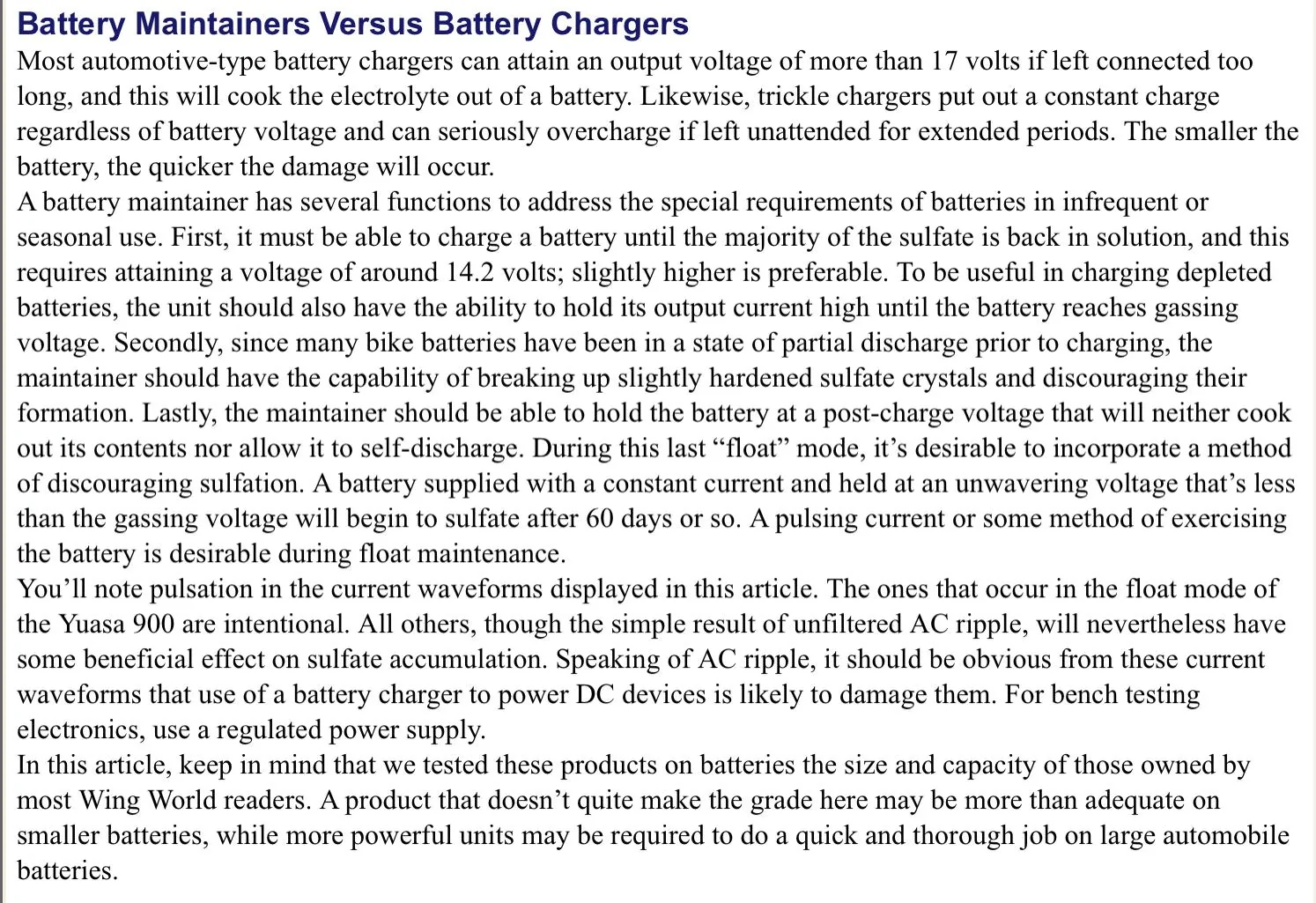
From what I have researched the JL will not charge the batteries past 12.9 before the smart alternator drops back, a fully charged battery is 12.66 give or take a few points but AGM‘s fully charged are 12.9-13.1 depending on the maker so the JL will never fully charge batteries unless the OEM ones are designed differntly.

My current dual battery setup uses two full size Full River 750 AGM‘s and the maker clearly advised me to that although the JL will keep my batteries reliable it’s best to use a smart charger periodically to condition and fully charge them for a long life.

Most if not all AGM batteries resist getting sulfated but if your batteries never get that kicker charge to just keep the juice flowing it can still happen and this will shorten the batteries life.

I was using a well known tender on my new setup until I started talking to batter makers and decided to go a different route as the one I was using never got above 13.5-13.7 at the peak output and for my batteries at least they need to see 14.5 ideally for several hours to condition them so once a week I use a NOCO 10 for a quick top off and monthly I use a Odyssey 20 for a long happy reconditioning

Here again is some info i at least found useful for those interested

Jeep Wrangler JL OEM Battery Replacement 59D7B034-6DE0-4607-9D85-167213DB28FD
Jeep Wrangler JL OEM Battery Replacement 2073E830-12C0-4454-BC89-99991ADB1440
 

Punk'n2doorsport

Well-Known Member
First Name
Willian
Joined
May 25, 2019
Threads
2
Messages
68
Reaction score
52
Location
Nova scotia
Vehicle(s)
2018 JL wrangler sport, 6spd manual, 3.6L
Build Thread
Link
Occupation
Trucker
Vehicle Showcase
1
Once upon a time Willian @Punk'n2doorsport, in the factory that makes these batteries, one of the men in a suit said to the shop foreman, "bring me two batteries, one of each kind, I wish to test them!"

The foreman nearly pooped his pants, but returned to the shop floor to convey the big man's request to the foreman's underlings.

"Bring me the best 2 of these batteries you've ever made!"

And so they were brought.

The shop foreman was pleased, as was the man in the suit, returning these batteries to inventory having tested them to satisfaction.

You got those 2 batteries.

Fable end.
Hahahahaha amazing,
I know right now im in the process of looking for replacements cause i have an over lander so was going to run a group 94 and replace aux with a better battery if i could.
I already havr a northstar 103AH AGM as my 2nd battery that powers fridge, cb and is wired up to a fuse panel so a bigger crank and id be golden.

As a side note has any one done over landing builds and used solar to maintain crank battery? I seen a few kits that turn our hoods in to solar panels and kinda curious
 

Punk'n2doorsport

Well-Known Member
First Name
Willian
Joined
May 25, 2019
Threads
2
Messages
68
Reaction score
52
Location
Nova scotia
Vehicle(s)
2018 JL wrangler sport, 6spd manual, 3.6L
Build Thread
Link
Occupation
Trucker
Vehicle Showcase
1
From what I have researched the JL will not charge the batteries past 12.9 before the smart alternator drops back, a fully charged battery is 12.66 give or take a few points but AGM‘s fully charged are 12.9-13.1 depending on the maker so the JL will never fully charge batteries unless the OEM ones are designed differntly.

My current dual battery setup uses two full size Full River 750 AGM‘s and the maker clearly advised me to that although the JL will keep my batteries reliable it’s best to use a smart charger periodically to condition and fully charge them for a long life.

Most if not all AGM batteries resist getting sulfated but if your batteries never get that kicker charge to just keep the juice flowing it can still happen and this will shorten the batteries life.

I was using a well known tender on my new setup until I started talking to batter makers and decided to go a different route as the one I was using never got above 13.5-13.7 at the peak output and for my batteries at least they need to see 14.5 ideally for several hours to condition them so once a week I use a NOCO 10 for a quick top off and monthly I use a Odyssey 20 for a long happy reconditioning

Here again is some info i at least found useful for those interested

59D7B034-6DE0-4607-9D85-167213DB28FD.jpeg
2073E830-12C0-4454-BC89-99991ADB1440.jpeg
What is your set up? Can i see? Pleasseee haha
 

Gee-pah

Banned
Banned
Banned
First Name
Andy
Joined
Nov 19, 2019
Threads
59
Messages
1,657
Reaction score
1,283
Location
SanFrancisco
Vehicle(s)
JL Wrangler
Hahahahaha amazing,
I know right now im in the process of looking for replacements cause i have an over lander so was going to run a group 94 and replace aux with a better battery if i could.
I already havr a northstar 103AH AGM as my 2nd battery that powers fridge, cb and is wired up to a fuse panel so a bigger crank and id be golden.

As a side note has any one done over landing builds and used solar to maintain crank battery? I seen a few kits that turn our hoods in to solar panels and kinda curious
I am working on one now actually--it's intent being to charge the batteries under the hood and a dedicated battery I have in the cargo area that I'm going to use to run a dash camera in parking mode from a solar panel when the engine is off, and the alternator when the engine is on. My panel though is on a roof rack, not the hood.

The kits you see are great https://www.cascadia4x4.com/ . If you're looking to save $ and have limited needs you can always acquire the smaller 30 amp kit that's designed for the Rubi hood (with less contiguous smooth surface) even if you have a non Rubi hood that would accept the 80 watt model.

Lensun https://www.lensunsolar.com/Flexible-solar-panel/Black-flexible-solar-panel is another outfit that makes hood adaptable solar panels but I think their off the shelf offerings are only rectangular. (They do customizations.) There is about a 16 7/8" gap on the hood between the windshield washer/windshield tie down pieces (WWWTP) on all JL/JT hoods, so make sure any panel you buy that isn't dedicated to fit a JL (like the larger Cascadia one with cutouts for the WWWTP this IS dedicated to non Rubi (JT Rubi too)) is narrow enough.

The length I think is around 30" max.

When I finish mine (tomorrow hopefully) and test it out I'll post the build.

LSS, a bit off topic, and more of this if I writeup my success, I'm of the opinion that batteries in the cabin best not be the same type as the lead acid variety under the hood (i.e. AGM) for safety reasons (off gassing and fire) and chose a Lithium Iron Phosphate battery for the interior. These LiFePO4 batteries are IMHO awesome, if not cheap in amp adjusted terms, given the number of charges/discharges they can cycle and their resistance to voltage drops with temperature.

Some may think that's overly cautious. I respect that.

They do though have one serious limitation in requiring above freezing temperature charging--a limitation I overcame with $, in purchasing just such a battery with a built in heater.

More to come.
Sponsored


Top