Sponsored

AUX battery delete/bypass - Which method is proper?

Jebiruph

Well-Known Member
First Name
Jerry
Joined
Feb 18, 2018
Threads
57
Messages
2,403
Reaction score
2,999
Location
Iowa
Vehicle(s)
2018 JLU, 2020 JT, 2024 WL
Don't have a multimeter. I can run out and check


No multimeter unfortunately. With the engine off in ACC it reads 12.5v.

So, what happened was, I almost always hit the button upon starting the engine. Last weekend I stopped to grab a drink. Forgot to hit the button after I left. Stopped at a light and engine shut off. No big deal ESS was on. Light changed and when I released the brake, the engine started but sort of lurched. It kicked into park and I had to move the shifter to park and back to drive. after which the light came on the cluster and the message "start/stop unavailable. Service start/stop system" appeared. Assumed the Aux. battery was bad so, when I got home I did the bypass method. But the message still appears each startup and the A with a circle light stays on. The Mopar main battery has a date of 2021. This is on a 2019. So, assuming the batteries were replaced at some point after only 2 years of service.
I think 12.5 is a little low. Since the main battery is the starting battery, after a failed restart l would investigate the main battery. You may have eliminated the working battery.
Sponsored


Dusty Dude

Well-Known Member
Joined
Apr 16, 2023
Threads
56
Messages
1,677
Reaction score
3,788
Location
Colorado Springs, CO
Vehicle(s)
1970 Ply Roadrunner, 2010 Challenger SRT
One thing to consider when doing this mod that I don’t see mentioned:

How hard is it to put back to original (for warranty work or resale). Pull the fuse, disconnect the negative cable, isolate the cable, and forget about it. If you have to put it back for any reason, the wiring harness isn’t butchered, less chance of accidentally blowing another fuse, and it is as simple as reconnecting the cable and reinserting the fuse.

IOW, don’t complicate things.
 

bobholthaus

Well-Known Member
First Name
Bob
Joined
Apr 4, 2020
Threads
25
Messages
599
Reaction score
502
Location
St. Louis, MO
Vehicle(s)
2023 JKURD AEV JL370; 2014 GC Overland Diesel
Build Thread
Link
Occupation
Technology Integrator
One thing to consider when doing this mod that I don’t see mentioned:

How hard is it to put back to original (for warranty work or resale). Pull the fuse, disconnect the negative cable, isolate the cable, and forget about it. If you have to put it back for any reason, the wiring harness isn’t butchered, less chance of accidentally blowing another fuse, and it is as simple as reconnecting the cable and reinserting the fuse.

IOW, don’t complicate things.
And is it really this simple? This is really what I was trying to get at above (making all of this as simple as possible to understand). With this option, are there any error lights on? And then I just bypass ESS with either a tazer or the other wiring harness sold?
 

andy29847

Well-Known Member
First Name
Andy
Joined
Oct 22, 2022
Threads
15
Messages
440
Reaction score
714
Location
Trenton, SC
Vehicle(s)
2020 JLUR
So, I did the bypass. Pulled the fuse and disconnected the negative Aux battery cable. I still have a "service ESS" warning light and message. Bad main battery?
Unplug the Intelligent battery sensor (IBS - not really intelligent) that goes between the battery cables and the negative post on the main battery. Leave it unplugged for 30 seconds. This resets the IBS.
 

Sponsored

AndySpill

Well-Known Member
First Name
Andy
Joined
Oct 24, 2023
Threads
71
Messages
1,654
Reaction score
1,270
Location
Pittsburgh
Vehicle(s)
2018 JL Sahara
One thing to consider when doing this mod that I don’t see mentioned:

How hard is it to put back to original (for warranty work or resale). Pull the fuse, disconnect the negative cable, isolate the cable, and forget about it. If you have to put it back for any reason, the wiring harness isn’t butchered, less chance of accidentally blowing another fuse, and it is as simple as reconnecting the cable and reinserting the fuse.

IOW, don’t complicate things.
Dusty, you may have missed it, and that's okay, but I covered above, under the pros of disconnecting the ESS/Aux battery with as few steps as possible, and leaving that battery in place, the idea of it being the easiest method to restore to factory.
 

Dusty Dude

Well-Known Member
Joined
Apr 16, 2023
Threads
56
Messages
1,677
Reaction score
3,788
Location
Colorado Springs, CO
Vehicle(s)
1970 Ply Roadrunner, 2010 Challenger SRT
And is it really this simple? This is really what I was trying to get at above (making all of this as simple as possible to understand). With this option, are there any error lights on? And then I just bypass ESS with either a tazer or the other wiring harness sold?
Yes, it is that simple. You shouldn’t have any error lights (assuming your main battery is in good condition). You will still need the Tazer (or equivalent) to bypass the ESS.
 

Dusty Dude

Well-Known Member
Joined
Apr 16, 2023
Threads
56
Messages
1,677
Reaction score
3,788
Location
Colorado Springs, CO
Vehicle(s)
1970 Ply Roadrunner, 2010 Challenger SRT
Dusty, you may have missed it, and that's okay, but I covered above, under the pros of disconnecting the ESS/Aux battery with as few steps as possible, and leaving that battery in place, the idea of it being the easiest method to restore to factory.
Sorry Andy, I missed it. My first cup of coffee hasn’t kicked in yet…;)
 

AndySpill

Well-Known Member
First Name
Andy
Joined
Oct 24, 2023
Threads
71
Messages
1,654
Reaction score
1,270
Location
Pittsburgh
Vehicle(s)
2018 JL Sahara
And is it really this simple? This is really what I was trying to get at above (making all of this as simple as possible to understand). With this option, are there any error lights on? And then I just bypass ESS with either a tazer or the other wiring harness sold?
Bob:

I thought I covered this, but even if I did, I completely get that I may have not gotten this message conveyed. (I can only imagine the things I read where I don't glean 100% of the writer's intent.) Let me try this in another way.

It's really this simple.

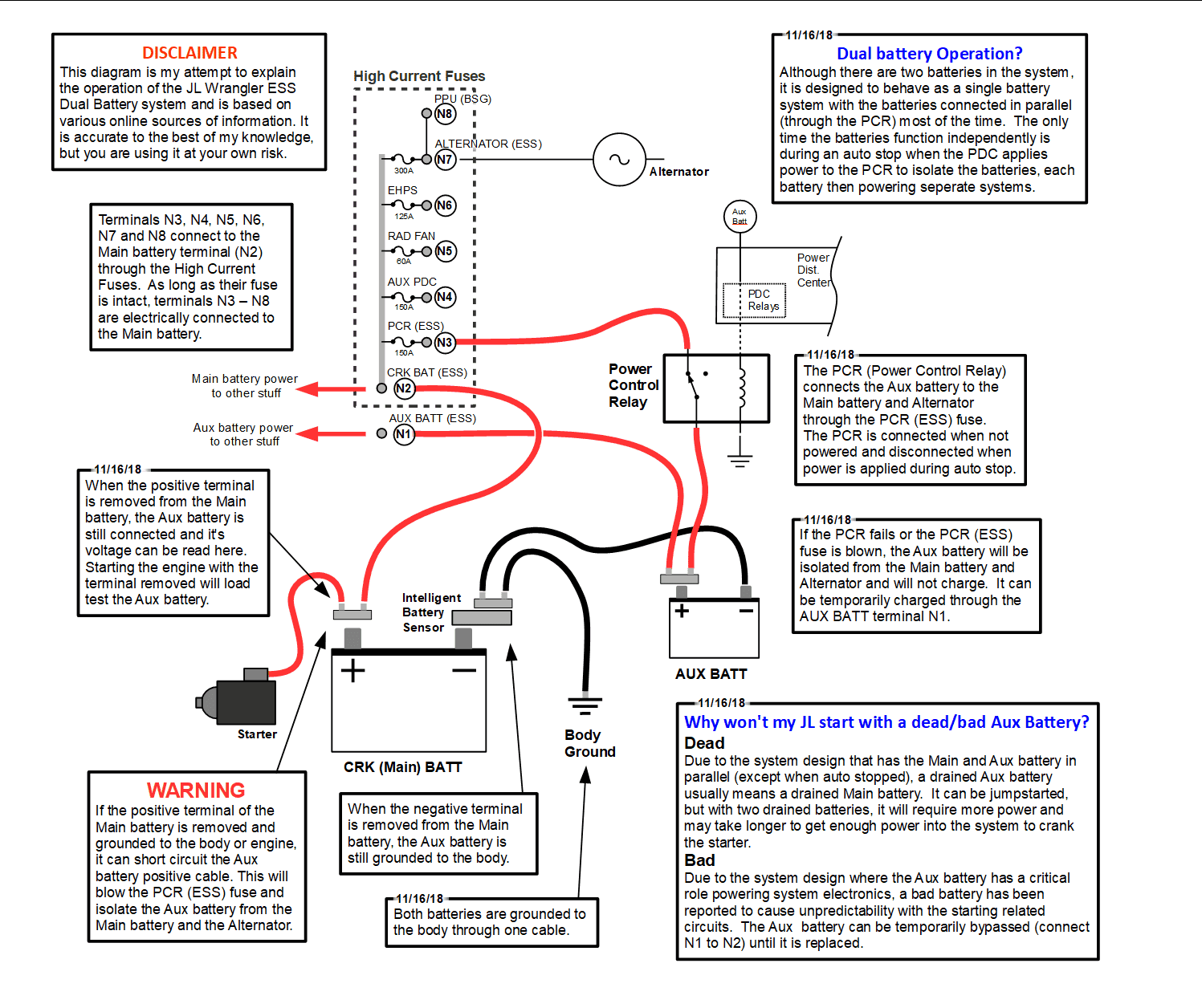
There are no error lights because your JL is unaware that Fuse 42 is not in place, and that the Power Control Relay (PCR), that device that separates the batteries for an instant at cold crank and during ESS events, can't function because of this fuse pull.

Your JL aimlessly thinks it is isolating the ESS/Aux battery for testing, when pulling Fuse 42 prevents that, and instead, calls for electrical current from this ESS/Aux battery are instead routed to both batteries: which for you is only the main battery, because you have disconnected the ESS/Aux battery.

It is precisely because this method of removing the ESS/Aux battery from the electrical schematic is so silent, that it is recommended to turn off the ESS system, or risk it engaging from solely the main battery.

Here again, many vehicles run ESS from one battery. But to repeat, the perfect storm of a cold night, long traffic light, old main battery, and (aftermarket) appliances could find you sucking voltage from your main battery, which will early terminate the ESS event, hopefully in time for the main battery to still have adequate cranking power to restart the engine that charges it.

We can only guess what threshold levels the engineers at Stellantis set this early ESS event termination level at, and whether they were more aggressive with it than vehicles running ESS with only one battery (and most other vehicles aren't nearly as often outfitted with as many energy sucking aftermarket appliances), precisely because, as designed from the factory, the main battery is preserved during ESS events in the dual AGM battery JL, to effect the bulk of the work in the post ESS event crank., unlike in other vehicles.

Shane from Genesis Offroad knows a thing or two about the JLs energy consumption and from what I've read is fine running ESS events off the main battery, but it's also true, given the way Stellantis designed the ESS system, ESS will stop working after 6 ESS events under one engine crank, resetting itself at the next cold crank, if the vehicle sees identical voltages between (what it thinks) are the ESS and main battery, assuming there must be some electrical short between the two batteries that cause it to read a voltage this is a composite of both batteries linked in parallel (like what you see on the dash in accessory mode with the engine off with two factory batteries connected.)

Because Shane runs ESS events off the main, absolutely no disparaging intent implied, he faces this 6 ESS event test.

I've never run that many, (6) ESS events under one cold crank. It is an awesome kit for overlanders and I only mention this 6 ESS event condition to highlight when, and when not, your JL is aware of the changes you are making.

All this said, there is another route. You could disconnect your ESS battery and stop, no fuse pull, no N1 to N2 jumper, Jerry's original technique.

Doing so will prevent an early model 2018 without software upgrade from cranking. Dual AGM battery JLs in later model years will fail on the first crank attempt but subsequent ones will succeed provided the main battery has ample power, turning ESS off in the dash. In this case you not pulling Fuse 42 or jumpering N1 to N2 DID make the JL aware that something was wrong.

And some may call this approach, if you don't mind idiot lights in the dash, a good thing. You don't need to remember to turn ESS off with the button or buy tech to do it.

But, as raised by me in a prior thread about this, Jerry believes the ESS off light in the dash serves as an early warning sign of problems, that if you expressly engage, might cause you to miss out on knowing of problems with your vehicle, and he doesn't advise it.
 

Sponsored

AndySpill

Well-Known Member
First Name
Andy
Joined
Oct 24, 2023
Threads
71
Messages
1,654
Reaction score
1,270
Location
Pittsburgh
Vehicle(s)
2018 JL Sahara
Questions for AndySpill. First, your explanations are terrific. Knowing the why is usually part of the fun working on Jeeps. This issue is not fun.

So, what is the downside to leaving batteries, terminal posts and fuses just as they are and using a wiring harness modification to turn off the ESS?

Is there an upside?
By turning off the ESS system, but leaving all else connected, you are risking the ESS/Aux battery, with time, being the more likely of the two batteries to start to cannibalize the main battery. You see both batteries are connected in parallel (positive to positive, negative to negative) at all times but an instant at cold crank and during ESS events.

For those already committed to not running ESS there is little upside to keeping the ESS/Aux battery connected in my opinion. If you must find an upside, when that ESS/Aux battery is working well, it aids the main battery in cranking the engine.

I'm going to make a medical analogy. This is serious. A young mom presents to her obstetrician/gynecologist with known genetics for breast cancer but is hell bent on breast feeding her infants (running ESS.) We let her do so, with 6 month mamograms (we trickle charge the batteries and load test them.)

Over time, as the kids age, their nutrition comes from food not breast milk. When that now older mom visits the obstetrician we have a conversation about getting her into a oncological breast surgeon to have a radical bilateral prophylactic (that's what it's called folks) mastectomy (removal of the breast tissue) (disconnecting the ESS battery and fuse pull) followed, while still anesthetized , a plastic surgeon performing breast reconstructive surgery to make her whole again.

Those "girls," like your ESS battery that isn't routinely trickle charged, are, IMHO, time bombs. If you are not running the ESS system (breast feeding), there's little upside to holding on to such a precancerous entity: literally or metaphorically.
 
Last edited:

AndySpill

Well-Known Member
First Name
Andy
Joined
Oct 24, 2023
Threads
71
Messages
1,654
Reaction score
1,270
Location
Pittsburgh
Vehicle(s)
2018 JL Sahara
I respect your ambition to optimize the ESS power source(s)!

I don't use ESS. My ESS is fully functional (start battery only), but I have a Tazer to provide ESS button memory and haven't enabled it since turning it off (I rarely encounter stop lights or sit in traffic - situations where I'd at least consider using it).

I'm doing something more like the Genesis system, for auxiliary/house loads (e.g. a fridge). As mentioned, I have the Genesis tray, but didn't purchase their electronics/wiring. Instead, I use a Redarc BCDC1225d which keeps my 2 AGM batteries electrically isolated (technically they share a common ground), provides a proper charging profile for the the deep cycled house battery, and adds supplemental solar charging. The BCDC ignition wire is connected to an alternator sensing relay.

I also have an onboard/hardwired NOCO GenPro for monthly maintenance charging on the start battery. I've considered running a trickle charger from the (solar charged) house battery back to the start battery.

Since I have 2 isolated batteries, each with enough capacity to function as a crank battery - and because I have voltmeters to monitor status, plus solar charging - I'm not particularly concerned about a dead start battery. I should see early warning signs and/or be able to self recover.

I'm not a fan of the effects of ESS paired with alternator "charging" on AGM batteries. With my system, I figure even if ESS were enabled I can achieve long battery life with regular maintenance charging on the start battery (which I do regardless of ESS usage).

I'll have to think on your "Stellantis should have" ESS concept, and I'm curious to see what you invent.
Thanks Foster:

My read on this--and I mean this in praise not judgement--is that you have modeled your electrical system not unlike that in a motorhome or RV, with a starter battery under the hood for cranking the engine and running strictly vehicle appliances, and a (as it's called in the RV world) "house" battery for running the human life support needs (cooking, heating, refrigeration) of homelife when the engine is often not running.

Although unlike in the RV world where that house battery is often situated in the cab, you have repurposed (well done) Shane's tray to position both batteries under the hood.
 

THAW

Well-Known Member
First Name
Foster
Joined
Oct 28, 2022
Threads
4
Messages
2,206
Reaction score
3,039
Location
PNW - prefer Middle of Nowhere
Vehicle(s)
23 JL4DrRubicon
Because Shane runs ESS events off the main...
One minor correction: the Genesis system powers ESS events with both it's batteries.

There are a couple battery options for it, but the 2 batteries connected in parallel provide approximately 120 AH and 1500 CCA, a significant increase over factory (70/75 AH 600/700 CCA main, 12 AH 200 CCA aux)
 
Last edited:

Jaon

Active Member
First Name
Jason
Joined
Dec 3, 2020
Threads
9
Messages
41
Reaction score
11
Location
Tennessee
Vehicle(s)
Wrangler JLU
So, I did the bypass. Pulled the fuse and disconnected the negative Aux battery cable. I still have a "service ESS" warning light and message. Bad main battery?
I did exactly the same and now have the service stop start system!
 

AndySpill

Well-Known Member
First Name
Andy
Joined
Oct 24, 2023
Threads
71
Messages
1,654
Reaction score
1,270
Location
Pittsburgh
Vehicle(s)
2018 JL Sahara
I did exactly the same and now have the service stop start system!
Because you disconnected the ESS/Aux battery doesn't mean, before you did so, or by the mere passage of time, your main battery isn't also in need of service.

The steps you took now make calls by your vehicle to read only the ESS/Aux battery's voltage read all available batteries' voltage, which in your case is only the main battery. And if that battery is need of replacement, no differently than an ESS/Aux battery on its "last legs," you could have the message you describe.

Of course it could be something else but if it were me I'd load test the main battery.

Good luck finding cause.
Sponsored


Top