Sponsored

Engine braking / compression braking difference between 4 and 6 cylinder engines?

OP
OP
mnforester

mnforester

Well-Known Member
First Name
Andrew
Joined
Jul 2, 2021
Threads
9
Messages
75
Reaction score
85
Location
Minnesota
Vehicle(s)
'21 Sport Altitude
You can also use hill descent in 4Lo and not even worry about brakes (or I should say "applying" your brakes, let the computer do it for you :)
Good point, I've yet to use Speed Control/Hill Descent. I need to find a place to try out that function.
Sponsored


blnewt

Well-Known Member
First Name
Brad
Joined
Oct 8, 2018
Threads
99
Messages
9,956
Reaction score
24,091
Location
New Mexico
Vehicle(s)
2019 Jeep JL V6 SportS, (Retired 74 CJ-5, 80 CJ-7)
Occupation
Just ask @cosine he knows!
Good point, I've yet to use Speed Control/Hill Descent. I need to find a place to try out that function.
I've used it quite a bit, pretty cool being able to go down to .5 miles an hour and just let the Jeep do the work. Keep in mind you will hear some unnerving sounds while it's doing it's thing, especially if you're really going down a steep section.
 

J0E

Well-Known Member
First Name
J0e
Joined
Sep 1, 2018
Threads
55
Messages
1,359
Reaction score
1,162
Location
Hawaii, MT, SLC, NYC
Website
bt39.com
Vehicle(s)
2021 JLR, 05 LJR on 43s
Build Thread
Link
Occupation
Drywall construction - reel estate
Hey thanks for the comments. Yes, tried 2H, 4H, and then 4L using manual gears. None could keep me from rolling faster and faster and RPMs went too high for my liking. I don't recall what the RPMs were - but clearly going too high.

I also believe that your Rubicon gearing vs my Sport S gearing will also make a difference. I hope my Wrangler can engine brake enough to make trail running in Rockies enjoyable. I'll try to find some steep slopes here in Minnesota to test out capabilities.
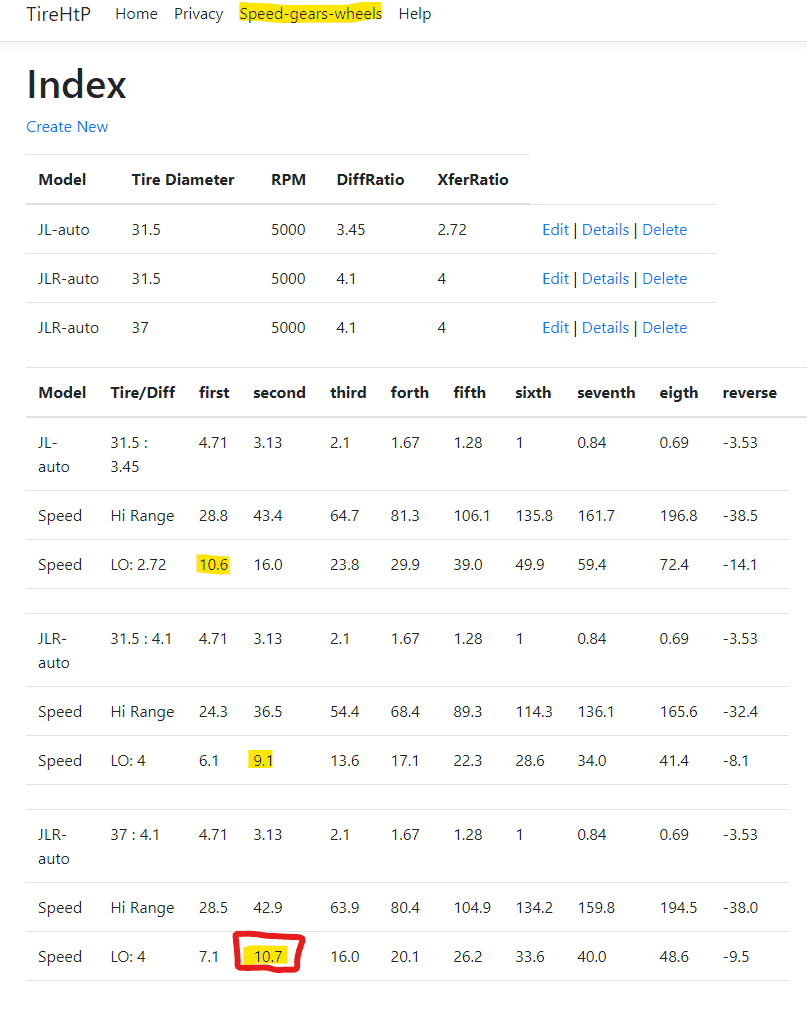
See my BT69.com gear calculator.

Stock Ruby in low range M2 is lower than you sport in low range M1. My JLR with stock gears on 37's in M2 is very close to yours in M1, and unless I'm really wheeling, M2 LR slows my rig down. So I still want to know where you were in LR M1 and wouldn't slow you down.

HR M1 are pretty close.

Jeep Wrangler JL Engine braking / compression braking difference between 4 and 6 cylinder engines? 1669352094789
 
OP
OP
mnforester

mnforester

Well-Known Member
First Name
Andrew
Joined
Jul 2, 2021
Threads
9
Messages
75
Reaction score
85
Location
Minnesota
Vehicle(s)
'21 Sport Altitude
See my BT69.com gear calculator.

Stock Ruby in low range M2 is lower than you sport in low range M1. My JLR with stock gears on 37's in M2 is very close to yours in M1, and unless I'm really wheeling, M2 LR slows my rig down. So I still want to know where you were in LR M1 and wouldn't slow you down.

HR M1 are pretty close.

1669352094789.png
Thanks, Joe, for the excellent info. I've bookmarked the link for future reference.

We were coming down off a volcano on a gravel road on the Big Island in Hawaii. It was steep, but so steep that I didn't think the Wrangler couldn't engine brake is way down. What I'm hearing from others is that I couldn't maintain a slow speed because the rental Wrangler we had was the 4 cylinder. Apparently the small displacement over just 4 cylinders can't effectively hold the vehicle back in steep situations. A few folks with 4 bangers have made that comment. I'm hearing my 3.6 will do much better. I'm excited to head west next summer.

Thanks again!
 
  • Like
Reactions: J0E

Ratbert

Well-Known Member
First Name
John
Joined
Jun 20, 2020
Threads
159
Messages
16,066
Reaction score
25,054
Location
PNW
Vehicle(s)
2022 AEV JL370 JLURD
Build Thread
Link
Occupation
Software Engineer
Clubs
 
Thanks, Joe, for the excellent info. I've bookmarked the link for future reference.

We were coming down off a volcano on a gravel road on the Big Island in Hawaii. It was steep, but so steep that I didn't think the Wrangler couldn't engine brake is way down. What I'm hearing from others is that I couldn't maintain a slow speed because the rental Wrangler we had was the 4 cylinder. Apparently the small displacement over just 4 cylinders can't effectively hold the vehicle back in steep situations. A few folks with 4 bangers have made that comment. I'm hearing my 3.6 will do much better. I'm excited to head west next summer.

Thanks again!
If you want to do that test in Colorado try Red Cone. It has an incredibly steep extended descent after you reach the peak.

I initially tried using hill descent (the duck button), but realized that I might burn up my brakes since it's so long and steep. 1st gear in 4lo (37s, 4.73s, diesel) had sufficient engine braking without having to use the brakes.
 

Sponsored

Philly_

Well-Known Member
Joined
Nov 20, 2021
Threads
18
Messages
1,375
Reaction score
2,415
Location
Dallas / Detroit / NYC
Vehicle(s)
2022 JL Rubicon
Build Thread
Link
Clubs
 
The 2.0 has next to no engine braking. It was the first thing I noticed when I took it off-road for the first time.

I will say, that off-road+ on the Rubicons makes a huge difference in throttle management and some how mimics engine braking while in low range. Because of this, I have no issues with it.
 

58Willys

Well-Known Member
First Name
Geoff
Joined
Jan 2, 2022
Threads
6
Messages
1,163
Reaction score
1,453
Location
Western Washington
Vehicle(s)
2018 JL Sport
Engine braking effect is mostly dependent on valve timing and compression ratios. Just comparing a 4 & 6 cyl isn’t going to predict anything.
 

Reinen

Well-Known Member
Joined
Jan 10, 2021
Threads
19
Messages
3,193
Reaction score
7,523
Location
Utah
Vehicle(s)
2021 Jeep Wrangler JL Rubicon
The 2.0 has next to no engine braking. It was the first thing I noticed when I took it off-road for the first time.

I will say, that off-road+ on the Rubicons makes a huge difference in throttle management and some how mimics engine braking while in low range. Because of this, I have no issues with it.
Maybe we shouldn't be so absolute about that. I engine brake all the time on a 9mi road that drops 3/4 mi in elevation. It does work, but on-road would be it's most effective use and it does require supplemental braking occasionally. But at least it does serve the function of keeping the brakes from wearing and overheating. Anyone who doesn't engine brake on that road REEKS of hot brakes by the bottom.

But off-road, yeah. It's not enough and I rarely engine brake there.
 

Alan_Hepburn

Well-Known Member
First Name
Alan
Joined
Dec 15, 2021
Threads
8
Messages
205
Reaction score
314
Location
Lewisburg, TN USA
Vehicle(s)
2020 JT Sport S, 2022 JLU Sport S
It's a common belief, but it's just a myth: engine braking in a gas engine is NOT a product of engine compression - it's caused by the intake stroke of the engine trying to pull air through a closed intake butterfly valve. That's also why diesel engines do not have significant engine braking: they don't have a butterfly valve in their intake.

There was a decent analysis of this way back in the old Usenet days in a newsgroup known as "rec.autos.tech" that went into detail, written by a gentleman who was an engineer at Ford:

The braking effect IS due to the high pumping work required to draw
air past the throttle.

In the following note, all torques are normalized by engine
displacement to give terms expressed as mean effective pressure. Mean
effective pressure can be thought of as a constant pressure acting on
the piston throughout its full stroke and is a convenient way of
dealing with PV diagrams.

I'll give an example of an engine firing and producing a brake torque
expressed as 22 psi BMEP. This is equivalent to a 5.0L engine
producing about 43 ft-lb of torque. The engine displacement isn't
really needed but does provide some order of magnitude feel for the
results. Further, to simplify I'll create a decel condition by
switching off the fuel and look at the resulting cylinder pressure
results with engine motored by the dynamometer.

The output of an engine is proportional to the integrated area
contained within the cylinder's PV (pressure vs volume) diagram. A
four stroke engine requires two revs to complete the cycle. Starting
at TDC on the intake stroke air is drawn into the cylinder at manifold
pressure (about 4.6 psi Manifold Absolute Pressure) until the piston
get to BDC. Now the gas is compressed according to pv**gamma (gamma is
the polytropic exponent that usually ranges from about 1.29 to 1.34 in
real engines). Yes, work was done on the trapped air in compression.
Now let's assume you have decel fuel shutoff (no pressure rise due to
combustion). At TDC compression the gas is simply expanded back down
to BDC again following the polytropic expansion process. Hmmm, the
high pressure air just did work on the piston in the expansion
process, exactly recovering ALL of the compression work done during
compression. In the real engine, however, there are heat losses and
some ring leakage. So the cylinder pressure during expansion is a bit
lower than it was during compression. The area of a PV diagram
enclosed by the region from BDC intake to BDC expansion is called the
IMEP or indicated mean effective pressure. Integration of PdV from BDC
intake to BDC expansion results in the simulated decel test case
results in a IMEP about -1.2 psi based on some real cylinder pressure
data for an engine motoring (i.e. fuel off) at a MAP that would
produce about 22 psi BMEP (BMEP = tq*150.8/disp).

Ok, now we are at BDC on the expansion stroke and the exhaust valve
opens (assume at BDC). The pressure in the cylinder quickly rises to
exhaust backpressure before the piston has moved far from BDC. Next,
during the exhaust stroke the gas is pushed out of the cylinder at
exhaust backpressure. The definition of pumping work or PMEP is the
integral of PdV from BDC expansion to BDC intake and on a pressure vs
volume plot looks like a simple rectangle. This area is can be
approximated by PMEP=(Pin-Pexh)*(Delta Volume)/DISP_vol. For this PMEP
calculation, deltaV=DISP_vol and the PMEP becomes ~-9.7 psi which is a
significanly higher loss (really more negative) than the IMEP.

The net work done by the gases on the piston (or by the piston on the
gases) is the sum of the work during compression and expansion (IMEP)
and the gas exhange work, PMEP.

NMEP = IMEP + PMEP or
Net gas torque = Indicated Torque + pumping torque

The simple equation for converting mean effective pressures to real
torque values is: TQ = (MEP*disp)/150.8 in the English units system.

If the above MEP values are for a 5L v-8 operating at a manifold
pressure that would give ~43 ft-lbs of torque, then the torques due to
gas work are:

IMEP = -2.4 ft-lb
PMEP = -19.4 ft-lb

It is pretty obvious by now that the dominant loss is the gas exchange
loss. In fact for a real decel condition, MAP would be somewhat lower
than the value used in this example resulting in more negative values
while the IMEP would only get slightly less negative.

So, bottom line, the pumping work easily overwhelms the equation and
dominates the effect AND is why diesel engine don't have good decel
braking without some extra device to create pumping work (Jake brake)
 
Last edited:

J0E

Well-Known Member
First Name
J0e
Joined
Sep 1, 2018
Threads
55
Messages
1,359
Reaction score
1,162
Location
Hawaii, MT, SLC, NYC
Website
bt39.com
Vehicle(s)
2021 JLR, 05 LJR on 43s
Build Thread
Link
Occupation
Drywall construction - reel estate
The 2.0 has next to no engine braking. It was the first thing I noticed when I took it off-road for the first time.

I will say, that off-road+ on the Rubicons makes a huge difference in throttle management and some how mimics engine braking while in low range. Because of this, I have no issues with it.
not true. Quantify next to no. On my stock JLR, 30 deg descents, M1 does all the breaking. On a 38 deg decent we frequently take (up and down), M1 does 90%. Once I mounted 37's with stock gears, it takes a little bit more brake.

Maybe we shouldn't be so absolute about that. I engine brake all the time on a 9mi road that drops 3/4 mi in elevation. It does work, but on-road would be it's most effective use and it does require supplemental braking occasionally. But at least it does serve the function of keeping the brakes from wearing and overheating. Anyone who doesn't engine brake on that road REEKS of hot brakes by the bottom.

But off-road, yeah. It's not enough and I rarely engine brake there.
One route I typically lead off the mountain (street, 20 - 25 MPH, corners at 15-20) I use engine braking for 95% of the slow down. After doing this route for the 15th time, a women in the club said over the radio, why is everyone's brake lights on except Joes? Mostly JKs, but no one else ever noticed.

But off-road, yeah. It's not enough and I rarely engine brake there.
Your missing out, in low range you have 4x the braking power.
 
Last edited:

Sponsored

AirportDave

Well-Known Member
First Name
Dave
Joined
Jun 24, 2019
Threads
28
Messages
335
Reaction score
790
Location
Denver, CO
Vehicle(s)
2022 JLUXR, 2018 GC Trailhawk Hemi
Occupation
Aeronautics Professional
I had the 2.0 eTorque in my previous '18 JLR, and have the 3.6 eTorque in my '22 JLUXR, and can say from first hand wheeling experience with both, that both motors IMHO have outstanding compression braking.
 
  • Like
Reactions: J0E

Jerkwater

Active Member
Joined
Nov 10, 2021
Threads
1
Messages
27
Reaction score
46
Location
North Vancouver, BC, Canada
Vehicle(s)
2018 JLU Sahara
not true. Quantify next to no. On my stock JLR, 30 deg descents, M1 does all the breaking. On a 38 deg decent we frequently take (up and down), M1 does 90%. Once I mounted 37's with stock gears, it takes a little bit more brake.


One route I typically lead off the mountain (street, 20 - 25 MPH, corners at 15-20) I use engine braking for 95% of the slow down. After doing this route for the 15th time, a women in the club said over the radio, why is everyone's brake lights on except Joes? Mostly JKs, but no one else ever noticed.


Your missing out, in low range you have 4x the braking power.
When you are engine braking on the 30 deg and 38 deg descents, about how many rpms is your engine going up to? And which engine do you have?

Also, when it is engine braking without assistance from the brakes, do the rpms tend to stay relatively constant, or is there any oscillation?

My 2018 JLU Sahara seems to have the issue the OP noted, which I've read about in a few other threads here, too.

I have a 3.6 V6 w/ ESS, automatic transmission, stock selec-track transfer case, and aftermarket 4.10 gears. Even on a 13 degree descent, in M2 low range my Jeep will start off slowly with the rpms gradually rising, but eventually the RPMs will quickly go up to about 4-5k rpm and fluctuate back and forth in that range. Based on my limited experience, it doesn't feel right.
Sponsored


Top