
Sponsored
MauiSteve
Well-Known Member
It was interesting and I'm pretty sure accurate.
However, there are variations such as working on loose sand that would enter into a tire choice.
However, there are variations such as working on loose sand that would enter into a tire choice.
AnnDee4444
Well-Known Member
I don't agree with how he is measuring contact patch area. In my opinion, it should just be the rubber contacting the ground, not including the air space between the tread.
5:00 in the video shows his method.
5:00 in the video shows his method.
azwjowner
Well-Known Member
I agree, but I think his method is fine for the same tread -- i.e. both Baja Boss tires. I think this is the reason why the KM3 gave the illusion of a larger contact patch area, however.I don't agree with how he is measuring contact patch area. In my opinion, it should just be the rubber contacting the ground, not including the air space between the tread.
5:00 in the video shows his method.
calemasters
Well-Known Member
- First Name
- Allen
- Joined
- Sep 14, 2020
- Threads
- 74
- Messages
- 1,437
- Reaction score
- 2,102
- Location
- Springfield, Mo.
- Vehicle(s)
- 2026 Moab 392 w/27X package & Escalade
- Occupation
- Retired Mechanical Engineer
The results surprised me. But I can't stand skinny tires. I generally select the widest tire that properly fits my rim width.
Sponsored

wibornz
Well-Known Member
- First Name
- Ted
- Joined
- Aug 3, 2018
- Threads
- 194
- Messages
- 14,719
- Reaction score
- 71,696
- Location
- lansing, Mi.
- Website
- www.instagram.com
- Vehicle(s)
- JL Unlimited Rubicon
- Occupation
- Retired from Corrections....I have stories.
Good video. I go with the 12.5 instead of the 13.50 wide tires....why because the 13.50 width tires do not fit in the auto car wash.
My struggle is real.
My struggle is real.
Flip
Well-Known Member
Just one of the reasons I went with 33" pizza cutters: I'm not sure I can change a large heavy tire on the trail solo and I'm a flat tire magnet. I'm so paranoid of getting flat tires; I not only carry a spare tire but 3 different jacks, a can of fix-a-flat, air compressor, 4-way, breaker bar, deep well socket, a plug kit, hair spray and lighter.


Yellow Cake Kid
Well-Known Member
This video demonstrates the obvious.
For example:
A) The LT255/85 R17 load range E tire has a maximum inflation of 80psi. At 80psi the load capacity of the LT255/85 R17 tire is 3195 pounds
B) The LT315/70 R17 load range E has a maximum inflation of 65psi. At 65psi the load capacity of the LT315/70R17 tire is 3195 pounds
Load Range is primarily intended to describe the maximum air pressure and the maximum load capacity a tire can provide.
Load capacity is a function of the mass of air that may be stored in the tire, so when the comparison is made at the same inflation PSI it should be blatantly obvious that the tire with a lower volume will have a greatly reduced load capacity, and therefore deform more dramatically than the tire with greater air volume.
It would be helpful for that video to point out that "load capacity" is a basic characteristic of a tire, and explain why we should expect the tire with lower volume to provide decreased load capacity.
It would seem pertinent to point out that the maximum load capacity of either of these tires exceeds the static load presented by the particular vehicle by over 100%.
When we use these LT pavement tires to crawl offroad at low pressure we are utilizing them in a manner contrary to what they are designed and manufactured to accomplish.
It would also seem helpful to observe that dynamic loading differs from static loading. In other words, a tire simply resting on top of a rock, is under different, and less stress than a tire that is climbing and or bouncing over a rock while it is being forced into the rock by the drivetrain.
I recently purchased a 4 Runner to use as a country drive station wagon, and have enjoyed some of the Tinkerer's videos, but when I watched this video a few days ago it struck me as a very complicated exercise in discovering the obvious and presenting it as entertainment.
For example:
A) The LT255/85 R17 load range E tire has a maximum inflation of 80psi. At 80psi the load capacity of the LT255/85 R17 tire is 3195 pounds
B) The LT315/70 R17 load range E has a maximum inflation of 65psi. At 65psi the load capacity of the LT315/70R17 tire is 3195 pounds
Load Range is primarily intended to describe the maximum air pressure and the maximum load capacity a tire can provide.
Load capacity is a function of the mass of air that may be stored in the tire, so when the comparison is made at the same inflation PSI it should be blatantly obvious that the tire with a lower volume will have a greatly reduced load capacity, and therefore deform more dramatically than the tire with greater air volume.
It would be helpful for that video to point out that "load capacity" is a basic characteristic of a tire, and explain why we should expect the tire with lower volume to provide decreased load capacity.
It would seem pertinent to point out that the maximum load capacity of either of these tires exceeds the static load presented by the particular vehicle by over 100%.
When we use these LT pavement tires to crawl offroad at low pressure we are utilizing them in a manner contrary to what they are designed and manufactured to accomplish.
It would also seem helpful to observe that dynamic loading differs from static loading. In other words, a tire simply resting on top of a rock, is under different, and less stress than a tire that is climbing and or bouncing over a rock while it is being forced into the rock by the drivetrain.
I recently purchased a 4 Runner to use as a country drive station wagon, and have enjoyed some of the Tinkerer's videos, but when I watched this video a few days ago it struck me as a very complicated exercise in discovering the obvious and presenting it as entertainment.
Last edited:
aldo98229
Well-Known Member
- First Name
- Aldo
- Joined
- Nov 16, 2019
- Threads
- 89
- Messages
- 11,102
- Reaction score
- 28,053
- Location
- Bellingham, WA
- Vehicle(s)
- 2023 Jeep Gladiator, 2018 Fiat 124 Spider
- Occupation
- Market Research
- Vehicle Showcase
- 3
I have owned 315/70R17 and 35x12.5R17 four times: on my 2012 Rubicon 4-door, 2013 Rubicon 2-door, 2018 JKURR, and my current JL Sahara; all with a Mopar lift - I never liked how the Jeeps felt on-road on tires that size. I could feel the added heft and width in the corners and over bumps.
Years ago I had a set of 34X10.5R17 KO2s on my 2015 Sahara. It was the perfect size for a 4,400-lb Jeep IMO. The problem is that’s an odd size; those tires are freaking expensive.
I recently switched my JL from 35X12.5R17 to narrower 285/75R18 (i.e., 35 x 11.2 inches) tires. The skinnier tires weigh 10 lbs less each. I immediately felt the improvement in the cornering and the ride. There’s much less tire bounce coming in through the steering wheel and the suspension.
Years ago I had a set of 34X10.5R17 KO2s on my 2015 Sahara. It was the perfect size for a 4,400-lb Jeep IMO. The problem is that’s an odd size; those tires are freaking expensive.
I recently switched my JL from 35X12.5R17 to narrower 285/75R18 (i.e., 35 x 11.2 inches) tires. The skinnier tires weigh 10 lbs less each. I immediately felt the improvement in the cornering and the ride. There’s much less tire bounce coming in through the steering wheel and the suspension.
TorturedMargot
Well-Known Member
Probably the best Jeep video I’ve ever seen, and it’s not really even about jeeps. Just love the scientific breakdown and the hard work that went in to the video. I’d love to see the difference between a Ridge Grappler and a BFG.
Sponsored
GATORB8
Well-Known Member
If you have any interest in IFS (or just geek out on suspension), his other videos are done with the same approach. I disagree with his JL comparison, but he's a Yota fanboy so you'll get some of that.Probably the best Jeep video I’ve ever seen, and it’s not really even about jeeps. Just love the scientific breakdown and the hard work that went in to the video. I’d love to see the difference between a Ridge Grappler and a BFG.
TorturedMargot
Well-Known Member
I’ll definitely check out the other stuff. I could tell he loves Toyota but that’s okay. I can ignore that and enjoy the scientific contentIf you have any interest in IFS (or just geek out on suspension), his other videos are done with the same approach. I disagree with his JL comparison, but he's a Yota fanboy so you'll get some of that.
azwjowner
Well-Known Member
Toyo now sells the A/T III in that size at a normal price.Years ago I had a set of 34X10.5R17 KO2s on my 2015 Sahara. It was the perfect size for a 4,400-lb Jeep IMO. The problem is that’s an odd size; those tires are freaking expensive.
GATORB8
Well-Known Member
Agree, his suspension stuff seems a lot more insightful in a controlled environment.This video demonstrates the obvious.
For example:
A) The LT255/85 R17 load range E tire has a maximum inflation of 80psi. At 80psi the load capacity of the LT255/85 R17 tire is 3195 pounds
B) The LT315/70 R17 load range E has a maximum inflation of 65psi. At 65psi the load capacity of the LT315/70R17 tire is 3195 pounds
Load Range is primarily intended to describe the maximum air pressure and the maximum load capacity a tire can provide.
Load capacity is a function of the mass of air that may be stored in the tire, so when the comparison is made at the same inflation PSI it should be blatantly obvious that the tire with a lower volume will have a greatly reduced load capacity, and therefore deform more dramatically than the tire with greater air volume.
It would be helpful for that video to point out that "load capacity" is a basic characteristic of a tire, and explain why we should expect the tire with lower volume to provide decreased load capacity.
It would seem pertinent to point out that the maximum load capacity of either of these tires exceeds the static load presented by the particular vehicle by over 100%.
When we use these LT pavement tires to crawl offroad at low pressure we are utilizing them in a manner contrary to what they are designed and manufactured to accomplish.
It would also seem helpful to observe that dynamic loading differs from static loading. In other words, a tire simply resting on top of a rock, is under different, and less stress than a tire that is climbing and or bouncing over a rock while it is being forced into the rock by the drivetrain.
I recently purchased a 4 Runner to use as a country drive station wagon, and have enjoyed some of the Tinkerer's videos, but when I watched this video a few days ago it struck me as a very complicated exercise in discovering the obvious and presenting it as entertainment.
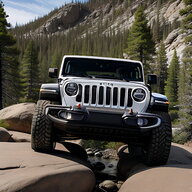
Would be more difficult to simulate side and front tire loading in a driveway, but it would have been more interesting if he added in a test with a substrate that has less bearing capacity than concrete, like mud or sand.
RicRecon
Well-Known Member
Cool feedback. Most (like all three) 35/11.5/17 tires I’ve seen are load range C. Curious whether the 315s or 35s you mentioned were load range E or D? Just trying to evaluate whether that had any impact on your experiences.I have owned 315/70R17 and 35x12.5R17 four times: on my 2012 Rubicon 4-door, 2013 Rubicon 2-door, 2018 JKURR, and my current JL Sahara; all with a Mopar lift - I never liked how the Jeeps felt on-road on tires that size. I could feel the added heft and width in the corners and over bumps.
Years ago I had a set of 34X10.5R17 KO2s on my 2015 Sahara. It was the perfect size for a 4,400-lb Jeep IMO. The problem is that’s an odd size; those tires are freaking expensive.
I recently switched my JL from 35X12.5R17 to narrower 285/75R18 (i.e., 35 x 11.2 inches) tires. The skinnier tires weigh 10 lbs less each. I immediately felt the improvement in the cornering and the ride. There’s much less tire bounce coming in through the steering wheel and the suspension.
Sponsored
Similar threads

- Replies
- 83
- Views
- 8,223


- Replies
- 73
- Views
- 50,832
