
LFMS
Active Member
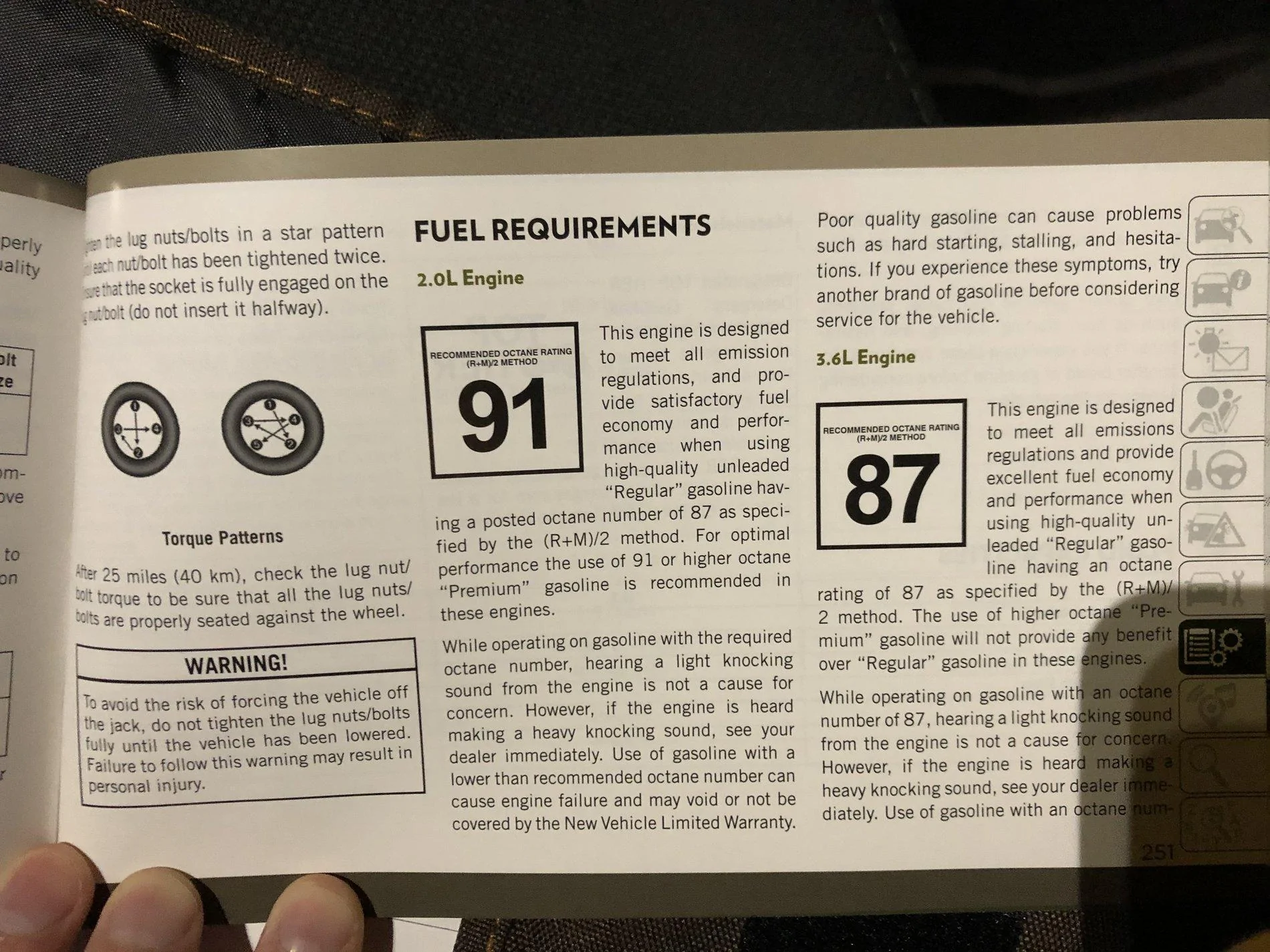
They might have changed the manual, but in my 2018 it recommends 91. Btw I use 93 - tried both 87 and 93 and the difference was noticeable, so for me it was a no brainer...
Sponsored

It’s been clarified and changed for all JL model years including 2018. FCA even put out a special “blurb” about 18 months ago announcing the language Changes and clarifications
They might have changed the manual, but in my 2018 it recommends 91. Btw I use 93 - tried both 87 and 93 and the difference was noticeable, so for me it was a no brainer...

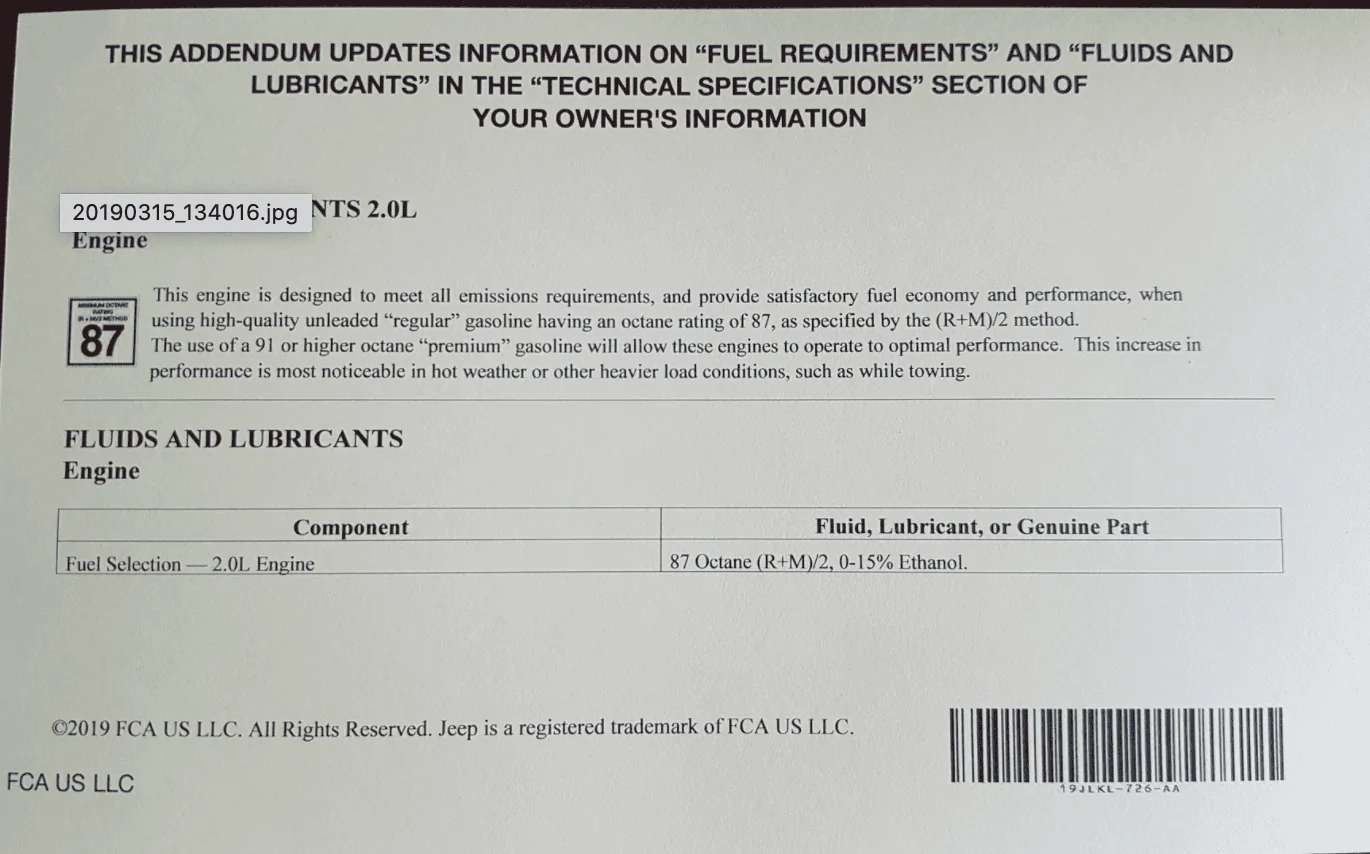
Here is the change included in the Addendum:It’s been clarified and changed for all JL model years including 2018. FCA even put out a special “blurb” about 18 months ago announcing the language Changes and clarifications
It’s absolutely your choice. But why do you think, based on the information you have, that the higher octane is “better for the engine?” The owners manual doesn’t say this. In the reverse, you are saying that 87 is “worse for the engine” yet, that is what FCA minimally requires. Why would they require something that is ”worse for the engine”?if it got a little better gas mileage, it may be worth it. And better on the engine.
Which, I believe, is exactly the language I posted from the 2020 owners manual on page 1.Here is the change included in the Addendum:

You are correct. You posted the reference in the manual.Which, I believe, is exactly the language I posted from the 2020 owners manual on page 1.

mostly referring to experience with small engines. Again, I am clearly not knowledgeable when I comes to these new engines. Hence the reason I posted the question. Thank you guys for all the replies and great info.It’s absolutely your choice. But why do you think, based on the information you have, that the higher octane is “better for the engine?” The owners manual doesn’t say this. In the reverse, you are saying that 87 is “worse for the engine” yet, that is what FCA minimally requires. Why would they require something that is ”worse for the engine”?
do this: have your wife or son fill up your Jeep for the next 6 months, they should log what they put in but not tell you. You should decide, tank by tank, what type of fuel that they put in. Log it. Can you tell? Maybe. Or maybe not.

It’s absolutely your choice. But why do you think, based on the information you have, that the higher octane is “better for the engine?” The owners manual doesn’t say this. In the reverse, you are saying that 87 is “worse for the engine” yet, that is what FCA minimally requires. Why would they require something that is ”worse for the engine”?
For the v6, you won't see or feel a difference, the 2.0t is a different story. Jeep doesn't give a number for the extra octane, just states for peak performance. Other manufacturers with similar engines actually give a hard number. Mazda rates the 2.5t engine 25hp higher on 93 octane vs 87. Being that jeep hp rating for the 2.0t is very similar, the difference really could be 10% more horsepower. We've run nothing but 91 in our 2019 jlur, so I can't say if you'd feel a difference. I can say that even on mountain passes above 10,000 ft this jeep is a rocket compared to any other jeep I've ever driven (20+ fwiw) and I wouldn't dream of degrading that performance in order to save a couple bucks.


David,
I used to be a Powertrain Software Engineer for Chrysler back on the 2000 through 2008 model year programs. I helped design and implement quite a bit of the software on their Small Car, Large Car and Jeep/Truck Engine Control Module programs back then. And candidly, I had only left that really phenomenal gig in Auburn Hills, MI to move to the Front Range of Colorado. I still design and develop really cool software, just no longer for the automotive industry. However I feel I'm still qualified to answer your question.
As a matter of personal opinion (with some inside knowledge), I'm quite certain the owner's manual specifies using the lower octane (lower cost) fuel simply as a subtle mechanism to promote a lower cost of ownership for it's vehicles. If it did mention the possible range of fuels, or to use only the best possible fuel, may possibly turn some potential buyers off. Yet regardless of their reasons, they can certainly do a better job in trying to minimize the confusion on this subject. I suspect that their market research explicitly determined to avoid this subject altogether.
First, the car company needs to certify both emissions and fuel economy based on worst case fuel specifications, not the best. Second, there are indeed installed systems on the engine designed to detect knock dynamically (on-the-fly) in real time and adjust various engine parameters to decrease the amount of knock sensed. It does this through both dedicated knock sensors and engine performance metrics. The parameters adjusted are typically spark timing and fuel injector pulsewidth. There are other variables as well but this detail isn't really that important for our overall (informal) discussion. The physics and the implemented algorithms are indeed way more sophisticated than what I'm simply describing here.
However, while the engine can certainly 'react' to limit knock as it happens it is still nonetheless 'after-the-fact' of the knock event itself. In other words, the knock prevention algorithms only work after these conditions have happened to begin with.
The theoretical goal is to prevent any knock in the first place. Engine knock of any type or amount is DETRIMENTAL in some way. Knock is caused by improper detonation which works against the mechanics of the crankshaft's rotation. So rather than contributing to the engine's overall power output (torque) any knock at all, no matter how small, is retarding it. Unfortunately, this improper detonation can also cause piston damage (due to the unintended mechanical vibrations from the knock itself). These vibrations are acting on the piston and the rings causing excessive and undesireable wear on the piston's walls (all of it's sliding surfaces).
Suscinctly stated, the best possible internal combustion operation is therefore to NEVER have any knock whatsoever in the first place, period.
Another misconception is that octane is a measure of a fuel's energy content. This is false. Octane is a measure of the fuel's ignition flashpoint. The higher the octane value, the more consistent the pressure and temperature needs to be in order to ignite. It's a measure of the fuel's ability to combust at the exact same flash-point threshold reliably. The lower the octane, the larger the range of pressure and temperature values where this flash-point may occur.
Therefore the higher the octane, the more consistent this threshold is where the fuel actually ignites. The more consistent this is the easier it is for the engine controller software to determine and maintain the best possible spark timing, using the smallest possible injector pulsewidth (least amount of fuel) to produce the desired output torque based on accelerator pedal position (demanded speed).
Again with lower octane fuel, it's ignition flash-point is less consistent and the 'predicted' spark timing or pulsewidth calculation for each cylinder may not be as accurate for each particular combustion event. If this prediction is ever even slightly wrong, improper combustion can occur leading to a knock condition. So in theory, anything that can contribute to a more accurate combustion equation, where the spark is delivered to the piston's stroke in the most optimal position, lowers the probability for a knock event in the first place.
Recall, the engine controller software must always readjust it's variables to predict the spark timing for the next combustion event based on what it currently sensed for this as well as statistical calculations from some number of previous events. The more consistent these dynamics are, the smaller the adjustment required between events and the better the engine performs.
In summary, using premium fuel regardless of what they recommend and independent of whether you can afford it, will always be in both you and your engine's best interest.
I personally always use premium fuel and full synthetic oils (different topic). However, I achieved almost 300,000 miles on my previous vehicle, a 2005 Dodge Grand Caravan. The only thing that was not stock on it's 3.3L engine was a replaced water pump and an EGR valve. I might still be driving it if a distracted 16 year old on his phone hadn't pulled out into traffic. Luckily I swerved at 40mph, or he would have been T-boned. No one was injured but both vehicles were totaled. It's the reason I now have this wonderful JL Sport. I'm truly intending to put even more miles on this vehicle.
Hope this helps.
Jay


