
Sponsored

Turtleback Expedition and JLU Towing Capacity?

OP
OP
SuperNerdEE

SuperNerdEE

Well-Known Member
Joined
Oct 12, 2018
Threads
12
Messages
80
Reaction score
66
Location
Oregon
Vehicle(s)
2018 JL Rubicon
B1FDF74F-4083-47DD-9972-612284B133A8.jpeg
34078BB2-8D5E-493B-94A9-5FB608B95CCA.jpeg

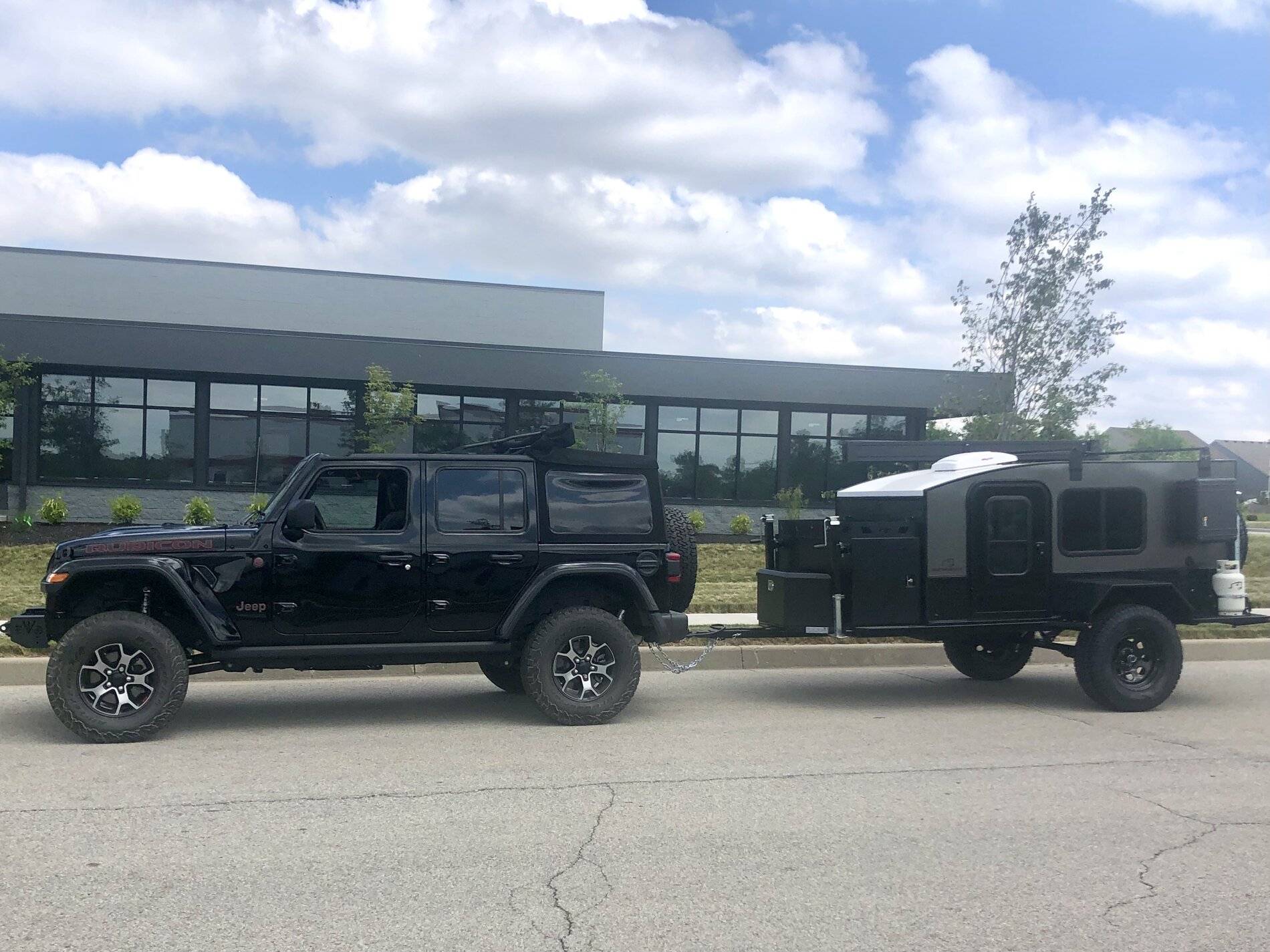
Hiker Trailer Off Road Extreme. Going on 2 years, we love it! 2018 JLU pulls it no problem. Up hills little sluggish but we’re not looking to set land speed record
Nice looking setup! How much does your trailer weigh packed? And what kind of lift do you have (at least it sure looks like you have one...)?
Sponsored


entropy

Well-Known Member
Joined
Sep 19, 2018
Threads
90
Messages
4,747
Reaction score
8,259
Location
Foothills of the San Gabriels
Vehicle(s)
2025 Jeep Wrangler Willys XR '41
Build Thread
Link
Occupation
OF top 1% content creator
B1FDF74F-4083-47DD-9972-612284B133A8.jpeg
34078BB2-8D5E-493B-94A9-5FB608B95CCA.jpeg

Hiker Trailer Off Road Extreme. Going on 2 years, we love it! 2018 JLU pulls it no problem. Up hills little sluggish but we’re not looking to set land speed record
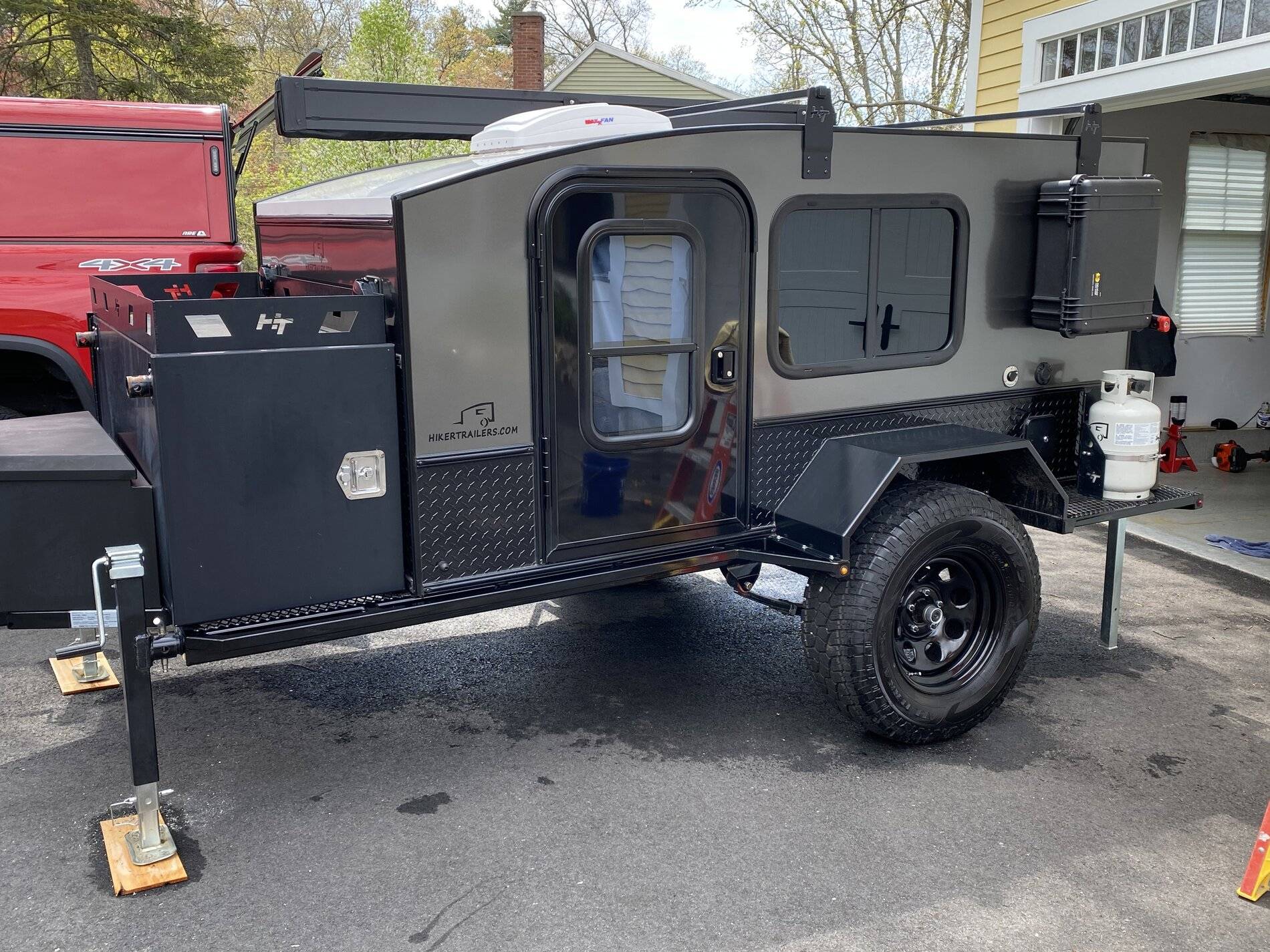
Nice looking trailer. cant wait to get mine.
 

NCJL

Well-Known Member
Joined
Feb 28, 2020
Threads
33
Messages
314
Reaction score
223
Location
EastBay
Vehicle(s)
2020 Rubicon
I just wanted to take a moment to post about the electrical issues. NCJL mentioned that all things were tied to the trailers chassis and that this is somehow wrong. I want to put my two cents in here.

It is common for power return (negative, neutral, whatever you want to call it) to be tied to chassis. Cars do this, trailers do this, and even airplanes do this. How do I know airplanes do it? I'm an electrical engineer in aerospace who works primarily in power electronics design and I design the electronic circuits that make up components akin to what is in this trailer. I've worked on fighter jets like JSF, big commercial aircraft like Boeing 777X, 737, 787, Gulfstream & Bombardier business jets, and recently the C-130J. Point being that tying all negative terminals to chassis is fine. Not only is it fine its standard practice.

So what special consideration do you need for a trailer like this? One thing you need to be careful with in this situation is the negative for the battery itself, which is the current return path. Why? It's for the battery monitor to properly function. The battery monitor works by monitoring current flow return back into the battery, so the shunt (a resistor) MUST be in series with it's connection to the chassis. This shunt is used to develop a voltage when current flows into the battery, and then that resultant voltage is monitored by the battery monitor. Classic ohms law stuff here: the resistance of the shunt is known (shunt is supplied by the battery monitor MFG) and the voltage developed across it is linearly related to the current through it. The monitor "knows" this relationship and uses it to determine the current at any given time and then accumulates the total current over time to record battery usage in amp-hours (Ah).

As long as this shunt is in series with the battery and the other side of it connected to the chassis, all the battery's loads (the electronics the battery powers) can be tied directly to the chassis. I have attached a crude diagram showing the equivalence using wires directly to loads or all things tied to the trailers chassis.

What about other sources that may exist besides the battery? Doesn't matter, at least not from the battery monitors perspective. Current must flow in a loop, meaning all current sourced by the batteries positive terminal must return to its negative. Will other sources muck this up? Nope. That's thanks to kirchhoff's current law: if there are other voltage sources in the trailer, their currents will not flow into the batteries negative terminal but they will flow back into whatever negative they have. That's current loops, folks.

So everything can be tied to the chassis. BUT, if your battery negative is tied to the chassis, then yes, you have a problem and the battery monitor won't work. That shunt has to be there.

I can't speak to the problems that NCJL had. I haven't seen his wiring issues. Certainly to light of a gauge wire will cause problems with the inverter, and if the shunt was bypassed or not installed then the monitor would fail to function. I've actually asked to see all of TB's wiring schematics and they've even sent me pictures of the electrical build and a diagram. All of it looks fine to me, including wire gauge.

I'm not saying this to discredit NCJL or state he didn't have issues or a bad build because someone did it poorly or used the wrong gauge or miswired the shunt. That's not for me to decide since I have no data. But I do want to drive the point drive home that the generic statement that NCJL made is misleading, if not incorrect entirely: "The wiring on the trailer that we bought was done in a manner similar to any utility type trailer, the frame is the negative. The return path/negative with a battery monitoring system must be done with wiring and separated from the tow vehicle."

trailer wiring.png
When the trailer jacks are down front and/or back you have added additional Negative/return paths, Earth. The tow vehicle is also a potential negative/return path. The tow vehicle provides the power for Brakes, brake lights, reverse lights and so on. We don’t want to include tow vehicle supplied power through the shunt. The battery monitoring system only has one Shunt/resister to monitor the negative/return path. Electricity takes the shortest/least resistance path to return to negative/Earth. The power sources and return sources must be separated for the battery monitor to only monitor the trailer battery.

In addition.
The negative wiring on the trailer delivered to me had pathways to the batteries installed around the shunt. Both sides of the shunt were attached to the frame. To further verify the accuracy of the battery monitor I would turn on/off loads and see what the monitor was saying. The only load the monitor would see was the inverter. This was due to the close proximity of the inverter to batteries. The closest least resistance path back to negative/Earth was through the shunt.

The Battery Monitor Shunt must also have all of the charging current going through the shunt. TB installed a solar port/controller and 120volt charger positive wire directly to 1 of the batteries with the negative tied to the frame, around the Shunt. No charge would ever be monitored.

After re-wiring the trailer I can monitor every load and charge amp down to the .1 amp.

All I did was install the Battery Monitor System per the manufacturer installation instructions, which TB did not do. No one from TB could speak to me with knowledge of the basic installation fundamentals of the battery monitor system.

The other electrical items that I re-wired to follow manufacturer installation instructions were:
2000 watt inverter. Increase wire size do to voltage drop and ampacity/load. Change fuse size. TB used #4 AWG. Instructions 2/0 AWG.
Battery wiring. Same reasons as above. Also wired batteries to allow for equal discharge and charging across batteries equally. The TB wiring would allow discharge and charging from 1 battery more than the other.
Solar Controller fixed with battery wiring.
120volt charger was replaced per Manufacturer instructions. Charger was designed to charge only one battery regardless of size. Also due to the equal charging as mentioned above.
Battery enclosure boxes discarded. Not installed utilizing the manufacturer provided mounting points.

Sorry for being so long.
 
OP
OP
SuperNerdEE

SuperNerdEE

Well-Known Member
Joined
Oct 12, 2018
Threads
12
Messages
80
Reaction score
66
Location
Oregon
Vehicle(s)
2018 JL Rubicon
Was the shunt between the negative terminal of the battery and chassis?
 

Sponsored

OP
OP
SuperNerdEE

SuperNerdEE

Well-Known Member
Joined
Oct 12, 2018
Threads
12
Messages
80
Reaction score
66
Location
Oregon
Vehicle(s)
2018 JL Rubicon
When the trailer jacks are down front and/or back you have added additional Negative/return paths, Earth. The tow vehicle is also a potential negative/return path. The tow vehicle provides the power for Brakes, brake lights, reverse lights and so on. We don’t want to include tow vehicle supplied power through the shunt. The battery monitoring system only has one Shunt/resister to monitor the negative/return path. Electricity takes the shortest/least resistance path to return to negative/Earth. The power sources and return sources must be separated for the battery monitor to only monitor the trailer battery.

In addition.
The negative wiring on the trailer delivered to me had pathways to the batteries installed around the shunt. Both sides of the shunt were attached to the frame. To further verify the accuracy of the battery monitor I would turn on/off loads and see what the monitor was saying. The only load the monitor would see was the inverter. This was due to the close proximity of the inverter to batteries. The closest least resistance path back to negative/Earth was through the shunt.

The Battery Monitor Shunt must also have all of the charging current going through the shunt. TB installed a solar port/controller and 120volt charger positive wire directly to 1 of the batteries with the negative tied to the frame, around the Shunt. No charge would ever be monitored.

After re-wiring the trailer I can monitor every load and charge amp down to the .1 amp.

All I did was install the Battery Monitor System per the manufacturer installation instructions, which TB did not do. No one from TB could speak to me with knowledge of the basic installation fundamentals of the battery monitor system.

The other electrical items that I re-wired to follow manufacturer installation instructions were:
2000 watt inverter. Increase wire size do to voltage drop and ampacity/load. Change fuse size. TB used #4 AWG. Instructions 2/0 AWG.
Battery wiring. Same reasons as above. Also wired batteries to allow for equal discharge and charging across batteries equally. The TB wiring would allow discharge and charging from 1 battery more than the other.
Solar Controller fixed with battery wiring.
120volt charger was replaced per Manufacturer instructions. Charger was designed to charge only one battery regardless of size. Also due to the equal charging as mentioned above.
Battery enclosure boxes discarded. Not installed utilizing the manufacturer provided mounting points.

Sorry for being so long.
I hit reply by accident. Was the shunt in between the negative terminal and chassis? It should be. If not then it was wrong. If it was all thing scan be tied to the chassis. There is no ther path to the battery through some mysterious concept of “ground.” If that shunt is there then ANY current going into or out from the battery must go through the shunt. It is not physically possible for current to flow in or out of the battery and not go through that shunt. That violates every electrical physical law.

Maybe I’m not picking up what your putting down but what you are saying doesn’t make sens in that regard.
 
OP
OP
SuperNerdEE

SuperNerdEE

Well-Known Member
Joined
Oct 12, 2018
Threads
12
Messages
80
Reaction score
66
Location
Oregon
Vehicle(s)
2018 JL Rubicon
Now I have reread and reread what you stated and the number one issue I see that Turtleback had in your setup is if both sides of the shunt are tied to the chassis: that won't work. That effectively short circuits the shunt, offering another path for current to flow around it. Thank you for that clarification and my apologies, I missed it. But my guess is that the inverter showed up only because it drew enough current. Your proximity argument doesn't work because all current must flow back to the negative terminal of the battery.

And that's what's hard for me here is you've got some things, like the shunt being bypassed, that are definitely evidence of incorrect wiring. But you keep making these odd statements that injure your position that are nonsensical. For instance:

"Electricity takes the shortest/least resistance path to return to negative/Earth. "

That's not true, at least how you imply what it means by your statement, "When the trailer jacks are down front and/or back you have added additional Negative/return paths, Earth." Electrical potential is all about the difference in electrical potential between two points, and voltage references are completely relative. If an electrical potential exists, which is what we call voltage, then current will flow from the higher potential to the lower potential through whatever conductor exists.

But stating that electricity takes the shortest path to "earth" is nonsense. Current flows from high potential through any conductive materials following ohms law, V=IR. Engineers refer to the flow of current in that it is a loop: you have to have a connection between the two potentials to allow current to flow. Earth means nothing. Ground means nothing. The entire concept of ground and earth is utterly meaningless. Ground is simply another potential to manage a reference point.

Try this out. Take a 12V battery and connect one of the two leads of a 12V lamp to the positive terminal, then take the other lead from the lamp and attach it to the earth (ground). Nothing will happen. The lamp will not illuminate. Attach it to anything except for the negative terminal of the battery and that lamp will remain off. Because current must flow from the positive terminal to the negative. Once you've done that, hell you can then tie the negative terminal to the ground if you wish, or the chassis of a car, some random hunk of metal, doesn't matter. Matter of fact, in this thought experiment you could even tie the positive terminal to the ground while the lamp is in the circuit and it will have ZERO effect. And no current will flow into ground that way either.

I hate to be a hard ass about all this, but I literally do this for a living. I have taught quite a few folks the finer details of it and I interview undergraduate students who spent 4 years studying it to determine if they understand it.

But, if they bypassed your shunt by attaching both sides of it to the chassis, yeah no, that won't work.
 
OP
OP
SuperNerdEE

SuperNerdEE

Well-Known Member
Joined
Oct 12, 2018
Threads
12
Messages
80
Reaction score
66
Location
Oregon
Vehicle(s)
2018 JL Rubicon
Sorry, NCJL, I keep rereading it and realizing you said other things I didn't notice. Breifly.

Wire AWG is on them.

And tying the solar panel to the negative of a battery is wrong too. Everything must go to the shunt which can be done via the chassis, so long as the shunt isn't bypassed.

Anyway. Sounds like there were certainly some errors on their end. I have been grilling them over their wiring and have been given diagrams and photos of the setup. It is (at least now) correct. I'm sorry you had such a headache.

I don't know what setup you had, but the BMV 712 included shunt has a black mounting bracket attached to the shunt with holes on either side for mounting. I'm operating under the assumption that that black mounting plate is not electrically conductive (at least not significantly), otherwise the mounting points need to be attached to something non conductive. Their installation guide doesn't make it clear.
 

Sponsored

OffroadCalling77

Well-Known Member
First Name
Josiah
Joined
Jan 3, 2021
Threads
74
Messages
2,415
Reaction score
3,425
Location
Brea, CA
Vehicle(s)
21 Rubicon 392, 21 Sahara Altitude
Occupation
Biz Owner
This post got too nerdy. EE nerdy.
I’ll be holding my final judgment until his feedback on the wiring when he picks up his trailer next month.
 
Last edited:

NCJL

Well-Known Member
Joined
Feb 28, 2020
Threads
33
Messages
314
Reaction score
223
Location
EastBay
Vehicle(s)
2020 Rubicon
This post has gotten nerdy!

I’m only sharing my experience with my TurtleBack purchase. TB sent me a 2,000.00 check for the electrical repair. This only covered my out of pocket cost not labor. All I had to do was follow manufacturer installation instructions for each item and it worked.

The electrical system as installed by TB did not work as advertised, did not function as manufacturer recommended. The battery monitor didn’t monitor and then it did. The 2000 watt inverter would supply over 600 watts and then it did. And so on.

The electrical system is just one of the major problems. I consider the suspension, tire carrier and weight of the trailer to be of more concern. Possible injury and or death!

TB Installed 2” wheel spacers on my trailer. The tires rubbed the inner fender. I called TB. TB first suggested they would send me 3” wheel spacers. I replied that spacers would only be accepted if the wheel hub/spindle manufacturer stated in writing that the load carrying capacity would not be lowered with the use of wheel spacers. TB did not supply this and then offered to provide me the upgraded ICON suspension. I would still need to supply a different wheel with a backspacing of around 4” to not need wheel spacers.

I was told by TB staff when picking up the trailer they only had one wheel come loose and separate from a trailer causing the trailer to be damaged. Not sure what the damage was to trailer or others in the path of the separated wheel. TB said that the customer did not properly torque the wheel adapter causing the failure. This information was told to me because I questioned the use and safety of wheel spacers/adapters.

Also when picking up the trailer TB showed me the pad lock capability of the recently upgraded tire carrier. This was added because some of the tire carriers had opened on the road causing damage. This information was just offered. I did not inquire about the tire carrier
 

OffroadCalling77

Well-Known Member
First Name
Josiah
Joined
Jan 3, 2021
Threads
74
Messages
2,415
Reaction score
3,425
Location
Brea, CA
Vehicle(s)
21 Rubicon 392, 21 Sahara Altitude
Occupation
Biz Owner
This post has gotten nerdy!

I’m only sharing my experience with my TurtleBack purchase. TB sent me a 2,000.00 check for the electrical repair. This only covered my out of pocket cost not labor. All I had to do was follow manufacturer installation instructions for each item and it worked.

The electrical system as installed by TB did not work as advertised, did not function as manufacturer recommended. The battery monitor didn’t monitor and then it did. The 2000 watt inverter would supply over 600 watts and then it did. And so on.

The electrical system is just one of the major problems. I consider the suspension, tire carrier and weight of the trailer to be of more concern. Possible injury and or death!

TB Installed 2” wheel spacers on my trailer. The tires rubbed the inner fender. I called TB. TB first suggested they would send me 3” wheel spacers. I replied that spacers would only be accepted if the wheel hub/spindle manufacturer stated in writing that the load carrying capacity would not be lowered with the use of wheel spacers. TB did not supply this and then offered to provide me the upgraded ICON suspension. I would still need to supply a different wheel with a backspacing of around 4” to not need wheel spacers.

I was told by TB staff when picking up the trailer they only had one wheel come loose and separate from a trailer causing the trailer to be damaged. Not sure what the damage was to trailer or others in the path of the separated wheel. TB said that the customer did not properly torque the wheel adapter causing the failure. This information was told to me because I questioned the use and safety of wheel spacers/adapters.

Also when picking up the trailer TB showed me the pad lock capability of the recently upgraded tire carrier. This was added because some of the tire carriers had opened on the road causing damage. This information was just offered. I did not inquire about the tire carrier
I hate to say this but it sounds like you may have been a tool used to correct outstanding fabrication and installation issues. Sounds like maybe the new owner began fixing these things over the last year since he bought. Optimistic?
 

Wow 392

Banned
Banned
Banned
First Name
Ward
Joined
Jun 22, 2021
Threads
0
Messages
3
Reaction score
0
Location
The World
Vehicle(s)
2016 JK Hard Rock, 2018 JKURR Recon, 2021 JLUR 392
I'm getting very seriously interested in Turtleback's Expedition 2.0. Dry weight of this trailer is 1,850 lbs, and the towing capacity of the JLU is 3,500 lbs. Full tank of water is nearly 400 lbs, add a bunch of gear and a roof top tent and its conceivable to reach or maybe even exceed 3500 lbs. Personally I doubt that, but I read a review stating that the weight can get up to 400 lbs (link for those interested https://theprepared.com/blog/turtleback-expedition-review/ )

Anyway, please let me know if you run with this trailer or similar and how towing it with your JLU has worked out. FYI I have a 2018 8-speed auto with the 3.6L V6.
We built our own using a Smittybilt trailer. Ours is about 2700 lbs loaded out. It pulls just fine, only notice on Interstates but we never drive them anyway.
 
OP
OP
SuperNerdEE

SuperNerdEE

Well-Known Member
Joined
Oct 12, 2018
Threads
12
Messages
80
Reaction score
66
Location
Oregon
Vehicle(s)
2018 JL Rubicon
This post has gotten nerdy!

I’m only sharing my experience with my TurtleBack purchase. TB sent me a 2,000.00 check for the electrical repair. This only covered my out of pocket cost not labor. All I had to do was follow manufacturer installation instructions for each item and it worked.

The electrical system as installed by TB did not work as advertised, did not function as manufacturer recommended. The battery monitor didn’t monitor and then it did. The 2000 watt inverter would supply over 600 watts and then it did. And so on.

The electrical system is just one of the major problems. I consider the suspension, tire carrier and weight of the trailer to be of more concern. Possible injury and or death!

TB Installed 2” wheel spacers on my trailer. The tires rubbed the inner fender. I called TB. TB first suggested they would send me 3” wheel spacers. I replied that spacers would only be accepted if the wheel hub/spindle manufacturer stated in writing that the load carrying capacity would not be lowered with the use of wheel spacers. TB did not supply this and then offered to provide me the upgraded ICON suspension. I would still need to supply a different wheel with a backspacing of around 4” to not need wheel spacers.

I was told by TB staff when picking up the trailer they only had one wheel come loose and separate from a trailer causing the trailer to be damaged. Not sure what the damage was to trailer or others in the path of the separated wheel. TB said that the customer did not properly torque the wheel adapter causing the failure. This information was told to me because I questioned the use and safety of wheel spacers/adapters.

Also when picking up the trailer TB showed me the pad lock capability of the recently upgraded tire carrier. This was added because some of the tire carriers had opened on the road causing damage. This information was just offered. I did not inquire about the tire carrier
Sorry for being so nerdy. I will try and pull it back ;)

Again, it sure sounds like they messed up your wiring in a variety of ways. My understanding is they lacked a schematic for builds - per TB every build was custom enough that they hadn't come up with wiring diagrams. Thankfully that has changed. I will be testing and exercising the electrical system to every extent when I pick up my trailer to ensure it functions properly.

I know so little about spacers but I can understand the concern there given. Me I'm just slumming it with their standard size wheels/tires.

I am very curious about this pad lock on the tire carrier. I had never thought about the tire carrier opening on the road. That's a scary prospect. Is this now a standard option? Does you're trailer have that pad lock?

One more, in a post you had previously mentioned the u-bolts stretching, iirc. I got pictures from TB on how those u-bolts are setup, wrapped around the frame and going through the bumper up to the tire carrier. While I can see the large lever arm with the weight of the tire, I must say it is a little surprising that you could get plastic deformation of the bolts. That's actually scary because if that's happening the bolts could fail. Did you every address this, and how did you determine it was stretching on the bolt and not just the nuts getting loose?
Sponsored


Top