Sponsored

Sold on 89 Octane

OP
OP

YBABRAT

Well-Known Member
Joined
May 12, 2024
Threads
55
Messages
1,409
Reaction score
1,355
Location
VIRGINIA
Vehicle(s)
2019 2 Door Rubicon X Wannabe
Occupation
None... but it pays well.
For those of you who are not road tripping but have long daily commutes, you could save a ton of money by driving a $25,000 used Tesla Model 3. Fast, incredibly reliable, and cheap to drive if utilizing home charging. Way better than an Accord or Camry for that type of use case. Equivalent to gas car getting 100 - 125 mpg. Again- ideal use case; 200 miles or less per day with home charger availability.
If we only had electric cars, right now. The nation's power grid would fail. Also with the amount of fatal hwy accidents, who knows how bad fires would be an issue. At least engine fires you can walk away from. But a Li battery will burn around you. Richard Hammond narrowly escaped his test drive, and he rolled down a side embankment.
Sponsored


NWJeepr

Banned
Banned
Banned
Joined
Apr 28, 2023
Threads
29
Messages
3,638
Reaction score
7,876
Location
Twin Peaks
Vehicle(s)
2025 Wrangler 2-door
Here come all the professional environmentalists and electrical engineers to tell us in simple terms why EV's = bad. Meanwhile, those of us who also drive EV's just shake our heads. Ok boomers, yeah...
 

Windshieldfarmer

Well-Known Member
First Name
Randy
Joined
Feb 27, 2020
Threads
0
Messages
1,695
Reaction score
2,446
Location
Wichita, Ks
Vehicle(s)
2015 JKU, 2020 JlU on order
If we only had electric cars, right now. The nation's power grid would fail. Also with the amount of fatal hwy accidents, who knows how bad fires would be an issue. At least engine fires you can walk away from. But a Li battery will burn around you. Richard Hammond narrowly escaped his test drive, and he rolled down a side embankment.
EV fires are indeed bad when they occur…but are 90% less likely to occur than an ICE vehicle (based on identical number of miles driven).

Not to worried about the grid as adoption rates for EVs have slowed because of charging challenges…and the use case for EVs is somewhat narrow. All I know is it works well for me. I “fill up” my BMW IX at night for $8.00 which gives 300 miles of real range on a full charge. I also know my IX makes a 392 seem slow.

Candidly I am dramatically more at risk of dying in my Jeep while off-roading and rolling it down a mountain than I am dying in an EV fire.
 

Windshieldfarmer

Well-Known Member
First Name
Randy
Joined
Feb 27, 2020
Threads
0
Messages
1,695
Reaction score
2,446
Location
Wichita, Ks
Vehicle(s)
2015 JKU, 2020 JlU on order
Here come all the professional environmentalists and electrical engineers to tell us in simple terms why EV's = bad. Meanwhile, those of us who also drive EV's just shake our heads. Ok boomers, yeah...
By the way…I’m a boomer who drank the EV koolaid🙂🙂
 

Sponsored

ROkchips

Well-Known Member
First Name
Adam
Joined
Jan 25, 2022
Threads
5
Messages
112
Reaction score
82
Location
Fort Worth, Texas
Vehicle(s)
2024 Wrangler Rubicon
I did two tanks of Sonoco 89 and by 1/2 of second tank things stabilized to show better all around.

Top Avg MPG before move to 89... 22.4 MPG on 30 mile mountain hwy.
Now with 89, I get 25.6 MPG. I noticed better performance too. I could have had 26 MPG if my exit was not on a steep grade hill.

This recent measurement was in 90°F sunny day drive.

I think 89 is the minimum we should run on today's Mopar engines, even though manual states regular gas.
I have never ran 89 in anything that I have owned over the years as it was either 88 or 91/93 until this vehicle now its 89 all the time...didn't really see any improvement with higher octane.
 
OP
OP

YBABRAT

Well-Known Member
Joined
May 12, 2024
Threads
55
Messages
1,409
Reaction score
1,355
Location
VIRGINIA
Vehicle(s)
2019 2 Door Rubicon X Wannabe
Occupation
None... but it pays well.
I have never ran 89 in anything that I have owned over the years as it was either 88 or 91/93 until this vehicle now its 89 all the time...didn't really see any improvement with higher octane.
Donno... and it has been puzzling me with half saying no change on their 3.6L v6. I wonder if manual v6 engines see no benefit over automatics. Manuals are all driven differently.... nobody shifts quite the same and have less gears to work with. But if that were the case, it would prove oem axle gears need 15% to 20% more gear. The ECU does a lot of dynamic changes. Nobody can think so fast in changing gears and throttle position before actually making the adjustment.

I have proven keeping 2k to 2.5k RPM is a sweet spot for 4.10 gears and automatics. For a 6 speed, what is gained by my rule on rpm use, will wash out when either going below or being a lead foot.

I was able to get 23.5MPG until I did 3 fun runs up a mountain hill. At the end my MPG dropped to 21.5 or so. For me 70 to 73MPH with 91 octane can bring the best MPG given that momentum will pull through a hill sooner as engine within its power band will keep momentum strong. If loosing speed before you react, engine may be below 2000RPM and consume more gas while gaining momentum to pull through the hill. Again a little more gear will being RPMs up into the powerband. A lot of cars get the best MPG at 2100 to 2300 RPM. It's been that way since the 60s? Something to do with heat being more stable with operation and most gas engines really don't have a power band that fits well with 1200 to 1800 RPM.

I truly think Jeep short cutted on trying to make emissions requirements with gas milage. It only works good in flat lander driving. Most commuting is expressway and highway. If vehicle speed is constant and RPM is lower than average, you can get decent MPG. Basically jeep is dogging gas engines into being more urbanized by regulations and how Jeep implements cutting emissions where it counts.
 

Gunfighter

Well-Known Member
First Name
P.J.
Joined
Oct 7, 2020
Threads
16
Messages
580
Reaction score
949
Location
West Michigan
Vehicle(s)
2021 Jeep Wrangler High Altitude
Occupation
Trying not to get warning points
Vehicle Showcase
1
Made a difference for the better for my engine...YMMV.
 

1BadManVan

Well-Known Member
First Name
Darren
Joined
Feb 7, 2022
Threads
12
Messages
528
Reaction score
843
Location
Bc Canada
Vehicle(s)
2019 Wrangler JLU Sahara/2018 Durango R/T
Occupation
Locomotive Engineer
Donno... and it has been puzzling me with half saying no change on their 3.6L v6. I wonder if manual v6 engines see no benefit over automatics. Manuals are all driven differently.... nobody shifts quite the same and have less gears to work with. But if that were the case, it would prove oem axle gears need 15% to 20% more gear. The ECU does a lot of dynamic changes. Nobody can think so fast in changing gears and throttle position before actually making the adjustment.

I have proven keeping 2k to 2.5k RPM is a sweet spot for 4.10 gears and automatics. For a 6 speed, what is gained by my rule on rpm use, will wash out when either going below or being a lead foot.

I was able to get 23.5MPG until I did 3 fun runs up a mountain hill. At the end my MPG dropped to 21.5 or so. For me 70 to 73MPH with 91 octane can bring the best MPG given that momentum will pull through a hill sooner as engine within its power band will keep momentum strong. If loosing speed before you react, engine may be below 2000RPM and consume more gas while gaining momentum to pull through the hill. Again a little more gear will being RPMs up into the powerband. A lot of cars get the best MPG at 2100 to 2300 RPM. It's been that way since the 60s? Something to do with heat being more stable with operation and most gas engines really don't have a power band that fits well with 1200 to 1800 RPM.

I truly think Jeep short cutted on trying to make emissions requirements with gas milage. It only works good in flat lander driving. Most commuting is expressway and highway. If vehicle speed is constant and RPM is lower than average, you can get decent MPG. Basically jeep is dogging gas engines into being more urbanized by regulations and how Jeep implements cutting emissions where it counts.
Depends on your altitude as well. Higher the altitude, less dense air, less octane required. So lower altitude and denser air will make a bigger difference running a higher octane. Thats why places that are higher altitude, also sell lower octane fuel, because engines can run it.

We live at sea level, high humidity, we definitely notice the difference
 

Sponsored

2019JLUS

Banned
Banned
Banned
Joined
May 7, 2024
Threads
12
Messages
596
Reaction score
850
Location
USA
Vehicle(s)
19' Sport S
I did two tanks of Sonoco 89 and by 1/2 of second tank things stabilized to show better all around.

Top Avg MPG before move to 89... 22.4 MPG on 30 mile mountain hwy.
Now with 89, I get 25.6 MPG. I noticed better performance too. I could have had 26 MPG if my exit was not on a steep grade hill.

This recent measurement was in 90°F sunny day drive.

I think 89 is the minimum we should run on today's Mopar engines, even though manual states regular gas.
It sounds like you've made a solid case for 89 octane based on your experience. Engine performance and fuel economy can indeed improve with higher octane fuel, especially if the engine is tuned to take advantage of it. While the manual might specify regular, the engine management system can often adapt to higher octane fuels, potentially optimizing performance and efficiency. If you’re seeing those kinds of improvements, sticking with 89 octane could be a good choice for you.
 
OP
OP

YBABRAT

Well-Known Member
Joined
May 12, 2024
Threads
55
Messages
1,409
Reaction score
1,355
Location
VIRGINIA
Vehicle(s)
2019 2 Door Rubicon X Wannabe
Occupation
None... but it pays well.
It sounds like you've made a solid case for 89 octane based on your experience. Engine performance and fuel economy can indeed improve with higher octane fuel, especially if the engine is tuned to take advantage of it. While the manual might specify regular, the engine management system can often adapt to higher octane fuels, potentially optimizing performance and efficiency. If you’re seeing those kinds of improvements, sticking with 89 octane could be a good choice for you.
Also gearing... which I did correlate after thinking why some don't see improvement. Either stock lower trimmed JLs or modified for wheeling, gearing seems inadequate, do to weight and or larger wheels / tires.

I really think manuals have a disadvantage on seeing improvement and with any trim. A 20% larger gearing will improve both MPG and performance. At least with v6 the RPM range really needs to be around 2000RPM in cruising.

Another thing... Eboosted v6 had the same issue, but hidden by eboost in helping engine when in need for added power. Though it can only boost for short periods of time. Around here where I drive, eboost would not recover well for the amount of eboost need by v6. I don't have eboost but can see an issue with beeing limited by 24v battery reserve power.
 

jmr

Well-Known Member
First Name
Jim
Joined
Apr 2, 2018
Threads
12
Messages
298
Reaction score
640
Location
Wentzville, MO
Vehicle(s)
'24 JL Rubicon Unlimited, '25 JT Mojave
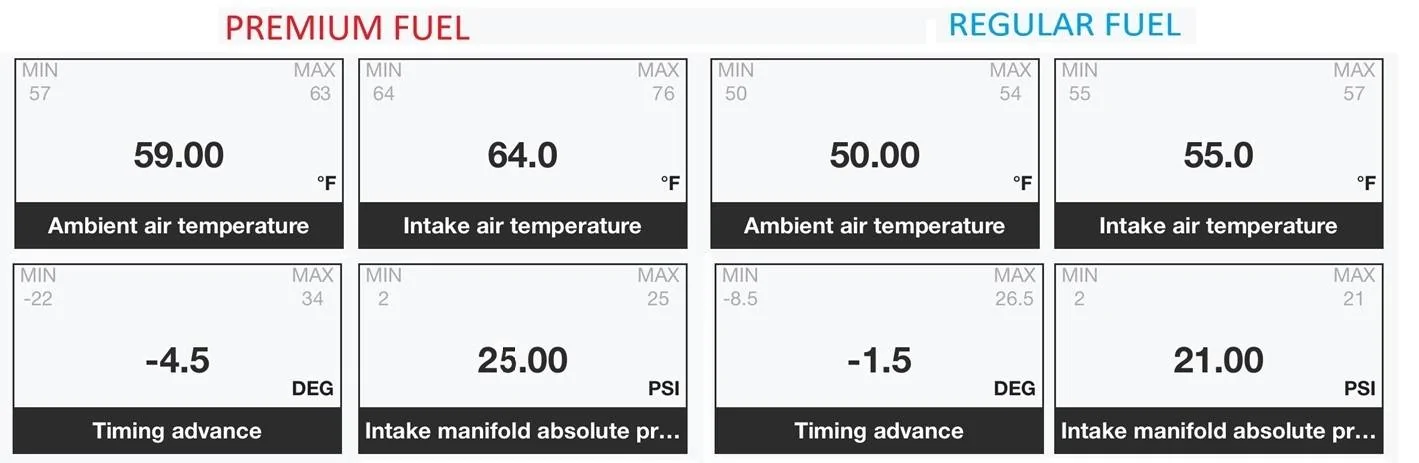
I have a 2.0l and used jscan to log the difference between 87 vs 93 octane. The ECU allows for more boost and timing running premium 93 vs regular 87 octane.
Jeep Wrangler JL Sold on 89 Octane PremiumRegularFuelComparison
 
OP
OP

YBABRAT

Well-Known Member
Joined
May 12, 2024
Threads
55
Messages
1,409
Reaction score
1,355
Location
VIRGINIA
Vehicle(s)
2019 2 Door Rubicon X Wannabe
Occupation
None... but it pays well.
I have a 2.0l and used jscan to log the difference between 87 vs 93 octane. The ECU allows for more boost and timing running premium 93 vs regular 87 octane.
PremiumRegularFuelComparison.jpg
That is a given... I refrained from a turbo because it states it runs on premium gas, as it is one issue that I did not want to deal with in summer heat.

I find it odd people will run it on regular. That is another issue that kept me away from a used turbo.

Nothing against a turbo 4, just it does not fit my requirements for my usage. Glad you found the right fuel. Remember, ethanol runs leaner than gas, so in hot weather find 93 for your turbo.
 

jimcoffey62

Well-Known Member
First Name
Jim
Joined
Jul 7, 2022
Threads
6
Messages
125
Reaction score
141
Location
Galveston County, TX
Vehicle(s)
2022 Wrangler 2 door sport
Build Thread
Link
Occupation
Engineer
Clubs
 
In this area, most gas stations have 87, 89, and 93 octanes. However, 89 is the least cost-effective grade to get. It seems to almost always be priced closer to 93 than it is to 87. So, if you need 89, the most cost-effective way to do it would be to fill half the tank with 87 and half with 93. You would end up with about 90 octane, and the price would be the net average price between the 87 and the 93, which around here is less than filling it with 89. .... But, I probably wouldn't do it that way if there was a line of people behind me waiting fo the pump. It does take a little more time, as you need to run the pump transaction twice.
fyi
the gas station only has two big tanks. There is no tank for 89 octane. It is blended at the pump.
Sponsored


Top