
Sponsored

Jumperless Aux Battery Bypass

Heimkehr

Well-Known Member
First Name
James
Joined
Sep 3, 2020
Threads
48
Messages
11,087
Reaction score
22,468
Location
Pennsylvania
Vehicle(s)
2021 JLU 2.0T
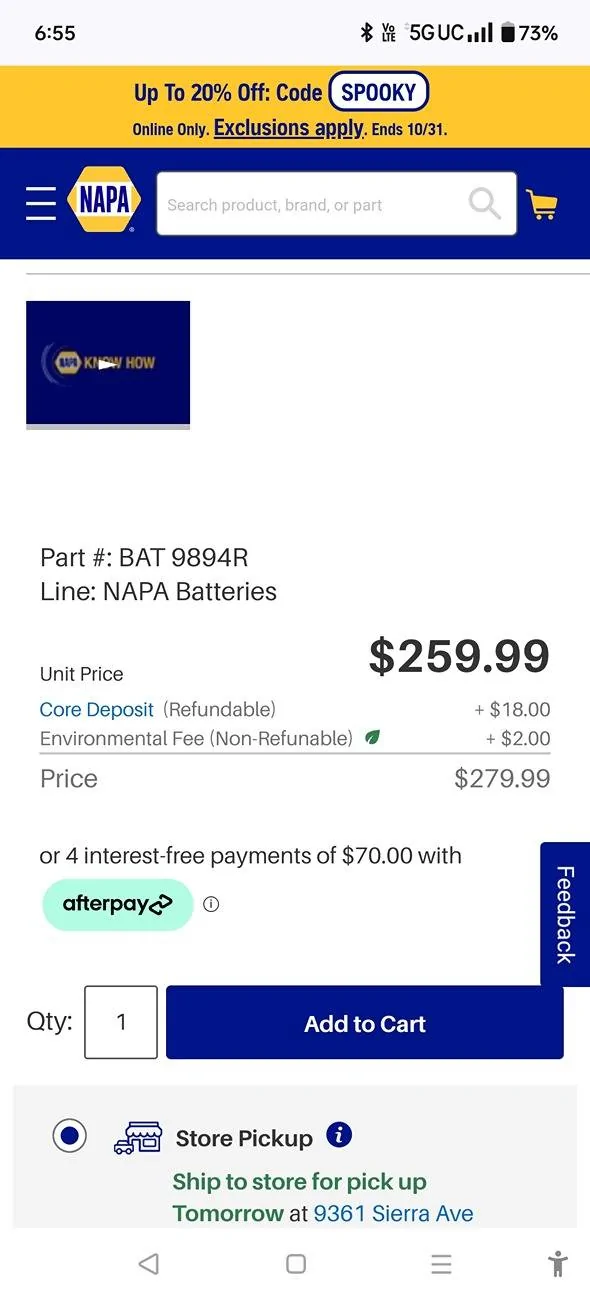
Would this be good? On sale.

Screenshot_2024-10-29-18-55-49-12_40deb401b9ffe8e1df2f1cc5ba480b12.jpg
Sure.

FWIW, the Interstate H7 AGM that I purchased at Costco was exactly $100.00 less than the Napa price, as well as the equivalent batteries sold at the chain auto stores. Just thought I'd mention that in case you have a membership.
Sponsored


JLRik

Well-Known Member
First Name
Rik
Joined
Oct 28, 2024
Threads
0
Messages
56
Reaction score
17
Location
Thousand Oaks CA
Vehicle(s)
2019 JL Rubicon
Sure.

FWIW, the Interstate H7 AGM that I purchased at Costco was exactly $100.00 less than the Napa price, as well as the equivalent batteries sold at the chain auto stores. Just thought I'd mention that in case you have a membership.
On it! To Costco I shall go. Regarding the aux battery, will anything be impacted if I leave it in there with positive connected/negative disconnected? Or better to yank it (and if so, what to do with positive cable)?
 

Heimkehr

Well-Known Member
First Name
James
Joined
Sep 3, 2020
Threads
48
Messages
11,087
Reaction score
22,468
Location
Pennsylvania
Vehicle(s)
2021 JLU 2.0T
On it! To Costco I shall go. Regarding the aux battery, will anything be impacted if I leave it in there with positive connected/negative disconnected? Or better to yank it (and if so, what to do with positive cable)?
Probably not, but I advocate full removal where possible. Any cable(s) that can't be easily removed should be well-taped on the ends, and secured in such a way that they don't foul anything else. 👍
 

JLRik

Well-Known Member
First Name
Rik
Joined
Oct 28, 2024
Threads
0
Messages
56
Reaction score
17
Location
Thousand Oaks CA
Vehicle(s)
2019 JL Rubicon
Probably not, but I advocate full removal where possible. Any cable(s) that can't be easily removed should be well-taped on the ends, and secured in such a way that they don't foul anything else. 👍
Where does the other end of the positive route to from the aux battery? Does it simply end up on the main battery positive post? I know that some folks advocate for pulling the aux battery from the fender panel area, while others go in from the top...I may opt for from the top because I don't have a supply of the plastic plugs that will surely break if I pull the inner fender panel.
 

AndySpill

Well-Known Member
First Name
Andy
Joined
Oct 24, 2023
Threads
72
Messages
1,659
Reaction score
1,273
Location
Pittsburgh
Vehicle(s)
2018 JL Sahara
Thanks again! For a 2019 Rubicon with the tow package, and the LED lights, which battery do you recommend? I'm a fan of Odyssey batteries, but I imagine there may be a better choice for the JLs?
I thought James' post @Heimkehr just prior a great answer to this question. :)
 

Sponsored

Mguy

Well-Known Member
Joined
Nov 29, 2023
Threads
6
Messages
408
Reaction score
386
Location
Far Away
Vehicle(s)
2020 JLUR 6spd MT
Owners who have the aux battery and are considering modification to electrically eliminate it should not be mislead by some recent posts in this thread. A mention to "reinsert Fuse 42 but leave the ESS battery disconnected," or an assertion that "full removal where possible" of the aux battery positive cables is desirable can lead to a bad outcome.

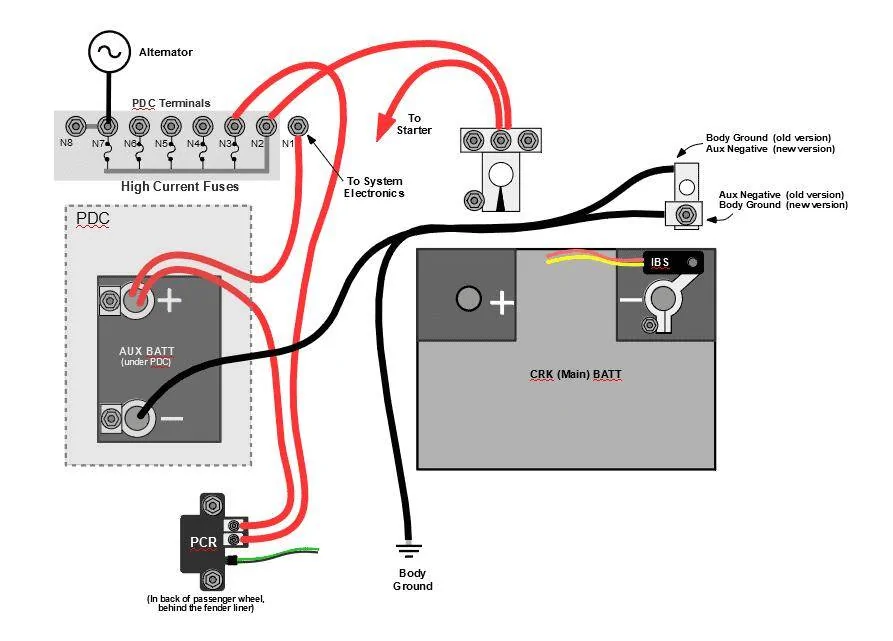
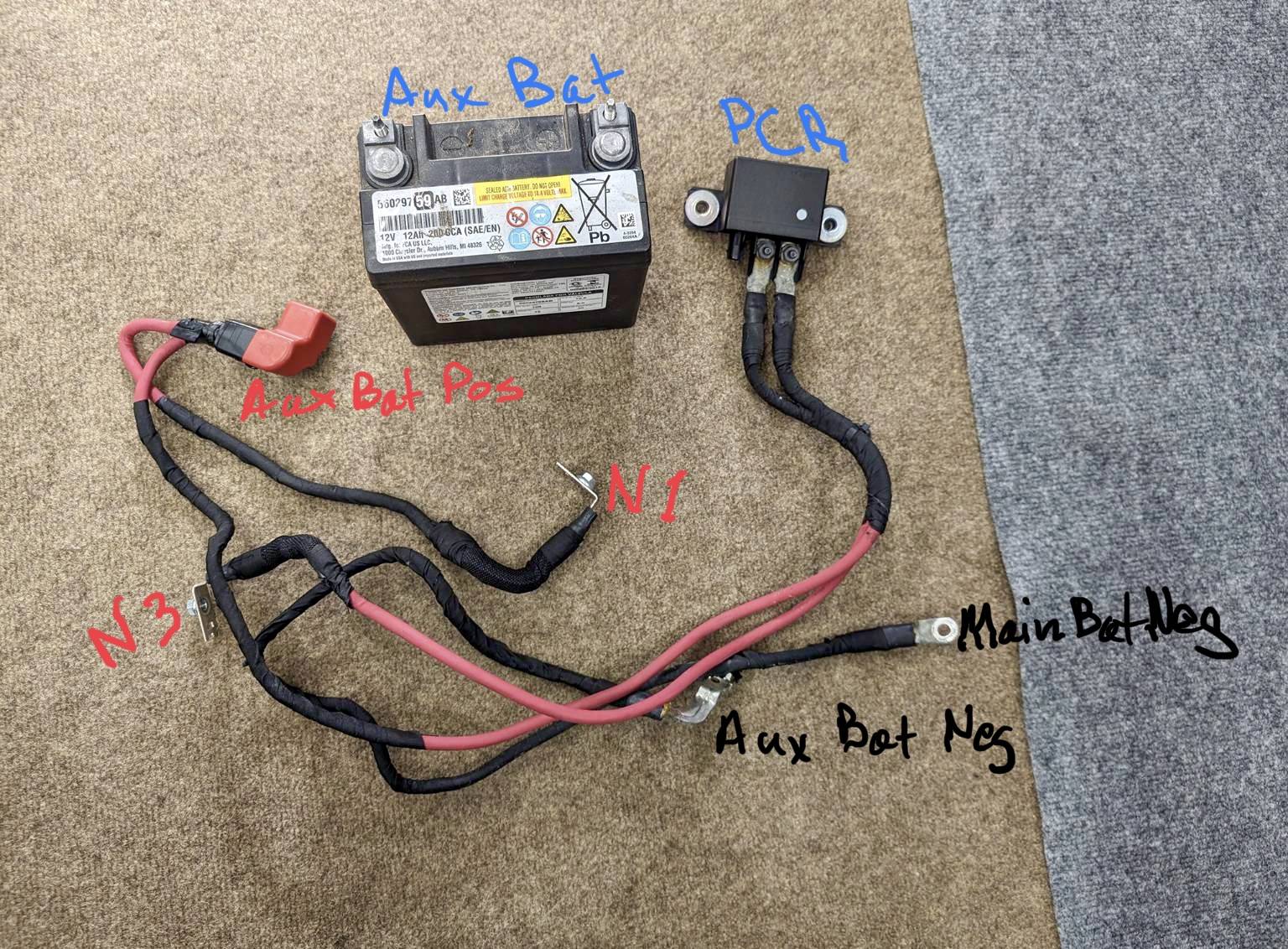
Some explanation. The stock aux battery cabling creates an electrically parallel subsystem of fused devices which receive power through the unfused N1 terminal. This subsystem has two power sources. There is the aux battery itself through one of its two positive cables that are directly attached to N1. The second aux battery positive cable provides the second power source from the main crank battery, by way of both the N3 150 amp fuse and the Power Control Relay (PCR). The F42 fuse operates on the PCR control circuit--it's removal prevents the PCR power circuit from opening and thus prevents power to N1 from being cut off.

When the aux battery is electrically removed by disconnecting it's negative, N1 obviously can no longer receive power from the aux battery. To receive power from N1's second source, the main battery, the two aux positive cables must remain connected to each other at aux battery terminal, and the PCR power circuit must remain closed. So, disconnecting and removing the positive cabling from themselves at the aux battery, or allowing the PCR to operate as a result of F42 being in place, will cut power to all N1 devices. Not good.

So again, for the aux battery positive, the correct procedure after disconnect of the aux battery negative is:

1) Remove F42 fuse.
2) Leave all positive cabling in place, whether or not the aux battery is physically removed. If removed, the cabling at the aux battery can either be insulated in place or brought up and connected to the main battery positive.
3) For owners more electrically inclined there are other options, including connecting N1 to N2 after removal of stock aux battery cabling.
 

JLRik

Well-Known Member
First Name
Rik
Joined
Oct 28, 2024
Threads
0
Messages
56
Reaction score
17
Location
Thousand Oaks CA
Vehicle(s)
2019 JL Rubicon
Owners who have the aux battery and are considering modification to electrically eliminate it should not be mislead by some recent posts in this thread. A mention to "reinsert Fuse 42 but leave the ESS battery disconnected," or an assertion that "full removal where possible" of the aux battery positive cables is desirable can lead to a bad outcome.

Some explanation. The stock aux battery cabling creates an electrically parallel subsystem of fused devices which receive power through the unfused N1 terminal. This subsystem has two power sources. There is the aux battery itself through one of its two positive cables that are directly attached to N1. The second aux battery positive cable provides the second power source from the main crank battery, by way of both the N3 150 amp fuse and the Power Control Relay (PCR). The F42 fuse operates on the PCR control circuit--it's removal prevents the PCR power circuit from opening and thus prevents power to N1 from being cut off.

When the aux battery is electrically removed by disconnecting it's negative, N1 obviously can no longer receive power from the aux battery. To receive power from N1's second source, the main battery, the two aux positive cables must remain connected to each other at aux battery terminal, and the PCR power circuit must remain closed. So, disconnecting and removing the positive cabling from themselves at the aux battery, or allowing the PCR to operate as a result of F42 being in place, will cut power to all N1 devices. Not good.

So again, for the aux battery positive, the correct procedure after disconnect of the aux battery negative is:

1) Remove F42 fuse.
2) Leave all positive cabling in place, whether or not the aux battery is physically removed. If removed, the cabling at the aux battery can either be insulated in place or brought up and connected to the main battery positive.
3) For owners more electrically inclined there are other options, including connecting N1 to N2 after removal of stock aux battery cabling.
Thanks for that detail explanation that makes things more clear. I have not yet disconnected the aux battery, but I'm assuming from the detail explanation that you provided that there are two positive cables that are attached to the auxiliary battery on a single terminal? And, if so, after I remove the aux battery I can simply leave the singular negative cable insulated and tied up out of the way that goes to the AUX battery terminal, and then connect the two positive cables together somehow and then wrap that connection? I don't want to end up with more headaches than I would by simply leaving things alone. My assumption is that if I'm going to disable the auto stop system anyways, that there is little use for the aux battery living in its current housing.
 

Mguy

Well-Known Member
Joined
Nov 29, 2023
Threads
6
Messages
408
Reaction score
386
Location
Far Away
Vehicle(s)
2020 JLUR 6spd MT
I can simply leave the singular negative cable insulated and tied up out of the way that goes to the AUX battery terminal, and then connect the two positive cables together somehow and then wrap that connection?

My assumption is that if I'm going to disable the auto stop system anyways, that there is little use for the aux battery living in its current housing.
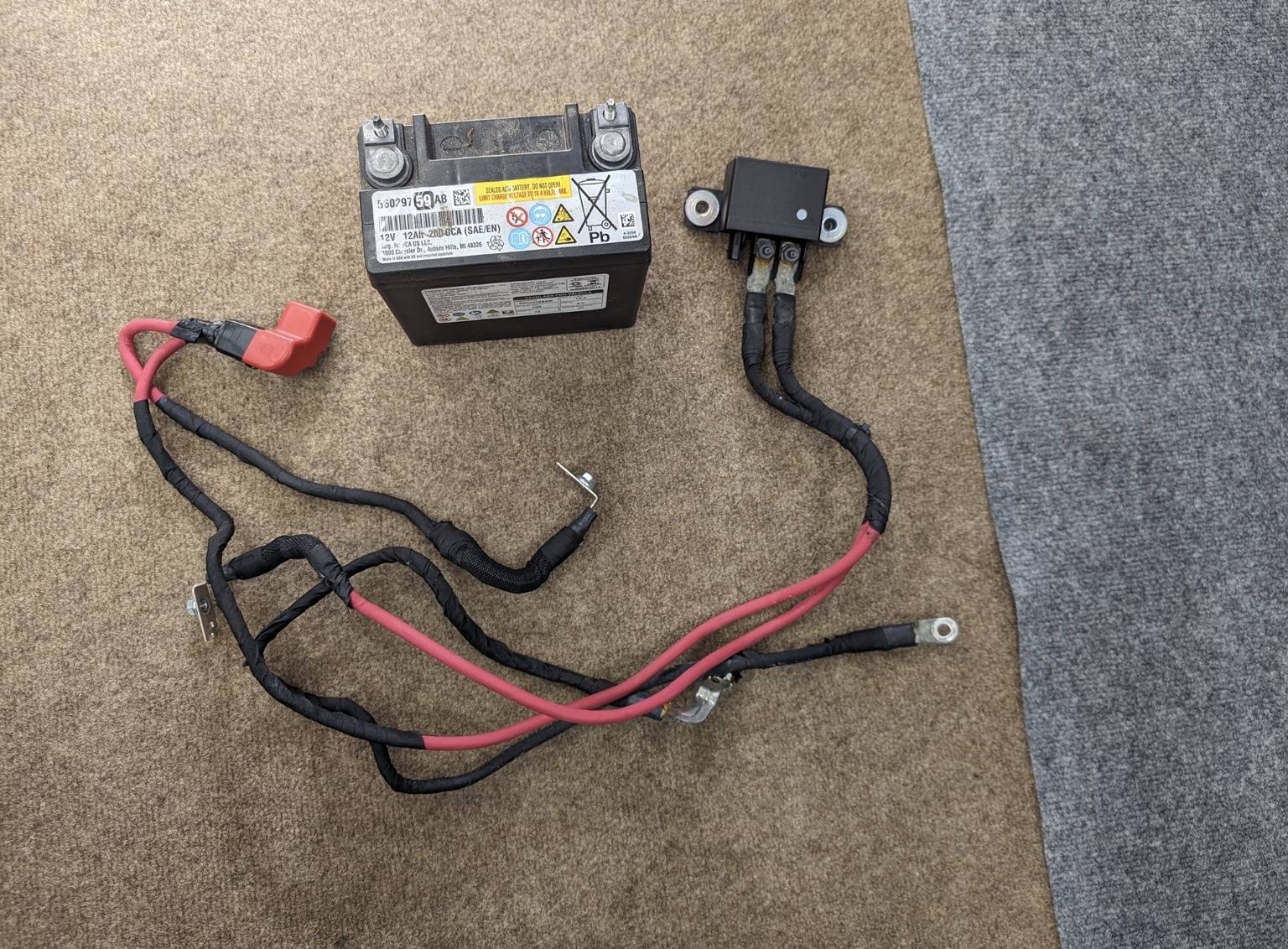
The black negative cable at the aux battery can be removed or it's terminal insulated. The red positive cables are already together at the aux battery terminal in the stock installation, but a bolt may be needed under the red terminal cap. See the below photo of a removed aux battery and it's cabling, which is from another owner on this forum.

To be clear about your assumption, ESS still operates after the aux battery negative/F42 disconnect. You have to either use the dash shut off button, or resort to aftermarket hardware/software, to prevent ESS operation.
Jeep Wrangler JL Jumperless Aux Battery Bypass ADFCFA0A-01D9-4560-9031-3CFA5EF51F30
 
Last edited:

Ratbert

Well-Known Member
First Name
John
Joined
Jun 20, 2020
Threads
159
Messages
16,165
Reaction score
25,238
Location
PNW
Vehicle(s)
2022 AEV JL370 JLURD
Build Thread
Link
Occupation
Software Engineer
Clubs
 

Sponsored

THAW

Well-Known Member
First Name
Foster
Joined
Oct 28, 2022
Threads
4
Messages
2,258
Reaction score
3,116
Location
PNW - prefer Middle of Nowhere
Vehicle(s)
23 JL4DrRubicon
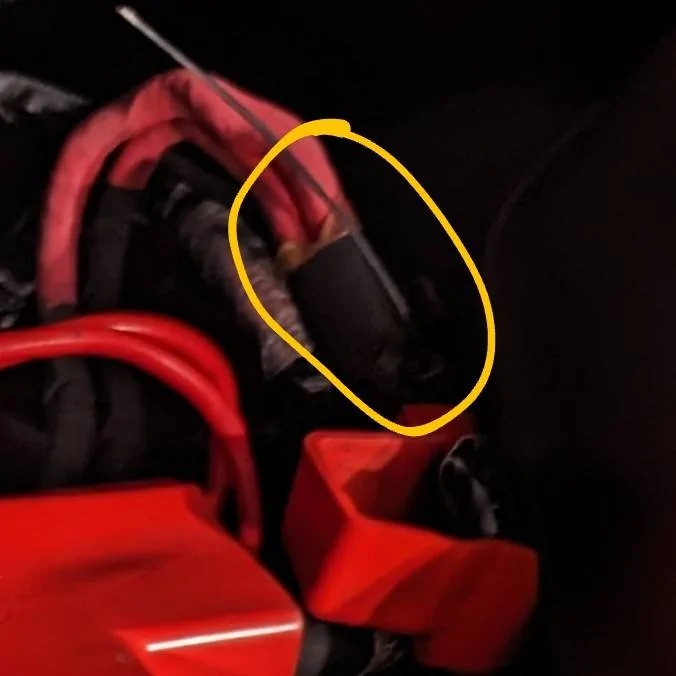
The red positive cables are already together at the aux battery terminal in the stock installation, but a bolt may be needed under the red terminal cap.
Minor point of clarification: the two positive AUX (ESS) battery cables are in fact crimped together on one connector.

Best photo I have:
Jeep Wrangler JL Jumperless Aux Battery Bypass 1000003574
 
Last edited:

JLRik

Well-Known Member
First Name
Rik
Joined
Oct 28, 2024
Threads
0
Messages
56
Reaction score
17
Location
Thousand Oaks CA
Vehicle(s)
2019 JL Rubicon
Or if you're fortunate enough to have an EcoDiesel, just get at the aux by pulling the main.
I'm not that fortunate. That photo is very helpful, but I was wondering if anybody has a simplified schematic that shows the starting and ending points of those cables? I know that once I remove what I need to remove I'll set it and forget it, but it would be cool to have a schematic to kind of know how it works while I'm dismantling it. My guess is that the two red cables that go to that smaller box is for a fuse? And 2 of the flat bladed pieces would go to the positive and negative terminals on the main battery? That leaves one random unexplained blade and one other end that I assume goes to a body ground?

I ordered the auto stop delete that was recommended on this forum and the company was kind enough to provide a discount for being a for a member.


Top