
Mguy
Well-Known Member
- Thread starter
- #1
If you have electrically isolated (deleted, bypassed) your aux battery, you've probably wondered what to do with it. Throwing it off a cliff is one idea, but here's another. The goals and parameters are 1) emergency start capability with the dead or drained main battery disconnected, 2) use of the negative/F42 disconnect for normal driving, 3) easy, reasonably accurate charging of both batteries using the Jeep's alternator and, when desired 4) quick and easy return of all wiring to stock.
Note, Jebiruph has a post that discusses reserve use of the aux battery by connecting it in parallel to the main battery. See https://www.jlwranglerforums.com/forum/threads/ess-dual-battery-management.60034/
A few notes on my experience. Testing of my new Mopar aux battery shows it's resting voltage is 12.8. After 3 months, it self discharges to 12.6v, and starts the engine with the main disconnected. My aux battery is now only 6 months old, but AGMs that are fully charged every 3 months with virtually no loads in between should easily last, at least for starting purposes, several years.
My aux battery is recharged after 3 month by reconnecting it's negative and running for four or so hours in about a six hour period. The main battery is fully charged before this process. Typically there are about four stops/starts for the two hour down time, but there's no ESS stopping or use of the accessory setting on the ignition switch. After six hours, with the batteries going into rest, the aux battery is promptly disconnected to prevent cross-draining. While not the best way to charge dissimilar AGM batteries, it's not terrible.
The actual setup is a variation on the negative/F42 disconnect. Unlike with Jebiruph's reserve setup, the aux battery is intentionally not paralleled as a starting "boost" because the poor or dead state of a failed starting battery often means attempts will not work. Instead, the aux battery is used as a complete substitute for the main battery. This emergency start setup could include a battery switch and wiring for paralleling/selecting/boosting, but that would make restoring to stock more involved. For those not concerned with added hardware, a switch is a good way to go.
So, switching for emergency starting is at the negative side of the system. This means the battery positives need to always be connected to each other, and to the system itself. The stock positive wiring, left in place after the negative/F42 disconnect, does this. However, for aux battery starting, current would go through the 150 amp N3 fuse. While an average aux battery start may not be an issue, it's not good to have the fuse in emergency situations.
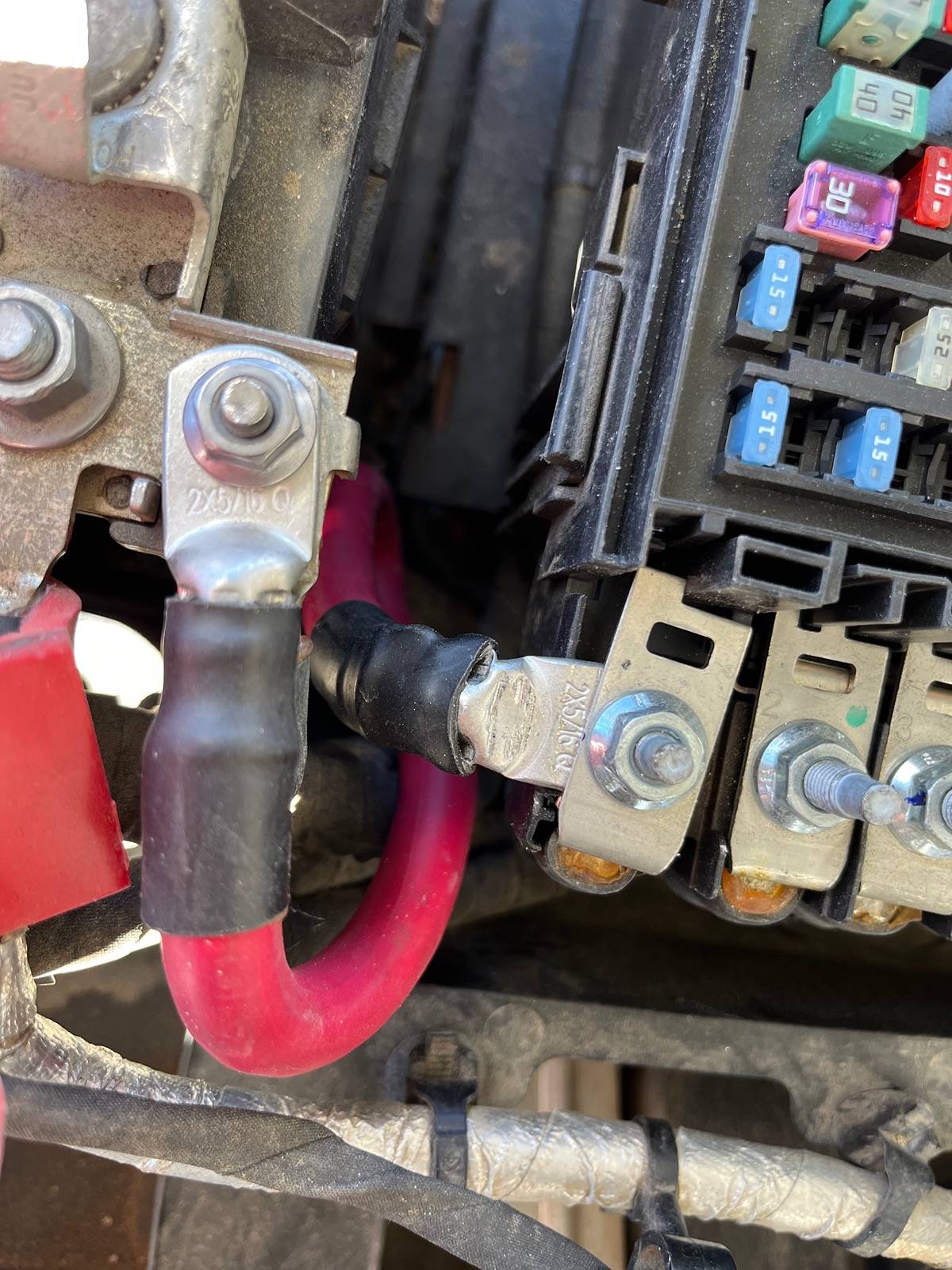
I considered several alternatives for connecting the aux battery positive to the starter, which itself is connected to the positive bus on the main battery. The N3 lug from the aux battery could be moved to the main battery positive bus, but I found there was not enough slack in the wire without some sort of extension. Another solution would be fashioning a copper strap or bridge from N1 to N2, which already have stock connections to the aux and main battery positives. I went a third way, adding a 2 gauge wire from N1 to the main battery positive bus. For a good electrical connection, and to overcome the height of the N1 terminal guide edges, I made and a spacer out of 1/4 inch thick copper (photos to follow).
Negative "switching" for an emergency start is removal of the ground lug from the IBS and connecting it to the already disconnected aux negative lug. Returning to stock is simple. Remove the added positive cable (not necessary to do when charging the aux battery), reconnect the aux negative (and if necessary, the ground) to the IBS, and insert a fuse in F42 (debatably not necessary if a blown one is already in the socket).
There are a couple of lingering concerns I have with running the Jeep after an emergency start. The intent with the setup is to return to a safe/repair location with just the aux battery connected and receiving whatever charge the Jeep chooses to give it. The Jeep's loads won't care if, and I'm assuming that, the aux battery is a sufficient buffer. However, with this setup the IBS is not sensing anything, so error codes wouldn't surprise me. So far I have only idled the Jeep for a few minutes after test aux battery starts, during which everything, including system voltage (averaging about 14.5v), seems fine.
Hopefully some owners will find this setup useful. Comments welcome.

Note, Jebiruph has a post that discusses reserve use of the aux battery by connecting it in parallel to the main battery. See https://www.jlwranglerforums.com/forum/threads/ess-dual-battery-management.60034/
A few notes on my experience. Testing of my new Mopar aux battery shows it's resting voltage is 12.8. After 3 months, it self discharges to 12.6v, and starts the engine with the main disconnected. My aux battery is now only 6 months old, but AGMs that are fully charged every 3 months with virtually no loads in between should easily last, at least for starting purposes, several years.
My aux battery is recharged after 3 month by reconnecting it's negative and running for four or so hours in about a six hour period. The main battery is fully charged before this process. Typically there are about four stops/starts for the two hour down time, but there's no ESS stopping or use of the accessory setting on the ignition switch. After six hours, with the batteries going into rest, the aux battery is promptly disconnected to prevent cross-draining. While not the best way to charge dissimilar AGM batteries, it's not terrible.
The actual setup is a variation on the negative/F42 disconnect. Unlike with Jebiruph's reserve setup, the aux battery is intentionally not paralleled as a starting "boost" because the poor or dead state of a failed starting battery often means attempts will not work. Instead, the aux battery is used as a complete substitute for the main battery. This emergency start setup could include a battery switch and wiring for paralleling/selecting/boosting, but that would make restoring to stock more involved. For those not concerned with added hardware, a switch is a good way to go.
So, switching for emergency starting is at the negative side of the system. This means the battery positives need to always be connected to each other, and to the system itself. The stock positive wiring, left in place after the negative/F42 disconnect, does this. However, for aux battery starting, current would go through the 150 amp N3 fuse. While an average aux battery start may not be an issue, it's not good to have the fuse in emergency situations.
I considered several alternatives for connecting the aux battery positive to the starter, which itself is connected to the positive bus on the main battery. The N3 lug from the aux battery could be moved to the main battery positive bus, but I found there was not enough slack in the wire without some sort of extension. Another solution would be fashioning a copper strap or bridge from N1 to N2, which already have stock connections to the aux and main battery positives. I went a third way, adding a 2 gauge wire from N1 to the main battery positive bus. For a good electrical connection, and to overcome the height of the N1 terminal guide edges, I made and a spacer out of 1/4 inch thick copper (photos to follow).
Negative "switching" for an emergency start is removal of the ground lug from the IBS and connecting it to the already disconnected aux negative lug. Returning to stock is simple. Remove the added positive cable (not necessary to do when charging the aux battery), reconnect the aux negative (and if necessary, the ground) to the IBS, and insert a fuse in F42 (debatably not necessary if a blown one is already in the socket).
There are a couple of lingering concerns I have with running the Jeep after an emergency start. The intent with the setup is to return to a safe/repair location with just the aux battery connected and receiving whatever charge the Jeep chooses to give it. The Jeep's loads won't care if, and I'm assuming that, the aux battery is a sufficient buffer. However, with this setup the IBS is not sensing anything, so error codes wouldn't surprise me. So far I have only idled the Jeep for a few minutes after test aux battery starts, during which everything, including system voltage (averaging about 14.5v), seems fine.
Hopefully some owners will find this setup useful. Comments welcome.
Sponsored
Last edited: