Sponsored

Which Battery Tester?

Jebiruph

Well-Known Member
First Name
Jerry
Joined
Feb 18, 2018
Threads
57
Messages
2,402
Reaction score
2,996
Location
Iowa
Vehicle(s)
2018 JLU, 2020 JT, 2024 WL
Yes, with respect to JL electronics/function, the IBS should be on the crank/main battery. But that may not be convenient with the Genesis system.

Either way, the IBS monitors the battery it's attached to, so JScan can be used to monitor that battery regardless of whether it cranks the engine or is electrically disconnected from other Jeep electronics when the vehicle isn't operating.
It is possible (according to some) to get the IBS mounted on the main battery. Then when the system detects a low main battery, it provides higher alternator output for faster battery charging. Otherwise it's monitoring the accessory battery that may not get used as much and may not trigger the higher alternator output.
Sponsored


Jebiruph

Well-Known Member
First Name
Jerry
Joined
Feb 18, 2018
Threads
57
Messages
2,402
Reaction score
2,996
Location
Iowa
Vehicle(s)
2018 JLU, 2020 JT, 2024 WL
For the record, I have a Genesis dual battery system with Odyssey batteries. What is driving my inclination to be able to better understand the condition of batteries is that I had to find one and replace the primary last year, in a panic, the day before I left for the Rubicon. Fortunately, I found possibly the only Odyssey AGM 25 in southern CA. If I had half the brains god gave a frog, I would have ordered one it a week or two or month earlier, when I was finishing up the engine replacement and it showed weakness in holding a charge while troubleshooting a bad PCM and repeatedly cranking the engine. At that time, I performed a parasitic load test and it was an extremely low draw.

So, now I have a one year old battery and a 3 year old battery. The newer battery in the primary position is starting to give my stomach the gurgles. I've had to bridge the secondary battery in to start it a few times over the past year after having either letting it set for weeks or having left a fridge plugged in. I thought the fridge logic would protect the main battery even with my older version Genesis system. Evidently, it's still abusive to them. I do have a new Gen 3 Genesis top plate in the garage, but want to find out the battery conditions before installing it.
Do you have to have identical batteries for the Genesis system or is it personal preference? If I remember correctly, the batteries are connected through battery management electronics making having identical batteries less critical.
 
OP
OP
roaniecowpony

roaniecowpony

Well-Known Member
Joined
Dec 4, 2018
Threads
194
Messages
12,911
Reaction score
20,419
Location
SoCal
Vehicle(s)
2018 JLUR, 14 GMC 1500 CC All TERRAIN
Occupation
Retired Engineer
I have two Odyssey ODP-AGM 25 batteries. One is a year old and the other is about 3 years old. Maybe 4.
 

Mguy

Well-Known Member
Joined
Nov 29, 2023
Threads
6
Messages
400
Reaction score
382
Location
Far Away
Vehicle(s)
2020 JLUR 6spd MT
It is possible (according to some) to get the IBS mounted on the main battery. Then when the system detects a low main battery, it provides higher alternator output for faster battery charging. Otherwise it's monitoring the accessory battery that may not get used as much and may not trigger the higher alternator output.
Quoting @alphawolff from post 55 in this thread:

You can throw the IBS in the trash and the vehicle will still start, charge, and function like normal minus the CEL and S/S being disabled.

What evidence or documentation shows the IBS affects charging?
 

Jebiruph

Well-Known Member
First Name
Jerry
Joined
Feb 18, 2018
Threads
57
Messages
2,402
Reaction score
2,996
Location
Iowa
Vehicle(s)
2018 JLU, 2020 JT, 2024 WL
Quoting @alphawolff from post 55 in this thread:

You can throw the IBS in the trash and the vehicle will still start, charge, and function like normal minus the CEL and S/S being disabled.

What evidence or documentation shows the IBS affects charging?
Without the IBS, it will work like a regular smart charging system. To accommodate the ESS system, when the IBS reports the battery is not fully charged, the PCM will increase the alternator output to facilitate faster battery charging.
 

Sponsored

Jebiruph

Well-Known Member
First Name
Jerry
Joined
Feb 18, 2018
Threads
57
Messages
2,402
Reaction score
2,996
Location
Iowa
Vehicle(s)
2018 JLU, 2020 JT, 2024 WL
I have two Odyssey ODP-AGM 25 batteries. One is a year old and the other is about 3 years old. Maybe 4.
I meant for if a battery is failing and an identical battery is not readily available.
 

THAW

Well-Known Member
First Name
Foster
Joined
Oct 28, 2022
Threads
4
Messages
2,184
Reaction score
3,014
Location
PNW - prefer Middle of Nowhere
Vehicle(s)
23 JL4DrRubicon
Quoting @alphawolff from post 55 in this thread:

You can throw the IBS in the trash and the vehicle will still start, charge, and function like normal minus the CEL and S/S being disabled.

What evidence or documentation shows the IBS affects charging?
That statement might not mean what you think it means. It's very likely the IBS (when present) affects voltage/charging, such as for battery temperature compensation and lowering voltage when the battery is deemed charged.

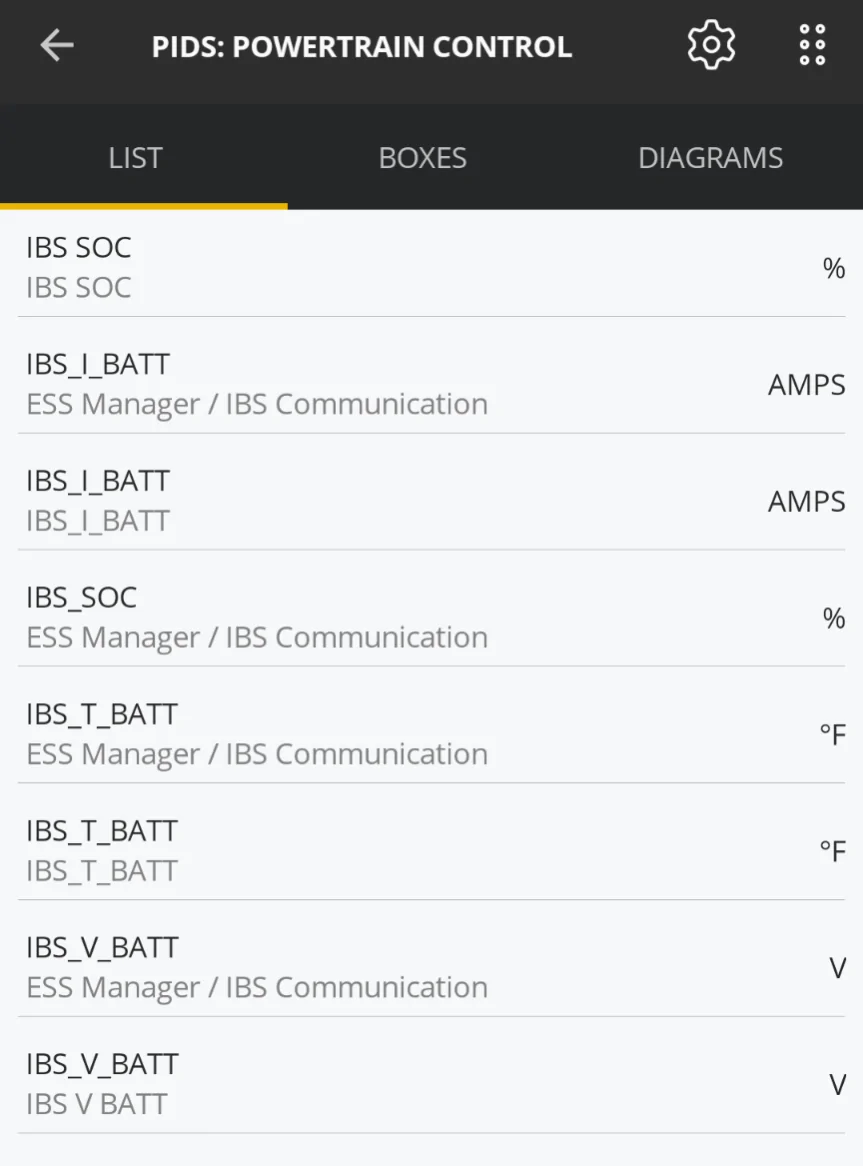
I can tell you for certain the PCM collects IBS data, including SoC and current. In fact, it has a separate set of IBS PIDs specifically not labeled "ESS":
Jeep Wrangler JL Which Battery Tester? Screenshot_20251024-235141
 

Mguy

Well-Known Member
Joined
Nov 29, 2023
Threads
6
Messages
400
Reaction score
382
Location
Far Away
Vehicle(s)
2020 JLUR 6spd MT
You can throw the IBS in the trash and the vehicle will still start, charge, and function like normal minus the CEL and S/S being disabled.

Without the IBS, it will work like a regular smart charging system. To accommodate the ESS system, when the IBS reports the battery is not fully charged, the PCM will increase the alternator output to facilitate faster battery charging.
That statement might not mean what you think it means. . . . I can tell you for certain the PCM collects IBS data . . . .
Lots of internet talk on this forum about the IBS and it's abundant data, "smart" charging, alternator "output," and other such concepts. My thinking about the talk showing up in this thread was expressed by my question, "What evidence or documentation shows the IBS affects charging?"

It's still my thinking. Particularly when there's talk that "the PCM collects IBS data" rather than "the IBS sends data . . . . "
 
Last edited:

Jebiruph

Well-Known Member
First Name
Jerry
Joined
Feb 18, 2018
Threads
57
Messages
2,402
Reaction score
2,996
Location
Iowa
Vehicle(s)
2018 JLU, 2020 JT, 2024 WL
You can throw the IBS in the trash and the vehicle will still start, charge, and function like normal minus the CEL and S/S being disabled.


Lots of internet talk on this forum about the IBS and it's abundant data, "smart" charging, alternator "output," and other such concepts. My thinking about the talk showing up in this thread was expressed by my question, "What evidence or documentation shows the IBS affects charging?"
Is the information you're quoting documented or internet talk on this forum?
 

Jebiruph

Well-Known Member
First Name
Jerry
Joined
Feb 18, 2018
Threads
57
Messages
2,402
Reaction score
2,996
Location
Iowa
Vehicle(s)
2018 JLU, 2020 JT, 2024 WL
"What evidence or documentation shows the IBS affects charging?"
There is also mis information in the factory documentation. The best thing is to confirm it yourself if you want to verify something.

If you observe your voltage over time, you will notice when your battery is not fully charged, the alternator output will stay consistently around the mid 14V range. When the battery is charged the alternator output will fluctuate based on the current load and goes up when decelerating.

Once you are familiar with how the system behaves with the IBS, disconnect the IBS and see if there is a difference.
 

Sponsored

THAW

Well-Known Member
First Name
Foster
Joined
Oct 28, 2022
Threads
4
Messages
2,184
Reaction score
3,014
Location
PNW - prefer Middle of Nowhere
Vehicle(s)
23 JL4DrRubicon
Is the information you're quoting documented or internet talk on this forum?
It's repeated, in bold, and ambiguous enough to interpret to fit the narrative, so it's gotta be true!

Particularly when there's talk that "the PCM collects IBS data" rather than "the IBS sends data . . . . "
What's your point? Yes, the IBS sends data on the CAN LIN Bus. And other modules clearly collect that data.

Do you have some other explanation for the JScan image I provided that clearly documents the PCM is aware of IBS data?
 
Last edited:

Mguy

Well-Known Member
Joined
Nov 29, 2023
Threads
6
Messages
400
Reaction score
382
Location
Far Away
Vehicle(s)
2020 JLUR 6spd MT
Seems merely asking "What evidence or documentation shows the IBS affects charging?" results in direct challenge of the questioner.

There is also mis information in the factory documentation. The best thing is to confirm it yourself if you want to verify something.

If you observe your voltage over time, you will notice when your battery is not fully charged, the alternator output will stay consistently around the mid 14V range. When the battery is charged the alternator output will fluctuate based on the current load and goes up when decelerating.

Once you are familiar with how the system behaves with the IBS, disconnect the IBS and see if there is a difference.
What IBS mis-information in factory documentation are you referring to? I'm aware of none.

My observation of JL system voltage, made over several years, is not consistent with yours. Voltages I see, including during driving periods longer than 4 hours, are consistent with decent AGM multi-stage charging, with end of charge shut-off. This type of charging has been provided by voltage regulation devices for the last several decades without the IBS data that Thaw touts.

Sounds like your answer to my question is for me to do the experiment that you haven't done yourself. If not correct, what details about IBS influenced charging did you discover?


What's your point? Yes, the IBS sends data on the CAN Bus.
Just because the IBS sends data doesn't mean the JL makes actual use for the charging routine. I don't doubt that as a JScan promoter for reading IBS data you said "the PCM collects IBS data" to imply that the PCM uses that data for charging.

So, my conclusion for this thread. I'm not making an assertion about IBS charging, I'm asking. There has been 8 years worth of IBS discussion on this forum without any evidence or documentation that I can find which shows actual IBS use for charging. In fact, I've been hopeful, but disappointed. Sensing amperage (an IBS feature) and incorporation as a JL charging parameter would be very helpful for both battery health and owner confidence. However, until there's something tangible I'm going to remain skeptical, and stick with Alphawolff's bold statement until proven otherwise.

But this being the internet, the believers will carry on. There's much to repeat.
 
Last edited:

Jebiruph

Well-Known Member
First Name
Jerry
Joined
Feb 18, 2018
Threads
57
Messages
2,402
Reaction score
2,996
Location
Iowa
Vehicle(s)
2018 JLU, 2020 JT, 2024 WL
@roaniecowpony I went looking for this old Genesis thread where someone moved the IBS to the crank battery and saw you were participating in this thread. https://www.jlwranglerforums.com/fo...e-limit-anyone-with-issues.45582/post-1004174

If you haven't yet, I would move the IBS to the crank battery and use jscan (or equivalent) to monitor the ongoing resistance of the battery as reported by the IBS, as @THAW described earlier.

Here's a theory - if once the IBS learns the battery, the IBS battery resistance information would be valid regardless of the state of charge of the battery, where an external battery tester requires a battery to be charged before it can be tested. So if your battery gets low on charge, with an external tester you would have to charge the battery before testing it, but the IBS resistance information would be available without charging. This could save you from trying to charge a bad battery or disposing of a good battery.
 

THAW

Well-Known Member
First Name
Foster
Joined
Oct 28, 2022
Threads
4
Messages
2,184
Reaction score
3,014
Location
PNW - prefer Middle of Nowhere
Vehicle(s)
23 JL4DrRubicon
Voltages I see, including during driving periods longer than 4 hours, are consistent with decent AGM multi-stage charging, with end of charge shut-off. This type of charging has been provided by voltage regulation devices for the last several decades without the IBS data that Thaw touts.
What are the phases in your hypothesized JL multi-stage charging routine? Bulk, Absorption, and Float?

In extensively observing live IBS current, I've not witnessed anything identifiable as a constant current phase (even when my battery was lowish SoC).


Top