
Sponsored

Stop/Start unavailable @!

UtahRubi

Well-Known Member
First Name
Ernie
Joined
Oct 21, 2018
Threads
8
Messages
117
Reaction score
152
Location
Kamas, Utah
Vehicle(s)
2018 JLU Rubicon
I had a broken sensor. Replaced it and the start/stop works perfectly. If you've moved the battery the sensor can be easily broken.
Sponsored


 

jeepoch

Well-Known Member
First Name
Jay
Joined
Nov 13, 2019
Threads
1
Messages
1,052
Reaction score
2,941
Location
Longmont, CO
Vehicle(s)
2019 JL Wrangler Sport S 3.6L Auto 2 door, 2.5" lift, 35s
I have the 3.6l 24v vvt etorque rubicon with tow package.. on my dash it always says I'm at 13.6- 13.8 volts on my battery.. is that normal?.. I'm used to my other cars running at 14.5 or so... my start/ stop still works though
Fred,

Your voltage gauge actually measures your alternator's output rather than just the battery voltage. So the higher the value, the harder the alternator is working based on electrical load. So a measurement of voltages in the upper 13V range rather than in the 14's is just a sign that your alternator doesn't have to work as hard in keeping your batteries charged. This typically indicates your batteries are good and only need a little 'juice" to keep them fully charged.

Running your alternator at 14.5V continuously generally is indicative of a bad battery (or charging issue). Furthermore, with good batteries, your alternator's output should decrease over time. On long highway trips you may even see 12V readings.

So your voltage is perfectly OK. Nothing to worry about.

Jay
 

Affroe

Well-Known Member
First Name
Fred
Joined
Oct 8, 2021
Threads
3
Messages
222
Reaction score
209
Location
California
Vehicle(s)
Nissan
Fred,

Your voltage gauge actually measures your alternator's output rather than just the battery voltage. So the higher the value, the harder the alternator is working based on electrical load. So a measurement of voltages in the upper 13V range rather than in the 14's is just a sign that your alternator doesn't have to work as hard in keeping your batteries charged. This typically indicates your batteries are good and only need a little 'juice" to keep them fully charged.

Running your alternator at 14.5V continuously generally is indicative of a bad battery (or charging issue). Furthermore, with good batteries, your alternator's output should decrease over time. On long highway trips you may even see 12V readings.

So your voltage is perfectly OK. Nothing to worry about.

Jay
Thanks for the info.. just finished reading a bunch of articles on it.. your right on.. coming from older cars I didn't know better but the only way to learn is to ask... thanks for taking the time to reply
 

Go Outside

Well-Known Member
First Name
Eric
Joined
Dec 4, 2019
Threads
8
Messages
150
Reaction score
64
Location
California
Vehicle(s)
2020 JLU
Fred,

Your voltage gauge actually measures your alternator's output rather than just the battery voltage. ...
Jay
Where did you learn this?
If it were true, the dash would display 0V when the engine was not running.

My dash displays 11.7 V with the ignition on and engine off. Meanwhile I measure 12.6V at the main battery with a high quality digital volt meter.

Also, when I start the engine the voltage (as indicated by the dashboard) increases slowly to 14.1V and never fluctuates.

I pulled the ESS battery out and it measured 12.4V sitting on the floor. I trickle charged it and it now holds 12.6V sitting on the floor.

I suspect there is a bad contact inside one of the ESS system relays. Does anyone have a wiring schematic? I troubleshoot complicated electrical systems as a career, if someone can share the schematic with me, I will trace the circuit and identify all the components that need to be checked and then share it in this thread.
 

Sponsored

GtX

Well-Known Member
First Name
David
Joined
Nov 9, 2019
Threads
8
Messages
2,080
Reaction score
3,310
Location
Illinois
Vehicle(s)
2020 JLUR 3.0D
Occupation
Working for the man.
Vehicle Showcase
1
Where did you learn this?
If it were true, the dash would display 0V when the engine was not running.

My dash displays 11.7 V with the ignition on and engine off. Meanwhile I measure 12.6V at the main battery with a high quality digital volt meter.

Also, when I start the engine the voltage (as indicated by the dashboard) increases slowly to 14.1V and never fluctuates.
Right, a 12V battery can't supply 14.1V. you're seeing the alternator voltage.
 

Go Outside

Well-Known Member
First Name
Eric
Joined
Dec 4, 2019
Threads
8
Messages
150
Reaction score
64
Location
California
Vehicle(s)
2020 JLU
Right, a 12V battery can't supply 14.1V. you're seeing the alternator voltage.
I thought it was being implied that the voltage reading at the dashboard was the alternator output alone, as if it were somehow measured independently of the batterys.

I agree that the voltage displayed on the dashboard is system voltage. It is the voltage potential between positive and negative, typically measured at some point in the circuit. If we were to measure this potential at any live point in the circuit ( ie Battery terminals, fuse block, alternator output, ECU ...) this measurement should be the same.

Since my dashboard voltage meter is reading lower than the measurement at the battery terminals and fuseblock, it is reasonable to assume that there is resistance in the system somewhere before the point at which the Jeep is taking the measurement, OR the Jeeps measuring system is inaccurate. In either case, if the ESS system is seeing a low voltage measurement whether it be a bad battery, bad connection or other inaccuracy, it is going to deactivate the ESS system.

Past experience tells me that the most likely cause of the reported low voltage potential is resistance in the circuit. Common causes of resistance are: bad contacts in relays, cold solder joints, poorly made electrical connections, loose fuses, bad grounds.

I understand that there are relays that disconnect one of the batteries during ESS events. It is reasonable to assume that this relay changes state when the ignition is on and the engine is not running. This relay and its connections are my first suspected component. But, with a wiring diagram, I can stop guessing, take measurements at various points in the circuit and determine where the resistance is. I am assuming that since this is a common problem it will have a common cause and we will all benefit.

Does anyone have a wiring diagram they are willing to share?
 

GtX

Well-Known Member
First Name
David
Joined
Nov 9, 2019
Threads
8
Messages
2,080
Reaction score
3,310
Location
Illinois
Vehicle(s)
2020 JLUR 3.0D
Occupation
Working for the man.
Vehicle Showcase
1
I thought it was being implied that the voltage reading at the dashboard was the alternator output alone, as if it were somehow measured independently of the batterys.
You'd think, but so many people on this board think a reading over 12V on the dash with the motor running indicates the batteries are good.
 

fczabala

Well-Known Member
Joined
May 18, 2020
Threads
27
Messages
1,187
Reaction score
3,437
Location
FL
Vehicle(s)
JLUR; X5
Clubs
 
I thought it was being implied that the voltage reading at the dashboard was the alternator output alone, as if it were somehow measured independently of the batterys.

I agree that the voltage displayed on the dashboard is system voltage. It is the voltage potential between positive and negative, typically measured at some point in the circuit. If we were to measure this potential at any live point in the circuit ( ie Battery terminals, fuse block, alternator output, ECU ...) this measurement should be the same.

Since my dashboard voltage meter is reading lower than the measurement at the battery terminals and fuseblock, it is reasonable to assume that there is resistance in the system somewhere before the point at which the Jeep is taking the measurement, OR the Jeeps measuring system is inaccurate. In either case, if the ESS system is seeing a low voltage measurement whether it be a bad battery, bad connection or other inaccuracy, it is going to deactivate the ESS system.

Past experience tells me that the most likely cause of the reported low voltage potential is resistance in the circuit. Common causes of resistance are: bad contacts in relays, cold solder joints, poorly made electrical connections, loose fuses, bad grounds.

I understand that there are relays that disconnect one of the batteries during ESS events. It is reasonable to assume that this relay changes state when the ignition is on and the engine is not running. This relay and its connections are my first suspected component. But, with a wiring diagram, I can stop guessing, take measurements at various points in the circuit and determine where the resistance is. I am assuming that since this is a common problem it will have a common cause and we will all benefit.

Does anyone have a wiring diagram they are willing to share?
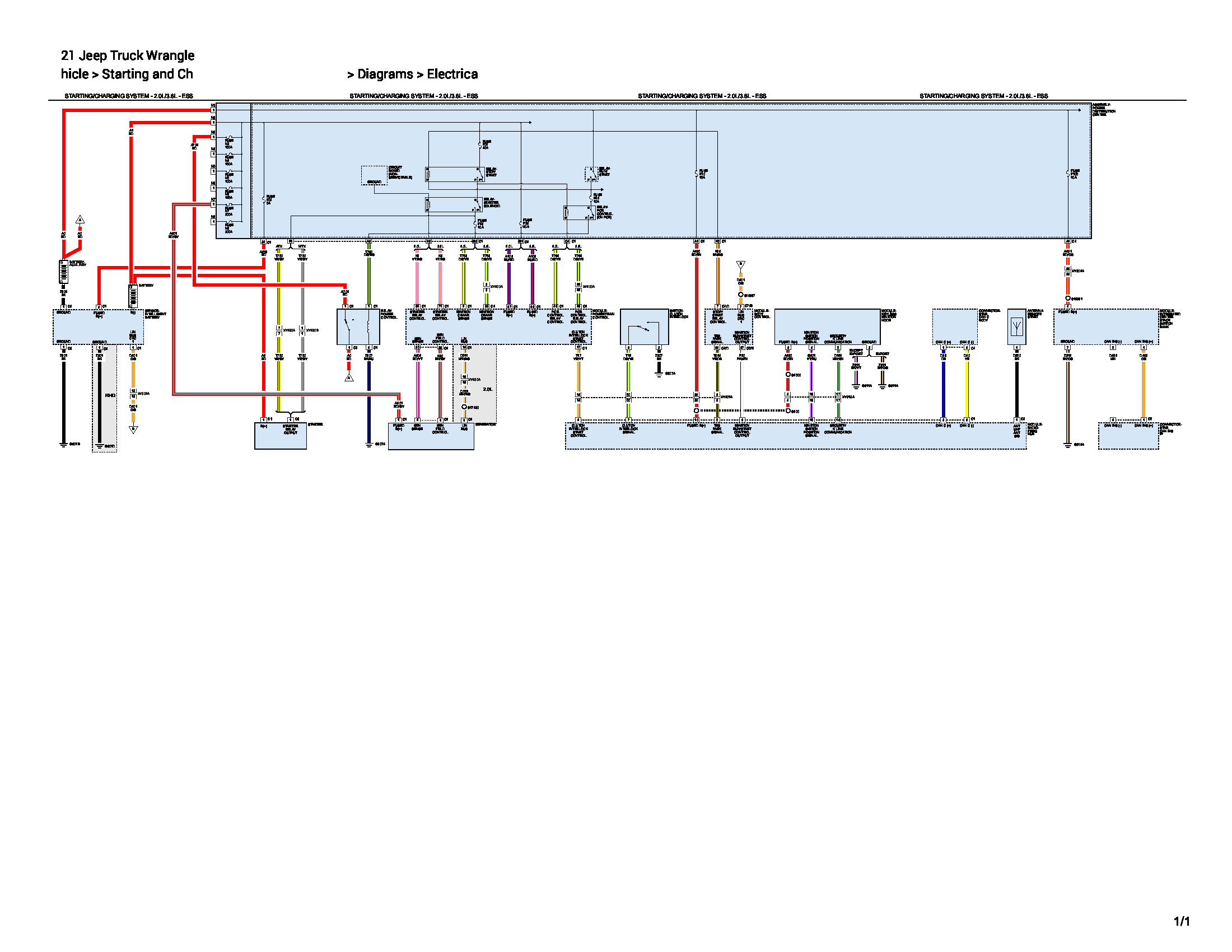
does this help?
Jeep Wrangler JL Stop/Start unavailable @! Starting_Charging System (2.0L_3.6L) ESS


I can send a pdf for better clarity. send me a pm
 

Go Outside

Well-Known Member
First Name
Eric
Joined
Dec 4, 2019
Threads
8
Messages
150
Reaction score
64
Location
California
Vehicle(s)
2020 JLU
maybe. I cant make out what the components are and dont see anything that would be batteries. There are some reference numbers that will need explanations, there should be a key for them.
 

Sponsored

Go Outside

Well-Known Member
First Name
Eric
Joined
Dec 4, 2019
Threads
8
Messages
150
Reaction score
64
Location
California
Vehicle(s)
2020 JLU
Also, I removed my aux battery, charged it and tested it. It is good so i put it back in. FWIW the original main battery tests good too. I wish I had tested it properly before buying a new one.
in the process the fault cleared and the ESS is now working again.
i still read 11.5v on the dash and 12.5v at the battery.
i probably could have charged the batteries, cleared the fault and been good to go.
 

phageghost

Well-Known Member
Joined
Jan 6, 2022
Threads
7
Messages
274
Reaction score
582
Location
San Diego, CA
Vehicle(s)
2022 JLURD
My hubby recently left my jeep in acc mode over night. After charging the battery I now get the @! Error at startup. I too would love some possible solutions.
I encountered a similar issue when I drained my battery and then recharged it using a 10A charger overnight right before a trip. The jeep ran but both my ESS and my Climate Control were inoperative. My working theory was that, as the voltage slowly increased during the charge, various modules would boot up at various times. If the main computer booted up before the HVAC module, it would have flagged the HVAC module as unresponsive and considered it dead. So I pulled the connection to both batteries, let it sit for a couple hours, and then plugged them back in so all the modules would boot up at once. That fixed it. So if you're getting codes and errors after charging the battery from dead while it's in the vehicle, I'd try doing a "hard reboot" of the electrical system and see if that fixes things.
 

Go Outside

Well-Known Member
First Name
Eric
Joined
Dec 4, 2019
Threads
8
Messages
150
Reaction score
64
Location
California
Vehicle(s)
2020 JLU
Thanks to FCZABALA for the wiring diagram.

It appears as though the battery is being monitored at a module connected to the negative terminal of the main battery. It seems to be a solid state device that is sending a digital signal back through the can-bus. The positive is run to this device through fuse F03. It is possible that the sensor is only measuring current and the voltage is being measured elsewhere but I suspect not.
I do not have my Jeep here but I will check voltage at the connection to the sensor tomorrow.

As an aside, the aux and main batteries are connected through the Power Control Relay and fuse N3. I do not know the logic that controls when they are connected and when they are not, but when they are not connected the aux battery is not being charged.
Also, if the voltage is being measured by the Intelligent Battery Sensor, then the aux battery's voltage is not being considered when the Power Control Relay is disconnecting the batteries.

What an overly complicated system. What benefit was this supposed to provide that no other manufacturer thinks is worth the trouble?
 

Go Outside

Well-Known Member
First Name
Eric
Joined
Dec 4, 2019
Threads
8
Messages
150
Reaction score
64
Location
California
Vehicle(s)
2020 JLU
There is a .5 volt drop between the battery and the connector for the battery sensor.
The dash is now reporting only that .5 volt difference. Maybe all the plugging and unplugging cleared up a bad connection.
Of course now I have a new problem. The radio is dead.
 

jeepoch

Well-Known Member
First Name
Jay
Joined
Nov 13, 2019
Threads
1
Messages
1,052
Reaction score
2,941
Location
Longmont, CO
Vehicle(s)
2019 JL Wrangler Sport S 3.6L Auto 2 door, 2.5" lift, 35s
What an overly complicated system. What benefit was this supposed to provide that no other manufacturer thinks is worth the trouble?
Eric, the ESS system is a side-effect of carbon taxes mandated by the EPA. Automotive companies are being forced to raise CAFE numbers and lower emissions output as best they can in order to minimize paying for carbon credits.

Nearly all ICE powerplants from all manufacturers now have some type of ESS system. At least on all models that don't meet these federal mandates.

The primary ESS design flaw with the JL implementation without the eTorque (48v) system is using two dissimilar sized batteries. Whoever thought that this was a good idea is clearly a moron and should have their engineering credentials revoked.

The complexity appears to stem from a rush to get something (anything) supporting ESS into the 2018 Model Year, likely to meet new green regulations. This certainly seems to be a 'thing-on-a-thing', a bolt-on afterthought rather than a comprehensive concept from program start.

Unfortunately, it looks like FCA (Stellantis) has wagered that as crappy as this design is, as long as it performs during the warranty period, we'll then, it's good enough.

[Edit]
As a sidenote, I just replaced my main battery with a 650 cold cranking amp (CCA) rated AGM battery after 3 years and 50K miles on my 2019 3.6L Sport. My ESS system had been struggling with "Battery Charging" and "Battery Protection Mode" Complaints for quite a while. The dealership replaced the AUX under extended warranty but wouldn't replace the main. After another month of the same issue, I just replaced the Main on my own; screw the dealership.

I've had zero problems with my ESS since. My alternator output has now dropped from between 14.5 and 14.7 to the upper 13 volt range. I also now see a good 1.5 miles per gallon increase in fuel economy. I'm back up to 22mpg with my 35's.

I guess, every two or three years will require a battery replacement of both. This frustratingly stupid idea of dissimilar batteries will likely ensure it.

I'd consider the over-the-top expensive Genesis solution if it wasn't for the six cycle ESS limit. I'm certain one could rewire their implementation to make it more factory compatible but I can replace both batteries three or four times and still have a lower operating budget.

I'd have thrown in the towel altogether if I didn't love this JL so much. Other than this crappy ESS design disaster, the Jeep itself is way cool and a fribben blast to drive.

Jay
Sponsored

 
Last edited:


Top