Sponsored

Sold on 89 Octane

Bikemobile

Well-Known Member
First Name
Zak
Joined
Oct 17, 2019
Threads
2
Messages
271
Reaction score
291
Location
Gunnison, Colorado
Vehicle(s)
2018 JL
Vehicle Showcase
1
Well, there's some possibility of that. If the engine can run more spark lead, it can potentially get more power from the same fuel charge.... or more mpg.
A small increase in MPG may be possible. When my 2 door 3.6/8 speed sport was 95% stock it got 22 mpg. It gets 20 ish now on 285's 2" lift and armored. If ignition timing improved efficiency by optimistically 10% then translated to drivetrain losses and driver behavior you might see a 1 mpg difference that would be negated by atmospheric conditions and user error
Sponsored


jadmt

Well-Known Member
First Name
jeff
Joined
May 19, 2020
Threads
78
Messages
5,133
Reaction score
9,775
Location
montana
Vehicle(s)
2024 wrangler rubicon w/AEV 2.5 dualsport lift
hard to believe that all the car companies have not caught on....they spend millions to increase fleet mpg by fractions and all they need i a better writer for the manual and a sticker for the gas cap.
 

TheRaven

Well-Known Member
Joined
Oct 22, 2020
Threads
6
Messages
2,844
Reaction score
4,176
Location
Reading, Pennsylvania
Vehicle(s)
Sold
Well, there's some possibility of that. If the engine can run more spark lead, it can potentially get more power from the same fuel charge.... or more mpg.
We're talking 2 (or 4 for 91) additional points of octane. Yes that will open up potential for more power...but nothing that's going to show up even in instrumental tests. You're talking about maybe a fraction of a hp or MPG.
 

aeonixx1001

Well-Known Member
First Name
Kim
Joined
Apr 26, 2020
Threads
4
Messages
842
Reaction score
776
Location
Arizona
Vehicle(s)
2020 Jeep JL
It just makes sense, Higher octane = more energy and you can say to the wheels. So it is more efficient, but then cost becomes a factor.....
The difference between 91 and 89 octane gasoline lies in their ability to withstand compression before detonating. Higher octane fuels, like 91, can withstand higher compression without detonating prematurely, which can be beneficial for certain engines.

Here are some key points to consider:

  1. Engine Requirements: If your car’s manufacturer recommends or requires 91 octane fuel, using it can improve performance and fuel efficiency. Using a lower octane fuel than recommended can lead to engine knocking and reduced efficiency12.
  2. Engine Type: High-performance engines, especially those with turbochargers or high compression ratios, often benefit from higher octane fuel12.
  3. Cost: Higher octane fuel is generally more expensive. If your car doesn’t require it, you might not see any significant benefits from using it12.
In summary, if your vehicle is designed to run on 91 octane fuel, it’s best to use it. Otherwise, using 89 octane fuel should be sufficient and more cost-effective
 
OP
OP

YBABRAT

Well-Known Member
Joined
May 12, 2024
Threads
55
Messages
1,409
Reaction score
1,355
Location
VIRGINIA
Vehicle(s)
2019 2 Door Rubicon X Wannabe
Occupation
None... but it pays well.
Just filled with pure 93... we'll see how it goes.
Right now my round trip MPG is 23.5 with return trip being 93°F.

Hopefully, through the rest of the week I may see nothing or a slight increase.

I assume my steep hilly mountain roads are having an effect on ECU compensation.

Unlike Engine Masters, it was a controlled environment no ECU involved. Apples to oranges, and they even admit it.

In most cases I'd you notice Detonation / Nock it's happening even before you take notice.

My MPG has been more stable and higher than with 87. There will be doubters and followers. I would not have shared if nothing good came from my change to a better grade fuel.


Like Hanz and Franz... believe me now or believe me later.
 

Sponsored

alphawolff

Well-Known Member
Joined
Jul 31, 2023
Threads
1
Messages
3,381
Reaction score
5,658
Location
california
Vehicle(s)
2021 JLU
I think mythbusters decided it was driver input that made the biggest difference in mpg
100%, but under normal load conditions like just cruising down the highway you will see a few MPG difference running 87 in an engine designed for 91. My 2011 grand cherokee was designed for 89 and we put 87 in it for most of its life before we discovered it asked for 89 (read the manual during a long road trip, lol). Instantly gained like 2 MPG, it was crazy.
 
  • Like
Reactions: AFD

roaniecowpony

Well-Known Member
Joined
Dec 4, 2018
Threads
194
Messages
12,941
Reaction score
20,479
Location
SoCal
Vehicle(s)
2018 JLUR, 14 GMC 1500 CC All TERRAIN
Occupation
Retired Engineer
It's an 11.5:1 compression, 4 valve engine, making 1.3 hp/c.i., I don't care if it gets less mpg, I'm putting 91 in it.
 

Bikemobile

Well-Known Member
First Name
Zak
Joined
Oct 17, 2019
Threads
2
Messages
271
Reaction score
291
Location
Gunnison, Colorado
Vehicle(s)
2018 JL
Vehicle Showcase
1
100%, but under normal load conditions like just cruising down the highway you will see a few MPG difference running 87 in an engine designed for 91. My 2011 grand cherokee was designed for 89 and we put 87 in it for most of its life before we discovered it asked for 89 (read the manual during a long road trip, lol). Instantly gained like 2 MPG, it was crazy.
Hemi grand Cherokee? I used to drive a Dodge Charger Pursuit for a living. Wore out 4 of them over the years. All 5.7 hemi's. My state employer said only run 85-87 for cost reasons. Someone decided that officially telling 700 troopers to use 85 when 89 is recommended in the manual might be a warranty issue at some point. Drive almost 400k miles and never really noticed a big difference in MPG when we switched back to mid grade. Of course we were idling or going 100 mph most of the time.
 

alphawolff

Well-Known Member
Joined
Jul 31, 2023
Threads
1
Messages
3,381
Reaction score
5,658
Location
california
Vehicle(s)
2021 JLU
Hemi grand Cherokee? I used to drive a Dodge Charger Pursuit for a living. Wore out 4 of them over the years. All 5.7 hemi's. My state employer said only run 85-87 for cost reasons. Someone decided that officially telling 700 troopers to use 85 when 89 is recommended in the manual might be a warranty issue at some point. Drive almost 400k miles and never really noticed a big difference in MPG when we switched back to mid grade. Of course we were idling or going 100 mph most of the time.
Yup, 5.7L. Requires 89, but will run on 87. Running 85 can cause engine damage if not at a high elevation.
 

Sponsored

2nd 392

Well-Known Member
First Name
Mike
Joined
Jun 20, 2021
Threads
15
Messages
10,012
Reaction score
16,730
Location
Ca
Vehicle(s)
Grand Cherokee srt.V10 Dodge 4x
It's an 11.5:1 compression, 4 valve engine, making 1.3 hp/c.i., I don't care if it gets less mpg, I'm putting 91 in it.
Yep- pre computers and FI (except the FI Vette) the top tier engines with 12.5:1 compression making ~ 1.3 hp/c.i required 100+ octane. Cost me a 6 figure today car when I couldn’t back off the timing and pour enough fuel to it (even colder plugs out of desperation) to stop detonation when we lost it.
 
Last edited:

jeepingib

Well-Known Member
First Name
Dusty
Joined
Jun 26, 2018
Threads
25
Messages
10,262
Reaction score
40,161
Location
College Station, TX
Vehicle(s)
18' JLUR Punk'n
Occupation
BBQ prophet
Why would you do that?

The contest here isn't to create a theoretical situation that would be extremely hard on the motor...in fact we should all be doing our best to take care of our engines and not abuse them purposefully. Premium fuel isn't going to save you from the damage you cause with abuse.
We call that merging onto the highway here in Texas. It's simple math. With the relatively high compression ratio of the PUG engine, here at sea level, when the air is insanely hot going into the engine, it's recipe for pre-detonation. Going up a tick on the octane scale prevents the engine from having to retard the timing so much. Does 87 still run? Yes, but because the engine has to pull timing so frequently, it is less efficient. I'm not saying that the 89 or 91 is right for all scenarios. Unless you are frequently noticing some pre-detonation, I don't recommend higher octane. But in the summer, when I notice it frequently, I bump up to 89.
 
  • Like
Reactions: AFD

Bikemobile

Well-Known Member
First Name
Zak
Joined
Oct 17, 2019
Threads
2
Messages
271
Reaction score
291
Location
Gunnison, Colorado
Vehicle(s)
2018 JL
Vehicle Showcase
1
Yup, 5.7L. Requires 89, but will run on 87. Running 85 can cause engine damage if not at a high elevation.
Interestingly, Colorado roads vary from 4000 feet to 14000 feet but I guess even at 4000 feet the octane isnt really an issue.
 

AFD

Well-Known Member
Joined
Oct 13, 2021
Threads
15
Messages
3,803
Reaction score
7,310
Location
Northeastern US
Vehicle(s)
2023 JL Rubicon (2DR/V6)
From what I could figure based on my normal commute, at most I'm spending an extra $200 each year for 89 versus sticking with the recommended 87 octane. In my last vehicle (that required 91 minimum and recommended higher), I always used 93 and it worked out to be an extra $400 per year (for 93 vs 87, not 93 vs 91).

Even if it has zero effect on performance, fuel mileage and engine longevity for the 3.6L, imo an extra $2,000 over 10 years on a $30k to $100k vehicle is dirt cheap insurance, even if it does absolutely nothing. I'm sure many of us have gambled away or spent that much on dumber things in a year's time.

And if my extra 2 to 3 MPG increase actually is due to the octane bump and not other factors, then it's likely a complete wash anyway and I'm probably getting less ethanol and some extra detergents for free.

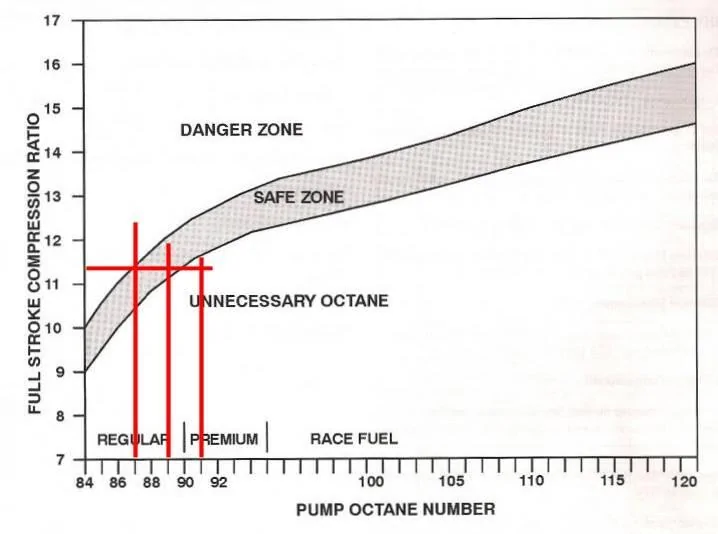
Just comparing the older Pentastar 3.6L with 10.2:1 compression ratio versus our current 3.6L with 11.3:1 ratio, according to the chart below, even regular 87 grade was more than enough for the older engine and just barely enough for the newer, though still within the "safe zone". Personally think I'd rather stick with 89 (or even be a little wasteful with 91) than rely on the ECU and knock sensors to retard timing when needed.


Jeep Wrangler JL Sold on 89 Octane 1724900098284-kg
 

roaniecowpony

Well-Known Member
Joined
Dec 4, 2018
Threads
194
Messages
12,941
Reaction score
20,479
Location
SoCal
Vehicle(s)
2018 JLUR, 14 GMC 1500 CC All TERRAIN
Occupation
Retired Engineer
From what I could figure based on my normal commute, at most I'm spending an extra $200 each year for 89 versus sticking with the recommended 87 octane. In my last vehicle (that required 91 minimum and recommended higher), I always used 93 and it worked out to be an extra $400 per year (for 93 vs 87, not 93 vs 91).

Even if it has zero effect on performance, fuel mileage and engine longevity for the 3.6L, imo an extra $2,000 over 10 years on a $30k to $100k vehicle is dirt cheap insurance, even if it does absolutely nothing. I'm sure many of us have gambled away or spent that much on dumber things in a year's time.

And if my extra 2 to 3 MPG increase actually is due to the octane bump and not other factors, then it's likely a complete wash anyway and I'm probably getting less ethanol and some extra detergents for free.

Just comparing the older Pentastar 3.6L with 10.2:1 compression ratio versus our current 3.6L with 11.3:1 ratio, according to the chart below, even regular 87 grade was more than enough for the older engine and just barely enough for the newer, though still within the "safe zone". Personally think I'd rather stick with 89 (or even be a little wasteful with 91) than rely on the ECU and knock sensors to retard timing when needed.


1724900098284-kg.jpg
Right... like hundreds for a muffler that does nothing except be louder, or some kind of fancy lights or ...
Sponsored


Top