Sponsored

MS-12991 RECOMMENDED; API SN REQUIRED

Old Jeeper

Banned
Banned
Banned
First Name
Don
Joined
Jul 7, 2022
Threads
43
Messages
2,841
Reaction score
4,211
Location
Port Charlotte, FL, Naples Fl, 17 Oaks Ranch, Tex
Vehicle(s)
2024 JLR-X 2023 JLR, 2021 JTR. 20 F 450 KR,
Occupation
US Army Infantry, IT Engineer
Wt is Weight?
YEP!

In Texas we have extreme weather Way WAY HOT and real cold below freezing. In fact on my ranch just N of San Antonio I had 2 degree F in daytime...but the ranch house sat atop a hill that I could see for 50 miles and the wind was crazy.

That said many years it never gets below freezing, so you watch the weather closely...
Sponsored

 

BDinTX

Well-Known Member
First Name
Brad
Joined
Jul 18, 2020
Threads
49
Messages
2,949
Reaction score
5,465
Location
Dallas, Tx
Vehicle(s)
2020 JLU Rubicon Recon, 2021 JLU Rubicon
Ya mid SAPS. I normally buy direct but it looks like you can save a few dollars shopping around.

MOTUL

From links on their website to buy a 5L jug
Motul Direct $52
Amazon $43
Summit $52

Then Northridge $55

8100_x-clean_5w-40_en_de_motul_17700_20240614.pdf


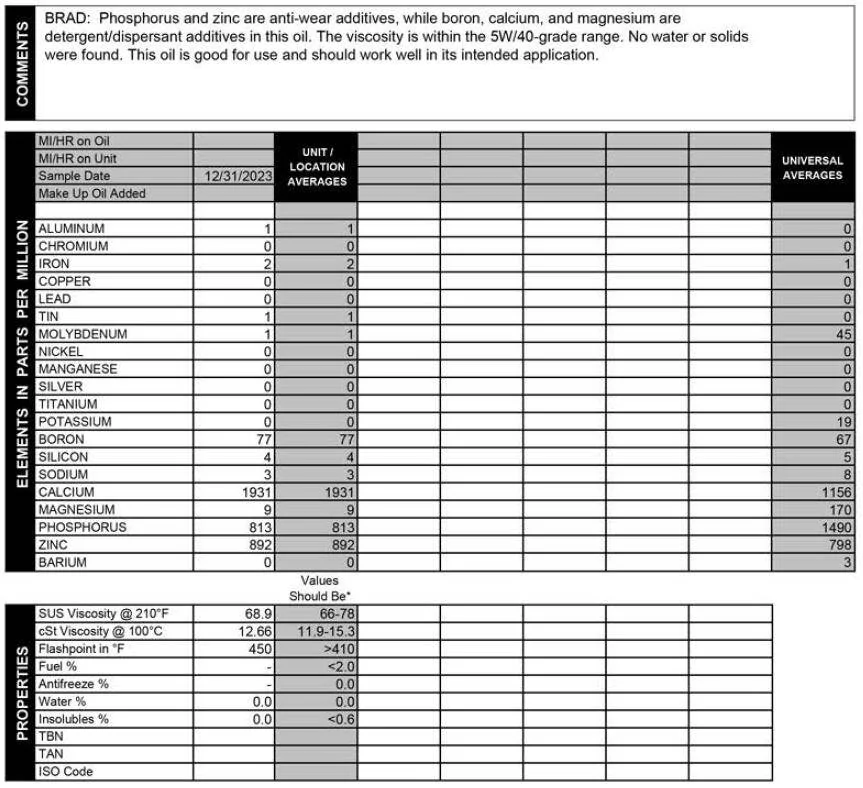
Oil analysis on fresh oil:
1718718504259-ah.jpg


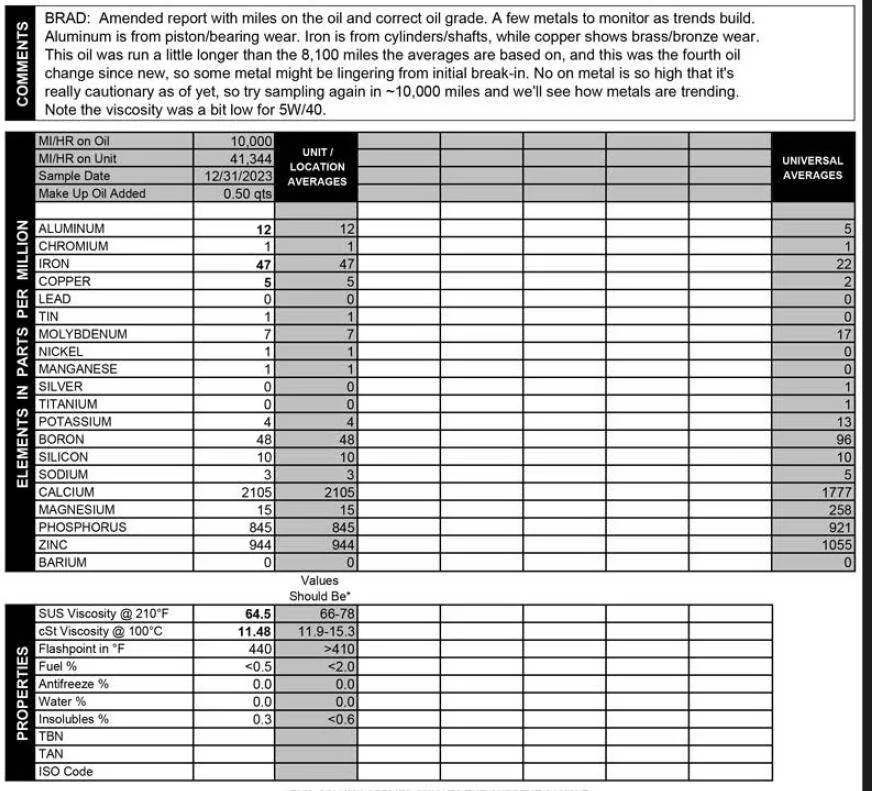
Analysis on first oil change with ~10k miles on the oil and ~40k on the vehicle.
They mistakenly thought it was a 5w-30 oil then corrected and resent the report. Still noted viscosity was on the low side.
1718718662659-i5.jpg


I'm closing in on 7,500 miles with current oil and plan to change this weekend. Will send this in for another analysis. I'm curious to see if the viscosity still reads low. Depending on the results, may indicate whether 10k miles is an appropriate OCI.
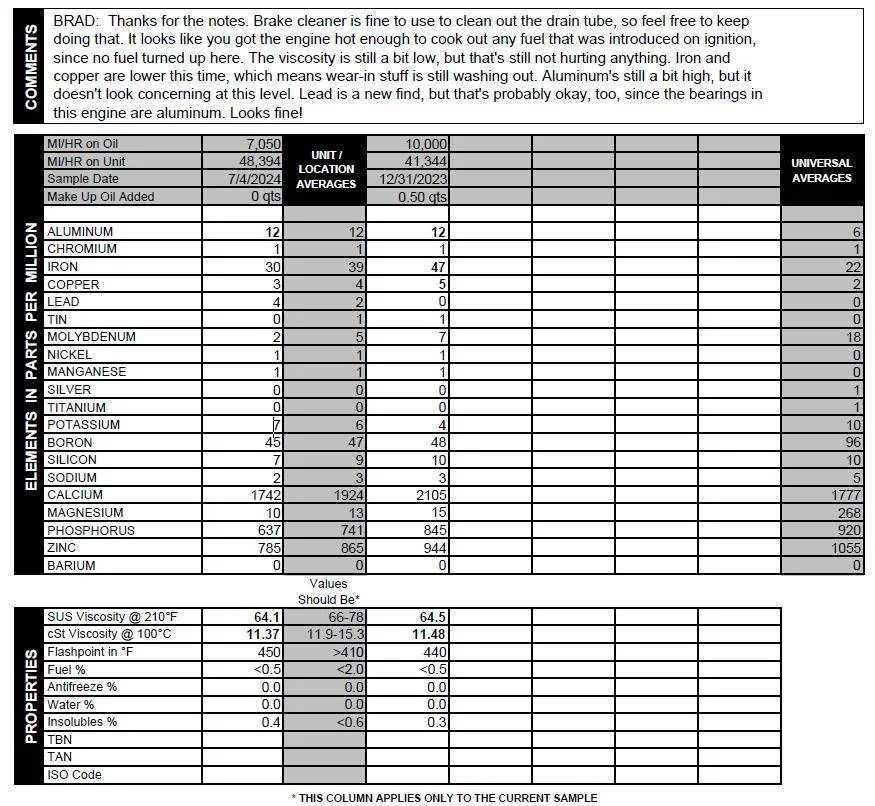
Got the latest oil analysis back. I had to change it a little earlier than planned due to a road trip, so 7,050 miles instead of 7,500.
Jeep Wrangler JL MS-12991 RECOMMENDED; API SN REQUIRED 1722633057590-n2


I emailed with some questions and got this back:

"Potassium is normal at 7 ppm, and the other additives you mentioned (moly, boron, calcium, phos, zinc) are fine, too. Every brand/blend uses a different additive package, and it's totally normal for additives to vary from one report to the next, especially when you swap oils.

Sodium and potassium can be signs of coolant contamination, but we don't worry about that unless they exceed 20 ppm. Silicon has two sources: dirt (not good) and silicone products (which is harmless). Silicon was low in your sample, so we don't have any concerns about air filtration.

Lead can be from fuel additives, yes. This engine has aluminum bearings, so we're not worried that the lead in your report shows poor wear.

As for the viscosity, it's fairly normal for us to see a marginally low reading from the 3.0L EcoBoost engines, and usually it's just from harmless shearing. We don't consider a low viscosity a sign of trouble unless it's correlating with excess fuel dilution or other problems, so no worries about that.

Your oil temp seems pretty normal, and as for the flashpoint reading--that's how we get a measure on fuel dilution. It's the temperature at which the oil's vapors ignite, and if the flashpoint is low, that means fuel is present (we didn't find any in your sample).

Regarding the oil type, Motul is good oil, and any API-certified engine oil that's cleared for use in your engine should work just fine. We don't see a difference in wear when it comes to different oils/blends. Oil is oil as far as we're concerned! Just look for that API sticker and you're good to go.
"

I wasn't worried about the potassium before their response but I was curious why it would go up since the virgin Motul analysis had zero potassium. So I'm a little worried a coolant leak may be developing. Somebody else on here mentioned detecting a coolant leak through oil analysis, hopeful I don't do the same.
 
OP
OP

Deleted User 38384

Banned
Banned
Banned
Joined
Aug 4, 2020
Threads
140
Messages
6,081
Reaction score
10,669
Clubs
 
Got the latest oil analysis back. I had to change it a little earlier than planned due to a road trip, so 7,050 miles instead of 7,500.
1722633057590-n2.jpg


I emailed with some questions and got this back:

"Potassium is normal at 7 ppm, and the other additives you mentioned (moly, boron, calcium, phos, zinc) are fine, too. Every brand/blend uses a different additive package, and it's totally normal for additives to vary from one report to the next, especially when you swap oils.

Sodium and potassium can be signs of coolant contamination, but we don't worry about that unless they exceed 20 ppm. Silicon has two sources: dirt (not good) and silicone products (which is harmless). Silicon was low in your sample, so we don't have any concerns about air filtration.

Lead can be from fuel additives, yes. This engine has aluminum bearings, so we're not worried that the lead in your report shows poor wear.

As for the viscosity, it's fairly normal for us to see a marginally low reading from the 3.0L EcoBoost engines, and usually it's just from harmless shearing. We don't consider a low viscosity a sign of trouble unless it's correlating with excess fuel dilution or other problems, so no worries about that.

Your oil temp seems pretty normal, and as for the flashpoint reading--that's how we get a measure on fuel dilution. It's the temperature at which the oil's vapors ignite, and if the flashpoint is low, that means fuel is present (we didn't find any in your sample).

Regarding the oil type, Motul is good oil, and any API-certified engine oil that's cleared for use in your engine should work just fine. We don't see a difference in wear when it comes to different oils/blends. Oil is oil as far as we're concerned! Just look for that API sticker and you're good to go.
"

I wasn't worried about the potassium before their response but I was curious why it would go up since the virgin Motul analysis had zero potassium. So I'm a little worried a coolant leak may be developing. Somebody else on here mentioned detecting a coolant leak through oil analysis, hopeful I don't do the same.
I've been adding about 1 oz of coolant to my EcoDiesel once a year on average.

I've been under the impression that it's evaporating, because coolant has a good habit of doing that. But you think that it's getting into your oil?

How often do you add coolant to your overflow tank and how much coolant do you add each time?
 

BDinTX

Well-Known Member
First Name
Brad
Joined
Jul 18, 2020
Threads
49
Messages
2,949
Reaction score
5,465
Location
Dallas, Tx
Vehicle(s)
2020 JLU Rubicon Recon, 2021 JLU Rubicon
I've been adding about 1 oz of coolant to my EcoDiesel once a year on average.

I've been under the impression that it's evaporating, because coolant has a good habit of doing that. But you think that it's getting into your oil?

How often do you add coolant to your overflow tank and how much coolant do you add each time?
Well since the virgin oil doesn't have potassium, even if the Mopar oil I was using had it as part of their additives, the number should be decreasing.

I can't remember the last time I've added coolant though. I checked my fluids before the trip but didn't need to add any. I didn't check when I got back though so I'll have to look at it when I get it back from the shop. Yesterday I got a check engine light and pulled code P20EE - SCR NOX catalyst efficiency below threshold bank 1.
 

Sponsored

BDinTX

Well-Known Member
First Name
Brad
Joined
Jul 18, 2020
Threads
49
Messages
2,949
Reaction score
5,465
Location
Dallas, Tx
Vehicle(s)
2020 JLU Rubicon Recon, 2021 JLU Rubicon
Haha oh yeah. If it lasts through the warranty I’ll seriously consider it.
 

Compression-Ignition

Well-Known Member
First Name
Roy
Joined
Nov 12, 2019
Threads
22
Messages
1,045
Reaction score
1,093
Location
Montana
Vehicle(s)
'22 JLUR 3.0 Diesel, '20 6.7L F350, '94 12 valve
Nope, fair question, not upset by it. Here’s the thing that became glaringly obvious though the more I dug into this issue.

Almost every oil I’ve looked at has some level of SAPS included in the mix (Sulphated Ash, Phosphorus, and Sulfur). Something I came to realize is that most oils with low to mid SAPS content are typically endorsed to be used in vehicles with particulate filters whereas a full SAPS oil is normally only approved in vehicles that don’t have sensitive exhaust emissions components. A great example of this is BMW LL01 vs BMW LL04 designations. LL04 is approved for use on their diesel and hybrid vehicles that have much more complicated emissions control equipment whereas LL01 isn’t.

SAPS content is a careful balance though. We can’t run a low SAPS oil in these engines without running a risk to the longevity of internal component life span. On the flip side, a full SAPS blend has so many byproducts to reduce engine wear and tear that it inherently produces more soot that will clog emissions components faster than the systems can realistically handle without accelerated wear and tear.

Someone somewhere is of the opinion that MS-12991 is a specific designation that outlines a SAPS content tolerance that these engines are best suited for without burning up the emissions equipment early. In reality, there’s been zero evidence produced anywhere that I can find that actually tells us what the standards are for this specific rating. Just short of asking an engineer at VM Motori, good luck finding it. Hence why so many ram EcoDiesel owners have been experimenting with different oils to try and find a proper balance that’s better than what the owners manual recommends. The leading theory so far is that Jeep was dead set on finding an oil that wouldn’t lead to catastrophic bearing failure like gen 2 dealt with and still remain within the scope of reasonable ash accumulation for the emissions equipment to handle on its own.

So what the hell does any of this mean? It’s the SA part of SAPS that’s the real killer here. The sulphated ash content of the oil circulating in the emissions equipment builds up in the DPF over time and binds to soot like a fat kid on a cake. The more sulphated ash in your oil, the more likely it is to stick to the soot being produced from the combustion process getting blown into the DPF, EGR, etc.

I thought it was all BS internet nonsense until I started rotating oils to see if it was true. Castrol Euro for instance has GREAT UOA results with the ram side of the gen 3 crowd, but in my experience it was an absolute nightmare to try and burn off in passive regen and active regen. I literally had to force regen twice while I was in Moab because of it. Never again. Switched to the hype train red label amsoil and viola, instant satisfaction after the first 100 miles of use. Not only did passive regen start looking like it was actually doing something useful for a change (burning as much as 30% soot in less than 20 miles) but my active regens went from basically every 7 days to every 21+ days.

I’m by no means some expert at any of this, but I can’t deny the results I’ve had in the last 2500 miles. It’s a night and day difference that’s got me convinced to stay the hell away from anything that’s not a mid saps oil. As long as my internals are happy at the end of this little experiment, I’ll gladly keep running oil that’s not on the approved list.
What is the mileage associated with the days? I.E., every 200 miles. And have you noticed how long your regens take to complete?

@DewHawk
 

DewHawk

Well-Known Member
First Name
Rob
Joined
Aug 18, 2021
Threads
16
Messages
646
Reaction score
1,328
Location
Aurora, CO
Website
www.instagram.com
Vehicle(s)
'19 Stinger GT2, '04 M3
Occupation
USAF F-16 Crew Chief
What is the mileage associated with the days? I.E., every 200 miles. And have you noticed how long your regens take to complete?

@DewHawk
My use case is far from ideal for this power plant. I think my average day maybe racks up something like 25 miles since I have a fairly short commute. That being said I use the highway and long country roads very often to try and avoid the city grind stop and go.

Average active regen distance seems to vary between 250-350 miles of use. Sometimes it’s worse, sometimes it’s better. I haven’t been keeping a record of distance with my regens but I’ve been watching how often it happens per fill up which is usually at least once per tank of diesel. If I’ve been covering longer distances I can stretch it out to every 2 fill ups. Just a ton of variables since I use this thing for just about everything.

When the active regen fires off, it usually takes me about 7-10 miles of driving on the highway. Doesn’t take very long at all.

For comparison sake, when I was running Castrol Euro, it usually took me double the time for active regen to clear the DPF and regens would happen about twice per tank of diesel unless I was constantly running nothing but long distance highway miles.

I know I mentioned it somewhere previously but with my trip to EJS this year running the Castrol I watched my DPF soot percentage slowly (and painfully) drop from roughly 68% to just 13% going from Aurora CO to Moab using nothing but highway and climbing the Rockies on I-70. If that’s not hot garbage then I don’t know what is.

I’m slowly approaching the point where I’m ready to change the Amsoil and collect a sample for oil analysis to see how the internals are doing. Less than 2000 miles left to go at this stage. Still haven’t noticed anything negative running this oil everyday even in 100+ degree weather at my elevation on 37’s. Motor and turbo are still singing their tune happily and haven’t skipped a beat.
 

PeCoasta

Well-Known Member
Joined
Apr 11, 2023
Threads
2
Messages
73
Reaction score
79
Location
Earth
Vehicle(s)
2022 JLURD | 2022 F350
Got the latest oil analysis back. I had to change it a little earlier than planned due to a road trip, so 7,050 miles instead of 7,500.
1722633057590-n2.jpg


I emailed with some questions and got this back:

"Potassium is normal at 7 ppm, and the other additives you mentioned (moly, boron, calcium, phos, zinc) are fine, too. Every brand/blend uses a different additive package, and it's totally normal for additives to vary from one report to the next, especially when you swap oils.

Sodium and potassium can be signs of coolant contamination, but we don't worry about that unless they exceed 20 ppm. Silicon has two sources: dirt (not good) and silicone products (which is harmless). Silicon was low in your sample, so we don't have any concerns about air filtration.

Lead can be from fuel additives, yes. This engine has aluminum bearings, so we're not worried that the lead in your report shows poor wear.

As for the viscosity, it's fairly normal for us to see a marginally low reading from the 3.0L EcoBoost engines, and usually it's just from harmless shearing. We don't consider a low viscosity a sign of trouble unless it's correlating with excess fuel dilution or other problems, so no worries about that.

Your oil temp seems pretty normal, and as for the flashpoint reading--that's how we get a measure on fuel dilution. It's the temperature at which the oil's vapors ignite, and if the flashpoint is low, that means fuel is present (we didn't find any in your sample).

Regarding the oil type, Motul is good oil, and any API-certified engine oil that's cleared for use in your engine should work just fine. We don't see a difference in wear when it comes to different oils/blends. Oil is oil as far as we're concerned! Just look for that API sticker and you're good to go.
"

I wasn't worried about the potassium before their response but I was curious why it would go up since the virgin Motul analysis had zero potassium. So I'm a little worried a coolant leak may be developing. Somebody else on here mentioned detecting a coolant leak through oil analysis, hopeful I don't do the same.
Did you just start running mid-sap ?
 

BDinTX

Well-Known Member
First Name
Brad
Joined
Jul 18, 2020
Threads
49
Messages
2,949
Reaction score
5,465
Location
Dallas, Tx
Vehicle(s)
2020 JLU Rubicon Recon, 2021 JLU Rubicon
Did you just start running mid-sap ?
I went from the free oil changes using Mopar oil to Motul. I'd assume Mopar is also mid saps
 

zouch

Well-Known Member
Joined
Sep 17, 2020
Threads
39
Messages
3,730
Reaction score
3,817
Location
Berkeley, CA
Vehicle(s)
XJ, JLUWD
shucks; wish you would have done the TBN testing too to see bow well it was still working.
i was shocked by how high the TBN was on the UOA i just did using Red Line.


Ya mid SAPS. I normally buy direct but it looks like you can save a few dollars shopping around.

MOTUL

From links on their website to buy a 5L jug
Motul Direct $52
Amazon $43
Summit $52

Then Northridge $55

8100_x-clean_5w-40_en_de_motul_17700_20240614.pdf


Oil analysis on fresh oil:
1718718504259-ah.jpg


Analysis on first oil change with ~10k miles on the oil and ~40k on the vehicle.
They mistakenly thought it was a 5w-30 oil then corrected and resent the report. Still noted viscosity was on the low side.
1718718662659-i5.jpg


I'm closing in on 7,500 miles with current oil and plan to change this weekend. Will send this in for another analysis. I'm curious to see if the viscosity still reads low. Depending on the results, may indicate whether 10k miles is an appropriate OCI.
Sponsored


Top