Sponsored

Latest TSB on the Pentastar engine

OP
OP

carlos c

Member
First Name
Carlos
Joined
Dec 21, 2024
Threads
1
Messages
22
Reaction score
16
Location
ct usa
Vehicle(s)
18 jeep wrangler jlu
Anyone gotten this under warranty?

I asked my dealer last time I was there about a TSB for the 3.6 for new cams and they didn't seem to know off the top of theor heads, but I dodnt give them specifics. Figured if under warranty I'll get it done next time I'm there.
My 18 rubicon as 80.000 miles, so no warranty.
Sponsored


o2zoom

Active Member
First Name
Jim
Joined
Mar 27, 2024
Threads
9
Messages
28
Reaction score
23
Location
Oceanside, CA
Vehicle(s)
Jeep Rubicon JLU, Jeep TJ
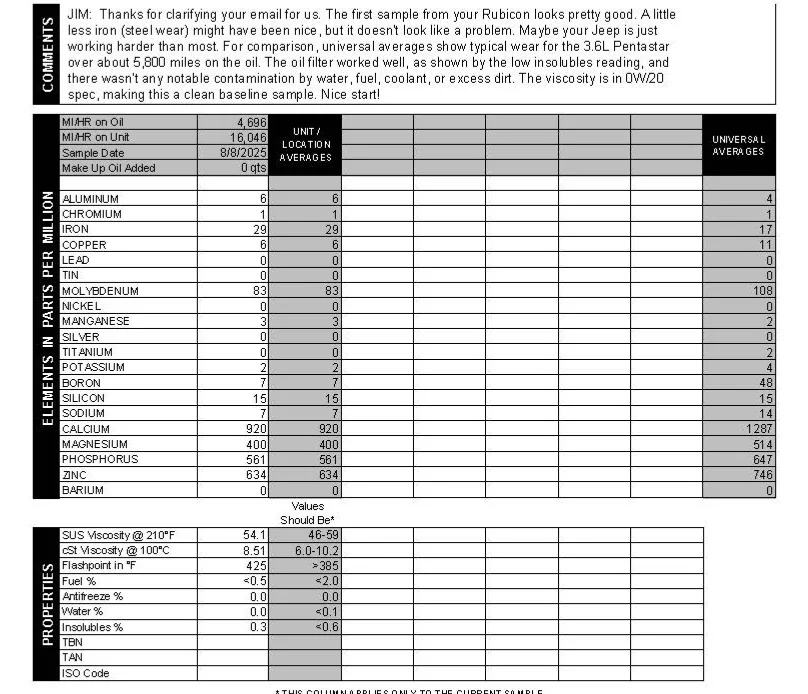
Thanks carlos c for providing the Rockwell hardness test results. I also think 53 is on the low end of an acceptable scale. Back in my hot rod days in the 60s if we had a custom cam ground the minimum we required was 60. Didn’t make any difference whether we were building small block or big block Chevy engines, with the increased springs pressures it was a necessity. These Pentastar’s V6s are working pretty hard and are horse power revving engines not lower RPM torque engines. I agree a little oil starvation could also be a culprit and coconspirator to these camshaft and lifter issues. Knock wood no issues at 17,570 miles. Attached copy of my oil lab report for reference done a 16,046 miles. Only concern is a little on the high side for iron. Will see what the next lab report shows.
Jeep Wrangler JL Latest TSB on the Pentastar engine 23 RUBICON-250808
 

Fatfreewilly

Well-Known Member
First Name
Bubba
Joined
Jul 31, 2019
Threads
16
Messages
328
Reaction score
404
Location
PA/NJ
Vehicle(s)
2016 JK Black Bear Edition - 2dr.
Interesting 2025 jeeps not included in the TSB. I wonder if they might have fixed something?
Different metal maybe?

Does just changing your oil every 3-5k religiously solve this? Or would some like Lucas help?
 

entropy

Well-Known Member
Joined
Sep 19, 2018
Threads
90
Messages
4,747
Reaction score
8,257
Location
Foothills of the San Gabriels
Vehicle(s)
2025 Jeep Wrangler Willys XR '41
Build Thread
Link
Occupation
OF top 1% content creator
Different metal maybe?

Does just changing your oil every 3-5k religiously solve this? Or would some like Lucas help?
I think if your engine is doomed to fail it will regardless of what you do regarding engine oil.
 

Sponsored

Jeep Wick

Well-Known Member
First Name
Wick
Joined
Dec 7, 2021
Threads
17
Messages
1,759
Reaction score
2,053
Location
America
Vehicle(s)
2022 High Tide XR
Occupation
Mechanic
I would like to think thicker oils offer protection. There is a shear factor involved. Watch The Oil Geek on YouTube.
 

SCJeeps

Well-Known Member
Joined
May 12, 2019
Threads
16
Messages
69
Reaction score
138
Location
TX
Vehicle(s)
2023 JLUR XR, 1952 Willy’s M38
I have been studying this failure for a while hoping the true root cause would come out. I have done this work (root cause analysis) on powertrains and it is usually very complex and lots of interactions of factors. Sometimes it can take years to drive to a true bottom line conclusion. In this case we don’t get access to “all” the data. I’m sure there is a team of Stellantis folks working the problem.

Several folks have asked if they can put good quality oil in or increase the change interval and prevent this, increase viscosity, etc; NO. If that would fix the problem then the TSB would have recommended that, it is lots cheaper than replacements. Also, it should be noted that this failure is on the sliding “high lift” portion of the follower where traditional valve tappet sliding is occuring, not rolling. Sliding on cam is different than rolling and is not necessarily dependent upon single factor oil viscosity, but often additives in the oil( such as zddp) can help. There are standardized tests that certified oils must meet in order to operate correctly under these conditions. Please note this failure is not related to follower bearing roller failures in the Gen 1 pentastar, these are unrelated and different designs.

This could be an interactions with statistical overlay of tolerance stack ups, material hardness variations, usage duty cycle( how often an engine is going into high lift, surface finish variation on cam vs follower, etc. It literally can be thousands of large or small interactions causing these failures. Because this is a fleet engine I’m curious what % is truly affected, 1%, less?

My current conclusion is if you have a 3.6 PUG to change the oil at regular intervals, use high quality synthetic oil and monitor for first signs of failure before the cam material is worn and distributed throughout the motor.
 

alphawolff

Well-Known Member
Joined
Jul 31, 2023
Threads
1
Messages
3,354
Reaction score
5,604
Location
california
Vehicle(s)
2021 JLU
I have been studying this failure for a while hoping the true root cause would come out. I have done this work (root cause analysis) on powertrains and it is usually very complex and lots of interactions of factors. Sometimes it can take years to drive to a true bottom line conclusion. In this case we don’t get access to “all” the data. I’m sure there is a team of Stellantis folks working the problem.

Several folks have asked if they can put good quality oil in or increase the change interval and prevent this, increase viscosity, etc; NO. If that would fix the problem then the TSB would have recommended that, it is lots cheaper than replacements. Also, it should be noted that this failure is on the sliding “high lift” portion of the follower where traditional valve tappet sliding is occuring, not rolling. Sliding on cam is different than rolling and is not necessarily dependent upon single factor oil viscosity, but often additives in the oil( such as zddp) can help. There are standardized tests that certified oils must meet in order to operate correctly under these conditions. Please note this failure is not related to follower bearing roller failures in the Gen 1 pentastar, these are unrelated and different designs.

This could be an interactions with statistical overlay of tolerance stack ups, material hardness variations, usage duty cycle( how often an engine is going into high lift, surface finish variation on cam vs follower, etc. It literally can be thousands of large or small interactions causing these failures. Because this is a fleet engine I’m curious what % is truly affected, 1%, less?

My current conclusion is if you have a 3.6 PUG to change the oil at regular intervals, use high quality synthetic oil and monitor for first signs of failure before the cam material is worn and distributed throughout the motor.
It is EXTREAMLY rare for an OEM to change rated oil viscosity after certification. In most cases it could change estimated EPA fuel economy amounts, which opens up an entire legal headache. I suspect it's a per occurrence fine, and you can imagine how many 3.6ls on on the roads.

An example of this is the 2.4L multi-air excessive oil consumption failures. Depending on your configuration they were able to issue software to disable cost down vacuum pull to reduce oil consumption by injecting a tiny bit of fuel to keep the vacuum lower. On some models this actually affected the fuel economy, so instead of doing the update they got entire engines replaced. The fuel economy part was directly mentioned in the recall documentation as the reason for why only some models got flash updates.

Some OEMs even have different oil viscosity requirements based on region. A good example is the mazda RX-8. In north America it was rated for 5w-20 oil, but in every other nation it was rated as 5w-30. I believe the NC/ND Miata also has similar oil viscosity discrepancies.

EPA/CAFE requirements really did a number on oil viscosity suggestions. If dropping from 5w-30 to 5w-20 saved even a small mpg on rated average it was generally implemented. Remember the 3.6L engine was originally designed for 5w-30 oil, and some early 3.6L 5w-20 owner's manuals even mentioned 5w-30 as an acceptable substitute.
Sponsored


Top