
Sponsored

Botched winch install

GATORB8

Well-Known Member
First Name
Matt
Joined
May 30, 2021
Threads
29
Messages
8,830
Reaction score
11,726
Location
CLT NC
Vehicle(s)
21 JLURe, 06 LJ, 25 HDZR2
The max operating temp (185° F) seems like a potential deal breaker for the engine bay.

And there's still the issue of potentially overheating 120 A rated wire with 200 A continuous current.
Where is the 120 amp rating coming from?

NEC's not applicable, most charts account for a 3% voltage drop.

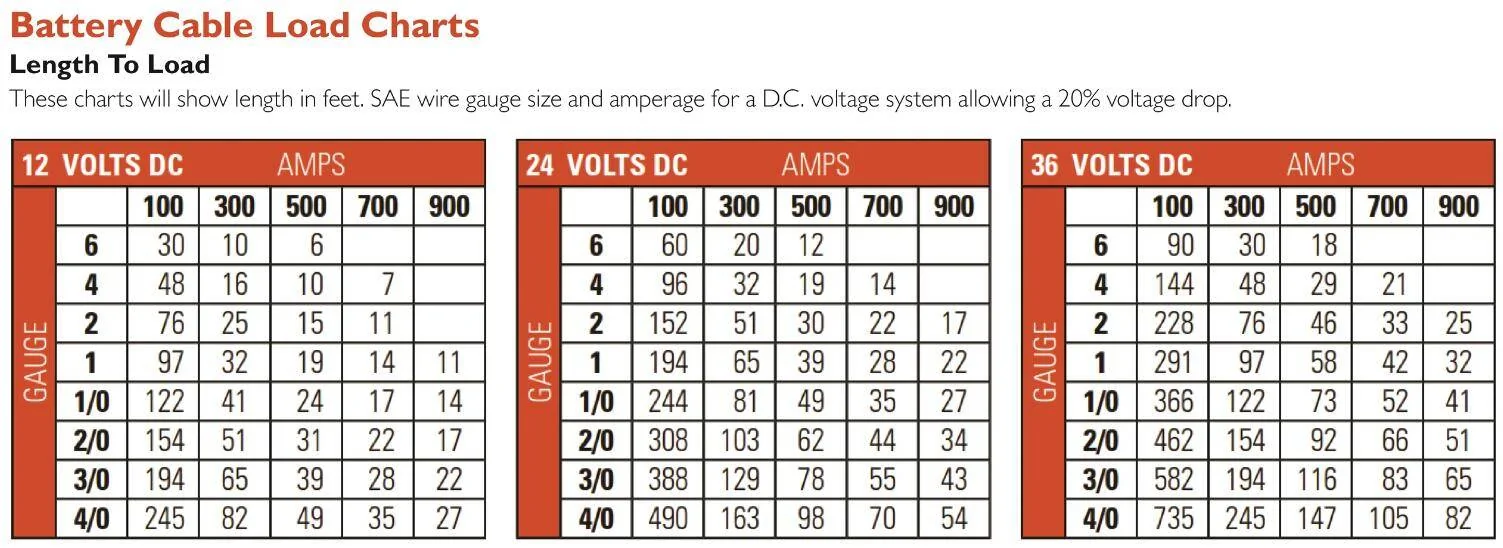
SAE J1127 (Battery Cable) doesn't specify ampacity. Best I can find is Waytek's battery cable chart allowing 20%:
Jeep Wrangler JL Botched winch install 1725481416929-d4
Sponsored


THAW

Well-Known Member
First Name
Foster
Joined
Oct 28, 2022
Threads
4
Messages
2,181
Reaction score
3,010
Location
PNW - prefer Middle of Nowhere
Vehicle(s)
23 JL4DrRubicon
Where is the 120 amp rating coming from?

NEC's not applicable, most charts account for a 3% voltage drop.

SAE J1127 (Battery Cable) doesn't specify ampacity. Best I can find is Waytek's battery cable chart allowing 20%:
1725481416929-d4.webp
Thanks for sharing the fuse/breaker trip and wire load charts - great stuff.

But, if 11 feet of 2 gauge wire can take 700 A continous, why did the OP winch cable melt it's insulation?
 
Last edited:

GATORB8

Well-Known Member
First Name
Matt
Joined
May 30, 2021
Threads
29
Messages
8,830
Reaction score
11,726
Location
CLT NC
Vehicle(s)
21 JLURe, 06 LJ, 25 HDZR2
Thanks for sharing the fuse/breaker and wire load charts - great stuff.

But, if 11 feet of 2 gauge wire can take 700 A continous, why did the OP winch cable melt it's insulation?
Since it's an automotive chart, I'd assume it's based on a specific starter motor load duration.

Where resistance is minimal, current can skyrocket. (I=V/R) Solid 2 AWG is .000124 ohms/ft (from a quick google).

For 11 feet, I = 12V/.001364 ohms = 8,797.65 Amps.
 

Zandcwhite

Well-Known Member
First Name
Zach
Joined
Sep 4, 2019
Threads
11
Messages
8,277
Reaction score
14,163
Location
Patterson, ca
Vehicle(s)
2019 jlur
Since it's an automotive chart, I'd assume it's based on a specific starter motor load duration.

Where resistance is minimal, current can skyrocket. (I=V/R) Solid 2 AWG is .000124 ohms/ft (from a quick google).

For 11 feet, I = 12V/.001364 ohms = 8,797.65 Amps.
But it's supplied by a battery that might hit 800A on a dead short for a few seconds. In my opinion this is why starters and winches aren't fused, the battery is current limiting.
 

GATORB8

Well-Known Member
First Name
Matt
Joined
May 30, 2021
Threads
29
Messages
8,830
Reaction score
11,726
Location
CLT NC
Vehicle(s)
21 JLURe, 06 LJ, 25 HDZR2
But it's supplied by a battery that might hit 800A on a dead short for a few seconds. In my opinion this is why starters and winches aren't fused, the battery is current limiting.
Good point.

A couple decades out of circuits classes, so if it's maxed at 800 A, call it 12 V. You're basically making a heating element out of the wire for a few seconds putting out 9600 W, thus the insulation burnoff.
 

Sponsored

CO2Wrangler

Well-Known Member
Joined
Jun 17, 2023
Threads
9
Messages
250
Reaction score
367
Location
Colorado
Vehicle(s)
21 JLURD
The max operating temp (185° F) seems like a potential deal breaker for the engine bay.

And there's still the issue of potentially overheating 120 A rated wire with 200 A continuous current.
Can you put your hand on the top of your battery with the hood open without burning yourself? Yes? Then 185 degrees seems like it'd be just fine.

I'm also done with this thread because there are a few folks in here who just want to argue for arguments' sake and I don't have the time for it. Best of luck everyone!
 

THAW

Well-Known Member
First Name
Foster
Joined
Oct 28, 2022
Threads
4
Messages
2,181
Reaction score
3,010
Location
PNW - prefer Middle of Nowhere
Vehicle(s)
23 JL4DrRubicon
Can you put your hand on the top of your battery with the hood open without burning yourself? Yes? Then 185 degrees seems like it'd be just fine.

I'm also done with this thread because there are a few folks in here who just want to argue for arguments' sake and I don't have the time for it. Best of luck everyone!

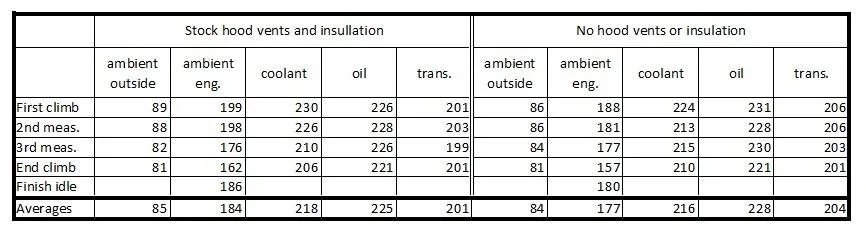
Engine bay temps can hit 200° F, according to testing in this thread:
Jeep Wrangler JL Botched winch install hood-vent-measurements-jpg

Personally, I've experimented with touching metal components near the battery and they are too hot to comfortably hold my palm on them for more than a second or 2. I should try my infrared thermometer.

I'm definitely still genuinely curious but skeptical about using a circuit breaker for winch wiring. Thanks for contributing your thoughts.
 

YBABRAT

Well-Known Member
Joined
May 12, 2024
Threads
55
Messages
1,409
Reaction score
1,355
Location
VIRGINIA
Vehicle(s)
2019 2 Door Rubicon X Wannabe
Occupation
None... but it pays well.
I'm only replying because some valid points are being stretched. A battery is not going to current limit when engine is running. Alternator will push up to 200A to counter the lack of current by battery alone.

Once voltage drops below 13.8V alternator will be in overload state. It does not bode well for charging systems longevity and stability.

There will be a few factors...One, an AGM does not like a deep discharge. So, while you are away from car., how are you to monitor such things while safely winching. Yes, you must be away from vehical to be safe.

AGM deep discharge state is at a higher voltage than Flooded Cell. Unfortunately it will not take long to deplete any single battery setup. You could drain enough in the heat to make a weakened battery slow to charge and possibly unable to start after shutdown.

A battery's internal temp is higher than it's case temp. If you are in 90°F + temps you must keep winching in short durations allowing the charging system to balance the battery as it cools.

Just wanted to point out a few things before giving my two cents.

I don't have to worry about under hood temps. I've done enough modding to allow good air flow to keep to keep temps stable. Though not everyone can have the perfect conditions.... so instead of throwing a solid state ($500 to $1000) circuit breaker into the mix to put this discussion aside. You can simplify and create your own smart semi solid state programmable circuit breaker less than $50.00.

I chose to think about this option due to a number of factors. But one stands out over all, as for perfect simplicity and control over winching for one who has no clue or brain dead.

I plan on writing up how to setup and use this device
In my winch install thread.

https://www.amazon.com/gp/product/B09ZTHRD3G/ref=ppx_yo_dt_b_asin_title_o00_s00?ie=UTF8&psc=1

The device can be used to control a starter solenoid to activate or deactivate. It's fully programmable, so you can set it to allow winching within a predetermined set time frame, and if voltage drops below a programmed voltage, it will disconnect and wait up to 16 minutes for charging up battery. Never use the solenoid to control winch operation as a bypass to the controller.

I leave with that for consideration.
 

THAW

Well-Known Member
First Name
Foster
Joined
Oct 28, 2022
Threads
4
Messages
2,181
Reaction score
3,010
Location
PNW - prefer Middle of Nowhere
Vehicle(s)
23 JL4DrRubicon
Good point.

A couple decades out of circuits classes, so if it's maxed at 800 A, call it 12 V. You're basically making a heating element out of the wire for a few seconds putting out 9600 W, thus the insulation burnoff.
I believe heat loss is the product of resistance and square of current (I² * R) So, 800²
* .001364 = 873 watts.

And of course as the wire heats up, resistance increases (~40% per 1° C for copper) creating a feedback loop.

According to the Waytek 20% voltage drop chart, 11 feet of 2 gauge wire can indefinitely dissipate 668 watts (700² * .001364). Seems like that kind of wattage would cause a build up and overheat the wire.
Sponsored

 
Last edited:


Top