
Sponsored

battery charger

Terrymo

Well-Known Member
First Name
Terry
Joined
Jun 17, 2022
Threads
48
Messages
10,686
Reaction score
33,002
Location
SoCal
Vehicle(s)
2023 JLURXR 3.6 ET
Clubs
 
The 3.6l etorque does not have the aux battery. If I charge the main will this also charger the 48v battery?
The 3.6 etorque does not have a small 12 volt auxiliary battery.
Using a charger on the 12 volt battery on an etorque does not charge the 48 volt battery.
While driving, the belt start generator charges the 48 volt battery, then that power goes through an inverter, and the 12 volt battery is charged.
Sponsored

 

Mguy

Well-Known Member
Joined
Nov 29, 2023
Threads
6
Messages
400
Reaction score
382
Location
Far Away
Vehicle(s)
2020 JLUR 6spd MT
"Don't be fooled by conspiracy theories" says Lucy, one of the forum's popular regulars.

Conspiracies, amps, "C" values, charging stages, maximums, minimums--it's too complicated for a guy like me to unravel in this thread. So I'll just rely upon the use of quality batteries and what those manufacturers say about charging. From one high end manufacturer, Lifeline, section 5.4, of their tech manual,

"The charging current during the Bulk stage should be set as high as practical; higher current levels mean faster recharge time and less time for the plates to become sulfated. Due to the low impedance design, Lifeline® batteries can tolerate in-rush current levels as high as 5C (500A for a 100Ah battery)."


Odyssey's manual, section V.F, says,

"For optimum charging, the current output should at least 40% of the battery’s C10 rating. This means a battery that has a 10-hour rating of 100 amp hours should be charged with 40 amps. Charge current should never be less than 10% of the battery’s C10 rating."

My bolding of "at least" from the Odyssey manual. It doesn't say anything that I can find about the recommended maximum charger amp rating. Some battery users who understand that loads draw current are not surprised, but at this point in the thread, they're probably bored and not reading.

So yes, there could be a coordinated counter-conspiracy by engineers, but it seems some are able to sneak stuff past the legal pin head conspirators.

Edit 12/2/2025 after post #78
No science, no forum interest in legit safety issues, just Lucy looking to play football with more pedantic semantic antics. Nothing more likely to this thread.
 
Last edited:

THAW

Well-Known Member
First Name
Foster
Joined
Oct 28, 2022
Threads
4
Messages
2,183
Reaction score
3,013
Location
PNW - prefer Middle of Nowhere
Vehicle(s)
23 JL4DrRubicon
From one high end manufacturer, Lifeline, section 5.4, of their tech manual,

"The charging current during the Bulk stage should be set as high as practical; higher current levels mean faster recharge time and less time for the plates to become sulfated. Due to the low impedance design, Lifeline® batteries can tolerate in-rush current levels as high as 5C (500A for a 100Ah battery)."
I pray your point isn't to mislead people into thinking the ability to "tolerate in-rush current as high as 5C" has anything to do with charging at that rate. In-rush current is by definition a brief (typically milliseconds) surge upon initial connection to a power source.

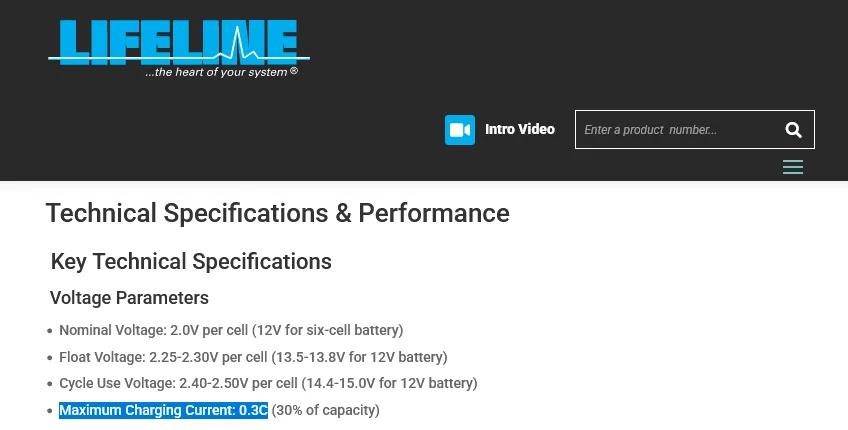
Jeep Wrangler JL battery charger lifelineAGM3

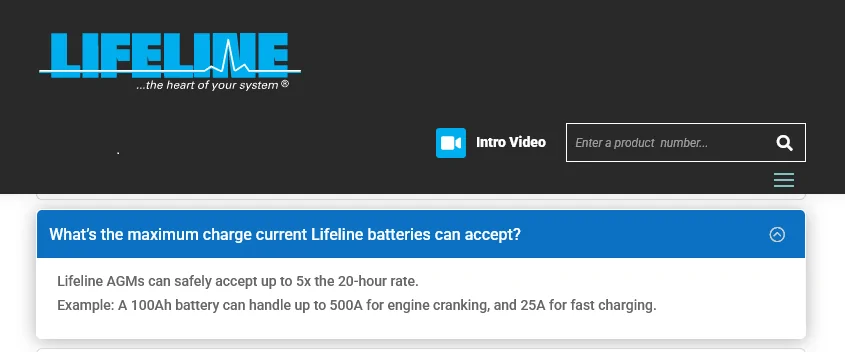
Max charging current is listed right on the website:
Jeep Wrangler JL battery charger lifetlineAGM

And, immediately below the excerpt from the technical manual you deceptively decontextualized and poorly interpreted:
"For example, charging a 100Ah battery at 40% DOD with a 25A charger would take:
[(40/100) x 100 Ă· 25] + 3 = 4.6 hours to reach full charge.
If a 10A charger is used, it would take:
[(40/100) x 100 Ă· 10] + 3 = 7 hours to reach full charge."

There's a reason an industry standard and "practical" 0.25C charge rate was used as the upper bound in Lifeline's technical manual examples demonstrating the difference between fast and slow charge cycles, and it wasn't lawyers.
 
Last edited:

THAW

Well-Known Member
First Name
Foster
Joined
Oct 28, 2022
Threads
4
Messages
2,183
Reaction score
3,013
Location
PNW - prefer Middle of Nowhere
Vehicle(s)
23 JL4DrRubicon
Circling back to this Lifeline/Concorde Batteries technical document excerpt:
"The charging current during the Bulk stage should be set as high as practical..."
Not very scientific. And, "practical" likely had a different meaning in a document first written 17 years ago by a purveyor of high-end, deep-cycle, low-resistance AGM batteries marketed based on fast-charging (for the era) properties for use in large bank marine/RV applications known for under-sized alternator charging. But, I digress...

A charger that doesn't limit current because it's Amp rating/setting is too high, effectively won't have a Bulk stage at all.

The point of properly matching charger Amp rating to battery capacity is so the constant-current Bulk stage efficiently brings the battery up to Absorption voltage without causing excessive/damaging heat build-up. Depending on various conditions, rushing/skipping to Absorption voltage might not be problematic; but, it isn't likely to promote optimal battery life for a discharged, low-end, small-capacity (i.e. higher resistance) battery - say a MOPAR 12 Ah AUX (ESS) battery sealed in a battery tray enclosure and connected separately to a charger with an Amp rating equivalent to 0.83C.

Additionally, the shorter the Bulk stage, the lower the battery SoC when the charger first sets Absorption voltage. As a result, some less-than-genius smart chargers may not hold the battery in the Absorption stage long enough to charge it to 100% SoC, creating more potential for shortening battery life.

So, again, it's inadvisable to charge your JL AUX (ESS) battery separately with most 10 Amp chargers. If you do, don't be surprised if the battery has a sub-optimal (for a JL) lifespan.
Sponsored


Top