Sponsored

Battery and Charging System Help and Understanding

Seabee1999

Active Member
First Name
David
Joined
Sep 24, 2022
Threads
4
Messages
27
Reaction score
23
Location
Norman, Oklahoma
Vehicle(s)
2021 Jeep Wrangler Sport S
Occupation
USN (ret.)
Clubs
 
Good day, yesterday I was at the local dealership getting my backseat issue resolved. This was done under warranty for which I am thankful for. Prior to getting my backseat issue resolved I had battery issues. The charging system was working and pushing out 14v but my battery(-ies) were not doing well. The mechanic mentioned the possibility of bad cells. So yesterday I had both batteries replaced.

On the way home, I wanted to see how the battery health and charging were on the dash display. The reading of the display read 13.9v. I was a little concerned but not too much. This morning on my way into work the charge didn't get much past 12.6v during the drive. On occasion, the display would read 13.9v but then drop to 12.6.

On the old batteries, the charging would consistently stay at or above 14.1v while running. I am looking to see if anyone else has experienced something like this before with their Jeep. I am not that familiar with the dual battery system so I'm also looking to learn what might be going on. Thanks for any information or insight you all can provide.
Sponsored


 

Terrymo

Well-Known Member
First Name
Terry
Joined
Jun 17, 2022
Threads
48
Messages
10,760
Reaction score
33,232
Location
SoCal
Vehicle(s)
2023 JLURXR 3.6 ET
Clubs
 
@Seabee1999
Your alternator is putting out what is demanded of it by the accessories in use and to replenish the charge on the batteries. With weak batteries you will see higher voltage output by the alternator more frequently or even constantly. With healthy batteries you will see lower and fluctuating alternator voltages based on demand.
 

jeepoch

Well-Known Member
First Name
Jay
Joined
Nov 13, 2019
Threads
1
Messages
1,052
Reaction score
2,941
Location
Longmont, CO
Vehicle(s)
2019 JL Wrangler Sport S 3.6L Auto 2 door, 2.5" lift, 35s
Norman,

Here's a pretty recent post I made covering this same subject. I think it's just as relevant to your question here.

https://www.jlwranglerforums.com/fo...y-voltage-what-is-normal.115077/#post-2392911

Overall, the dual battery solution to ESS on the JL is one of the most questionably stupid implementations ever deployed on any vehicle program ever. It really decreases (at least my) enjoyment on an otherwise pretty decent ownership experience. Having two dissimilar sized batteries connected in parallel is in the realm of pure engineering incompetence.

Within the timeframe of the JL program launch back in 2018 it certainly smells of some half-baked design, shoe-horned in at the last minute likely due to CAFE and EPA mandated green compliance directives. But how any world class automotive manufacturer has maintained this system's shortcomings over so many model years is absolutely astonishing.

Don't get me wrong, I really love my 2019 JL 2 door 3.6L Auto. It's the best damn daily driver I've ever owned (by far bar none), except of course the tarneshment of the ever-present possibility of the always ubiquitous battery charging issues.

Even being candid and honest, I oddly like the ESS functionality in general. It's surprisingly nice to hear silence when stopped at traffic lights. It's even fun trying to predict and control it's use during both hectic and routine driving conditions.

Unfortunately, I'm now on my third set of batteries in the four years I've owned it. I have certainly had more battery charging complaints and issues than any other vehicle I've ever owned. My EVIC routinely displays "Battery Protection Mode" and "Battery System Charging" ESS complaints way too frequently. Even after replacing both. I even purchase the best possible AGM replacements and certainly not from the dealership thieves.

Batteries in general, no matter their technology, never quite live up to expectations, at least not within the real world demands placed on them. And especially not with an atrociously inadequate charging scheme as found under the JL hood.

My solution is to connect a good external battery maintainer to my JL frequently, typically around several times per week. If I wasn't having the time-of-my-life driving this thing all around the mountains here in my home state of Colorado, I'd have abandoned this hopelessly useless battery charging disaster a long time ago.

Regardless, I hope you enjoy your JL, despite this crappy charging system as much as I do.

Best regards,
Jay
 

Nvdardx28

Well-Known Member
First Name
James
Joined
Dec 12, 2018
Threads
1
Messages
84
Reaction score
74
Location
MA
Vehicle(s)
2019 Jeep Wrangler JLUR
Occupation
Electrical Engineer
Good day, yesterday I was at the local dealership getting my backseat issue resolved. This was done under warranty for which I am thankful for. Prior to getting my backseat issue resolved I had battery issues. The charging system was working and pushing out 14v but my battery(-ies) were not doing well. The mechanic mentioned the possibility of bad cells. So yesterday I had both batteries replaced.

On the way home, I wanted to see how the battery health and charging were on the dash display. The reading of the display read 13.9v. I was a little concerned but not too much. This morning on my way into work the charge didn't get much past 12.6v during the drive. On occasion, the display would read 13.9v but then drop to 12.6.

On the old batteries, the charging would consistently stay at or above 14.1v while running. I am looking to see if anyone else has experienced something like this before with their Jeep. I am not that familiar with the dual battery system so I'm also looking to learn what might be going on. Thanks for any information or insight you all can provide.
If the batteries were just replaced it could have been initially at a low state of charge, which could explain why you were seeing 12.6V most of the time. Lead acid batteries don't do well sitting on a shelf as they have a high self discharge current, and actually require a charge refresh or maintenance every 4-6 months. Most places that sell batteries do not follow the recommended shelf life maintenance routine.

So I would expect that after driving for a good road trip or after several short/medium drives you will see the battery voltage consistently above 13V, as the driving will bring the charge of the battery all the way up to 100%.

I would always recommend getting a battery maintainer and using it periodically as it allows the battery to get a good full charge cycle under very controlled ideal conditions.
 

Sponsored

Tyler-98-W68

Well-Known Member
First Name
Tyler
Joined
Jul 7, 2022
Threads
20
Messages
151
Reaction score
108
Location
Canada
Vehicle(s)
2021 Sahara 4xe, 2022 Rubicon 4xe
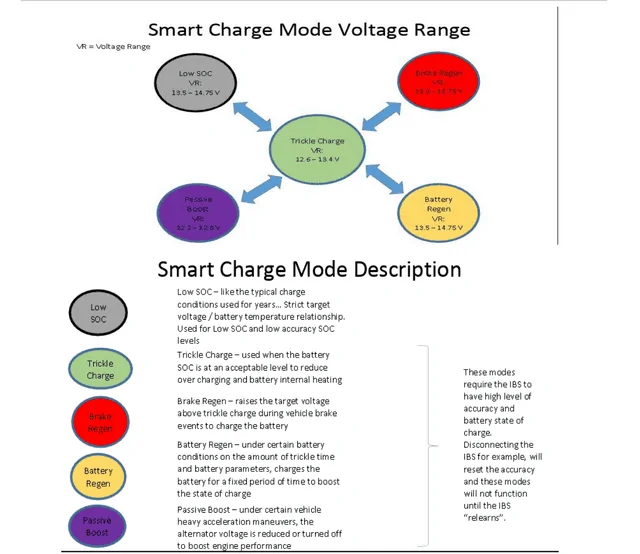
You can't use voltage to judge the health of the batteries.

Smart alternator charging varies the voltage.

Example on my 4xe (it uses a DC/DC charger to charge the 12v battery but with the same algorithm as smart alternator charging


Jeep Wrangler JL Battery and Charging System Help and Understanding smart-alternator-charging
 

Pape

Well-Known Member
Joined
Jul 4, 2023
Threads
16
Messages
1,913
Reaction score
2,036
Location
Quebec
Vehicle(s)
JLU Sahara
What is bugging me is usually AGM battery charge voltage start at 14.4V, My Jk was at exactly 14.4V while charging at was drooping down to 13.8 once the battery charged. My JL never passed over 14.1 therefore is not really charging but only maintaining, Is my assumption wrong or I'm missing something ?
 

Nvdardx28

Well-Known Member
First Name
James
Joined
Dec 12, 2018
Threads
1
Messages
84
Reaction score
74
Location
MA
Vehicle(s)
2019 Jeep Wrangler JLUR
Occupation
Electrical Engineer
What is bugging me is usually AGM battery charge voltage start at 14.4V, My Jk was at exactly 14.4V while charging at was drooping down to 13.8 once the battery charged. My JL never passed over 14.1 therefore is not really charging but only maintaining, Is my assumption wrong or I'm missing something ?
Newer vehicles will limit the charging voltage based on temperature, since Lead Acid batteries are sensitive to thermal runaway. You can 100% fully charge a battery by charging at 13.8V. The reason to go to higher charge voltages such as 14.4V, is to help condition the battery, this mode is also known as equalization or desulfation. The higher voltage helps undo some of the oxidation that grows onto the lead plates in the battery, which in turn helps recovery the capacity of the battery.

You see this charging profile in chargers that only have 2 modes, 13.8V and 14.4V which might have been in the JK. In the JL it can clearly go to intermediate voltages between 13.8V and 14.4V, which is much more preferable in terms of limiting over charging and protecting the battery health.

I don't know for certain if the charge controller in the JL is sophisticated enough keep track of the charge history of the battery to know when the last time the battery was charged at 14.4V. But it does appear to limit the charging voltage when necessary, like when you see 14.1V. Continuously charging at 14.4V will equalize the cells and desulfate the lead plates but if it is done excessively the chemical process will burn off a lot of the acid and will result in a weak battery.

And to be clear there is a difference between battery health and state of charge. A battery with poor health, can but not always, have a healthy voltage but the with poor health there will be poor capacity. A battery with a low state of charge will exhibit a low voltage at the terminals but its health can still be good.
 

Pape

Well-Known Member
Joined
Jul 4, 2023
Threads
16
Messages
1,913
Reaction score
2,036
Location
Quebec
Vehicle(s)
JLU Sahara
Newer vehicles will limit the charging voltage based on temperature, since Lead Acid batteries are sensitive to thermal runaway. You can 100% fully charge a battery by charging at 13.8V. The reason to go to higher charge voltages such as 14.4V, is to help condition the battery, this mode is also known as equalization or desulfation. The higher voltage helps undo some of the oxidation that grows onto the lead plates in the battery, which in turn helps recovery the capacity of the battery.

You see this charging profile in chargers that only have 2 modes, 13.8V and 14.4V which might have been in the JK. In the JL it can clearly go to intermediate voltages between 13.8V and 14.4V, which is much more preferable in terms of limiting over charging and protecting the battery health.

I don't know for certain if the charge controller in the JL is sophisticated enough keep track of the charge history of the battery to know when the last time the battery was charged at 14.4V. But it does appear to limit the charging voltage when necessary, like when you see 14.1V. Continuously charging at 14.4V will equalize the cells and desulfate the lead plates but if it is done excessively the chemical process will burn off a lot of the acid and will result in a weak battery.

And to be clear there is a difference between battery health and state of charge. A battery with poor health, can but not always, have a healthy voltage but the with poor health there will be poor capacity. A battery with a low state of charge will exhibit a low voltage at the terminals but its health can still be good.
We have different number for charging mode, do you know what is the made and model on top of your head for the OEM battery ? I guess it is time to go read the technical spec
 

Nvdardx28

Well-Known Member
First Name
James
Joined
Dec 12, 2018
Threads
1
Messages
84
Reaction score
74
Location
MA
Vehicle(s)
2019 Jeep Wrangler JLUR
Occupation
Electrical Engineer
We have different number for charging mode, do you know what is the made and model on top of your head for the OEM battery ? I guess it is time to go read the technical spec
I'm not sure exactly what your question asks, but all 12V Lead Acids, AGMs etc. are very similar in how you charge them. The only limiting factor is the maximum charging current which is based on the capacity of the battery.
 

Sponsored

Pape

Well-Known Member
Joined
Jul 4, 2023
Threads
16
Messages
1,913
Reaction score
2,036
Location
Quebec
Vehicle(s)
JLU Sahara
I currently do not have access to my JL to validate the battery make and model but If I take an Odyssey H7 L4 for example it will only charge between 14.4V and 14.8V at 20c therefore how the JL can charge such a battery if I never see the voltage exceeding 14V while driving ?
 
OP
OP

Seabee1999

Active Member
First Name
David
Joined
Sep 24, 2022
Threads
4
Messages
27
Reaction score
23
Location
Norman, Oklahoma
Vehicle(s)
2021 Jeep Wrangler Sport S
Occupation
USN (ret.)
Clubs
 
Thanks to all who have responded so far. I appreciate the dialogue as well. As for my original question, through the replies, PMs and phone call, I believe I have a better grasp at what is happening with the battery and charging system.

I am used to a single battery and used to seeing the gauge pegged at a certain voltage. Seeing how this system works is new and one I am getting used to as well.

As suggested by a few others, I’ll do the bypass the auxiliary battery and run on a single one for now. For my needs and for my sense of what is/was “normal” I like that route.

Again, I appreciate greatly everyone’s insight and input.
 

Pape

Well-Known Member
Joined
Jul 4, 2023
Threads
16
Messages
1,913
Reaction score
2,036
Location
Quebec
Vehicle(s)
JLU Sahara
I'm not sure exactly what your question asks, but all 12V Lead Acids, AGMs etc. are very similar in how you charge them. The only limiting factor is the maximum charging current which is based on the capacity of the battery.
Did have a look at the OEM battery, I was not expecting to see a MAX charging voltage of 14.4V.
I was unable to find the minimum charging voltage. From the look of it the OEM battery, is maybe a AGM, but does not meet charging operation of the standard AGM battery but more the standard of an normal lead acid battery. All I can say is to use caution while using external battery charger on the OEM battery. Especially if they have battery type definition like the NOCO who will charge AGM battery at 14.8V and standard at 14.5V
Sponsored


Top