
Sponsored

As if you needed another reason for Amsoil

Ratbert

Well-Known Member
First Name
John
Joined
Jun 20, 2020
Threads
159
Messages
16,162
Reaction score
25,231
Location
PNW
Vehicle(s)
2022 AEV JL370 JLURD
Build Thread
Link
Occupation
Software Engineer
Clubs
 
I'm thinking I must have missed some massive Amsoil fiasco a few years back.

Pure speculation, but were people claiming it was as amazing as @Tredsdert's world-renowned Marvel Mystery Oil?

Step right up, folks! Is your engine knocking like a bill collector at payday? Losing power faster than a politician’s promise? Then you need Marvel Mystery Oil!

This ain’t snake oil—it’s science! Just a splash in your fuel or oil, and BOOM! Carbon vanishes, valves glide like a hot knife through butter, and your engine purrs like a speakeasy jazz band.

Don’t let your motor croak like a flapper’s last cigarette—get Marvel Mystery Oil today!
 

Deleted User 38384

Banned
Banned
Banned
Joined
Aug 4, 2020
Threads
140
Messages
6,081
Reaction score
10,670
Clubs
 
I'm thinking I must have missed some massive Amsoil fiasco a few years back.

Pure speculation, but were people claiming it was as amazing as @Tredsdert's world-renowned Marvel Mystery Oil?
I've since come to the realization that there is actually no fuel additive on the market for diesel engines that is nearly or even close to as good for your engine as straight biodiesel!

Honestly, I'm still shocked that no one has read this post yet. The post which basically kills all fuel additive arguments... And nobody read it! Even bump the damn thread because of how massive this find was, and not a single soul gave a shit.. 🤦‍♂️

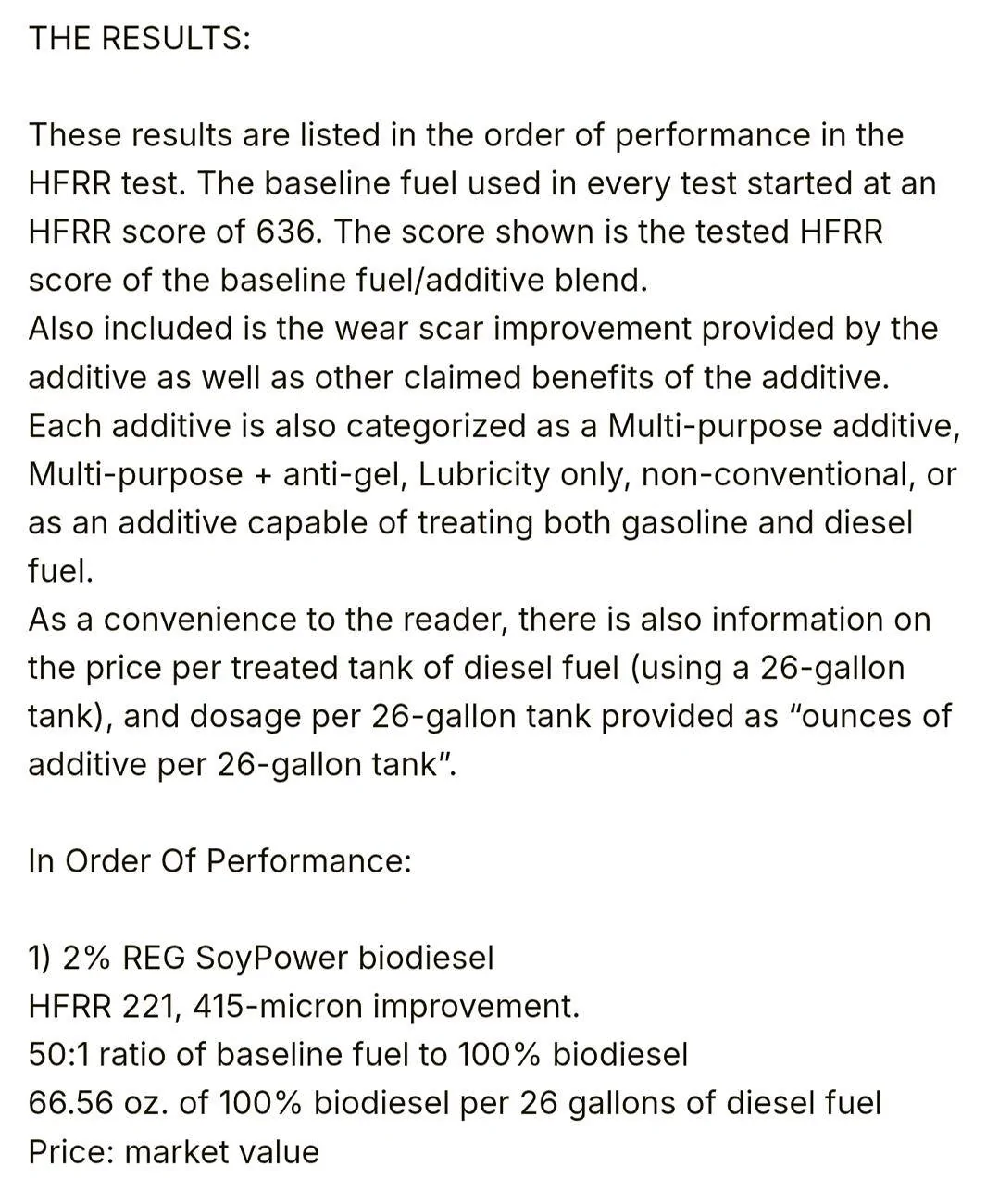
I give to you, the reason why fuel additives for diesel engines are no longer necessary:

There has been 3rd party testing done on many of the fuel additives available, including Marvel mystery oil and that product actually increases the wear scaring as shown in the result of this thread.

https://www.dieselplace.com/threads/lubricity-additive-study-results.177728/
Interesting stuff...

This actually brings up more questions than I had before.

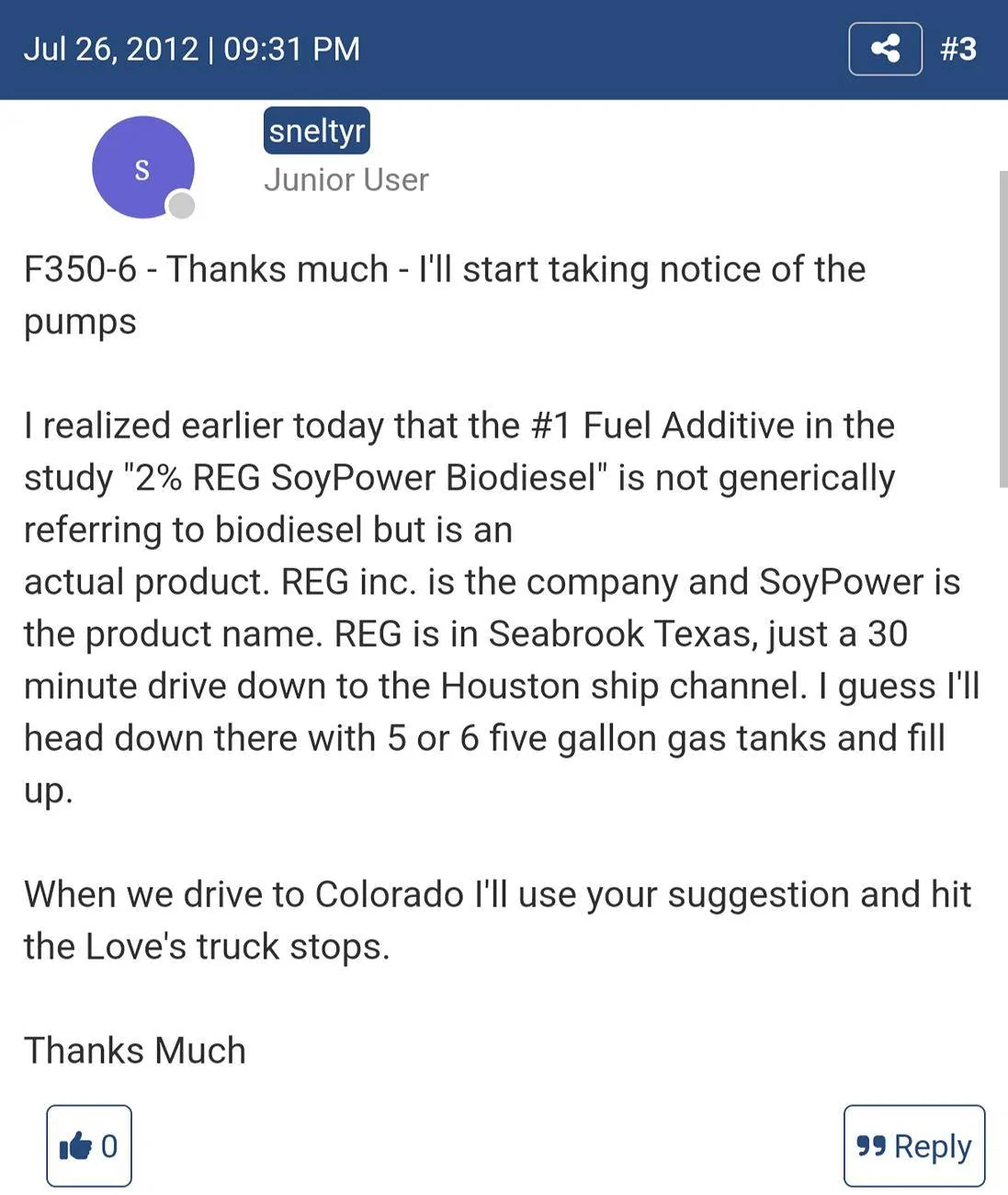
So basically the study was done back in 2003 when biodiesel fuel was really hard to come by. And the number one winner for HFRR improvement is to add a 50:1 ratio of baseline fuel to 100% biodiesel.

I just did the math and it was pretty redundant because it tells you right there in that study, 2% REG SoyPower bio-diesel, where 2% is the amount of biodiesel put into each tank of 100% diesel fuel.

So basically what this study found is that your best bet for the best lubricity of your diesel fuel is to simply use a biodiesel fuel mixture. But again that was back in 2003. Nowadays biodiesel fuel is readily available all across the country.

So if this study is correct, we don't need any fuel additives! In fact just buying B5 biodiesel fuel is going to provide plenty of lubricity for all of our vehicles. I actually get all of my fuel at Bucees, who sells 10% biodiesel fuel.

At this point, I might as well keep using Marvel Mystery oil because my lubricity is so insanely good based on the study listed above, that a 42 micron worst score isn't going to matter now. On a more serious note, should we even be using fuel additives at this point?


Jeep Wrangler JL As if you needed another reason for Amsoil {filename}

Jeep Wrangler JL As if you needed another reason for Amsoil {filename}


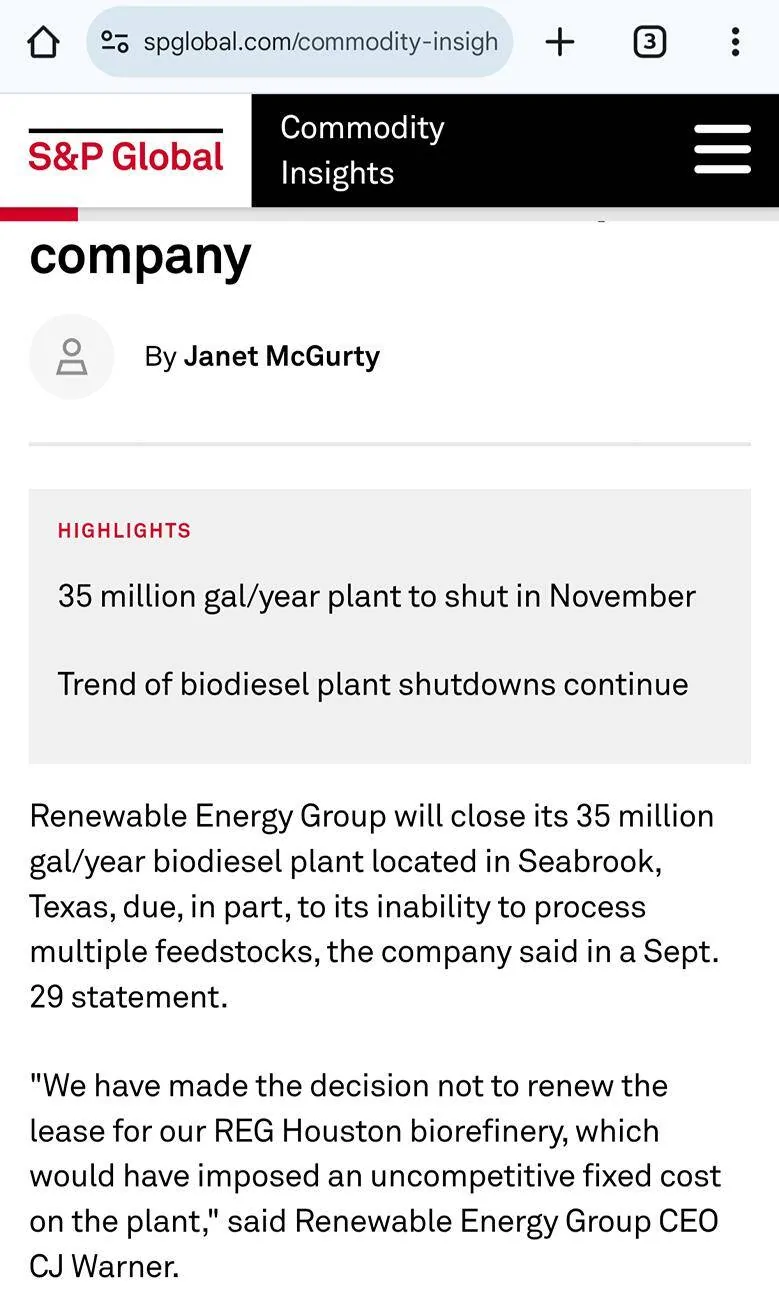
If you didn't read the study all the way through, the study was done in Texas.

I'm at the point now where if this post doesn't take off, and I don't feel it's getting the views it deserves, I'm going to turn it into its own thread. I mean this is additive killing information!
 

Sponsored

NWJeepr

Banned
Banned
Banned
Joined
Apr 28, 2023
Threads
29
Messages
3,638
Reaction score
7,877
Location
Twin Peaks
Vehicle(s)
2025 Wrangler 2-door
I'm at the point now where if this post doesn't take off, and I don't feel it's getting the views it deserves, I'm going to turn it into its own thread. I mean this is additive killing information!
Reading is hard. Posting a 37-minute youtube video describing 3rd-hand knowledge of additives with lots of sensationalism mixed in will net better results for sure. 👍
 

Deleted User 38384

Banned
Banned
Banned
Joined
Aug 4, 2020
Threads
140
Messages
6,081
Reaction score
10,670
Clubs
 
Reading is hard. Posting a 37-minute youtube video describing 3rd-hand knowledge of additives with lots of sensationalism mixed in will net better results for sure. 👍
The sad part is, you're completely right.

And the shit part is, I'm the guy who's not going to watch a video that tells me 2 minutes worth of information over 37 minutes. Because I know it's going to be 35 minutes of bullshit that I don't need to hear.

Instead I would much rather read a 10-page essay, and then do a little research on my own to figure out how truthful it is.

The world's changing, there's lots of idiots now, lazy lazy idiots! :facepalm: 😓
 
OP
OP
autotragic

autotragic

Banned
Banned
Banned
Joined
Nov 29, 2023
Threads
7
Messages
3,199
Reaction score
6,516
Location
the cornbelt
Vehicle(s)
'21 JLR 6MT
  • Thread starter
  • Banned
  • #8
I've since come to the realization that there is actually no fuel additive on the market for diesel engines that is nearly or even close to as good for your engine as straight biodiesel!

Honestly, I'm still shocked that no one has read this post yet. The post which basically kills all fuel additive arguments... And nobody read it! Even bump the damn thread because of how massive this find was, and not a single soul gave a shit.. 🤦‍♂️

I give to you, the reason why fuel additives for diesel engines are no longer necessary:


I'm at the point now where if this post doesn't take off, and I don't feel it's getting the views it deserves, I'm going to turn it into its own thread. I mean this is additive killing information!
I just want you to know that I don't even own a diesel and I care about this post.

I drive a diesel obviously everyday but it's not mine but I know that our boss has some kind of treatment done to the fuel especially in the winter because of fuel gelling.
 

1945gpw

Member
Joined
Apr 12, 2023
Threads
1
Messages
20
Reaction score
17
Location
AZ
Vehicle(s)
2005 TDI, 2022 4Runner, 2023 Eco-Rubicon
I've since come to the realization that there is actually no fuel additive on the market for diesel engines that is nearly or even close to as good for your engine as straight biodiesel!

Honestly, I'm still shocked that no one has read this post yet. The post which basically kills all fuel additive arguments... And nobody read it! Even bump the damn thread because of how massive this find was, and not a single soul gave a shit.. 🤦‍♂️

I give to you, the reason why fuel additives for diesel engines are no longer necessary:


I'm at the point now where if this post doesn't take off, and I don't feel it's getting the views it deserves, I'm going to turn it into its own thread. I mean this is additive killing information!

Personally I'm not convinced bio diesel is the "best" option to take with there being few negative things to consider if using it. From a pure lubricity factor it does appear that pre mixed 5 or 20% from the gas pump would take care of the lubricity for the cp4 but I think there are a few issues to consider.

First is availability, in my state there appear to only be a few stations selling bio making it rather difficult to get.
If I were to purchase a large quantity of 99% bio to mix in my own diesel there are a few issues with that. Bio diesel will start algae growth if stored for to long. Also when mixing the two fuels, from my understanding this is highly discouraged as the two fuels have just enough difference is specific gravity and polarity that water can form and the two fuels can separate layers in the tank causing issues in cold weather.
Second is the methanol byproduct contained within the biodiesel which would destroy rubber seals over time if used in the fuel system.

I am by no means an expert in this stuff but just some things I've been researching as I've been geeking out about this fuel additive stuff the last few weeks lol

Also an interesting addendum that was added to the existing jeep eco-diesel manual post recall for the CP4 pump. Some key points within the addendum referring to Bio-diesel

(1. At Every Oil Change Interval As Indicated By Oil Change Indicator System.
- Replace fuel filter and drain water from the fuel filter assembly

2. In states that use Biodiesel blends greater than 5% (B6-B20) [Example Minnesota in summer months] oil changes and fuel filter replacements are required every 8,000 miles and should not exceed 6 months.

3. [B6-B20] Fuel must be used within 30 days by driving (to less than a quarter tank) and filled with fresh diesel fuel.)

4. Priming the engine : add 2-5 gal of fuel to the tank, Without your foot on the brake push the ignition switch two times. Wait 30 seconds (do this 2x)

5. Commercially available fuel additives are not neccessary for the proper operation of your diesel engine.

6. For "extreme cold" (sub 20 degrees) use "Mopar Premium Diesel Fuel treatment" to assist with cold starts.

7. Diesel used must be from a 'reputable supplier' and be of 'good quality'.

8. No. 2 Diesel fuel meeting ASTM specification D-975 Grade S15.

9. If the vehicle is exposed to etreme cold (below 20 degrees) or is required to operate at cold temps for prolonged periods, use climatized No. 2 diesel fuel or dilute the No.2 diesel fuel with 50% No.1 diesel fuel.

10. If available in your area, a high cetane "premium" diesel fuel may offer improved cold-starting and warm-up performance

11. If the "Water in Fuel Indicator Light" remains on, DO NOT START engine before you drain the water from the fuel filter to avoid engine damage.

12. Fuel dilution of lubricating oil has been observed with the use of Biodiesel fuel. Fuel in oil must not exceed 5%.)
 

Deleted User 38384

Banned
Banned
Banned
Joined
Aug 4, 2020
Threads
140
Messages
6,081
Reaction score
10,670
Clubs
 
Personally I'm not convinced bio diesel is the "best" option to take with there being few negative things to consider if using it. From a pure lubricity factor it does appear that pre mixed 5 or 20% from the gas pump would take care of the lubricity for the cp4 but I think there are a few issues to consider.

First is availability, in my state there appear to only be a few stations selling bio making it rather difficult to get.
If I were to purchase a large quantity of 99% bio to mix in my own diesel there are a few issues with that. Bio diesel will start algae growth if stored for to long. Also when mixing the two fuels, from my understanding this is highly discouraged as the two fuels have just enough difference is specific gravity and polarity that water can form and the two fuels can separate layers in the tank causing issues in cold weather.
Second is the methanol byproduct contained within the biodiesel which would destroy rubber seals over time if used in the fuel system.

I am by no means an expert in this stuff but just some things I've been researching as I've been geeking out about this fuel additive stuff the last few weeks lol

Also an interesting addendum that was added to the existing jeep eco-diesel manual post recall for the CP4 pump. Some key points within the addendum referring to Bio-diesel

(1. At Every Oil Change Interval As Indicated By Oil Change Indicator System.
- Replace fuel filter and drain water from the fuel filter assembly

2. In states that use Biodiesel blends greater than 5% (B6-B20) [Example Minnesota in summer months] oil changes and fuel filter replacements are required every 8,000 miles and should not exceed 6 months.

3. [B6-B20] Fuel must be used within 30 days by driving (to less than a quarter tank) and filled with fresh diesel fuel.)

4. Priming the engine : add 2-5 gal of fuel to the tank, Without your foot on the brake push the ignition switch two times. Wait 30 seconds (do this 2x)

5. Commercially available fuel additives are not neccessary for the proper operation of your diesel engine.

6. For "extreme cold" (sub 20 degrees) use "Mopar Premium Diesel Fuel treatment" to assist with cold starts.

7. Diesel used must be from a 'reputable supplier' and be of 'good quality'.

8. No. 2 Diesel fuel meeting ASTM specification D-975 Grade S15.

9. If the vehicle is exposed to etreme cold (below 20 degrees) or is required to operate at cold temps for prolonged periods, use climatized No. 2 diesel fuel or dilute the No.2 diesel fuel with 50% No.1 diesel fuel.

10. If available in your area, a high cetane "premium" diesel fuel may offer improved cold-starting and warm-up performance

11. If the "Water in Fuel Indicator Light" remains on, DO NOT START engine before you drain the water from the fuel filter to avoid engine damage.

12. Fuel dilution of lubricating oil has been observed with the use of Biodiesel fuel. Fuel in oil must not exceed 5%.)
Sorry, bit of rambling in this one! As I went along, the response just kept growing... 😓

Interesting points. I will say I feel like the only ones that really pertain to most people here are the algae growth in stored biodiesel fuel, and whether or not biodiesel fuel is available near you.

I'm lucky enough that all of the pumps near me specifically sell biodiesel. Honestly I would have more trouble finding non-biodiesel diesel fuel in my area, then I would finding biodiesel fuel.

However pertaining to the amended rules of Mopar for dealing with the HPFP issues they've had. Really that says more about the fact that they didn't actually fix the Bosch CP4.2, and thus need to edit how they handle treatment of the HPFP in our Wranglers. Let's be honest here If they fixed the Bosch CP4.2, they wouldn't need to create an amended upkeep list. They only did so because they didn't fix the problem.

As for the rubber gaskets being destroyed by the methanol in biodiesel, a little bit of research into the percentage of methanol in the final product goes a long way here.

(I don't know why, the website hates me today, it won't let me upload photos. 🤦‍♂️ )

(So I'm just going to tell you what the screenshots inform you of and I guess you can do your own Google searches of it later if you so choose.)

Basically through a process called Transesterification where in 20% of the weight of the process to make biodiesel fuel comes from methanol. However that doesn't match what the amount of methanol in the end product is. In the end product, of 100% biodiesel fuel, only about 2 to 10% of the product is methanol at the end. Now obviously with my local Buc-ee's, providing B10 biodiesel, where in the 10 stands for 10% biodiesel... of that 10% of biodiesel, only (let's just say the max) 10% of that 10% is methanol in the final product that you put into your vehicle. So if we do a little bit of math:

1 gallon = 128 fluid ounces

128 x .1 = 12.8 fluid ounces of 100% biodiesel per gallon of B10 biodiesel

12.8 x .1 = 1.28 fluid ounces of the final product is methanol.

Or if you want to get less technical, 1% of every gallon of B10 biodiesel fuel is methanol.

To correlate this to rubber gaskets and the destruction thereof, I'm going to look at E85 fuel which has on average a 10% ethanol content per gallon of E85 fuel. At which amount the scientists are saying will destroy most rubber gaskets in the automotive industry which typically are made of dipolymer FKM rubber, however when I say it will destroy them, what I mean by that is the normal wear and tear for gaskets in E85 fuel engines is typically several years or tens of thousands of miles... And again that's 10% versus the 1% in the fuel that I'm purchasing.

Here's the article:
https://www.oilandgasiq.com/oil-and...rubber-sealing-manufacturers-are-adjusting-to

(Not all of everything I mentioned above is listed in that article, again the unfortunate downside of me not being able to upload screenshots today)


But don't forget, E85 fuel powered engines are designed with rubber gaskets that will hold up to the higher amount of ethanol in their fuel. In the same way our EcoDiesel engines are designed for biodiesel fuel, which means the gaskets are going to be designed to hold up to the methanol in the biodiesel fuel, otherwise FCA wouldn't be recommending a certain percentage of biodiesel fuel. In this case as you said 5% biodiesel is the maximum they want you to use. And if you want to correlate that to a percentage, that's 0.5% of our diesel fuel that is methanol.

You know something else I just thought about, so the issue of 100% biodiesel fuel growing algae is a real thing, but at the same time, if 10% of that fuel is methanol, which is an alcohol, how much algae do you think is going to be growing in that sort of environment?


I could go on for days about this shit. But that's probably also why the original study that I was basing my findings off of, had listed 2% biodiesel. Which is underneath the 5% that FCA recommends. So if you want to be Frank, pretty sure if you run 5% biodiesel, you won't have any issues. At least for the normal lifespan of your gaskets in your ecodiesel Wrangler. 🤷‍♂️

But I mean realistically if you don't want to trust the lubricity studies done by an independent source, I mean that's your choice. Obviously I think in your case the biggest thing is that the biodiesel fuel is not readily available to you, so using what you have around you is probably best. However for those of us with the ability to actively get biodiesel fuel, the reality is, fuel additives aren't needed for us. 🤗 :rock:
 

Sponsored

1945gpw

Member
Joined
Apr 12, 2023
Threads
1
Messages
20
Reaction score
17
Location
AZ
Vehicle(s)
2005 TDI, 2022 4Runner, 2023 Eco-Rubicon
Sorry, bit of rambling in this one! As I went along, the response just kept growing... 😓

Interesting points. I will say I feel like the only ones that really pertain to most people here are the algae growth in stored biodiesel fuel, and whether or not biodiesel fuel is available near you.

I'm lucky enough that all of the pumps near me specifically sell biodiesel. Honestly I would have more trouble finding non-biodiesel diesel fuel in my area, then I would finding biodiesel fuel.

However pertaining to the amended rules of Mopar for dealing with the HPFP issues they've had. Really that says more about the fact that they didn't actually fix the Bosch CP4.2, and thus need to edit how they handle treatment of the HPFP in our Wranglers. Let's be honest here If they fixed the Bosch CP4.2, they wouldn't need to create an amended upkeep list. They only did so because they didn't fix the problem.

As for the rubber gaskets being destroyed by the methanol in biodiesel, a little bit of research into the percentage of methanol in the final product goes a long way here.

(I don't know why, the website hates me today, it won't let me upload photos. 🤦‍♂️ )

(So I'm just going to tell you what the screenshots inform you of and I guess you can do your own Google searches of it later if you so choose.)

Basically through a process called Transesterification where in 20% of the weight of the process to make biodiesel fuel comes from methanol. However that doesn't match what the amount of methanol in the end product is. In the end product, of 100% biodiesel fuel, only about 2 to 10% of the product is methanol at the end. Now obviously with my local Buc-ee's, providing B10 biodiesel, where in the 10 stands for 10% biodiesel... of that 10% of biodiesel, only (let's just say the max) 10% of that 10% is methanol in the final product that you put into your vehicle. So if we do a little bit of math:

1 gallon = 128 fluid ounces

128 x .1 = 12.8 fluid ounces of 100% biodiesel per gallon of B10 biodiesel

12.8 x .1 = 1.28 fluid ounces of the final product is methanol.

Or if you want to get less technical, 1% of every gallon of B10 biodiesel fuel is methanol.

To correlate this to rubber gaskets and the destruction thereof, I'm going to look at E85 fuel which has on average a 10% ethanol content per gallon of E85 fuel. At which amount the scientists are saying will destroy most rubber gaskets in the automotive industry which typically are made of dipolymer FKM rubber, however when I say it will destroy them, what I mean by that is the normal wear and tear for gaskets in E85 fuel engines is typically several years or tens of thousands of miles... And again that's 10% versus the 1% in the fuel that I'm purchasing.

Here's the article:
https://www.oilandgasiq.com/oil-and...rubber-sealing-manufacturers-are-adjusting-to

(Not all of everything I mentioned above is listed in that article, again the unfortunate downside of me not being able to upload screenshots today)


But don't forget, E85 fuel powered engines are designed with rubber gaskets that will hold up to the higher amount of ethanol in their fuel. In the same way our EcoDiesel engines are designed for biodiesel fuel, which means the gaskets are going to be designed to hold up to the methanol in the biodiesel fuel, otherwise FCA wouldn't be recommending a certain percentage of biodiesel fuel. In this case as you said 5% biodiesel is the maximum they want you to use. And if you want to correlate that to a percentage, that's 0.5% of our diesel fuel that is methanol.

You know something else I just thought about, so the issue of 100% biodiesel fuel growing algae is a real thing, but at the same time, if 10% of that fuel is methanol, which is an alcohol, how much algae do you think is going to be growing in that sort of environment?


I could go on for days about this shit. But that's probably also why the original study that I was basing my findings off of, had listed 2% biodiesel. Which is underneath the 5% that FCA recommends. So if you want to be Frank, pretty sure if you run 5% biodiesel, you won't have any issues. At least for the normal lifespan of your gaskets in your ecodiesel Wrangler. 🤷‍♂️

But I mean realistically if you don't want to trust the lubricity studies done by an independent source, I mean that's your choice. Obviously I think in your case the biggest thing is that the biodiesel fuel is not readily available to you, so using what you have around you is probably best. However for those of us with the ability to actively get biodiesel fuel, the reality is, fuel additives aren't needed for us. 🤗 :rock:

All good points. Yeah If I had the option of purchasing pre mixed bio from the pump like you I'd go that route and forget additives. But seeing as its rather difficult to find in my area I'm going to start using Opti-Lubes Extreme lube as its the most economical for the amount of lubricity it provides compared to other additives.
While opti-lubes XPD improved the HFRR score to approximately 380 the cost comes from the anit-gel additive which I don't need. A single dose (2oz) of their extreme lube additive has an HFRR score of 370 or a double dose brought it down to a HFRR score of 240 which is very close to the Bio results.
 

gek

Well-Known Member
Joined
Nov 1, 2021
Threads
21
Messages
11,393
Reaction score
73,767
Location
........ somewhere in the vicinity of Betelgeuse
Vehicle(s)
'̶𝟣̶8 ̶𝖩̶𝖫̶𝖴̶ '̶𝟤̶𝟣̶ ̶𝖶̶𝗂̶𝗅̶𝗅̶𝗒̶𝗌̶ ̶𝖬̶𝖺̶𝗇̶𝗎̶𝖺̶𝗅̶ '23 JLUR XR
Build Thread
Link
Occupation
Code Monkey
I'm thinking I must have missed some massive Amsoil fiasco a few years back.

Pure speculation, but were people claiming it was as amazing as @Tredsdert's world-renowned Marvel Mystery Oil?
No one knows what's in it, it's a mystery

Jeep Wrangler JL As if you needed another reason for Amsoil 1738291187079-ns
 
Last edited:

Deleted User 38384

Banned
Banned
Banned
Joined
Aug 4, 2020
Threads
140
Messages
6,081
Reaction score
10,670
Clubs
 
All good points. Yeah If I had the option of purchasing pre mixed bio from the pump like you I'd go that route and forget additives. But seeing as its rather difficult to find in my area I'm going to start using Opti-Lubes Extreme lube as its the most economical for the amount of lubricity it provides compared to other additives.
While opti-lubes XPD improved the HFRR score to approximately 380 the cost comes from the anit-gel additive which I don't need. A single dose (2oz) of their extreme lube additive has an HFRR score of 370 or a double dose brought it down to a HFRR score of 240 which is very close to the Bio results.
I got to say, after using fuel additives for the last 3 years, it's really awkward not using fuel additives now. Haven't for the last two fuel-ups. It's definitely going to take some getting used to. I probably say it way too much on here, but I'll feel so much better about not adding fuel additives when my CP4.2 has been swapped out for a CPX!

Know one knows what's in it, it's a mystery

Jeep Wrangler JL As if you needed another reason for Amsoil {filename}
Let's be honest here, it's only a mystery if you don't believe!!

For the rest of us, you know the Holy Grail?

Jeep Wrangler JL As if you needed another reason for Amsoil images (10)~3


(I figured out a go-around to upload pictures)
Sponsored


Top