Sponsored

Wrangler 2.0 or 3.6

Heimkehr

Well-Known Member
First Name
James
Joined
Sep 3, 2020
Threads
48
Messages
11,097
Reaction score
22,484
Location
Pennsylvania
Vehicle(s)
2021 JLU 2.0T
I just got home after driving a 2.0L and a 3.6L back to back.

I drove the 2.0L first. Honestly I was a little surprised at what I'm guessing was intake noise. It improved as things warmed up, but even at the end of the drive I noticed that at around 3200rpm the noise came in stronger and then backed off as rpm climbed.

I drove the V6 right after I got back. It may have been louder(?) overall but was more steady with no peak, and IMHO a much better quality sound.

I ended up buying the V6. As far as torque/drivability, it didn't matter to me. The 2.0L noise at 3200 rpm would have driven me crazy.
The 2.0T is paired only with the ZF 8-speed. At 60 MPH in 8th gear, and with the 3.45 axle, the engine is turning at ~1,400 RPM. That's functionally the same as a fast idle after a cold start.

What driving conditions were you experiencing such that the engine was maintaining 3,200 RPM, as your post suggests? That seems rather high no matter the axle ratio.
Sponsored

 

Dusty Dude

Well-Known Member
Joined
Apr 16, 2023
Threads
57
Messages
1,695
Reaction score
3,817
Location
Colorado Springs, CO
Vehicle(s)
1970 Ply Roadrunner, 2010 Challenger SRT
The 2.0l was originally designed for a small car that was probably 700-1500 lbs lighter with a lot less drivetrain loss. Which means that you are having to run it much harder.
 

DesmoDog

Well-Known Member
First Name
Craig
Joined
Oct 17, 2018
Threads
2
Messages
107
Reaction score
158
Location
SE Michigan, USA
Vehicle(s)
1993 Ducati 900SS Super Light
Occupation
Retired
The 2.0T is paired only with the ZF 8-speed. At 60 MPH in 8th gear, and with the 3.45 axle, the engine is turning at ~1,400 RPM. That's functionally the same as a fast idle after a cold start.

What driving conditions were you experiencing such that the engine was maintaining 3,200 RPM, as your post suggests? That seems rather high no matter the axle ratio.
I never said I was maintaining 3200 rpm, the engine was hitting 3200rpm under acceleration and then the noise "backed off as rpm climbed". That suggests maintaining an rpm?

As I mentioned, I used to do NVH work for a living. If I'm test driving anything I'm going to drive it in ways to specifically find conditions like this. The fact that the noise isn't at peak under steady cruise is quite common for NVH issues and isn't a get out of jail free card.

It's there, I'd hear it every time I drove the vehicle, and I didn't like it. Other people may not give a rip. That's fine, to each his own. Would it keep my from buying a Wrangler if it was the only engine available? Probably not. Did it influence my choice of engines over and above any performance difference? Absolutely it did. In general I like turbocharged powertrains. The V6 cost more and I still chose it. Well, ok, with the deal I got the V6 didn't cost more than the one with the 2.0L but still. I would have paid more to get it.

EDIT: To sum it up - to me the V6 has better sound quality, both from frequency content and the lack of a peak under acceleration. That's enough to sway me to a V6 over the turbo. Your mileage may vary. I'm not saying I'm right, I'm explaining why the V6 was the right choice for me.
 

James Westfall

Well-Known Member
Joined
Aug 11, 2025
Threads
1
Messages
371
Reaction score
436
Location
My own head
Vehicle(s)
A blue one
Occupation
Long time listener, first time caller.
I never said I was maintaining 3200 rpm, the engine was hitting 3200rpm under acceleration and then the noise "backed off as rpm climbed". That suggests maintaining an rpm?

As I mentioned, I used to do NVH work for a living. If I'm test driving anything I'm going to drive it in ways to specifically find conditions like this. The fact that the noise isn't at peak under steady cruise is quite common for NVH issues and isn't a get out of jail free card.

It's there, I'd hear it every time I drove the vehicle, and I didn't like it. Other people may not give a rip. That's fine, to each his own. Would it keep my from buying a Wrangler if it was the only engine available? Probably not. Did it influence my choice of engines over and above any performance difference? Absolutely it did. In general I like turbocharged powertrains. The V6 cost more and I still chose it. Well, ok, with the deal I got the V6 didn't cost more than the one with the 2.0L but still. I would have paid more to get it.

EDIT: To sum it up - to me the V6 has better sound quality, both from frequency content and the lack of a peak under acceleration. That's enough to sway me to a V6 over the turbo. Your mileage may vary. I'm not saying I'm right, I'm explaining why the V6 was the right choice for me.
You're not wrong. The 2.0 is terrible on the NVH front. There are a lot of very sensitive people here who don't like their choices being questioned.

I've now had two examples of both engines, and neither sound great. But the 3.6l definitely wins in the NVH department. It's smoother and the noise it makes isn't as unpleasant. It also doesn't have to rev as high as the 2.0 when accelerating.
 

Aonarch

Well-Known Member
First Name
Mike Hawk
Joined
Oct 20, 2021
Threads
10
Messages
903
Reaction score
1,594
Location
North GA / MT
Vehicle(s)
'25 JLUR '41, '24 F-150 V8 4x4, '22 Mach 1 6MT
Occupation
Motorsports Engineer
I just got home after driving a 2.0L and a 3.6L back to back. I've had a 2016 JKU Sahara since 2019 and got a wild hair this weekend that maybe it was time to update my ride.

To add a little background, I worked in vehicle NVH for about 20 years and am probably more biased than most about this sort of thing. I was also driving with no media playing so I could better hear what was going on.

I drove the 2.0L first. Honestly I was a little surprised at what I'm guessing was intake noise. It improved as things warmed up, but even at the end of the drive I noticed that at around 3200rpm the noise came in stronger and then backed off as rpm climbed. oooh... peaks in the sound signature are not good... I found it annoying.

I drove the V6 right after I got back. It may have been louder(?) overall but was more steady with no peak, and IMHO a much better quality sound.

I ended up buying the V6. As far as torque/drivability, it didn't matter to me. The 2.0L noise at 3200 rpm would have driven me crazy. People who drive with the radio turned up and haven't had to experience of nasty meetings regarding a peak in a vehicle's interior sound may not be as sensititive to this sort of thing.
You're not wrong. The 2.0 is terrible on the NVH front. There are a lot of very sensitive people here who don't like their choices being questioned.

I've now had two examples of both engines, and neither sound great. But the 3.6l definitely wins in the NVH department. It's smoother and the noise it makes isn't as unpleasant. It also doesn't have to rev as high as the 2.0 when accelerating.
I'm sensitive to NVH as well.

I've owned two 3.6l Wranglers and now this 2025 2.0T.

The 3.6l was fine, no issues, my last JT I had the Livernois E85 tune and it felt good with 4.10s and 35s. I'd have loved a supercharger on it, that would have been an excellent experience. You did have to drop a gear or two and rev it out on the interstate though. Just the nature of a NA engine with a rolling brick that is called a Jeep.

The 2.0T can be annoying. Cold starts sound like it is about to throw a rod or something.

But once warmed up and driving, it is fine, no real complaints. Some times it can be a bit noisy, but I guess for me, it is a Jeep. I'm ok with more NVH than in other class of vehicles. Mine has zero unwelcome vibrations or harshness, just the occasional weird sounding engine. It is pretty quiet cruising though.

I am a firm believer that the 2.0l turbo is the better engine for the Wrangler. More torque throughout the power band and more down low torque (2,000 rpm or so). Turbo to help with elevation in areas like Colorado, or for me, Montana.
 

Sponsored

James Westfall

Well-Known Member
Joined
Aug 11, 2025
Threads
1
Messages
371
Reaction score
436
Location
My own head
Vehicle(s)
A blue one
Occupation
Long time listener, first time caller.
I am a firm believer that the 2.0l turbo is the better engine for the Wrangler. More torque throughout the power band and more down low torque (2,000 rpm or so). Turbo to help with elevation in areas like Colorado, or for me, Montana.
I'm back in the 2.0 after having two 3.6's and the big reason is known issues. I feel more comfortable handling the known issues with the 2.0 than I do the 3.6 (i'm not equipped to do an engine swap in my garage, for instance). Having said that, the 3.6 is the winner in low-end power. It makes more torque off idle and it really shows in practice. The 2.0 shines in mid-range power. There's also the FI advantage at elevation, though I can't say it's ever made a difference for me. I've had both engines over 5000ft and neither one stood out to me...pretty much the same as at sea level.
 

Blues Fan 30

Well-Known Member
Joined
Jul 17, 2023
Threads
45
Messages
1,535
Reaction score
4,104
Location
St. Louis
Vehicle(s)
2024 Wrangler Sahara, 2024 Wrangler Rubicon XR
We own both and I personally like my 2.0 better than my wifes 3.6. I feel like the 3.6 searches higher rpms to get moving and with the 2.0 I dont have to give it nearly as much pedal. The v6 is also noisier. As for longevity time will tell. All that said, they are so similar that imo it shouldn't be a factor to pass on a possible good deal. As others have said it is weird that they have both since they are so similar in performance all around.
 

Aonarch

Well-Known Member
First Name
Mike Hawk
Joined
Oct 20, 2021
Threads
10
Messages
903
Reaction score
1,594
Location
North GA / MT
Vehicle(s)
'25 JLUR '41, '24 F-150 V8 4x4, '22 Mach 1 6MT
Occupation
Motorsports Engineer
I'm back in the 2.0 after having two 3.6's and the big reason is known issues. I feel more comfortable handling the known issues with the 2.0 than I do the 3.6 (i'm not equipped to do an engine swap in my garage, for instance). Having said that, the 3.6 is the winner in low-end power. It makes more torque off idle and it really shows in practice. The 2.0 shines in mid-range power. There's also the FI advantage at elevation, though I can't say it's ever made a difference for me. I've had both engines over 5000ft and neither one stood out to me...pretty much the same as at sea level.
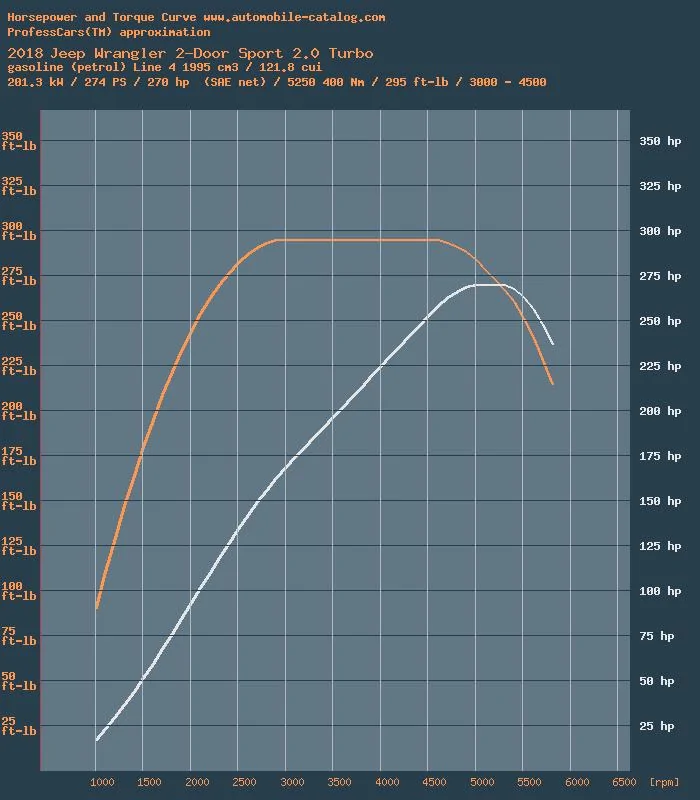
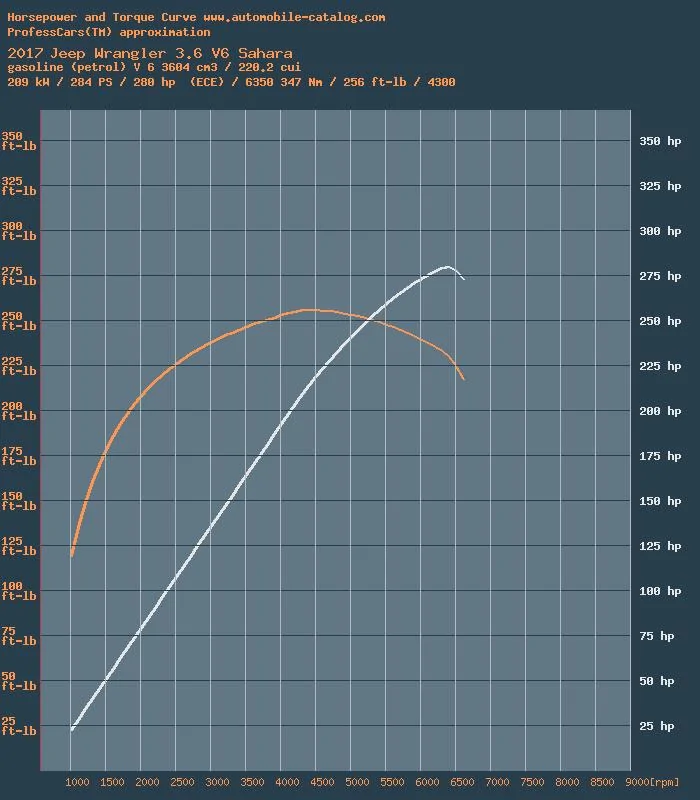
Off idle yes, but I mentioned 2,000 rpm because around there is when the 2.0T makes more torque than the 3.6l

EDIT: According to these dynos it is actually around 1400-1500 is when the torque figures are matched, and the 2.0T then takes off.

Off idle isn't that important to me. Even offroading, since I have the 4:1 T-Case. 1st gear in low range, will have plenty of RPMs while on throttle. 1500 RPM would be 1.86 MPH for me.

These dynos are tough, because most people don't start the runs at such low RPM. The Mishimoto dyno (Not posted here) makes the 2.0T look like it only starts working at around 2100, but I think that is a dyno operator error from loading the dyno and starting the graph so late.

Jeep Wrangler JL Wrangler 2.0 or 3.6 42571-c97816261d8864d22c7cc2913ceb9cca


Jeep Wrangler JL Wrangler 2.0 or 3.6 1759843311407-f9


Jeep Wrangler JL Wrangler 2.0 or 3.6 1759843347302-es
 
Last edited:

jadmt

Well-Known Member
First Name
jeff
Joined
May 19, 2020
Threads
78
Messages
5,169
Reaction score
9,921
Location
montana
Vehicle(s)
2024 wrangler rubicon w/AEV 2.5 dualsport lift
I have a 3.6 as do most of the people I wheel with.. my good buddy who I probably wheel with more than anyone else has the 2.0. We have traveled back and forth between montana to Moab and back often and he always gets better mpg than I do, in a drag race he will leave me (his has 4.56 mine 4.10) but going up say Soldier pass there really is no difference and neither has an issue maintaining 75mph....once in Moab there is 0 difference how they perform on the trails....this my 5th 3.6 and his previous wrangler was a 3.6...I would have no issue getting a 2.0 and he would have no issue getting a 3.6. I can 100% say that neither of us has been able to do something offroad that the other could not do and at no time has either of us been like yea the 3.6 or the 2.0 was the difference on that obstacle......
 

James Westfall

Well-Known Member
Joined
Aug 11, 2025
Threads
1
Messages
371
Reaction score
436
Location
My own head
Vehicle(s)
A blue one
Occupation
Long time listener, first time caller.
These dynos are tough, because most people don't start the runs at such low RPM. The Mishimoto dyno (Not posted here) makes the 2.0T look like it only starts working at around 2100, but I think that is a dyno operator error from loading the dyno and starting the graph so late.
Chassis dynos don't give useful numbers at low wheel speed. There's also the issue of the torque converter - it multiplies engine torque until it reaches coupling speed, which is generally in the 1600-2000rpm range.

Somewhere on here a member did a composite of dyno graphs from the 3.6 and 2.0...I don't remember who though. The composites show that the 2.0 starts making more torque than the 3.6 in between 2000-2400rpm. There are outlier graphs that have lower numbers and ones that have way higher numbers...but the average is in the 2000-2400rpm range.
 

Sponsored

SCJeeps

Well-Known Member
Joined
May 12, 2019
Threads
16
Messages
70
Reaction score
138
Location
TX
Vehicle(s)
2023 JLUR XR, 1952 Willy’s M38
If your metric is reliability it really is a toss up.

3.6 - known issue with cam and follower design(VVL). There is a quality issue here where the follower eats the cam. There is no fix for this and you can’t determine if you have a good one or a bad one, running heavier oils won’t help, it’s just a lottery. Then there are any of the other typical Pentastar issues; leaking oil cooler, oil filter housing cracks, etc. Other than those issues it is a decent platform and support is good as they have made millions of this engine and it is a fleet engine. Remember this engine is not the same as the 2011-2017 3.6, this is the UPG where they introduced the VVL and where most folks issues have come from.

2.0 - water pump bolt issues(resolved), leaking/cracking coolant tank, leaking oil separator, leaking main seal, and maybe a few folks with some timing chain tensioner issues. You don’t typically see a lot of valve train issues on the 2.0. Beyond that you do have some extra complexity with the turbo but no other major issues. I will say that this engine can produce some heat(due to turbo), there is a reason they never spec’d this in a JT(Gladiator) where towing capacity is critical. I suspect this is due to duty cycle and heat removal.

You can find catastrophic issues in both engines, I’m trying to focus on typical issues seen in the field.

Just my 2c. I have the 2.0 in my JLURXR with 4.56 and 37s and it performs well. My wife had the 3.6 in her Grand Cherokee and it was boring and felt unpowered.
 

AnvilWrangler666

Banned
Banned
Banned
Joined
Oct 6, 2025
Threads
0
Messages
4
Reaction score
15
Location
FL
Vehicle(s)
2025 Wrangler 4-Door Sport S
Looking to trade my 2020 Jeep gladiator rubicon in for a new wrangler and really leaning towards the 2.0 because I’ve had so much issues with the lifters on the 3.6. Is the 2.0 reliable or should I stick with a 3.6?
Test drive both back to back. My own testing led me to the 3.6 over the 2.0, but you can't go wrong either way.

I rented a 2.0 JL and put 300 miles of mixed use driving. I found the 2.0 had plenty of power, but at the cost of harshness and some turbo lag. The 2.0 also just sounded unrefined. In contrast, the 3.6 on the JL felt just as peppy, but at a smoother power delivery and a much better NVH experience. It was quiet and smooth. Lastly, the 3.6's MPI vs the 2.0's DI had a significant impact on my decision.

Good luck. Whichever one you choose, just take care of it and don't regret the choice. Both engines are solid, but they just offer a different driving experience.
 

Heimkehr

Well-Known Member
First Name
James
Joined
Sep 3, 2020
Threads
48
Messages
11,097
Reaction score
22,484
Location
Pennsylvania
Vehicle(s)
2021 JLU 2.0T
I've owned two 3.6l Wranglers and now this 2025 2.0T.

The 3.6l was fine, no issues
The 2.0T can be annoying. Cold starts sound like it is about to throw a rod or something.

But once warmed up and driving, it is fine, no real complaints. Some times it can be a bit noisy, but I guess for me, it is a Jeep. I'm ok with more NVH than in other class of vehicles.
I wouldn't select a Wrangler if I was sensitive to noise, vibration and harshness, irrespective of engine choice. My tolerance for that sort of thing would be proportionate to vehicle in question. The Honda that my wife owns is more refined in that regard than is my Jeep, but I'd expect the Honda to be so.

That's not to say that my JLU sounds like a bucket of bolts. It doesn't. Rather, my expectations are reasonably in tune with what the vehicle itself is designed to do.

We own both and I personally like my 2.0 better than my wifes 3.6. I feel like the 3.6 searches higher rpms to get moving and with the 2.0 I dont have to give it nearly as much pedal. The v6 is also noisier.
The V6 was recommended to me by a couple of folks. All of my pre-purchase test drives were in Pentastar-powered JLUs, either manual or automatic. I gave that engine as fair a chance as I could...

...and the experience left me unimpressed. That engine felt sluggish, such that I had to give it more right foot than I thought necessary (relative to its spec sheet) in a variety of driving scenarios, not least pulling away from a stoplight in a regular manner. I thought my expectations were fair, having driven a NA V6 for 11 years before deciding to replace that vehicle.

I decided to configure my factory order with the 2.0T, having neither test-driven nor even seen that engine in person until the day my new Jeep arrived at the dealer. Five years later, I'm reminded of the wisdom of my decision every time I drive my JLU. 👍 Yes, it sounds mechanically busy during cold starts, but it settles down soon enough. When fully warmed up and idling, that engine is easily one of the quietest I've ever owned.
 

DesmoDog

Well-Known Member
First Name
Craig
Joined
Oct 17, 2018
Threads
2
Messages
107
Reaction score
158
Location
SE Michigan, USA
Vehicle(s)
1993 Ducati 900SS Super Light
Occupation
Retired
<snip>It's smoother and the noise it makes isn't as unpleasant.
That is a much more concise way to say what I meant. That's exactly why I chose the V6.

Someone mentioned altitude. If I lived in Frisco, Colorado (like my sister) or spent more time in time mountains I would have chosen the turbo even with the NVH difference.

I'll end my ramblings by saying I agree there is no "wrong" choice. I can see reasons to go with either.
 

James Westfall

Well-Known Member
Joined
Aug 11, 2025
Threads
1
Messages
371
Reaction score
436
Location
My own head
Vehicle(s)
A blue one
Occupation
Long time listener, first time caller.
I'll end my ramblings by saying I agree there is no "wrong" choice. I can see reasons to go with either.
Honestly, I think there's no "right" choice. They both suck. If Stellantis wants to add a new killer feature that they can price in the stratosphere and will sell like crazy - offer a GM or Toyota V6 as an option.
Sponsored


Top