Sponsored

The Corporate Saga Behind Jeeps Collapse

Tr4ckD4ys

Well-Known Member
Joined
Dec 4, 2022
Threads
29
Messages
951
Reaction score
1,878
Location
NY
Vehicle(s)
2025 Jeep Wrangler Rubicon Xtreme 35-inch 2-door, '41 Green
Build Thread
Link
Occupation
Tech
Bloomberg posted an extensive article today originally titled “Jeeps Collapse” and then changed name to the above thread title. It’s behind a paywall unfortunately.

however, I wanted you guys to know ow that it is highly informative, very infuriating and generally depressing.

Will post the article text here below if I can, without any of the great pictures and analyses.

Jeep Wrangler JL The Corporate Saga Behind Jeeps Collapse IMG_0858


https://www.bloomberg.com/news/feat...all-a-corporate-saga-of-self-inflicted-wounds
Sponsored

 
Last edited:

hamiamham69

Well-Known Member
First Name
Mike
Joined
Mar 1, 2023
Threads
22
Messages
327
Reaction score
236
Location
Nantucket MA
Vehicle(s)
2019 Unlimited Sport
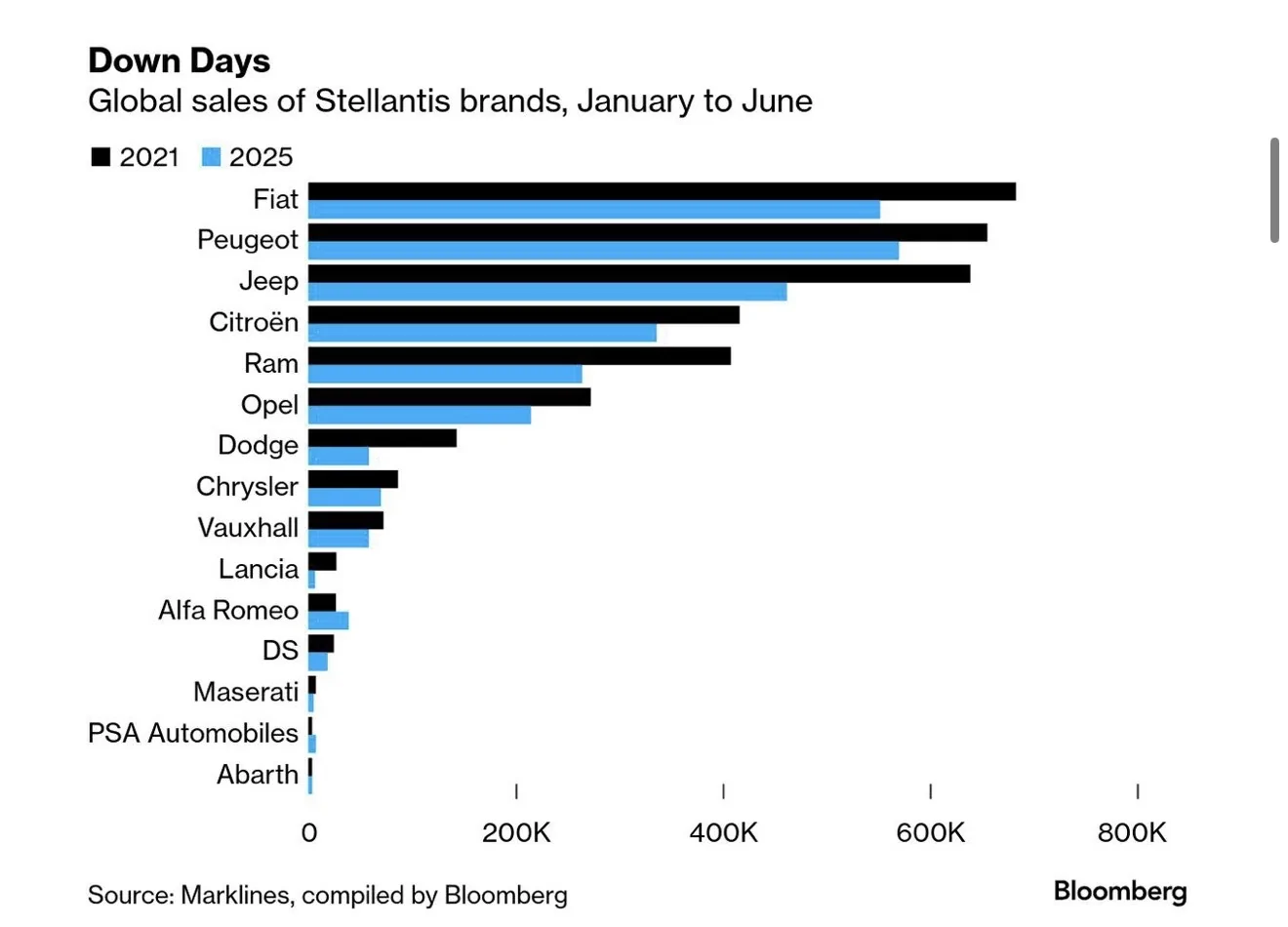
It’s a striking chart. They lack the scale of their competitors in virtually every brand and 5 of the 15 barely register. Even Chrysler and Dodge are marginal.
 

hamiamham69

Well-Known Member
First Name
Mike
Joined
Mar 1, 2023
Threads
22
Messages
327
Reaction score
236
Location
Nantucket MA
Vehicle(s)
2019 Unlimited Sport
For contrast Toyota sold 475K-odd RAV4’s in the US alone and 1.14mm globally..
 

Chris A

Well-Known Member
First Name
Chris
Joined
Feb 14, 2024
Threads
0
Messages
79
Reaction score
46
Location
Dallas, TX
Vehicle(s)
Gladiator Overland
This is what happens when you test the waters on how much can you charge before the sales stop. GM gave Mary Barra a big bonus because they basically got away with overcharging and producing fewer vehicles during COVID years. All manufacturers will find a balance between price and volume, quality and costs. I think Stellantis just pushed it to hard in all areas and it’s going to take time to correct. The current financial situation isn’t the best for auto sales and aren’t most sales volumes down across the board?
 

Sponsored

OP
OP
Tr4ckD4ys

Tr4ckD4ys

Well-Known Member
Joined
Dec 4, 2022
Threads
29
Messages
951
Reaction score
1,878
Location
NY
Vehicle(s)
2025 Jeep Wrangler Rubicon Xtreme 35-inch 2-door, '41 Green
Build Thread
Link
Occupation
Tech
Here’s the article:
The Corporate Saga Behind Jeep’s Downfall
An iconic brand mismanaged by a French-Italian-American auto conglomerate, a profit-obsessed CEO and a billionaire dynasty. And that was before Stellantis collided with Trump’s trade war.


Early in the fourth quarter of this year’s Super Bowl between the Philadelphia Eagles and the Kansas City Chiefs, 100 million viewers found themselves being soothed by Harrison Ford. From a cozy mountain lodge, mug in hand, the actor riffed on life, heroes and freedom—namely, the freedom to choose a gas-guzzler versus an electric vehicle, both of which are sold by Jeep. “Freedom is the roar of one man’s engine, and the silence of another’s,” Ford said in the two-minute TV spot as footage of World War II-era Jeeps flickered on screen, followed by two modern-day models flying into the desert. “We won’t always agree on which way to go, but our differences can be our strength.” As Ford unplugged his hybrid Wrangler and drove off into the mountains, he flashed the two-finger Jeep wave to a fellow traveler gunning his own plug-in.

The multimillion-dollar ad was a pricey way to remind Americans just how much they really do love freedom in the form of a rugged vehicle. But for Stellantis NV, the Dutch-headquartered Franco-American-Italian car company that owns Jeep—along with Dodge, Ram, Peugeot, Citroën, Alfa Romeo, Maserati and a hodgepodge of other makes—it was a bid to help resurrect a storied brand whose sales had collapsed. The commercial had been greenlit by John Elkann, the 49-year-old billionaire chairman of Stellantis, who for the time being was also the de facto chief executive officer. Having ousted the CEO, Carlos Tavares, two months earlier, Elkann had a massive cleanup job on his hands.

Global sales ofOf the many strategic blunders Tavares made during his four-year reign over what was once a $93 billion conglomerate, perhaps his most egregious was the mismanagement of Jeep, Stellantis’ crown jewel. He jacked up prices and increased production of Jeep’s most expensive trims, without adequately investing in new products, which left gaping holes in an aging lineup and swelling inventory on dealer lots. The extent of the damage became clear in July 2024, when Stellantis reported that its net income had been cut almost in half. By September, exasperated dealers sent an open letter to Tavares accusing him of destroying the company’s brands.

Elkann is the leader of the Agnelli family, Italy’s version of the Kennedy clan. His great-great-grandfather Giovanni Agnelli, known as “the Henry Ford of Italy,” founded Fiat SpA in 1899; his grandfather, the flamboyant Gianni Agnelli, multiplied the family’s riches while partying with Jacqueline Onassis and jumping out of helicopters for kicks. The lanky, lower-profile Elkann runs a family-controlled holding company in the Netherlands, Exor NV, which had €38 billion ($45 billion) in net assets at the end of 2024, with the Agnelli family stake valued at about €10 billion. Not only is Elkann responsible for managing the fortunes of 100 or so relatives, he’s also trying to transform Italy’s legacy companies into international giants that can survive another century. That quest has become more difficult as incumbent automakers struggle to compete in the age of electrification and the rise of China.
“Elkann longs to trade pistons for pixels, yet the road from Mirafiori to Silicon Valley is treacherous and muddy”

Over the years, Elkann, who counts Jeff Bezos, Sam Altman and LVMH’s Bernard Arnault in his network, has diversified away from the mass-market auto business, venturing into luxury, health care and technology. Doing so helped him boost Exor’s net asset value per share 14 times since March 2009, when the company was listed in Milan. He also became a smaller shareholder in a bigger auto company, one supposedly big enough to survive the industry’s upheaval. His most valuable asset is a controlling stake in a separate and much more profitable car company, Ferrari NV, which represented almost half of Exor’s entire value last year, while Stellantis accounted for just 13%.
If Stellantis, formed from the 2021 merger of Fiat Chrysler and France’s PSA Group, is Elkann’s link to the past, it’s also his problem, and a drag on his portfolio. “John Elkann longs to trade pistons for pixels, yet the road from Mirafiori to Silicon Valley is treacherous and muddy,” says Carlo Alberto Carnevale Maffè, a professor of business strategy at Milan’s Bocconi University, referring to the site of Fiat’s headquarters. “He’s perhaps betting on sleek M&A to redefine the empire, but the rust in Europe’s car industry demands more than a visionary’s touch to shine.”

Elkann in 2023 at the Formula One Grand Prix in Spielberg, Austria.Photographer: Mark Thompson/Getty Images
With Tavares out, Elkann and the board had begun scouring the globe for a unicorn CEO: someone who understood manufacturing and auto retail, but who also had a clear vision for a future increasingly defined by software and batteries instead of internal combustion; a turnaround whiz who knew the US market but could navigate the internal politics of the three-way culture war among the company’s American, French and Italian fiefdoms, not to mention a 248,000-person global workforce and restive unions; someone who could manage a newly assertive chairman and board filled with appointees safeguarding dynastic wealth and national interests. It’s as much a turnaround job as it is a sort of United Nations ambassadorship. And that was just the internal assignment.

Then there was the global politics, which Elkann tried to stabilize as the CEO search got underway. He embarked on an international apology tour, mending fences with Italy’s right-leaning prime minister, Giorgia Meloni, who’d clashed with Tavares over job cutsbrought on by lackluster sales at the Italian brands Alfa Romeo, Fiat and Maserati. He assured President Emmanuel Macron of Stellantis’ ongoing commitment to France, whose government indirectly owns a 6.7% stake via the state-owned investment bank Bpifrance, which has a seat on the board.

But Donald Trump was Elkann’s biggest problem. The reelected president’s vow to scrap EV targets and bring manufacturing jobs back to the US ran counter to Tavares’ strategy for the conglomerate, which was to remake Stellantis as a nationless manufacturer primed for the EV transition.
Elkann, like many of the corporate chieftains hoping to get on Trump’s good side, came to Washington bearing gifts. There was a $1 million donation from Stellantis to Trump’s inauguration fund, along with the promise of more than $5 billion in new investment, including a pledge to reopen an assembly plant in Illinois that had been controversially shuttered during the Biden presidency. Trump accepted the peace offering, then unleashed a barrage of tariff and policy announcements, further destabilizing the auto industry by upending supply chains, scrambling investment decisions and leaving carmakers on the hook for billions of dollars in new duties.
On a February call with investors reviewing Stellantis’ annual results, Elkann dismissed a question from an analyst who asked whether he would consider breaking up the company, given the uneven pace of global EV adoption and rising geopolitical tensions. Toyota Motor Corp. and other companies were gaining share because of their global reach, not in spite of it, Elkann said. “I believe that in our case, where we have regional scale and global scale, we’re actually very well equipped for the world to come.” (Elkann and Tavares declined to speak to Bloomberg Businessweek for this article.)

After trying to lure several external CEO candidates, the post sat open for almost six months, until late May, when Elkann and the board finally announced that they hadn’t poached an outsider to lead the company in its fight for survival but had promoted someone internally. Antonio Filosa, an Italian who’d successfully run Stellantis’ South American division and had been with the company for 26 years, would be the new CEO. Filosa’s profile had risen amid an exodus of senior management under Tavares; only seven months earlier he’d been promoted to run the North American operations. But in many ways, anointing him as CEO was a tacit admission of what no one was willing to say aloud: Outside talent wasn’t exactly clamoring for this job.
At first, Elkann didn’t appear to be the one destined to shepherd his family’s 126-year-old auto dynasty. The eldest of three, he was 5 when his parents divorced, and he grew up looking after his younger siblings as his mother shuttled them from New York to London, Paris and Brazil. He eventually moved to Turin to study engineering. When Elkann’s cousin, the heir apparent, died of stomach cancer at the age of 33, his grandfather turned to John, whom he’d also been grooming by having him work under a pseudonym at auto plants in Poland and the UK. He joined the board at 21 and took the helm of the company six years later, after the death of his grandfather and great-uncle. At the time Elkann took over, Fiat Group was the largest private industrial employer in Italy, and it was on the verge of bankruptcy. To save it, in 2004 he hired Sergio Marchionne, an outside CEO he believed would set up Fiat for a bright future.

Marchionne was a larger-than-life presence. A rumpled, chain-smoking workaholic, he carried six mobile phones to simultaneously fire off orders, orchestrate deals, kibitz with Elkann and charm the press with his candid assessments of the car business. He would become known on Wall Street as “Il Maestro” for saving Fiat and, eventually, the US car company Chrysler. The latter had long been the scrappy underdog of Detroit, lurching through booms and busts and being passed along to different owners seeking to profit from its American foothold. Lee Iacoccahad saved the company by securing a bailout from Congress in 1979, then he invented a new hit segment: the minivan. When the 2008 financial crisis happened and Chrysler needed another government bailout, Marchionne and Elkann swooped in.

Marchionne breathed life into Fiat Chrysler Automobiles NV (the company’s new name after Fiat bought out the remaining US stake in 2014) by reinvigorating its most prized brands, Jeep and Ram. In 2016 he retooled his car plants to make more SUVs and trucks, anticipating Americans’ shift to crossovers and pickups. SUVs grew from 38% of the US market in 2016 to 60% in 2024, while car sales plunged, according to Cox Automotive. General Motors Co. and Ford Motor Co. would soon follow the shift to more SUV and truck production. During his 14-year reign, Marchionne, with Elkann, increased the value of the car business by more than 10 times by merging Fiat with Chrysler and later spinning off Ferrari.
Marchionne laid out his views on the auto industry in a now-famous manifesto, “Confessions of a Capital Junkie,” which he presented as a 25-page slide deck in the spring of 2015. He argued that consolidation was the only way for the industry to achieve long-term viability. Car manufacturers’ capital expenditures were steadily increasing to keep up with technology—electric motors and batteries, new software architecture, sensors for advanced driver-assistance features—but they weren’t making a healthy return on their investments. He argued they should instead pool their efforts, sharing under-the-hood components the consumer would never see or touch and focusing their research and development budgets on features that would truly differentiate the brands. One-off joint ventures or collaborations didn’t go far enough. To truly future-proof the car industry, Il Maestro argued, companies needed to merge, either with one another or with an established tech giant, to achieve the scale necessary to survive. He acknowledged that such a merger would carry executional risks, but it was ultimately a matter of “leadership style and capability”—namely his, though that part wasn’t explicit.

Marchionne never got the chance to prove his case. An attempt to merge with GM was rebuffed, and in 2018 he died suddenly after undergoing surgery. Elkann, who’d been unaware of Marchionne’s health problems, was shell-shocked. He appointed one of his top lieutenants, former Jeep CEO Mike Manley, as CEO. The mission became boosting profits to ready Fiat Chrysler for another merger, this time with a company that had EV technology—something Marchionne had largely ignored but the carmaker now desperately needed.
PSA Group, run by Tavares, wasn’t Elkann’s first choice, but it had that EV tech, and Tavares was regarded as a hero in France for reviving the company. In 2021, Elkann and the French Peugeot family completed a merger and created Stellantis, with Tavares as CEO and Elkann as chairman. In Tavares, who was born in Portugal and educated in France, the French government felt it had a protector of its interests, and Elkann had a leader who could take Fiat Chrysler into the next century. The company’s center of gravity shifted to Paris.

Elkann, who had a close working relationship with Marchionne, stepped back when Tavares took over, and the board got comfortable with the consistent profits flowing in under Tavares. (A Stellantis spokesperson says Elkann’s role at that time didn’t require him to have day-to-day company involvement.) He had other parts of the family business to attend to, including Ferrari, The Economist magazine and bets on health care and tech. He’d been serving as interim CEO of Ferrari and made an inspired choice to lead the supercar maker: Benedetto Vigna, an Italian physicist who pioneered the use of 3D motion sensors in the Nintendo Wii and the iPhone. Elkann and Vigna regularly exchanged books on tech and philosophy. He’d struck up a friendship with Elon Musk after one of his companies assisted Tesla with the ramp-up of the Model 3, and Elkann invited him to join him for a fireside chat as part of Italy’s 2021 Tech Week, where the two commiserated about steering companies through crises. Elkann was also plowing hundreds of millions into tech firms and mixing with Silicon Valley power brokers as a fellow media magnate at the Allen & Co. tech conference in Sun Valley, Idaho.
Meanwhile, Tavares went ahead with his vision. Like Marchionne, he said scale was key to Stellantis’ survival, but with the caveat that EVs were the company’s future. He laid out a plan to invest more than €30 billion to electrify Stellantis’ model lines, build battery factories across Europe and North America and forge tech partnerships to access more advanced chips and improve software applications in cars. And he said all the right things: Stellantis’ dozen-plus brands would finally be given the resources necessary to compete. The company’s size would shield it from the disruptive forces reshaping the industry while saving it billions, he told investors in early 2021. He began cutting jobs, and he jacked up prices to take advantage of pandemic-induced supply shortages. The combination produced a high-octane earnings boost: The first year, Stellantis put up an almost 12% margin that was the envy of Detroit. The financial results were hard to argue with.

One thing Tavares didn’t have a good grasp of was the US market. Nor would he listen to American executives who did. When interest rates rose, he refused to discount cars or make more features standard on base models. Instead, he kept prices high and cut deeper internally. Over four years, he dismissed more than 50,000 people, or almost 17% of the workforce. He replaced engineers in the US, France and Italy, who for decades had been fine-tuning Citroën, Fiat and Jeep, with lower-paid alternates in Brazil, India and Morocco. He demanded that suppliers sell him parts virtually at cost, then balked at requests for price increases to offset inflation, triggering lawsuits and even factory shutdowns. As long as Stellantis remained profitable, the board went along, even as Tavares was hollowing out the essence of its most important brands. (A spokesperson says the board was not complacent and asked Elkann to be more involved in June 2024 as problems emerged.)
By mid-2024, Tavares couldn’t dismiss the US problems anymore. With unsold cars piling up and no strategy shift, key executives were leaving. That summer, Tavares gathered investors at the company’s US headquarters in Auburn Hills, Michigan, and promised to deliver double-digit margins yet again. He offered a mea culpa over the US business, allowing he’d been “arrogant.” But he had a plan: a slew of new EV models. Never mind that slowing EV sales were already forcing Ford and GM to cut production.

The vehicle launches didn’t go well. Tavares had gutted factory crews and driven out a deep bench of manufacturing leaders with decades of experience, hampering both EV and gas vehicle rollouts. Earlier that year, line workers in Detroit had huddled on Zoom calls with an engineer in India to troubleshoot. In one instance, a cable needed to hook up the electronics in the Ram pickup was too short, but the schematic on the engineer’s computer 8,000 miles away showed a different length. It took months to pinpoint what could have taken days in person, according to one United Auto Workersleader who was part of the group and asked not to be named commenting on internal matters.
In the end, much of Tavares’ product offensive was delayed, some models by months, others by years as the hype around EVs died down. The delays worsened an already deteriorating financial picture. Only when Stellantis reported its shocking profit shortfall in July 2024, tanking the stock, did the board realize the extent of the damage in the US, according to people familiar with the situation who asked not to be identified discussing internal matters. After accompanying Tavares on a trip to the US in August, Elkann started looking for a successor, people familiar with the process said.
Meanwhile, Tavares persuaded the board to push out his chief financial officer and continued to call for drastic cost cuts. But even his French champions were losing faith. Over the first weekend of December, Tavares was told that his strategic goals no longer aligned with the board’s, and he was ousted. Tavares, who’d expected to serve until his contract ran out in 2026, left without a fight, taking with him a $27 million payout. “I did my very best when I was there, with my team,” he told Bloomberg News in May in an interview in Portugal, where he’s been investing in local companies and making port wine at his vineyard. “I was not alone and with the board.”

Jeep was certainly not the only damaged brand, but it had the most to lose. Its value is almost mythical in the auto industry. Few vehicles are as deeply embedded in the American psyche as a Wrangler, cruising around in summer without its roof or doors. Jeep owners leave rubber ducks on one another’s hoods as an act of good karma and post nude selfies in their vehicles on Jeep subreddits. Even Bruce Springsteen once shilled for the brand, and it didn’t feel completely farcical.

But the paradox of Jeep is that it’s an off-road vehicle, and off-roading is niche. The more you try to expand it, the further you risk straying from what makes it unique. Many suitors have offered to take Jeep off Chrysler’s hands since Iacocca acquired it in 1987, and many an executive has defiled it while trying to multiply its riches. Marchionne and his successor mostly pulled it off, but even they stumbled trying to make it translate in China.
The company miscalculated again in 2021, when it brought Jeep into the luxury realm with the three-row Wagoneer and Grand Wagoneer, turning the rugged rock crawler into a land yacht topping out above $100,000. When the move upmarket backfired, Jeep didn’t have enough competitive mainstream models to fall back on. Tavares had temporarily discontinued the Jeep Cherokee, a midsize SUV priced just less than $40,000, to transfer production from Illinois to Mexico to save on labor costs. The Grand Cherokee and entry-level Compass were also badly in need of a refresh. The hole Cherokee left in the heart of the SUV market was a gift to the competition. Jeep was losing customers to more affordable brands such as Hyundai and the boxy Wrangler rival, the Ford Bronco.
With Jeep’s market share crumbling, the brand’s CEO left in the fall of 2023, and Tavares recruited Filosa to take over. Filosa had started at Fiat in 1999 as a plant rat—industry slang for a manufacturing executive who toils long enough in the bowels of factories to appreciate the intricacies of high-volume manufacturing with speed and quality—going on to successfully run Fiat’s Argentina business and eventually all of South America. Now in Detroit, Filosa had one goal: Stop the bleeding at Jeep. He lowered prices, made more premium features available at no additional cost and idled plants so dealers could sell off old inventory. But the problems he inherited had no quick fixes. Price cuts and marketing could do only so much; what the brand really needed was new products. In 2024 sales fell for a sixth consecutive year, and Jeep’s share of the American SUV market slipped to less than half its 13% peak since 2000, according to Edmunds.
Then in early February, with Elkann still looking to fill the CEO post, Trump announced a barrage of tariffs, blowing up Stellantis’ product plans in the process. He imposed a 25% duty on imports from Canada and Mexico, bypassing Congress. Stellantis executives in Detroit tried to estimate the size of the tariff bills, along with the cost of moving production and tweaking supply chains. They fielded letters from suppliers asking for financial help. The uncertainty scrambled the economics on imported vehicles.
Hesitant to sell cars whose cost he couldn’t predict, Filosa—now running North America—halted production at two plants in Canada and Mexico in early April, temporarily laying off not only those workers but also hundreds of UAW members in Michigan and Indiana who made transmissions and stamped metal for plants across the border. The much-anticipated return of the Cherokee, now made in Mexico, was waylaid because its supply chain had to be reworked to minimize tariff costs. The less expensive Compass was about to get a long-awaited face-lift at a plant in Canada, but Filosa paused the newer model’s US debut, creating panic among Canadian government and labor leaders.

Elkann shifted into diplomacy mode to try to convince Trump that leaving the tariffs in place would seriously weaken the very industry he wanted to protect. He joined the CEOs of GM and Ford on a call in March to plead with White House officials for an exemption for cars that complied with labor and other requirements in Trump’s original trade pact, which some key Stellantis vehicles did. Weeks later, Elkann paid Trump another visit at the White House, and in April, he made an appeal from the podium at Stellantis’ annual shareholders meeting. “The American and European car industries are being put at risk,” he said. “That would be a tragedy, as car manufacturing is a source of jobs, innovation and strong communities.”

The Trump administration did eventually make some concessions that helped American carmakers. The EU also agreed earlier this year to ease pollution rules, sparing Stellantis from an estimated €1 billion fine for exceeding emissions targets. But it was not enough for it to avoid significant financial hits. In April, Stellantis suspended its financial guidance for the year, citing tariff uncertainty, and the CFO later said trade duties would cost the automaker as much as $1.5 billion this year, roughly 27% of the 2024 net profit. (It restored guidance in July.) Not that its factory workers were buying those explanations of the company’s struggles. “Tariffs are just an excuse,” said Kevin Gotinsky, the head of the UAW’s Stellantis division, at a rally outside Detroit.
During that period, Elkann had also been searching for Stellantis’ new CEO both inside and outside the company. He’d sounded out José Muñoz, who in November was promoted to become Hyundai Motor Co.’s first non-Korean chief. He considered Mark Reuss, Mary Barra’s No. 2 at GM, and former Fiat Chrysler CEO Manley, who’d gone on to successfully lead the US dealership chain AutoNation Inc. Elkann also was in contact with Luca de Meo, a former Fiat executive who’d executed an impressive turnaround of Renault SA. But by then, de Meo was already lining up a new job outside autos as CEO of Kering SA, the French luxury group that owns Gucci. (A Stellantis spokesperson in an email disputed this characterization, saying “the Board had a number of strong candidates ready to take up the CEO role at the end of the process, both external and internal.”)
In late May, Stellantis announced it was promoting Filosa to lead the company. The 52-year-old was a loyal disciple of Marchionne’s who has the reputation of an intelligent and humane “corporate chameleon” able to easily alternate between remembering line workers’ names and applying pressure on white-collar underlings to get results, as one former colleague in Brazil described him. While Elkann had been scouring the globe for an external leader, he had also put Filosa through a CEO crash course, promoting him three times in the span of eight months. “Filosa was the board’s top candidate because of his proven track record of leadership and his people-first mindset,” says a Stellantis spokesperson.

While an internal hire meant the new chief wouldn’t need time to learn the culture or diagnose what had gone wrong, it also reinforced just how unattractive the role was to outsiders, staring down the barrel of more losses, possible downsizing and the tariff mess, says an automotive industry analyst who asked not to be identified discussing the company’s hiring process. Filosa’s appointment also signaled the company’s internal shift in power from France back to Detroit and Elkann’s home country of Italy, whose factories had been gutted under Tavares. Days before Tavares was ousted, Filosa—who speaks fluent Portuguese as well as English and Italian—made a not-so-subtle jab at the soon to be former regime. “Speak whatever language you want—just not French!” he joked to a Bloomberg reporter last November. (He declined to comment for this article.)
In late July, Filosa had his coming out—his first Stellantis earnings call as CEO. The company had already frontloaded the grim news earlier: a $2.7 billion loss in the first half of the year, with the bulk of the tariff pain still to come in the second half. Filosa introduced himself as a leader who fixes problems and runs toward tough decisions, but it quickly became apparent that he still had fires to put out before he could offer any grand blueprint to fix the company. Filosa talked about reversing plunging sales in the US and Europe with upcoming products, but cautioned that a new plan wouldn’t be ready until early next year. “Nothing works at Stellantis in the midterm if they don’t fix the US quickly,” said Philippe Houchois, an analyst with Jefferies.

Elkann, meanwhile, has been more involved with Stellantis than he’s been in years. He helped woo back Tim Kuniskis, a 30-year company veteran who left under Tavares, then rejoined a week after Tavares was ousted. Known for reviving the Dodge muscle car brand with souped-up engines named Demon, Hellcat and Redeye, Kuniskis is now overseeing US retail and marketing strategy in the Trump era. If there’s any American bravado left in Auburn Hills, he’ll try to summon it. And he’s getting a lift from Trump, whose rollback of EV targets and fuel economy rules will allow him to put popular engines back in the lineup. He’s already returned the popular Hemi engine to Ram pickup models, and Stellantis has four new and refreshed Jeep SUVs arriving later this year, including the crucial Cherokee. In July, Elkann gave a speech in Stuttgart, Germany, in which he warned European policymakers not to underestimate Chinese competition and urged them to lighten regulations and bring back clean-car incentives to help Stellantis and its peers compete. Then he helped poach one of Renault’s top design executives to head design for Stellantis’ European brands, a coup after the company had been drained of seasoned engineering and marketing talent.
But Elkann’s most telling moves are happening outside the walls of Stellantis. Days after Filosa’s Wall Street debut, Exor agreed to sell Iveco Group NV, a trucking company with roots stretching back to Elkann’s great-great-grandfather, to India’s Tata Motors Ltd. and an Italian defense company for more than $6 billion. It was another sign the scion is untethering himself from manufacturing to free up cash to invest in high-growth industries such as tech, biotech and luxury. At the start of 2025, Elkann joined the board of Meta Platforms Inc., while Exor also invested in a data analytics firm and increased its stake in the health-care technology company Koninklijke Philips NV.
There could be more dealmaking in the offing for Stellantis: Earlier this year, Elkann hired McKinsey & Co. to develop a strategy for the struggling Alfa Romeo and Maserati brands, which face yet another headwind from Trump’s tariffs. (Filosa has sought to tamp down speculation, telling Italian financial newspaper Il Sole 24 Ore that Maserati is not for sale.) The plan for Stellantis, at least for now, seems to be to get the company back in a financial position that gives Elkann a better hand to play. A Stellantis spokesperson says its chairman has “never walked away from problems” and has been a “supportive owner through difficult times” by giving management the resources needed to adapt.
But as much as Elkann prizes innovation, he’s an industrialist, much like his great-great-grandfather. His primary duty now is to play the role of investor and expand the family fortune, not fight a fading auto industry. He will shrink parts of the Exor empire to turn to more lucrative things if he needs to—and he’s already started.
 

LSJKU

Well-Known Member
Joined
Aug 13, 2018
Threads
2
Messages
610
Reaction score
810
Location
Hill Country
Vehicle(s)
2025 JL Rubicon, 2019 Raptor SCAB
Occupation
doodlebug
Bloomberg posted an extensive article today originally titled “Jeeps Collapse” and then changed name to the above thread title. It’s behind a paywall unfortunately.

however, I wanted you guys to know ow that it is highly informative, very infuriating and generally depressing.

Will post the article text here below if I can, without any of the great pictures and analyses.
IMG_0858.webp


https://www.bloomberg.com/news/feat...all-a-corporate-saga-of-self-inflicted-wounds
Seems like the article was behind a paywall, but I already know the jist of it. Same old sad, disappointing story since Fiat took the reins before the 2012 MY (the Pentastar debut). And we've all paid a heavy price since.
 

LSJKU

Well-Known Member
Joined
Aug 13, 2018
Threads
2
Messages
610
Reaction score
810
Location
Hill Country
Vehicle(s)
2025 JL Rubicon, 2019 Raptor SCAB
Occupation
doodlebug
Maybe AMC will buy them back.
Man, did I ever have some fun with my AMC CJ's. No soft/hhard top, no electronic engine nanny-states to deal with, super-simple to work on, and a hoot to drive. I never-ever believed I would recall the AMC days with such fondness.

The only thing that will surprise me more these days is to hear someone proclaim they loved the days a bowling pin company (AMF) owned Harley!
 

VKSheridan

Well-Known Member
First Name
Vince
Joined
Dec 21, 2019
Threads
9
Messages
1,031
Reaction score
1,654
Location
Broken Arrow, OK
Vehicle(s)
2020 2 Dr Rubicon JL Hardtop
Build Thread
Link
Occupation
Retired from the heavy equipment industry
Vehicle Showcase
1
This is what happens when your priority for admirable engineering shifts to admirable shareholder dividends. Jeep has struggled beyond its niche since the days of AMC so even if divested from Stellantis, I think it’s future will be similar to Oldsmobile or International. A brand that lasted until it didn’t.
 

Sponsored

flick2614

Well-Known Member
First Name
Randy
Joined
Aug 7, 2024
Threads
61
Messages
933
Reaction score
2,050
Location
AZ
Vehicle(s)
2021 Jeep JLU Rubicon Diesel
Clubs
 
Man, did I ever have some fun with my AMC CJ's. No soft/hhard top, no electronic engine nanny-states to deal with, super-simple to work on, and a hoot to drive. I never-ever believed I would recall the AMC days with such fondness.

The only thing that will surprise me more these days is to hear someone proclaim they loved the days a bowling pin company (AMF) owned Harley!
The FXR, the most popular vintage Harley was spawned out of the AMF days so it couldn't have been all that bad. :LOL:
 

NWJeepr

Banned
Banned
Banned
Joined
Apr 28, 2023
Threads
29
Messages
3,638
Reaction score
7,877
Location
Twin Peaks
Vehicle(s)
2025 Wrangler 2-door
Thanks for gifting the article. That is quite the testament to Tavares' misguided approach, something I think we've all seen and felt when buying products in that era.

It's also a testament to how horribly misguided US tariffs are and the global impact it has not only on our domestic auto industry, but on the supply chains and global auto industry which will be forever intertwined.
 

LSJKU

Well-Known Member
Joined
Aug 13, 2018
Threads
2
Messages
610
Reaction score
810
Location
Hill Country
Vehicle(s)
2025 JL Rubicon, 2019 Raptor SCAB
Occupation
doodlebug
This is what happens when your priority for admirable engineering shifts to admirable shareholder dividends. Jeep has struggled beyond its niche since the days of AMC so even if divested from Stellantis, I think it’s future will be similar to Oldsmobile or International. A brand that lasted until it didn’t.
I hope you are wrong, the are many auto mfg's out there that would love to own the Jeep brand, and would probably do the brand good. Unfortunately, I believe you're more right than wrong.
Sponsored


Top