Sponsored

Cold Engine Question

Rick4570

Well-Known Member
First Name
Rick
Joined
Jul 8, 2022
Threads
14
Messages
147
Reaction score
170
Location
Virginia
Vehicle(s)
2022 Jeep Wrangler
Maybe this is a silly question, but I'm curious. We are always told to let an engine warm up before heavy or high rpm use. So, if you are starting out in the morning on battery power only, and for whatever reason you have to floor it (perhaps a situation unexpected). Obviously the engine kicks in. How good can that be on a cold engine to start up and start going full throttle?
Sponsored

 

Reinen

Well-Known Member
Joined
Jan 10, 2021
Threads
19
Messages
3,190
Reaction score
7,519
Location
Utah
Vehicle(s)
2021 Jeep Wrangler JL Rubicon
Whoever told you that doesn't realize we're not using 1970's engines and motor oil anymore. Modern engines are fully lubricated much faster now and modern synthetic motor oil have additives to provide lubrication even when the engine is "dry".

On modern vehicles the only reason to recommend letting your engine warm up on cold days is so your defroster works and your windshield doesn't fog up. That takes less than a minute anyway. As for the engine, just start it and drive.
 

AFD

Well-Known Member
Joined
Oct 13, 2021
Threads
15
Messages
3,786
Reaction score
7,275
Location
Northeastern US
Vehicle(s)
2023 JL Rubicon (2DR/V6)
Just habit from my last vehicle's instructions in the owner's manual, but I always give it a minute or two for the RPMs to settle down to idle (or one notch on the temp gauge) and wait for the temp gauge to reach the usual half-way point before any spirited driving (unless it's actually needed).

Probably not necessary, but it certainly doesn't hurt anything. Most everyone else I know just jumps in and takes off like they're leaving the pits of the Indy 500.
 

jjvincent

Well-Known Member
First Name
John
Joined
May 31, 2021
Threads
6
Messages
973
Reaction score
1,411
Location
Bethlehem, PA
Vehicle(s)
2021 Wrangler, 2017 VW Alltrack, 2003 VW Eurovan
Occupation
Mechanical Engineer
Maybe this is a silly question, but I'm curious. We are always told to let an engine warm up before heavy or high rpm use. So, if you are starting out in the morning on battery power only, and for whatever reason you have to floor it (perhaps a situation unexpected). Obviously the engine kicks in. How good can that be on a cold engine to start up and start going full throttle?
So, a friend of mine works at a company that designs and tests OEM engines. Here is a test they do. They put the engine on a dyno and run it under load to full operating temp. Then shut it down. They take and have valves that switch over the coolant lines and then run -40F coolant through it until the motor is to that temp. Switch the valves over, fire it up and start dyno pulls. Repeat, repeat and repeat all day long. After a number of those cycles, they pull the motor apart, measure wear and check for any stress cracks.

This is normal for todays engines. As for 1975, not the case.

It's like when I toured the Porsche factory back in the late 80's. They literally dynoed every engine. I watched them take a brand new 944 Turbo engine, warm it up for 5 minutes and then do dyno pulls on it until it had the exhaust cherry red. Pretty much 45 minutes of that run time. Then pull the motor, inspect it and then put it in a brand new car. After that, it got a lap on the test track. Porshe was proud that every new car has 35km on them before you ever took delivery. In this day of age and with manufacturing processes along with quality control, that's not needed.
 
OP
OP

Rick4570

Well-Known Member
First Name
Rick
Joined
Jul 8, 2022
Threads
14
Messages
147
Reaction score
170
Location
Virginia
Vehicle(s)
2022 Jeep Wrangler
I also was told by a service tech that direct injection engines like the 2.0 in the Jeep need to be run at normal operating temperatures for longer periods of time than just the occasional start up to assist the electric. He said that they are finding more issues with carbon with the 4xe than with Wranglers with just the 2.0 alone. I never really know what to believe, but that was his opinion.
 

Sponsored

AFD

Well-Known Member
Joined
Oct 13, 2021
Threads
15
Messages
3,786
Reaction score
7,275
Location
Northeastern US
Vehicle(s)
2023 JL Rubicon (2DR/V6)
I also was told by a service tech that direct injection engines like the 2.0 in the Jeep need to be run at normal operating temperatures for longer periods of time than just the occasional start up to assist the electric. He said that they are finding more issues with carbon with the 4xe than with Wranglers with just the 2.0 alone. I never really know what to believe, but that was his opinion.
Other than for the diesel engine, the owner's manual doesn't recommend any particular warm-up before driving (or further before spirited driving), as far as I could find.

Not sure about any fundamental changes in metallurgy between engines of today and decades ago, but my last car that was sold up until 2014 (turbo 2.0L, but not direct-injected) definitely recommended/warned about warm-ups (and cool-downs after driving).

If the Wrangler manual doesn't state anything about it, then I really wouldn't worry about it too much. Personally, an extra minute or two every day and driving moderately for a bit really doesn't bother me, but if I need full-throttle for a good reason, then I'm absolutely gonna use it.

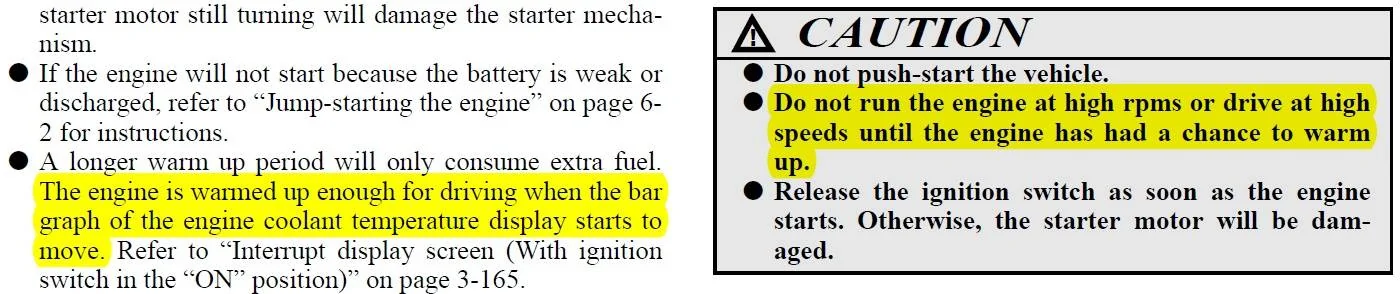
This is what was written in the owner's manual of my Evo from less than a decade ago..

Jeep Wrangler JL Cold Engine Question Image1
 

jjvincent

Well-Known Member
First Name
John
Joined
May 31, 2021
Threads
6
Messages
973
Reaction score
1,411
Location
Bethlehem, PA
Vehicle(s)
2021 Wrangler, 2017 VW Alltrack, 2003 VW Eurovan
Occupation
Mechanical Engineer
I also was told by a service tech that direct injection engines like the 2.0 in the Jeep need to be run at normal operating temperatures for longer periods of time than just the occasional start up to assist the electric. He said that they are finding more issues with carbon with the 4xe than with Wranglers with just the 2.0 alone. I never really know what to believe, but that was his opinion.
It depends on the manufacturer. Some DI motors gunk up the intake yet others do not. When they do gunk up, they throw misfire codes. I'm guessing that you are overthinking this. If it was a real problem, then there would be a sticky about it and hundreds of posts. As we all know, people like to complain on forums first.
 

Heimkehr

Well-Known Member
First Name
James
Joined
Sep 3, 2020
Threads
48
Messages
11,072
Reaction score
22,431
Location
Pennsylvania
Vehicle(s)
2021 JLU 2.0T
We are always told to let an engine warm up before heavy or high rpm use. So, if you are starting out in the morning on battery power only, and for whatever reason you have to floor it (perhaps a situation unexpected). Obviously the engine kicks in. How good can that be on a cold engine to start up and start going full throttle?
Is it possible to force the 2.0T in the 4xe to run in isolation? Said differently, can the driver disable the functioning of the electric motor, precisely to allow the gas engine to warm up on a cold morning before he then allows the electric motor to take over? This approach would seem to address the concerns regarding cold engines and above-average acceleration demands.
 

BXFXJeep

Well-Known Member
Joined
Jun 13, 2019
Threads
19
Messages
3,697
Reaction score
4,629
Location
Toronto, ON
Vehicle(s)
2021 4xe Sahara
Is it possible to force the 2.0T in the 4xe to run in isolation? Said differently, can the driver disable the functioning of the electric motor, precisely to allow the gas engine to warm up on a cold morning before he then allows the electric motor to take over? This approach would seem to address the concerns regarding cold engines and above-average acceleration demands.
Yes, E-Save forces the 2.0T to run, but there is always the electric assist happening, but the load is on the 2.0T, so you can warm up the 2.0T, I do this in the deep winter to warm up the cabin using the 2.0T.

That said, when the 4xe senses the battery is almost out of juice for the electric only mode, it fires up the 2.0T and warms it up, then transfers the load to it.

The way I drive though, is if I know I'll be horsing around, I warm up the 2.0T first.

Mind you, you can hit speeds above 50 mph on the electric motors, so it does take a bit to trigger the 2.0T, and if in the Electric mode it requires more pedal input for the 2.0T to kick in, Hybrid mode has less pedal input, that's why I leave it in electric mode all the time, vs Hybrid.
 

DewHawk

Well-Known Member
First Name
Rob
Joined
Aug 18, 2021
Threads
16
Messages
646
Reaction score
1,328
Location
Aurora, CO
Website
www.instagram.com
Vehicle(s)
'19 Stinger GT2, '04 M3
Occupation
USAF F-16 Crew Chief
Personally, I wait till at least 150*F of oil temp before I start romping on the motor but most of the time wait till 170. I keep it near 3k revs otherwise so I'm not beating on the internals.
I'm not a fan of waiting for coolant temps to dictate when an engine is warm enough to start beating on it. The plain and simple fact is that oil, no matter synthetic or conventional, has a better chance at doing it's job properly lubricating everything in the motor when the oil reaches it's efficiency range to eliminate water vapor and excess fuel.
For context, Pennzoil Ultra Platinum 5w30 is rated to a -54*F pour point (ideally you should run it to a max of -35*F before switching viscosity if you need lower temp protection). It's flash point is pretty irrelevant since your engine would grenade before reaching that. However, you're probably asking yourself "What does any of this mean?" Simple, cSt (centistokes) is how most measurements are taken to determine 'centimeter-gram-second' in kinematic viscosity or 'square millimeters per second'. The conversion is 1 mm2/s=1 cSt.
At 104*F, 5w30 Pennz Ultra Platinum has a kinematic viscosity of 56.3 cSt. If you've ever paid attention to your oil pressure gauge, you'll notice it's extremely high at temperatures like this. Having high oil pressure isn't a bad thing, but it does mean your engine is working that much harder to spin against that kinematic viscosity which in turn results in lower fuel economy, more carbon buildup, component wear and increased oil degradation. That is exacerbated when you're trying to increase RPM (putting your foot down). At 212*F the same oil has a cSt of 10.3 which means your pressure gauge should be reading somewhere near 30-40psi of oil pressure (roughly, every engine is a little different based on use). The result is your engine will spin with greater ease, meaning better fuel burn to reduce carbon buildup, increased efficiency, and your oil life will be more in line with optimal wear. Better fuel economy, better power, better oil life, and a happier motor.

TL;DR:
These motors might not have crazy tight tolerances on bearings, wrist pins, and piston rings like finely tuned sports cars, but it doesn't mean they are invincible to wear and tear either. Take the extra couple of minutes before you romp on it, your motor will thank you in the long run.
 

Sponsored

Willys41

Well-Known Member
First Name
Larry
Joined
Nov 2, 2021
Threads
3
Messages
1,166
Reaction score
1,299
Location
Pleasanton Ca.
Vehicle(s)
2020 Jeep Willys
For the past 40 years I have always wormed up my cars and trucks
I cant tell you whats right or wrong put I can tell you that all my cars and truck I put over 300k on each one and my Tundra has 370k on it right now
 

PatriotX

Well-Known Member
Joined
Apr 15, 2022
Threads
14
Messages
483
Reaction score
1,184
Location
Midwest/Great Lakes
Vehicle(s)
2022 4xe
Working with auto engineers from Detroit and Affalterbach, the consensus was driving the car under low-load conditions was best warming practice.
 

Margaret

Member
First Name
Margaret
Joined
Aug 9, 2023
Threads
0
Messages
5
Reaction score
5
Location
Ontario
Vehicle(s)
Wrangler 4XE
Whoever told you that doesn't realize we're not using 1970's engines and motor oil anymore. Modern engines are fully lubricated much faster now and modern synthetic motor oil have additives to provide lubrication even when the engine is "dry".

On modern vehicles the only reason to recommend letting your engine warm up on cold days is so your defroster works and your windshield doesn't fog up. That takes less than a minute anyway. As for the engine, just start it and drive.
Living in very cold northern ontario. There were days last winter when the battery would switch to hybrid because it was too cold for the battery. I think there is a safety margin built in. Seems when it’s-30C I can run the Jeep on battery out of the garage, but then when it’s outside for a while, it kicks off and says to condition the battery. If I am heading out longer than a “battery run” I start my engine for first 5 minutes. Not sure if necessary but I feel better about it.
Sponsored


Top