Sponsored

Auxiliary battery delete problems

AndySpill

Well-Known Member
First Name
Andy
Joined
Oct 24, 2023
Threads
71
Messages
1,654
Reaction score
1,270
Location
Pittsburgh
Vehicle(s)
2018 JL Sahara
Great points.

I should of clarified, I was curious if it would work for those that "deleted" the aux. Also as a preventative to that "perfect storm" you referenced.

I agee about sensitive electronics, but I believe the cutoff would only occur when the battery dropped below the excepted level to start the vehicle.
Interesting. I think that you're saying that this device has low voltage cutoff abilities. I admit to not knowing that reading to the spec. And such features might be a game changer in that it would be better to rob electronics wanting power while parked than not be able to crank.

I would think if the voltage gets low enough for this to disconnect power, that would also be low enough to already effect the electronics ?‍♂
My goodness Michael. That is a well thought out logical point. (It's been "a day" on the forum today, not that anyone forces me to be here.) I agree.

I would think the overlanders would have experience with this ?
I would agree. Genesis Offroad's kits for overlanders does precisely that you describe, only not depriving factory electronics of power while parked, but isolating its (aftermarket) batteries when parked to allocate one to overlanding appliances and cutting off such power demand if battery voltage drops too low. Of course it's quite more expensive that your linked product, which I assumed was not a voltage based cutoff device on its own, but certainly in theory could be hooked up to a voltage sensitive relay.

Hopefully someone else will chime in with the knowledge or experience.
Sponsored

 

andy29847

Well-Known Member
First Name
Andy
Joined
Oct 22, 2022
Threads
15
Messages
440
Reaction score
714
Location
Trenton, SC
Vehicle(s)
2020 JLUR
I don't advocate for two batteries. I don't advocate for one. What I say is that if you've made the choice to not run ESS events, that statistically speaking, IMHO, you a probably better off disconnecting the Aux battery precisely for the "surprise battery trouble you cite."

_______

I guess I am not in favor of running a mission critical system (engine cranking mid travel) against factory spec, Genesis Offroad equipment, whose excellent system exceeds factory spec, being an obvious exception.

I'm not going to compete with you on the length of an answer. You win the word war. :) However, your opening and closing statements appear to be contradictory.
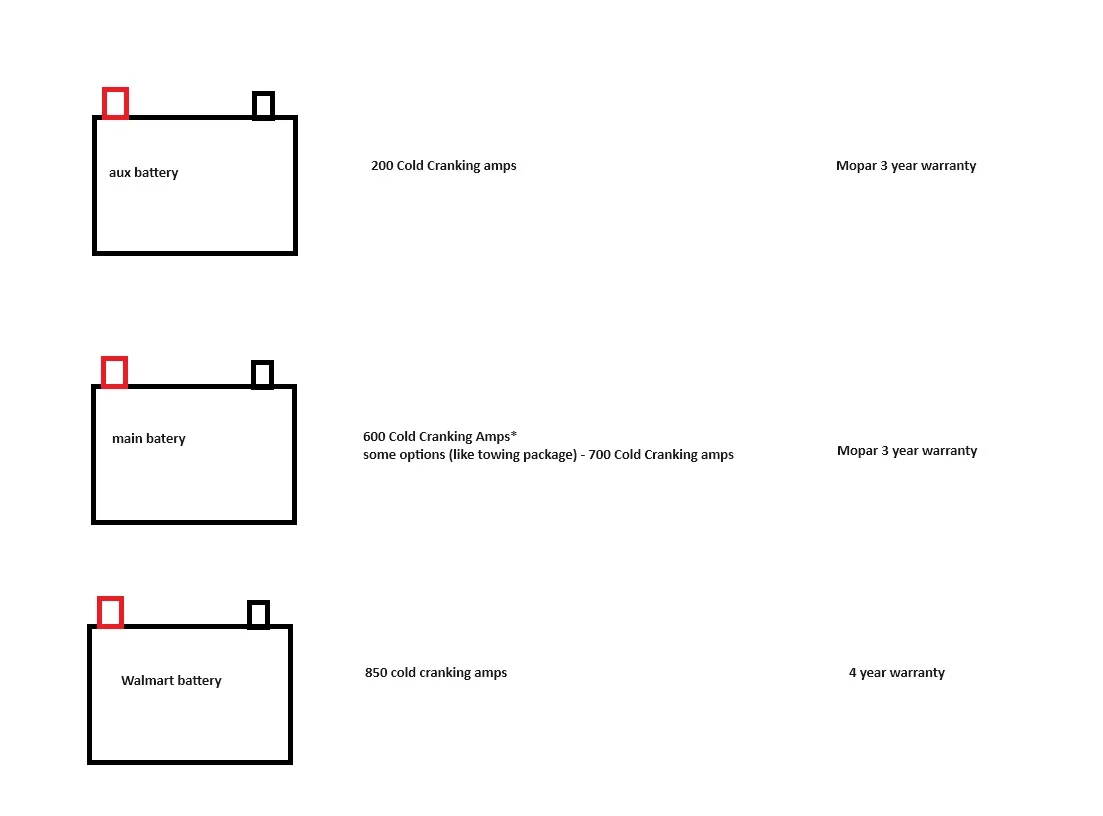
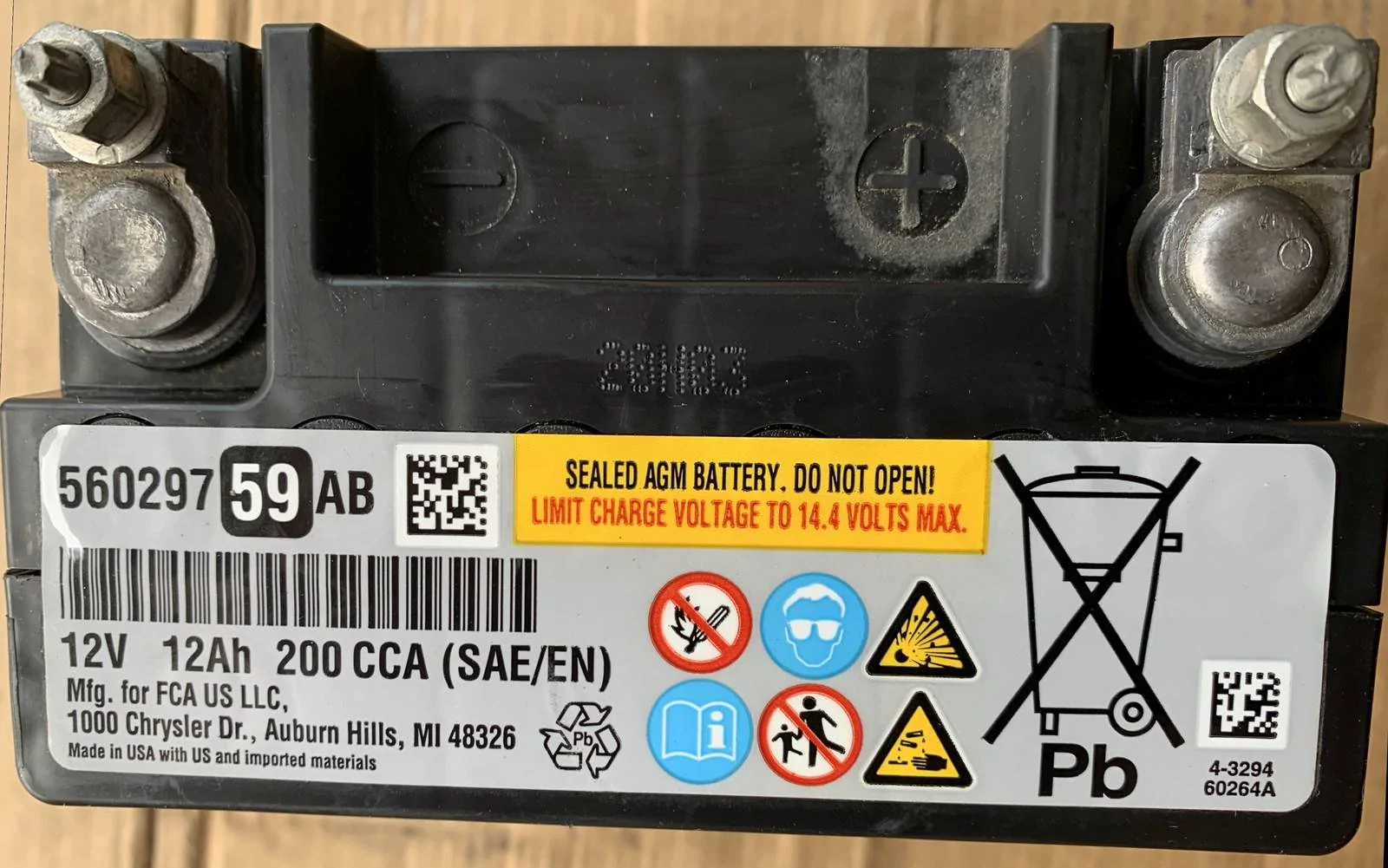
 

SargeDiesel

Well-Known Member
First Name
Michael
Joined
Jul 27, 2022
Threads
10
Messages
951
Reaction score
1,018
Location
Birmingham, AL
Vehicle(s)
JTRD
Interesting. I think that you're saying that this device has low voltage cutoff abilities. I admit to not knowing that reading to the spec. And such features might be a game changer in that it would be better to rob electronics wanting power while parked than not be able to crank.


My goodness Michael. That is a well thought out logical point. (It's been "a day" on the forum today, not that anyone forces me to be here.) I agree.


I would agree. Genesis Offroad's kits for overlanders does precisely that you describe, only not depriving factory electronics of power while parked, but isolating its (aftermarket) batteries when parked to allocate one to overlanding appliances and cutting off such power demand if battery voltage drops too low. Of course it's quite more expensive that your linked product, which I assumed was not a voltage based cutoff device on its own, but certainly in theory could be hooked up to a voltage sensitive relay.
Interesting. I think that you're saying that this device has low voltage cutoff abilities
I believe I misunderstood the specs. It seems the device is more of a small powerful battery. It disconnects external draw on the battery completely (now your sensitivity issues come into play). Then allows a start on a dead battery, basically like a portable battery booster , except semi-permanent and with a little more intelligence.

But my idea was, if you had a device that at a certain voltage, say 12.4(or so) it would automatically disconnect any draw from the battery and saving enough energy to start the vehicle.

I know for example, my dash camera has an intelligent wiring harness that will shut the camera down when the battery voltage drops below certain point... I'm thinking of something to do the reverse, so it would apply to everything draining the battery below a certain voltage.

*long day, take a break. You can't please everyone, no matter what your answer is, some people just cant take things "with a grain of salt " so to speak. Plus being the internet, people like to tear you down before they would choose to build you up.
Kick back, take a break and relax .
 

AndySpill

Well-Known Member
First Name
Andy
Joined
Oct 24, 2023
Threads
71
Messages
1,654
Reaction score
1,270
Location
Pittsburgh
Vehicle(s)
2018 JL Sahara
I'm not going to compete with you on the length of an answer. You win the word war. :) However, your opening and closing statements appear to be contradictory.
No they don't, and I'll be terse.

If I said, only, that "I don't advocate for two batteries," you'd have a point. Instead I said this, which doesn't tell people how many batteries to have, only that if your going to run ESS have two batteries, and if you're not, you're probably better off with one:

"I don't advocate for two batteries. I don't advocate for one. What I say is that if you've made the choice to not run ESS events, that statistically speaking, IMHO, you a probably better off disconnecting the Aux battery precisely for the "surprise battery trouble you cite."

Which doesn't conflict with"

"I guess I am not in favor of running a mission critical system (engine cranking mid travel) against factory spec, Genesis Offroad equipment, whose excellent system exceeds factory spec, being an obvious exception."

Which says, if your going run ESS (a system that can be mission critical for it to be able to re-crank) have 2 batteries on dual AGM battery JLs. Or of you prefer this way of saying it, try not to run ESS on the JL with one battery.
 

Sponsored

andy29847

Well-Known Member
First Name
Andy
Joined
Oct 22, 2022
Threads
15
Messages
440
Reaction score
714
Location
Trenton, SC
Vehicle(s)
2020 JLUR
No they don't, and I'll be terse.

If I said, only, that "I don't advocate for two batteries," you'd have a point. Instead I said this, which doesn't tell people how many batteries to have, only that if your going to run ESS have two batteries, and if you're not, you're probably better off with one:

"I don't advocate for two batteries. I don't advocate for one. What I say is that if you've made the choice to not run ESS events, that statistically speaking, IMHO, you a probably better off disconnecting the Aux battery precisely for the "surprise battery trouble you cite."

Which doesn't conflict with"

"I guess I am not in favor of running a mission critical system (engine cranking mid travel) against factory spec, Genesis Offroad equipment, whose excellent system exceeds factory spec, being an obvious exception."

Which says, if your going run ESS (a system that can be mission critical for it to be able to re-crank) have 2 batteries on dual AGM battery JLs. Or of you prefer this way of saying it, try not to run ESS on the JL with one battery.

That was terse compared to your previous responses. :)

You wrote this: "only that if your going to run ESS have two batteries, and if you're not, you're probably better off with one"

That is a recommendation, and it ignores the fact that many vehicles have stop/start with one battery.

Also, what is "engine cranking mid-travel"?
 

AndySpill

Well-Known Member
First Name
Andy
Joined
Oct 24, 2023
Threads
71
Messages
1,654
Reaction score
1,270
Location
Pittsburgh
Vehicle(s)
2018 JL Sahara
That was terse compared to your previous responses. :)

You wrote this: "only that if your going to run ESS have two batteries, and if you're not, you're probably better off with one"

That is a recommendation, and it ignores the fact that many vehicles have stop/start with one battery.

Also, what is "engine cranking mid-travel"?
Throughout my text, several times, I have written that "if your going to run ESS have two batteries" statement as one that is intended to be relevant only to dual AGM battery JLs.

I don't speak here to JLs with E-Torque (which do run ESS with two batteries, but of an entire different "flavor".) I don't speak to Broncos. I don't speak to other vehicles with ESS systems--except to expressly say that I'm aware of the fact that they run ESS systems with one battery just fine. I even mention that such two AGM battery designs might not have even been designed primarily to protect the power of the cranking battery (and the success of craning) by Stellantis, but as some have pointed out on the forum, to allow the Wrangler's electronics and entertainment system to work without hiccup.

And as mentioned, I feel the way I do for safety, and to error on the side of insuring that a mid-travel engine cranking (which you inquired about)--which is for me the engine re-cranking after an ESS event, is successful given--even if Stellantis never designed with this intention or foresight--the potential for large numbers of energy hungry aftermarket appliances added on (and unique to)to JLs, (and a few other brands of vehicles) from winches to lights, that suck the living daylights out of batteries, particularly, given inertia and motorized appliances, upon their startup. I recognize that people reading here vary in what aftermarket appliances they have installed, and I write to a generic audience such that I error on the side of safety. Mine is a cost/benefit analysis highly skewed against saving .9 cents in gasoline over getting T-boned and flip over in a left hand turn accident in which ESS is engaged. For this forum I lean towards being pretty darn "green," but "green" can go "f" itself IMHO when it comes at the expense of safety. Let everyone get home safely to their families and then debate me on the forum.

(Personally, I tend to shift my automatic dual AGM battery JL into a manual gear in such situations not simply to be able to control power to the wheels but because doing so temporarily prevents ESS from engaging.)

And yes, I get that unlike lights, winches are unlikely to be run during ESS events. The point is that they still draw significant power from a battery, much as that power is being replaced real time by the alternator, and that a battery can only delivery so much power--even being recharged--in its useful life before needing replacement.

Minimizing the depth of discharge (DOD) of (an AGM) battery will prolong the number of recharge cycles before it has to be replaced, prolonging its calendar life, but the total power a battery can delivery is far more a fixed element and again, I want people making left hand turns on high speed roads in ESS events to do so safely.

Of course if you turn your wheels prior to that turn you'll likely prevent ESS from engaging: the wheels turned too far being one of the things that will prevent ESS engagement, but of course you shouldn't turn your wheels prior to the turn in case you are rear ended.

And of course I get that this two battery system stinks in design. The batteries should have been made similar in size and IMHO, ideally periodically switched by the vehicle in their roles as ESS and main battery to even out wear and tear. My answer is trickle charging, Genesis Offroad offerings, or turning ESS off and running with just the main battery.

Sorry for the long explanation. I prefer clarity over brevity when the choice must be made.
 
Last edited:

andy29847

Well-Known Member
First Name
Andy
Joined
Oct 22, 2022
Threads
15
Messages
440
Reaction score
714
Location
Trenton, SC
Vehicle(s)
2020 JLUR
Throughout my text, several times, I have written that "if your going to run ESS have two batteries" statement as one that is intended to be relevant only to dual AGM battery JLs.

I don't speak here to JLs with E-Torque (which do run ESS with two batteries, but of an entire different "flavor".) I don't speak to Broncos. I don't speak to other vehicles with ESS systems--except to expressly say that I'm aware of the fact that they run ESS systems with one battery just fine. I even mention that such two AGM battery designs might not have even been designed primarily to protect the power of the cranking battery (and the success of craning) by Stellantis, but as some have pointed out on the forum, to allow the Wrangler's electronics and entertainment system to work without hiccup.

And as mentioned, I feel the way I do for safety, and to error on the side of insuring that a mid-travel engine cranking (which you inquired about)--which is for me the engine re-cranking after an ESS event, is successful given--even if Stellantis never designed with this intention or foresight--the potential for large numbers of energy hungry aftermarket appliances added on (and unique to)to JLs, (and a few other brands of vehicles) from winches to lights, that suck the living daylights out of batteries, particularly, given inertia and motorized appliances, upon their startup. I recognize that people reading here vary in what aftermarket appliances they have installed, and I write to a generic audience such that I error on the side of safety. Mine is a cost/benefit analysis highly skewed against saving .9 cents in gasoline over getting T-boned and flip over in a left hand turn accident in which ESS is engaged. For this forum I lean towards being pretty darn "green," but "green" can go "f" itself IMHO when it comes at the expense of safety. Let everyone get home safely to their families and then debate me on the forum.

(Personally, I tend to shift my automatic dual AGM battery JL into a manual gear in such situations not simply to be able to control power to the wheels but because doing so temporarily prevents ESS from engaging.)

And yes, I get that unlike lights, winches are unlikely to be run during ESS events. The point is that they still draw significant power from a battery, much as that power is being replaced real time by the alternator, and that a battery can only delivery so much power--even being recharged--in its useful life before needing replacement.

Minimizing the depth of discharge (DOD) of (an AGM) battery will prolong the number of recharge cycles before it has to be replaced, prolonging its calendar life, but the total power a battery can delivery is far more a fixed element and again, I want people making left hand turns on high speed roads in ESS events to do so safely.

Of course if you turn your wheels prior to that turn you'll likely prevent ESS from engaging: the wheels turned too far being one of the things that will prevent ESS engagement, but of course you shouldn't turn your wheels prior to the turn in case you are rear ended.

And of course I get that this two battery system stinks in design. The batteries should have been made similar in size and IMHO, ideally periodically switched by the vehicle in their roles as ESS and main battery to even out wear and tear. My answer is trickle charging, Genesis Offroad offerings, or turning ESS off and running with just the main battery.

Sorry for the long explanation. I prefer clarity over brevity when the choice must be made.

Your recommendation for 2 batteries when using ESS stop/start ignores the trouble that having 2 batteries causes. Check other auto forums and see if they have a full section, with numerous responses, devoted to battery issues.
 

AndySpill

Well-Known Member
First Name
Andy
Joined
Oct 24, 2023
Threads
71
Messages
1,654
Reaction score
1,270
Location
Pittsburgh
Vehicle(s)
2018 JL Sahara
Your recommendation for 2 batteries when using ESS stop/start ignores the trouble that having 2 batteries causes. Check other auto forums and see if they have a full section, with numerous responses, devoted to battery issues.
Andy, let's take a stroll down memory lane. First you accuse me of selling the idea of 2 batteries in the JL. I did not such thing. I explained to you how I did no such thing.

Then above you claim that I've ignored the trouble that having 2 batteries causes.

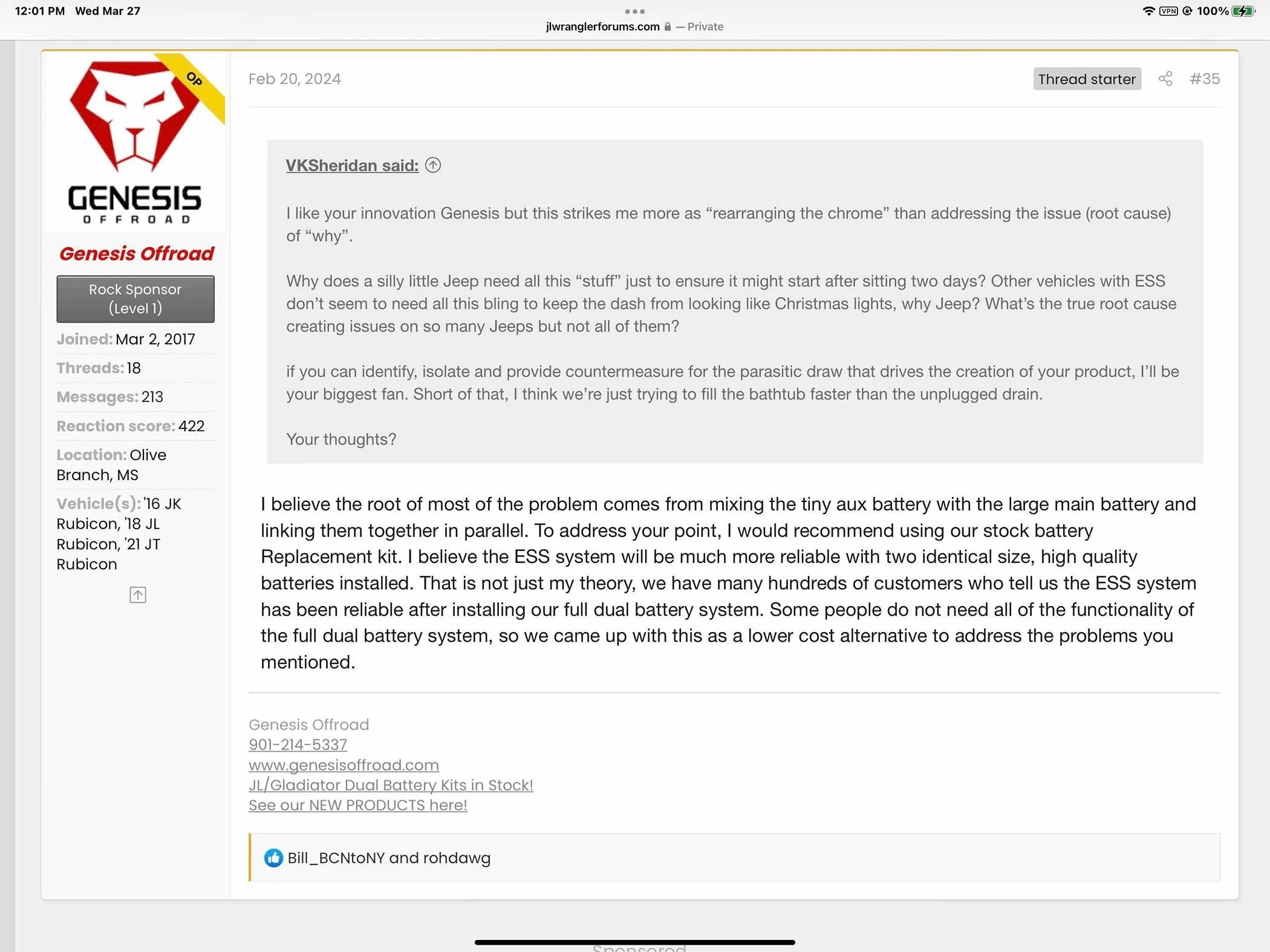
First---it's not two batteries that's IMHO technically the problem with the dual AGM battery JL design. It's two batteries hooked up in parallel of dissimilar size, which IMHO should have been of larger size, like the Genesis Offroad kit (yes, I'm aware that the kits Group 25 batteries are individually smaller in size that a JL's H6, let along H7 stock main battery), and ideally swapped periodically, physically or electronically in their roles as Aux and Main battery.

Wait, let me revise that before you go claiming that the (original) Genesis Offroad cut has voltage cutoffs unlike the factory dual AGM battery JL...the new Genesis https://www.genesisoffroad.com/2018-Jeep-JL-JT-Stock-Battery-Replacement-Kit_p_295.html which leaves the factory wiring intact, just substituting Group 25 batteries for both the main and Aux battery.

Second, check the opening of my second to last paragraph where I write " And of course I get that this two battery system stinks in design." Notice my use of the word "this." I dislike the dissimilar size battery design, not having two batteries.

The other forums for vehicles with one battery running ESS systems, and few complaints, are by in large composed of vehicles (the Bronco being the exception) not outfitted with the (amount of) energy hungry appliances Wrangler owners can tend to add.

These are my tenants as seen in many posts here.

* I run two factory batteries and ESS. I also trickle charge wtih a solar panel on my roof. I outdoor park. I don't recommend you do what I do or not. I simply think that if you aren't going to change the factory setup that you trickle charge: shore or solar based. I also look into changing my batteries about every 3 years or sooner even if they are doing great.

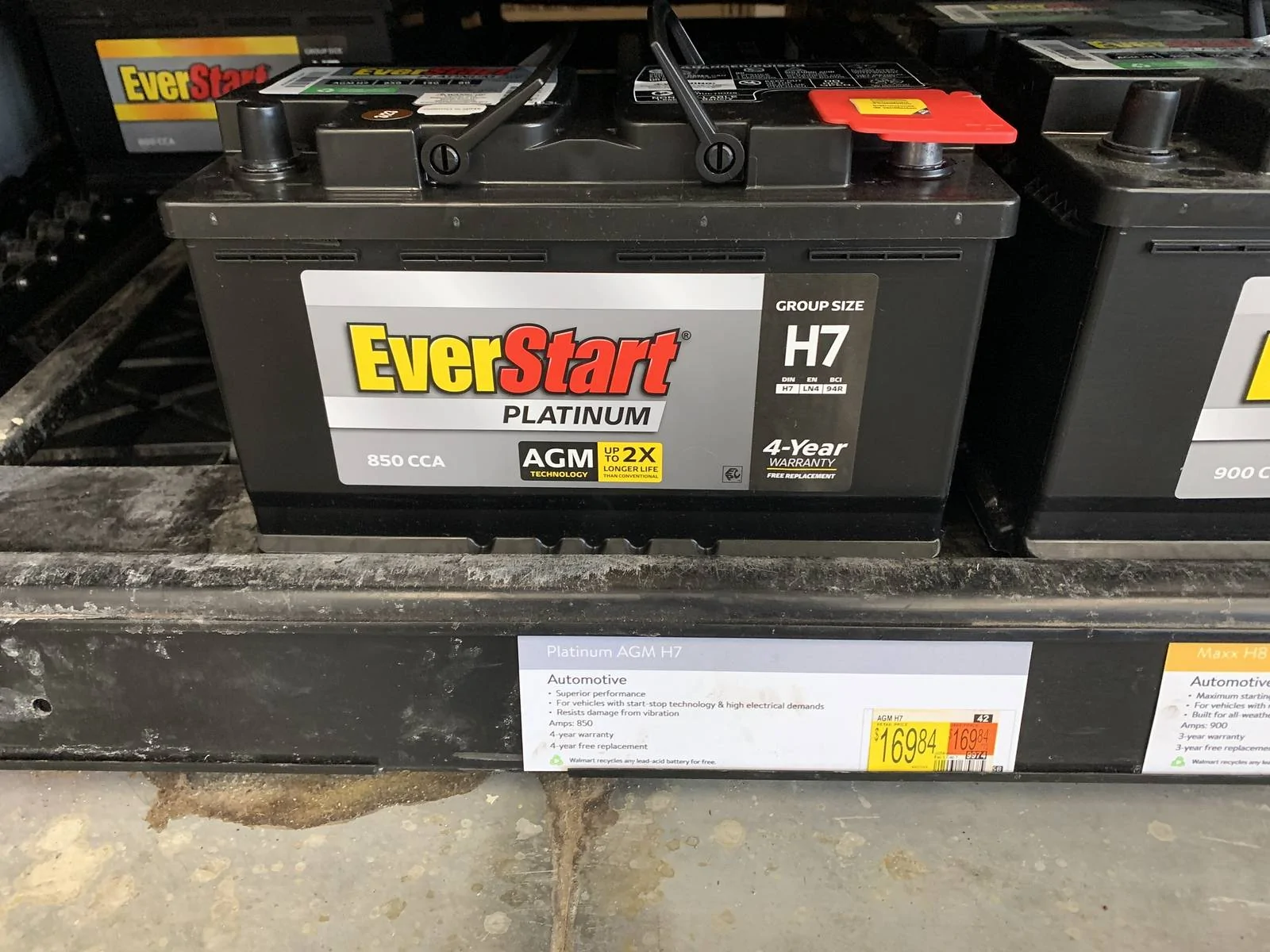
* I recommend, when replacing the main battery, that if you're running an H6 size, move to an H7. It's the same price and provides more power.

* If you want to get rid of the ESS battery I recommend that you turn off the ESS system by button push or tech, and pull Fuse 42. I do not recommend simply disconnecting the ESS battery, not pulling Fuse 42, and letting the vehicle turn the ESS off for you via a warning light in the dash as Jebiruph, the author of these one battery techniques (the original being jumpering N1 and N2 in the Power Distribution Center) feels that the vehicle's display of this light can be indicative of other problems that owners forcing it on but just disconnecting the ESS battery can mask. (In early 2018s this will strand you.)

* I am fine with people just turning ESS off but point out that it won't of course address the issues with dual parallel dissimilar size batteries. I advocate, if you are turning ESS off and committed to not using it, that you are better off disconnecting the ESS battery, which if you want to remove as well, is fine with me, just insulate lose end cables.

* I fully acknowledge problems with the dual battery system in the dual AGM battery JLs (not be confused with dual battery E-Torque models) and am all for people who adopt one of Shane's offerings at Genesis Offroad, although I tell them that if they are buying his original JL kit (not the 2 new offerings) just for ESS, that such a decision is IMHO overkill. My primary issue with this factory system, again, are the dissimilar size of the batteries hooked up in parallel.

* I fully acknowledge that a similarly energy hungry appliance rich Bronco runs on one battery. I don't know this vehicle as well as the Wrangler (not that I'm a Wrangler expert) and won't advocate running ESS on one battery in dual AGM battery JLs because the cost/benefit analysis IMHO suggests the savings in fuel doesn't justify the risk exposure of getting stranded in an ESS event, despite the 12.4 volt cutoff you cite, given the potential for JL owners to have large power draws above and beyond engine cranking.

I hope we are done.
 

andy29847

Well-Known Member
First Name
Andy
Joined
Oct 22, 2022
Threads
15
Messages
440
Reaction score
714
Location
Trenton, SC
Vehicle(s)
2020 JLUR
Andy, let's take a stroll down memory lane. First you accuse me of selling the idea of 2 batteries in the JL. I did not such thing. I explained to you how I did no such thing.

Then above you claim that I've ignored the trouble that having 2 batteries causes.

First---it's not two batteries that's IMHO technically the problem with the dual AGM battery JL design. It's two batteries hooked up in parallel of dissimilar size, which IMHO should have been of larger size, like the Genesis Offroad kit (yes, I'm aware that the kits Group 25 batteries are individually smaller in size that a JL's H6, let along H7 stock main battery), and ideally swapped periodically, physically or electronically in their roles as Aux and Main battery.

Wait, let me revise that before you go claiming that the (original) Genesis Offroad cut has voltage cutoffs unlike the factory dual AGM battery JL...the new Genesis https://www.genesisoffroad.com/2018-Jeep-JL-JT-Stock-Battery-Replacement-Kit_p_295.html which leaves the factory wiring intact, just substituting Group 25 batteries for both the main and Aux battery.

Second, check the opening of my second to last paragraph where I write " And of course I get that this two battery system stinks in design." Notice my use of the word "this." I dislike the dissimilar size battery design, not having two batteries.

The other forums for vehicles with one battery running ESS systems, and few complaints, are by in large composed of vehicles (the Bronco being the exception) not outfitted with the (amount of) energy hungry appliances Wrangler owners can tend to add.

These are my tenants as seen in many posts here.

* I run two factory batteries and ESS. I also trickle charge wtih a solar panel on my roof. I outdoor park. I don't recommend you do what I do or not. I simply think that if you aren't going to change the factory setup that you trickle charge: shore or solar based. I also look into changing my batteries about every 3 years or sooner even if they are doing great.

* I recommend, when replacing the main battery, that if you're running an H6 size, move to an H7. It's the same price and provides more power.

* If you want to get rid of the ESS battery I recommend that you turn off the ESS system by button push or tech, and pull Fuse 42. I do not recommend simply disconnecting the ESS battery, not pulling Fuse 42, and letting the vehicle turn the ESS off for you via a warning light in the dash as Jebiruph, the author of these one battery techniques (the original being jumpering N1 and N2 in the Power Distribution Center) feels that the vehicle's display of this light can be indicative of other problems that owners forcing it on but just disconnecting the ESS battery can mask. (In early 2018s this will strand you.)

* I am fine with people just turning ESS off but point out that it won't of course address the issues with dual parallel dissimilar size batteries. I advocate, if you are turning ESS off and committed to not using it, that you are better off disconnecting the ESS battery, which if you want to remove as well, is fine with me, just insulate lose end cables.

* I fully acknowledge problems with the dual battery system in the dual AGM battery JLs (not be confused with dual battery E-Torque models) and am all for people who adopt one of Shane's offerings at Genesis Offroad, although I tell them that if they are buying his original JL kit (not the 2 new offerings) just for ESS, that such a decision is IMHO overkill. My primary issue with this factory system, again, are the dissimilar size of the batteries hooked up in parallel.

* I fully acknowledge that a similarly energy hungry appliance rich Bronco runs on one battery. I don't know this vehicle as well as the Wrangler (not that I'm a Wrangler expert) and won't advocate running ESS on one battery in dual AGM battery JLs because the cost/benefit analysis IMHO suggests the savings in fuel doesn't justify the risk exposure of getting stranded in an ESS event, despite the 12.4 volt cutoff you cite, given the potential for JL owners to have large power draws above and beyond engine cranking.

I hope we are done.
First, I want to thank you for providing my entertainment for the past couple of days. It would be even more enjoyable if you were more concise. I'm not going to go through everything you wrote. I'd guess it would just generate another note. I'll say that I think you mean the best with the advice you are sharing, and that you are mostly right. I've tried to only respond when I think you are off-line. For instance, you write: "it's not two batteries that's IMHO technically the problem with the dual AGM battery JL design. It's two batteries hooked up in parallel of dissimilar size". That's just not so. Batteries of dissimilar size hooked in parallel are acceptable as long as the type, the voltage rating, and the age are the same. Look it up.

It's my opinion that if the Intelligent battery Sensor was really smart, and if the Smart Alternator was really intelligent, then the condition of the 2 batteries could be determined by the dash voltmeter. That is not the case.

I wish you well. I'll give this up if you will. :)

Andy
 

Sponsored

CaJLMetalHead

Well-Known Member
First Name
CAJLMetalHead
Joined
Sep 6, 2018
Threads
19
Messages
969
Reaction score
1,873
Location
96049
Vehicle(s)
Jeep Wrangler Sport Unlimited
Reasons for keeping the Aux battery.
That is when I stopped reading your post..

I AM KIDDING MAN !!... yeah... yours are all valid points.. I was never a fan of the little motorcycle JL AUX battery (my friend has a Harley Trike, and the battery in her trike is bigger than the AUX Battery in the JL... What the heck?)

Anyway.. excellent thread and discussions.. it is silly that Jeep added this convoluted ESS system that added complexity, extra points of failure, and added cost of ownership for a system that is quite unpopular among fellow JL owners (most of the JL owners I have met have removed the pesky AUX battery and use Tazer or similar products to disable ESS).. What I understand is that Stellantis was forced to include ESS in the JL design to appease the FCA? Bollocks!!...

This thread got me annoyed... time to get on my Jeep and crush a Prius !!
 

Mguy

Well-Known Member
Joined
Nov 29, 2023
Threads
6
Messages
400
Reaction score
382
Location
Far Away
Vehicle(s)
2020 JLUR 6spd MT
Batteries of dissimilar size hooked in parallel are acceptable as long as the type, the voltage rating, and the age are the same. Look it up.
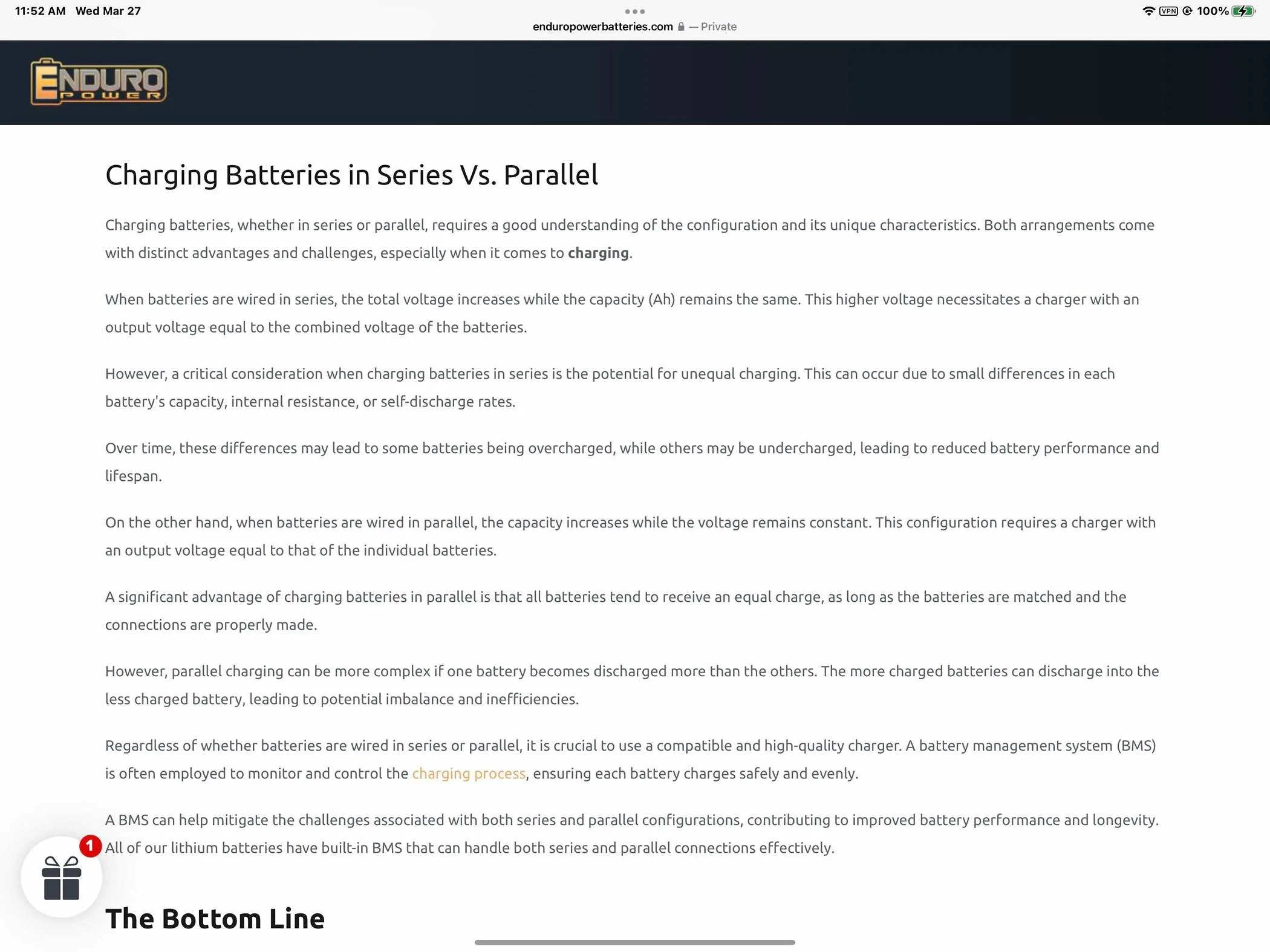
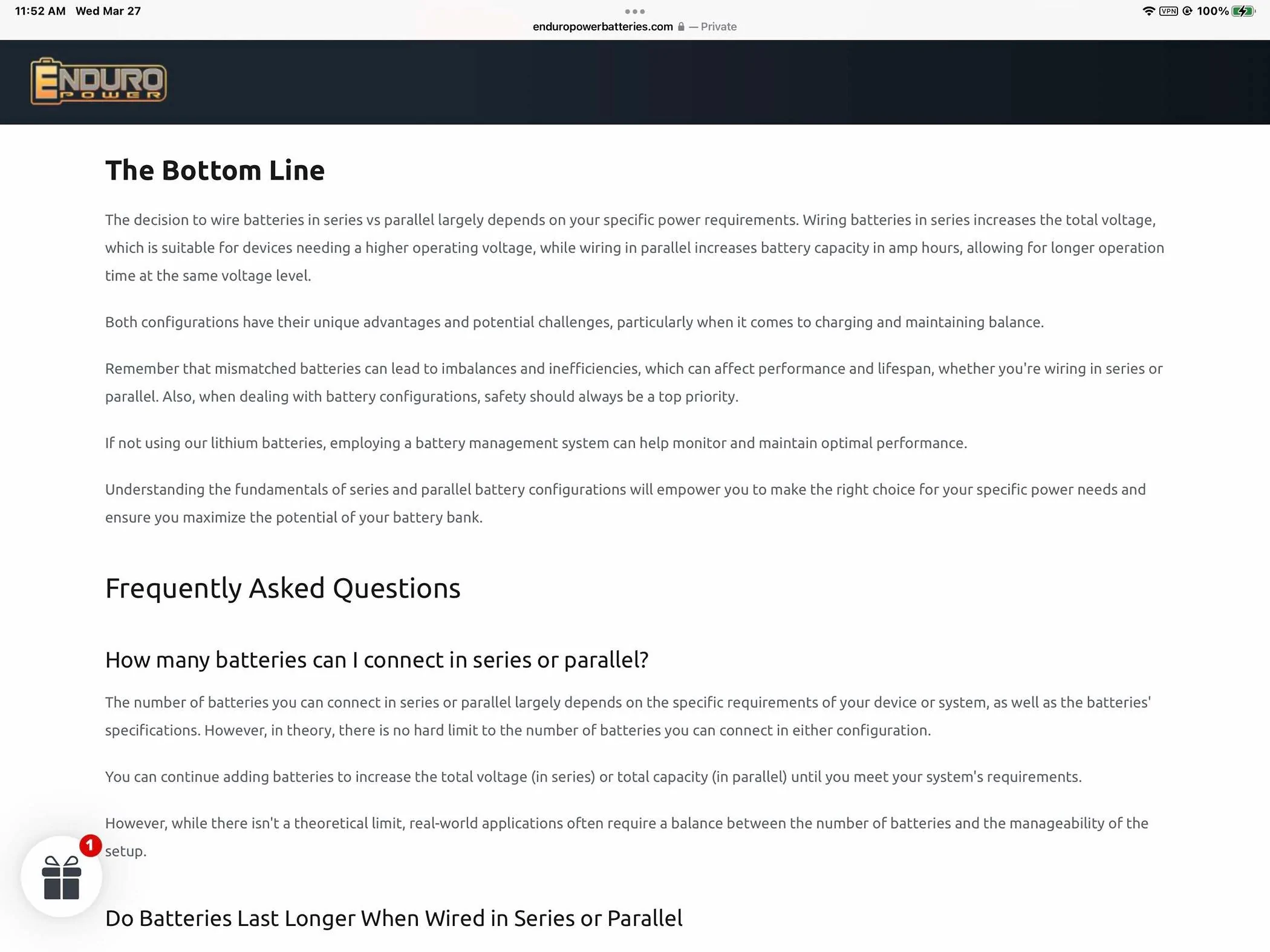
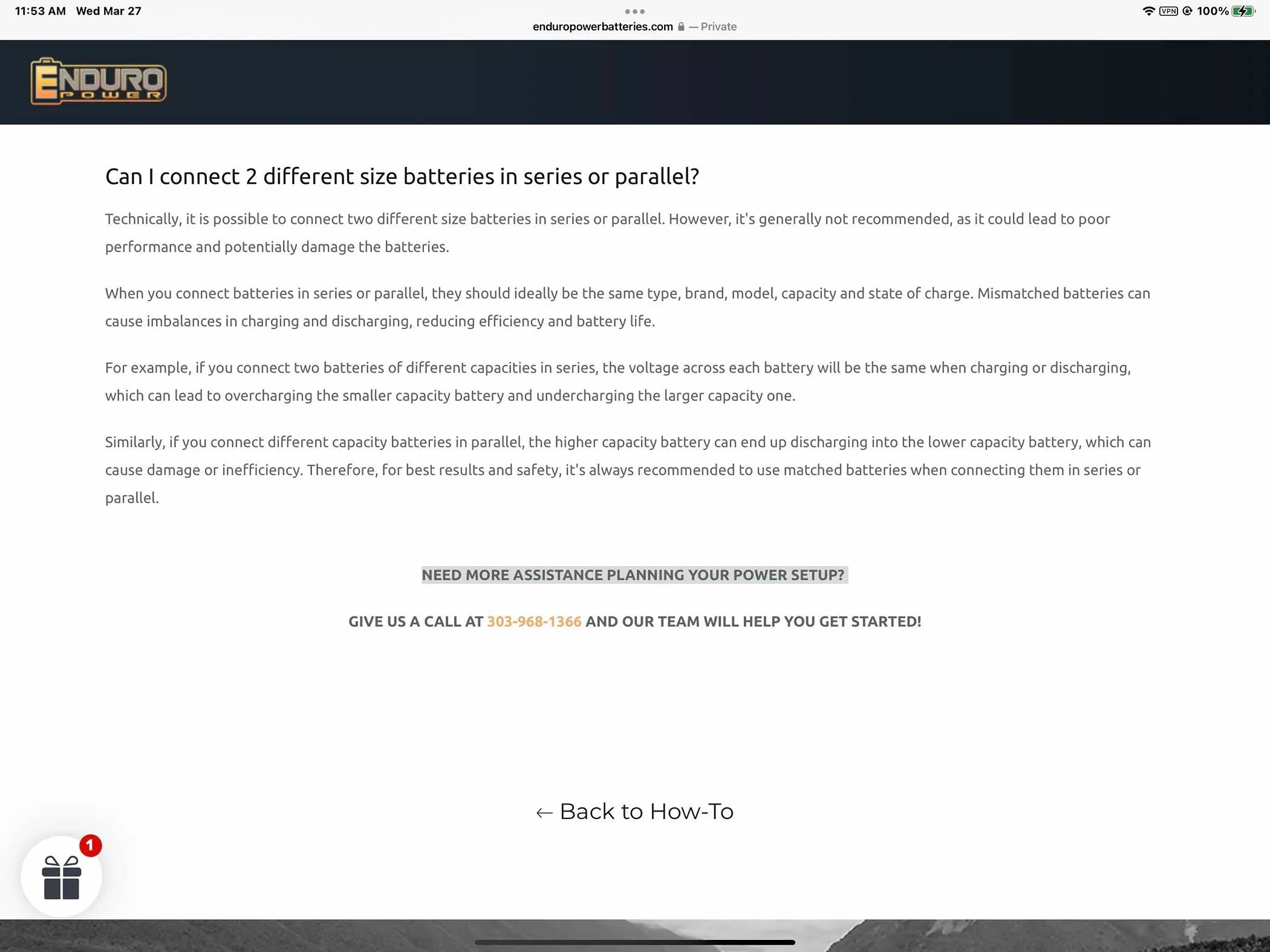
While there's much to wade through in this thread, to be really helpful this statement needs some clarification and elaboration. Two new AGMs of the same voltage, but of different capacities ("size," measured in amp-hours), which are permanently wired in parallel can be an "acceptable" single battery bank. However, the usable life of this bank will almost certainty be less than a same capacity bank of identical batteries. The basic reasons are there will be less than equal discharge within the bank (during load use and while resting), and less than optimal charging (at least during bulk stage). Stock JLs, despite the added software/hardware, suffer these circumstances. The result is progressive capacity loss and thus short battery life.
 

AndySpill

Well-Known Member
First Name
Andy
Joined
Oct 24, 2023
Threads
71
Messages
1,654
Reaction score
1,270
Location
Pittsburgh
Vehicle(s)
2018 JL Sahara
First, I want to thank you for providing my entertainment for the past couple of days.
And I want to not thank you for accusing me twice of saying things I didn't.

It would be even more enjoyable if you were more concise.
...and even more enjoyable than that if you read ("red"), understood, and didn't accuse me of things I didn't say, thereby not having to write, long or short, at all about what I said...

I may be long, but I'm clear; in fact sometimes I'm long to be clear.

I've tried to only respond when I think you are off-line. For instance, you write: "it's not two batteries that's IMHO technically the problem with the dual AGM battery JL design. It's two batteries hooked up in parallel of dissimilar size". That's just not so. Batteries of dissimilar size hooked in parallel are acceptable as long as the type, the voltage rating, and the age are the same. Look it up.
Right, "acceptable," not ideal. I don't have to look it up. With such dissimilar size batteries you risk greater depth of discharge, all else equal on the smaller battery when it is separated during ESS events (and not at a time when being replenished by the alternator,) resulting in greater voltage drops in it relative to the larger battery, and the flow of electrical current from the larger to smaller battery to compensate, as will happen in the parallel fashion in which they are factory connected.

Wait, didn't @Mguy Mike just say this prior? Are we both wrong?

...,which can lead to degradation of the overall battery system faster than batteries of equal size sharing equal load (read my comments about not only equal size batteries but switching off their main and Aux roles.)

Ho hmm Andy, I guess Shane at Genesis Offroad's https://www.genesisoffroad.com/2018-Jeep-JL-JT-Stock-Battery-Replacement-Kit_p_295.html kit then is wasted money by your standards, as the very two battery system you don't like, and falsely accused me of liking, is now...."acceptable" to you.

It's my opinion that if the Intelligent battery Sensor was really smart, and if the Smart Alternator was really intelligent, then the condition of the 2 batteries could be determined by the dash voltmeter. That is not the case.
Wait..hold your calls people, we have a winner...are you suggesting that the two batteries be independently accessed and charged, perhaps only being brought in parallel when voltages are on par?

Gosh--who on earth has suggested that before? (me)

You see that's the only way access each battery individually..(to separate them) and yet you write above, again:

Batteries of dissimilar size hooked in parallel are "acceptable" as long as the type, the voltage rating, and the age are the same. Look it up.
This from the man who not only advocates running one battery, but accuses me of wishing people run factory with the two batteries...

Here's the problem with your reference to such battery science. It's technically correct, but falls short of a reality where those batteries are separated (i.e. not in parallel as in ESS events) and taxed while not being replenished by an alternator, as happens in the dual AGM battery JL during ESS events, and in a world of batteries so lacking in quality control.

If you want to continue to poke holes in what I say that's fine...but what I say, not what you think wrongly that I say.
 
Last edited:

AndySpill

Well-Known Member
First Name
Andy
Joined
Oct 24, 2023
Threads
71
Messages
1,654
Reaction score
1,270
Location
Pittsburgh
Vehicle(s)
2018 JL Sahara
While there's much to wade through in this thread, to be really helpful this statement needs some clarification and elaboration. Two new AGMs of the same voltage, but of different capacities ("size," measured in amp-hours), which are permanently wired in parallel can be an "acceptable" single battery bank. However, the usable life of this bank will almost certainty be less than a same capacity bank of identical batteries. The basic reasons are there will be less than equal discharge within the bank (during load use and while resting), and less than optimal charging (at least during bulk stage). Stock JLs, despite the added software/hardware, suffer these circumstances. The result is progressive capacity loss and thus short battery life.
Not only do I agree but feel the problems you cite are further exacerbated in situations where those batteries are temporarily separated, taxed differently, and even taxed when an alternator is not simultaneously replenishing them, like, I don't know...

and ESS event maybe?;)
 

BRuby

Well-Known Member
Joined
Nov 28, 2019
Threads
5
Messages
754
Reaction score
897
Location
Chilling or working out at 60+
Vehicle(s)
JLUR Benz Porsche-M Subie-M
I've tried to only respond when I think you are off-line. For instance, you write: "it's not two batteries that's IMHO technically the problem with the dual AGM battery JL design. It's two batteries hooked up in parallel of dissimilar size". That's just not so. Batteries of dissimilar size hooked in parallel are acceptable as long as the type, the voltage rating, and the age are the same. Look it up.
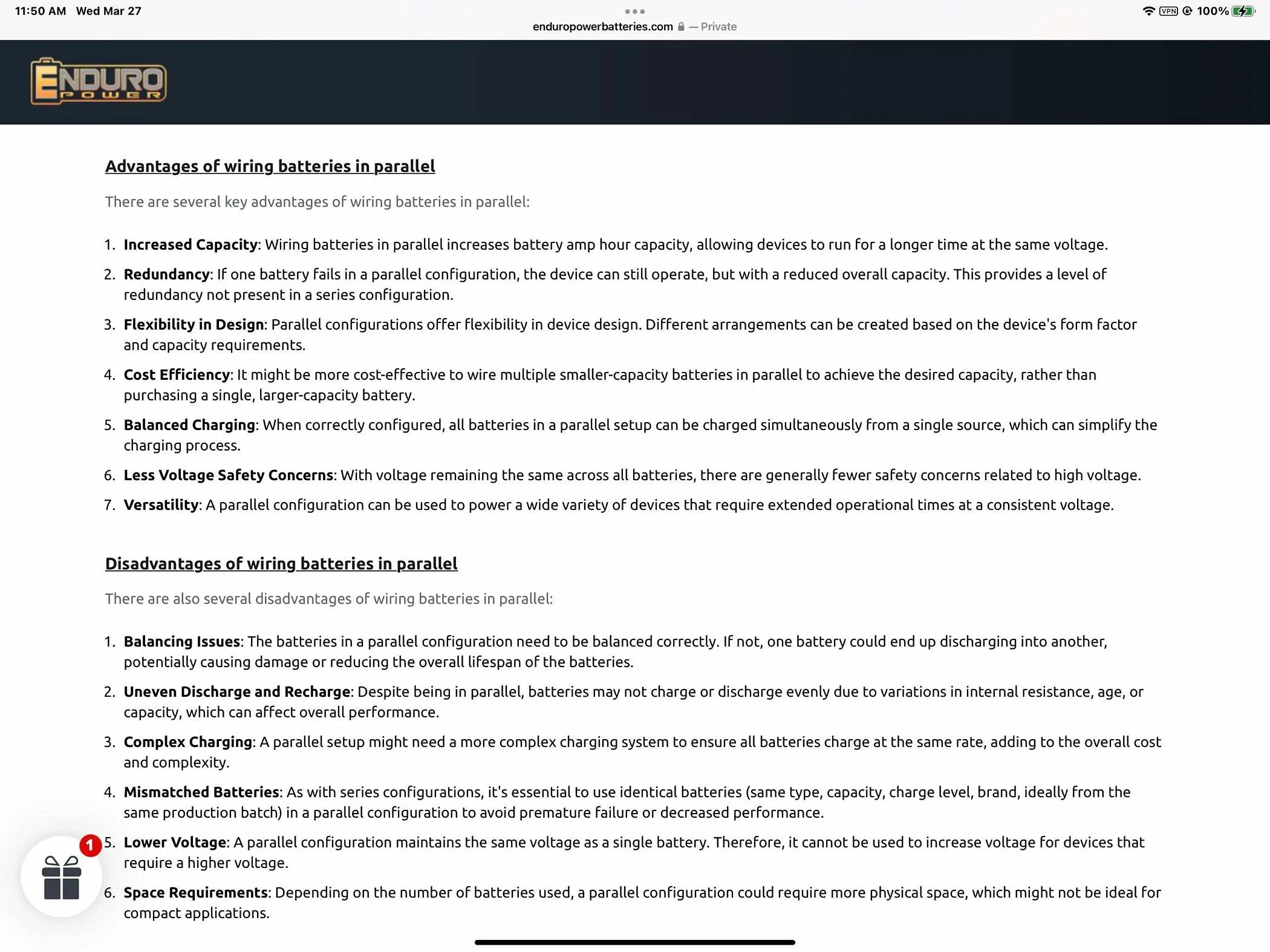
Hmm? Have never heard that this is acceptable (perfectly ok and is a recommended course of action). Most everyone says to hook up and use the same size age type etc batteries - when hooking up in parallel. Maybe state your sources to prove your point.
Thx

BTW - I have OEM 2018 JL batteries and they are still perfectly fine. So it can work - but you have to be very diligent to keep them fully smart charged separately and each desulfated separately. Yeah they have been load tested - as well as sitting for a month uncharged at a dealer recently. My ESS works almost immediately but most times I will simply press to turn it off. No big deal for me as my preference is to keep it 100% stock for selling if ever need be.

This topic has been hashed and re-hashed over 5 years ago on this forum - so is kinda like beating a dead horse for the millionth time.

The hundreds of smaller ESS batteries die for a reason. But mine is actually holding a better charge than my main. Odd but true.

Check out these screenshots on this topic:

Jeep Wrangler JL Auxiliary battery delete problems 4DB1AB2F-46C3-4597-82BE-897A8A9880E9


Jeep Wrangler JL Auxiliary battery delete problems 59E4CF42-964B-4BF2-919F-7F8C0C9EDB2F


Jeep Wrangler JL Auxiliary battery delete problems A741D360-5B51-4B2F-870E-3C90807C0A97


Jeep Wrangler JL Auxiliary battery delete problems 2E98AB5B-0717-4F9E-AC7F-95114EF9FC1D


Jeep Wrangler JL Auxiliary battery delete problems B5571FA1-19AC-49F4-AAFB-67CCBA76AC97
Sponsored


Top