

Sponsored

2024 4xe is disappointing... gets no range increase

BXFXJeep

Well-Known Member
Joined
Jun 13, 2019
Threads
20
Messages
3,710
Reaction score
4,645
Location
Toronto, ON
Vehicle(s)
2021 4xe Sahara
Electric isn't really the answer. In America, we travel way too far for electric cars to be feasible. We also like to travel abroad to different areas of the country and even with the electric stations, who is going to wait there for hours on end for a recharge. I went to the mall a few days ago and watched as all 30 electric stations were occupied with people recharging their batteries, with the families in the vehicles!! That's crazy! Seems like a better fit for someone who is retired, drives to the dinner, drug store than heads home for the day.
I do agree electric is not for everyone, but some people can make use of them.

It doesn't take hours to charge an EV, the quick chargers can get you up and running in less than an hour in most cases, level 2 charging is meant for at home overnight charging, and a top up at the malls etc
Sponsored

 

Zandcwhite

Well-Known Member
First Name
Zach
Joined
Sep 4, 2019
Threads
11
Messages
8,305
Reaction score
14,199
Location
Patterson, ca
Vehicle(s)
2019 jlur
I'm not sure from where you get your stats; I have properties in Chicago (unfortunately) and the surrounding burbs and every single tennant has a vehicle; it's a parking nightmare. Now, that's just my take on Chicago; looking at registered vehicles and populations from just a few states, the per-capita majority DOES own a vehicle...unless the govt supplied data I perused was wrong.
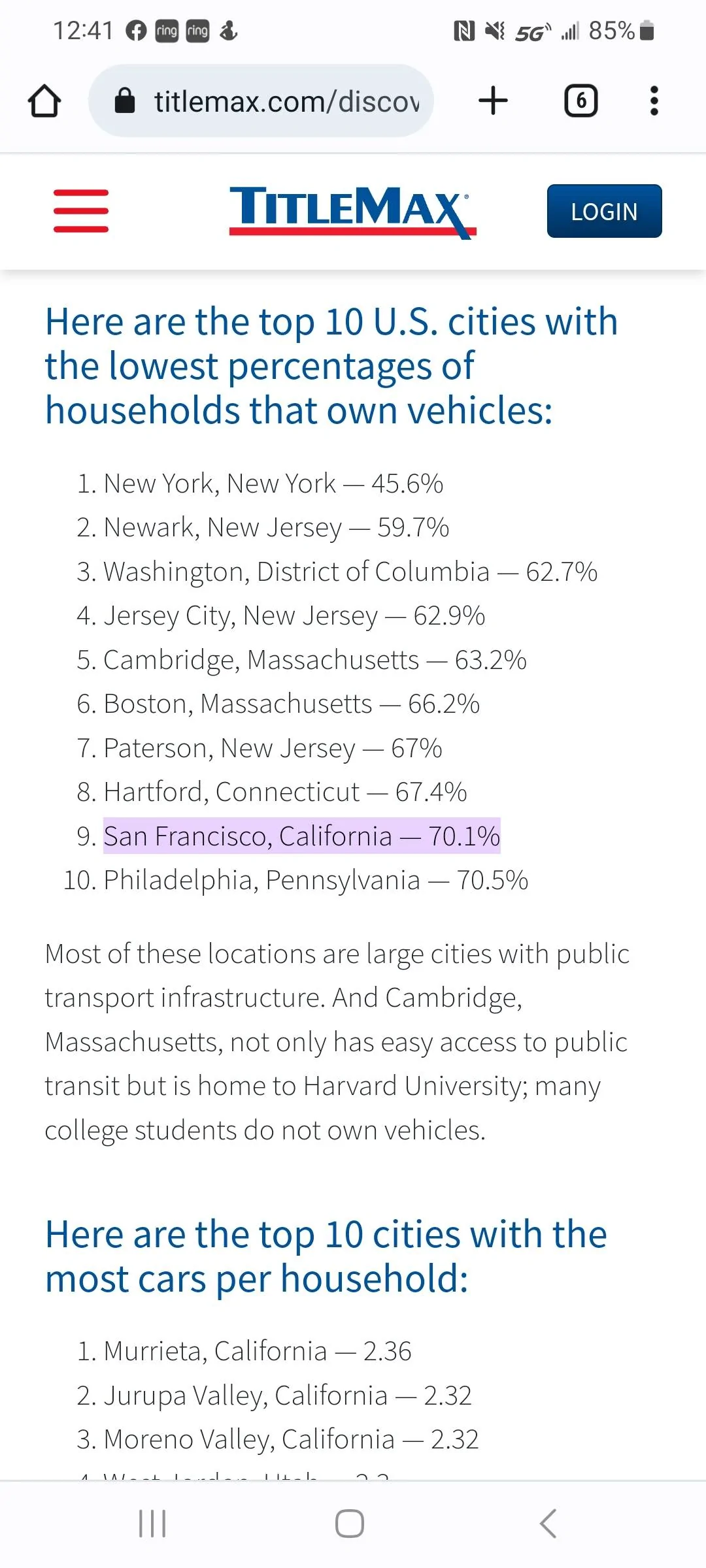
Pretty much everyone in the suburbs or multiple for most. Of course nearly every one of them can charge at home. Most apartment buildings in major cities will have less than half of the families owning even 1 vehicle. Manhattan was the lowest I've seen with just 22% of households owning vehicles. Looking at statewide numbers is misleading, as 1 car enthusiast can offset dozens of those car-less families. I can't remember a time we've had less than 4 vehicles in our household, doesn't change the fact that the people who live in the high rise apartments in San Fran simply don't own vehicles anymore. Even sf's ownership rate of 70% is not at all representative of people in high density housing as there are a bunch of houses around the city with garages and therefore easy vehicle ownership. I guarantee for those in apartments that number is below 40%.

Forgot my attachment
Jeep Wrangler JL 2024 4xe is disappointing... gets no range increase Screenshot_20230417_124117_Chrom
 
Last edited:

Bmeister

Well-Known Member
Joined
Jun 12, 2021
Threads
1
Messages
234
Reaction score
364
Location
Chicagoland (heart is in SC)
Vehicle(s)
2021 JLUR 4xe, 2012 JK, 2011 WK2 5.7
City of Chicago 2.7+ million, 80% of driving age = 2.16 million can drive
City of Chicago (NOT the whole state) = 1.9+ million vehicle registrations
1.9/2.16 = 88% per capita vehicle registration. They certainly can NOT move to all EV anytime soon and not just for making charging stations, but they will need 2-3x the number of powerplants to have the buffer required when everyone has an EV and only 1/3 charge simultaneously. The math does not work yet. Period.

I have to add since you mentioned SF, I have a niece working in tech in San Fran in not far from the Presidio. Pretty compact housing, and EVERYONE has a vehicle. Parking is a nightmare. I'll dig up registration data for SF also as I'm a numbers guy at heart. Putting everyone into EVs is not ready for prime time yet.
 

Zandcwhite

Well-Known Member
First Name
Zach
Joined
Sep 4, 2019
Threads
11
Messages
8,305
Reaction score
14,199
Location
Patterson, ca
Vehicle(s)
2019 jlur
I do agree electric is not for everyone, but some people can make use of them.

It doesn't take hours to charge an EV, the quick chargers can get you up and running in less than an hour in most cases, level 2 charging is meant for at home overnight charging, and a top up at the malls etc
I would argue that most people could Painlessly switch to a full EV right now. Almost every commuter I know drives less than 200mi/day and could easily charge their commuter car at home over night. Few people take 600+ mile road trips that would require multiple charge stops anymore and of those of us that do I’d bet it’s extremely rare that many do so more than a few times a year. We road-tripped my buddies model 3 from Fort Collins to CA and back and never had to charge for more than 22 minutes aside from the over night at the hotel. Most fuel stops take that long in reality if you aren’t 1 of those assholes that parks at the pump and then goes inside for snacks and to hit the restroom. 5 minutes fueling, park, go inside, before you know it you’ve been at the gas station a good 20 minutes anyway. Fast charging doesn’t take all that much longer and after 200-250 miles I relish getting out of the car for a bit anyway. If they build a wrangler EV with at least a 350 mile range I’ll trade the 2022 in no problem.
 

Zandcwhite

Well-Known Member
First Name
Zach
Joined
Sep 4, 2019
Threads
11
Messages
8,305
Reaction score
14,199
Location
Patterson, ca
Vehicle(s)
2019 jlur
City of Chicago 2.7+ million, 80% of driving age = 2.16 million can drive
City of Chicago (NOT the whole state) = 1.9+ million vehicle registrations
1.9/2.16 = 88% per capita vehicle registration. They certainly can NOT move to all EV anytime soon and not just for making charging stations, but they will need 2-3x the number of powerplants to have the buffer required when everyone has an EV and only 1/3 charge simultaneously. The math does not work yet. Period.

I have to add since you mentioned SF, I have a niece working in tech in San Fran in not far from the Presidio. Pretty compact housing, and EVERYONE has a vehicle. Parking is a nightmare. I'll dig up registration data for SF also as I'm a numbers guy at heart. Putting everyone into EVs is not ready for prime time yet.
Registration data is misleading unless you're going to cross reference high density housing vs homes that could easily charge EVs in the garage or driveway somehow? Even my data doesn't paint that picture as it's for household vehicle ownership regardless of dwelling type. Of course when you have apartment buildings only required to provide 10% parking capacity or less per apartment depending on the city, even 40% vehicle ownership is going to create a parking nightmare and feel like "everyone" owns a vehicle.
 

Sponsored

BXFXJeep

Well-Known Member
Joined
Jun 13, 2019
Threads
20
Messages
3,710
Reaction score
4,645
Location
Toronto, ON
Vehicle(s)
2021 4xe Sahara
I would argue that most people could Painlessly switch to a full EV right now. Almost every commuter I know drives less than 200mi/day and could easily charge their commuter car at home over night. Few people take 600+ mile road trips that would require multiple charge stops anymore and of those of us that do I’d bet it’s extremely rare that many do so more than a few times a year. We road-tripped my buddies model 3 from Fort Collins to CA and back and never had to charge for more than 22 minutes aside from the over night at the hotel. Most fuel stops take that long in reality if you aren’t 1 of those assholes that parks at the pump and then goes inside for snacks and to hit the restroom. 5 minutes fueling, park, go inside, before you know it you’ve been at the gas station a good 20 minutes anyway. Fast charging doesn’t take all that much longer and after 200-250 miles I relish getting out of the car for a bit anyway. If they build a wrangler EV with at least a 350 mile range I’ll trade the 2022 in no problem.
This is very true, it's just people keep latching on to the extreme cases to justify why EVs are a no go.

Then for some reason people think people that live in multi dwelling should not be driving, and should use public transportation.

The reason people in multi dwelling do not own cars is because the laws, bylaws, and schemes prohibit them from owning cars, then there is the suggestion they should move closer to their work, and similarly related nonsense, it's fine for people in houses drive a 100 miles to work, but people in multi dwelling for some reason should move closer to their work and use the city bus.
 

Bmeister

Well-Known Member
Joined
Jun 12, 2021
Threads
1
Messages
234
Reaction score
364
Location
Chicagoland (heart is in SC)
Vehicle(s)
2021 JLUR 4xe, 2012 JK, 2011 WK2 5.7
...Of course when you have apartment buildings only required to provide 10% parking capacity or less per apartment depending on the city, even 40% vehicle ownership is going to create a parking nightmare and feel like "everyone" owns a vehicle.
Assumptions are made without validated data; that's doesn't pass the smell test outside of California. My group has one parking space (mix of outside lot and covered) for each unit. I know other buildings in my area are comparable (we have to compete). You are generalizing and focusing only on high rises which, surprise, is not a minor percentage of population residence in Chicago. I would suspect (only because I don;t have the data and am not a property owner there) SF is similar.
 
Last edited:

Bmeister

Well-Known Member
Joined
Jun 12, 2021
Threads
1
Messages
234
Reaction score
364
Location
Chicagoland (heart is in SC)
Vehicle(s)
2021 JLUR 4xe, 2012 JK, 2011 WK2 5.7
This is very true, it's just people keep latching on to the extreme cases to justify why EVs are a no o go...
EDIT: (sorry not directed specifically to youBXFX) The extreme case is this: there is not enough power generation presently (15-20yrs to bring a new plant online) to power 1/3 of EVs charging simultaneously AND powering all the other things on the grid. There need to be 3x the powerplants at MINIMUM to handle the load and that is assuming the grid can handle it (another issue). This is not an extreme case. This is what engineers are sounding the alarm about. It's a technical issue. The infrastructure (powerplants) are needed and it takes many years to get them approved and built. It is MATH, not emotion and happy-feel-goodness.
 
Last edited:

MaskedRacerX

Well-Known Member
First Name
DT
Joined
May 1, 2021
Threads
0
Messages
256
Reaction score
304
Location
Florida East Coast
Vehicle(s)
'24 Wrangler Rubicon 4xe
I would argue that most people could Painlessly switch to a full EV right now. Almost every commuter I know drives less than 200mi/day and could easily charge their commuter car at home over night. Few people take 600+ mile road trips that would require multiple charge stops anymore and of those of us that do I’d bet it’s extremely rare that many do so more than a few times a year. We road-tripped my buddies model 3 from Fort Collins to CA and back and never had to charge for more than 22 minutes aside from the over night at the hotel. Most fuel stops take that long in reality if you aren’t 1 of those assholes that parks at the pump and then goes inside for snacks and to hit the restroom. 5 minutes fueling, park, go inside, before you know it you’ve been at the gas station a good 20 minutes anyway. Fast charging doesn’t take all that much longer and after 200-250 miles I relish getting out of the car for a bit anyway. If they build a wrangler EV with at least a 350 mile range I’ll trade the 2022 in no problem.
I totally agree with everything you wrote with one small edit, I'd change 'most' in the first sentence to 'many'.

There's definitely a shit-ton of people who fall into your various "Could switch to an EV" categories - I mean, heck, as just a random, unscientific sample: all ours friends (including our close ILs), and everyone on our block, could easily make the change.

There's two viewpoints in this thread (some bolstered by purely subjective perspectives on EVs ...) that aren't mutually exclusive:
  1. There are a significant number of people who could move to an EV.
  2. There are an equally large percent of the (US) population for whom an EV isn't a good option due to their living and/or parking situation.
 

sdiver68

Well-Known Member
First Name
Steve
Joined
May 11, 2020
Threads
6
Messages
121
Reaction score
174
Location
St. Louis
Vehicle(s)
Wrangler Sahara 4XE, Tesla M3LR, Nissan Sentra
Occupation
Management Consultant/Small Business Owner
The extreme case is this: there is not enough power generation presently (15-20yrs to bring a new plant online) to power 1/3 of EVs charging simultaneously AND powering all the other things on the grid. There need to be 3x the powerplants at MINIMUM to handle the load and that is assuming the grid can handle it (another issue). This is not an extreme case. This is what engineers are sounding the alarm about. It's a technical issue. The infrastructure (powerplants) are needed and it takes many years to get them approved and built. It is MATH, not emotion and happy-feel-goodness.
The union of concerned scientists disagrees with your take on grid capacity

https://blog.ucsusa.org/samantha-houston/can-the-electric-grid-handle-ev-charging/

Neither does Scientific American support your view

https://www.scientificamerican.com/article/why-electric-vehicles-wont-break-the-grid/

Nor Wall Street Journal, nor almost any other legit source.
 
Last edited:

Sponsored

Bmeister

Well-Known Member
Joined
Jun 12, 2021
Threads
1
Messages
234
Reaction score
364
Location
Chicagoland (heart is in SC)
Vehicle(s)
2021 JLUR 4xe, 2012 JK, 2011 WK2 5.7
The union of concerned scientists disagrees with your take on grid capacity

https://blog.ucsusa.org/samantha-houston/can-the-electric-grid-handle-ev-charging/

Neither does Scientific American

https://www.scientificamerican.com/article/why-electric-vehicles-wont-break-the-grid/

Nor Wall Street Journal, nor almost any other legit source.
If you read with comprehension, they all admit the grid and generation needs to be expanded and upgraded over several decades. Their words. We cannot "switch over" to all EVs in 10 years. Just do the math on current (no pun intended) total Twhr capability and current use. We are using 95% of what the generative capacity is at the present time.:headbang:
 

BXFXJeep

Well-Known Member
Joined
Jun 13, 2019
Threads
20
Messages
3,710
Reaction score
4,645
Location
Toronto, ON
Vehicle(s)
2021 4xe Sahara
If you read with comprehension, they all admit the grid and generation needs to be expanded and upgraded over several decades. Their words. We cannot "switch over" to all EVs in 10 years. Just do the math on current (no pun intended) total Twhr capability and current use. We are using 95% of what the generative capacity is at the present time.:headbang:
The whole scheme is to get a lot of people to stop driving period, by a lot I mean most.

Them paying rich people $7500+ to buy gas guzzlers masquerading as "green" is a good indicator this is all ? ?, and it's just another way of funneling tax dollars into cronies pocket.

I like my 4xe, so far it works for me when all things considered.
 

ag4ever

Well-Known Member
Joined
Mar 16, 2023
Threads
3
Messages
390
Reaction score
665
Location
Texas
Vehicle(s)
‘82 CJ-8, ‘82 CJ-8, ‘83 CJ-8, ‘26 Moab 392
Them paying rich people $7500+ to buy gas guzzlers masquerading as "green" is a good indicator this is all ? ?, and it's just another way of funneling tax dollars into cronies pocket.
Who is paying “rich” people $7,500 to buy EVs? Last I checked, it was a tax credit, not a tax rebate. Meaning you needed that much in tax liability to offset the credit. Plus, there is a $300k AGI cap. That severely limits the pool of “rich” people even getting the credit.

I would love to go get my check for $7,500 just let’s me know where I can get it.
 

GoBlue97

Member
Joined
Jan 13, 2023
Threads
4
Messages
22
Reaction score
30
Location
Detroit, MI
Vehicle(s)
2018 WK2
2024 is only the 3rd model year of the 4xe. They weren't going to rework the hybrid system or add more battery this quickly after its initial launch, even if they could.

We all know the 4xe doesn't have a lot of EV range. And it never will given the limitations of adding a PHEV system to the existing Wrangler chassis. But comparing a ~5500 lb SUV to a Kia Nero is just ... well it just doesn't make any sense.
This. You'll get your full EV Wrangler with JM.

The real question whether they'll do a REPB version (https://moparinsiders.com/stellantis-ceo-confirms-ram-1500-range-electric-paradigm-breaker-repb), like they're doing with the 1500 EV.

80% EV battery, 20% gas tank (5 gallons?).
 

BXFXJeep

Well-Known Member
Joined
Jun 13, 2019
Threads
20
Messages
3,710
Reaction score
4,645
Location
Toronto, ON
Vehicle(s)
2021 4xe Sahara
Who is paying “rich” people $7,500 to buy EVs? Last I checked, it was a tax credit, not a tax rebate. Meaning you needed that much in tax liability to offset the credit. Plus, there is a $300k AGI cap. That severely limits the pool of “rich” people even getting the credit.

I would love to go get my check for $7,500 just let’s me know where I can get it.
That $7,500 you actually owed the coffers, but your friendly government is kicking it back to grease your wheels, so you can pretend it's "your" money, someone in the exact same position as you buying a gas guzzler Wrangler without the ⚡ magic isn't getting that kickback.

Thinking 300k+ is where rich starts is ?

Hey I'm all for people doing whatever with their money, and making as much money as they like, I just don't like government playing favorites, especially when it's a blatant scam.
Sponsored


Top