Sponsored

This Confuses Me

AndySpill

Well-Known Member
First Name
Andy
Joined
Oct 24, 2023
Threads
71
Messages
1,654
Reaction score
1,270
Location
Pittsburgh
Vehicle(s)
2018 JL Sahara
Dual battery JL owners: run factory with two batteries or disconnect the Aux battery and run with one. It's all good to me.

I will say though that if you have no desire to run ESS, yank the cable from the Aux battery's negative post that connects to the main battery's negative post, tape up the end of this cable you just detached, and take this problematic Aux battery out of the loop. As to keeping the Aux battery in place, or removing it: suit yourself, it's all good to me.

But here's what I don't get. Many an owner will yank Fuse 42 to prevent the vehicle from separating the batteries. Now all power's supplied by the main battery, unknown to the vehicle itself, and then many buy tech to turn ESS off automatically, so as to not run ESS on just the main battery.

Unless I misunderstand, barring some really early 2018's, if you keep Fuse 42 in place with a disconnected Aux battery and try to crank you'll fail the first time, but future cranks will occur off the main battery, and if successful, the vehicle will turn ESS off for you-- granted lighting up a light in the EVIC-- and crank on the first try thereafter.

So...while toys like the Tazer JL are great for other things, people are turning their ESS off by spending money on "ESS off tech" and pulling Fuse 42 so they don't see that ESS off idiot light in the dash: the very condition they seek?

What am missing, other than people don't like to see idiot lights in the dash so they're taking the Fuse 42 pull and ESS off tech purchase route?
Sponsored


 

Tethmes

Well-Known Member
First Name
Dylan
Joined
Feb 20, 2022
Threads
34
Messages
663
Reaction score
1,847
Location
Michigan
Vehicle(s)
2022 JLWS, 2023 KLR650
Occupation
Management
I think you're conflating two separate processes that simply have some overlaps if I'm reading your post right.

ESS eliminators are for turning off ESS. They don't delete the system or the programming for it, they simply force the vehicle to remember the last state of the ESS button instead of defaulting to the system being "on".

Deleting the AUX battery/fuse 42 is about deleting a problematic weak point in the electrical system.

Where the overlap comes in is when you delete the AUX battery, your main battery is now providing power for an ESS event, so it's a common thing to get an ESS device so that you're not putting unnecessary strain on your main battery.
 

wanderer

Well-Known Member
First Name
Ralph
Joined
Aug 10, 2017
Threads
255
Messages
1,973
Reaction score
1,082
Location
Carlsbad CA
Vehicle(s)
2018 jlu rubicon. Surfboard. Bare feet, moose drawn air sled, Interstellar time warp space transport fighter
Occupation
Engineering Geologist
Can’t you just disconnect the aux battery and use it as a backup battery when the main one dies.OR
Get a stronger heavy duty battery and replace the weak aux battery used by ess
 
OP
OP

AndySpill

Well-Known Member
First Name
Andy
Joined
Oct 24, 2023
Threads
71
Messages
1,654
Reaction score
1,270
Location
Pittsburgh
Vehicle(s)
2018 JL Sahara
I think you're conflating two separate processes that simply have some overlaps if I'm reading your post right.

ESS eliminators are for turning off ESS. They don't delete the system or the programming for it, they simply force the vehicle to remember the last state of the ESS button instead of defaulting to the system being "on".
Agreed. But by not removing Fuse 42 AND pulling the Aux battery cable described you will force, on the second crank attempt, the vehicle to turn ESS off and make purchase of devices that remember ESS' state (to turn it off for you so you don't need to push the button each time you crank) unneccesary.

Deleting the AUX battery/fuse 42 is about deleting a problematic weak point in the electrical system.
That's half correct is my point. Yes, deleting the AUX battery is about taking a weak point out of the vehicle, but pulling Fuse 42 is not. All pulling Fuse 42 does is trick the vehicle into thinking that in situations where it thinks it has separated the batteries, like as happens just prior to factory designed cold crank for an instant, and during ESS events, that it's effected this separation, when in fact it has not. And by keeping Fuse 42 intact, while disconnecting the Aux battery, after 2 attempts to cold crank, (the first failing) the ESS system will be turned off for you by the vehicle, throwing a light on in the EVIC in all but early model dual battery 2018 JLs that haven't been flashed. You don't need to buy tech to remember ESS' off state from crank to crank using this approach of keeping Fuse 42 installed..

The only downside--if you want to call it a downside (I think) is the EVIC light, telling you that ESS has been shut off by the vehicle: exactly what you wanted anyway either because you hate ESS, or recognize it possibly problematic to run with just the main battery on a JL. (Plenty of vehicles do ESS with one battery.)

Which leads me to my initial question: Do people pull Fuse 42 because 1) they hate the EVIC light, or because 2) they don't understand that there is a no purchase tech to turn ESS off way to keep ESS off without pushing the button each time you crank, or 3) are there additional ramifications to this EVIC light that I am missing.

Where the overlap comes in is when you delete the AUX battery, your main battery is now providing power for an ESS event, so it's a common thing to get an ESS device so that you're not putting unnecessary strain on your main battery.
We agree that ESS should be disabled when running one battery and why. We differ on the way to turn ESS off without having to press the button each time you crank.
 
OP
OP

AndySpill

Well-Known Member
First Name
Andy
Joined
Oct 24, 2023
Threads
71
Messages
1,654
Reaction score
1,270
Location
Pittsburgh
Vehicle(s)
2018 JL Sahara
Can’t you just disconnect the aux battery and use it as a backup battery when the main one dies.OR
Yes. But it is probably smart to make sure you don't run ESS events against the remaining main and only battery (at least in a JL.) This discussion deals with why people buy tech to do this automatically, so they don't have to push the ESS off button each time they crank, when not pulling Fuse 42 will get the vehicle to turn ESS off for you, granted, with an EVIC light in the dash telling you that ESS has been turned off by the vehicle, and you won't need to spend the money on such ESS off tech.

Get a stronger heavy duty battery and replace the weak aux battery used by ess
This could be a solution for those who want to run ESS events. But given the fact that you simply can't fit a larger battery in the place where the Aux battery is located, your solution is at minimum purchasing Genesis Offroad's dual battery tray, and replacing both the main battery and Aux batteries, rerouting the cables the originally connected to the Aux battery to one of these new batteries, or buying the full blown kit that monitors and permits control of vehicle power by the operator.

Genesis Offroad kits are awesome. But they're designed for overlanders who want to manage their camping power needs, not solve their ESS problems.
 

Sponsored

TheBirdie72

Well-Known Member
First Name
Steve
Joined
Dec 16, 2021
Threads
25
Messages
5,389
Reaction score
25,732
Location
Rhode Island
Vehicle(s)
2021 Jeep Wrangler Freedom Edition 2 Door
All this talk about turning off ESS….
I haven’t even seen my ESS come on in well over a year and a half, at least. Maybe two? ?‍♂

I used to push the button to turn it off each time when I would get in to drive it, right after I bought the Jeep brand new back in June 2021… it worked for the first 6? months….now it never happens. Ever. It’s like my Jeep has somehow “learned” I don’t like it, and doesn’t even try do it anymore. Really.

I haven’t disconnected anything electrical or pulled any fuses. The only mechanical upgrades I’ve done are rubi takeoff suspension and 33” Falken tires / pro comp wheels. Sometimes I run the heat/AC, sometimes I don’t. Run topless multiple weeks a year when I can; don't ever see ESS. And no, haven’t had any electrical issues or gremlins, either. Charging / alternator is working well, and no dashboard lights.

I did figure out early on (at least with my Jeep) that “how” you brake can keep it from coming on too, though. Like if you maintain very light brake pedal pressure and slow to stops gently at stop signs / lights, it won’t come on. I did this for a while early on when driving and eventually it just stopped coming on altogether. Maybe that’s how it learned? Drive like an old geezer long enough and it just gives up? ?‍♂ Haha I don’t know…. I know I stopped braking like that to test it a while ago - brake normally now… still nothing. No button pushes. No ESS ever.

Is my Jeep magic? ?
 

andy29847

Well-Known Member
First Name
Andy
Joined
Oct 22, 2022
Threads
15
Messages
440
Reaction score
714
Location
Trenton, SC
Vehicle(s)
2020 JLUR
The Jeep battery system functions as one battery except when the vehicle is in a stop/start event. In that case, the small battery keeps cab items running. The 2 batteries are joined again for the vehicle restart.

Many Jeep owners have eliminated the complications of have 2 batteries by removing the aux battery negative cable.

Pulling fuse F42 is not necessary. Pulling F42 disconnects the Power control Relay. This keeps the auto start (AKA - Avengers) light from showing an alarm.

Removing the aux battery and fuse F42 does NOT change the way auto stop/start works. Your Jeep will function as designed.

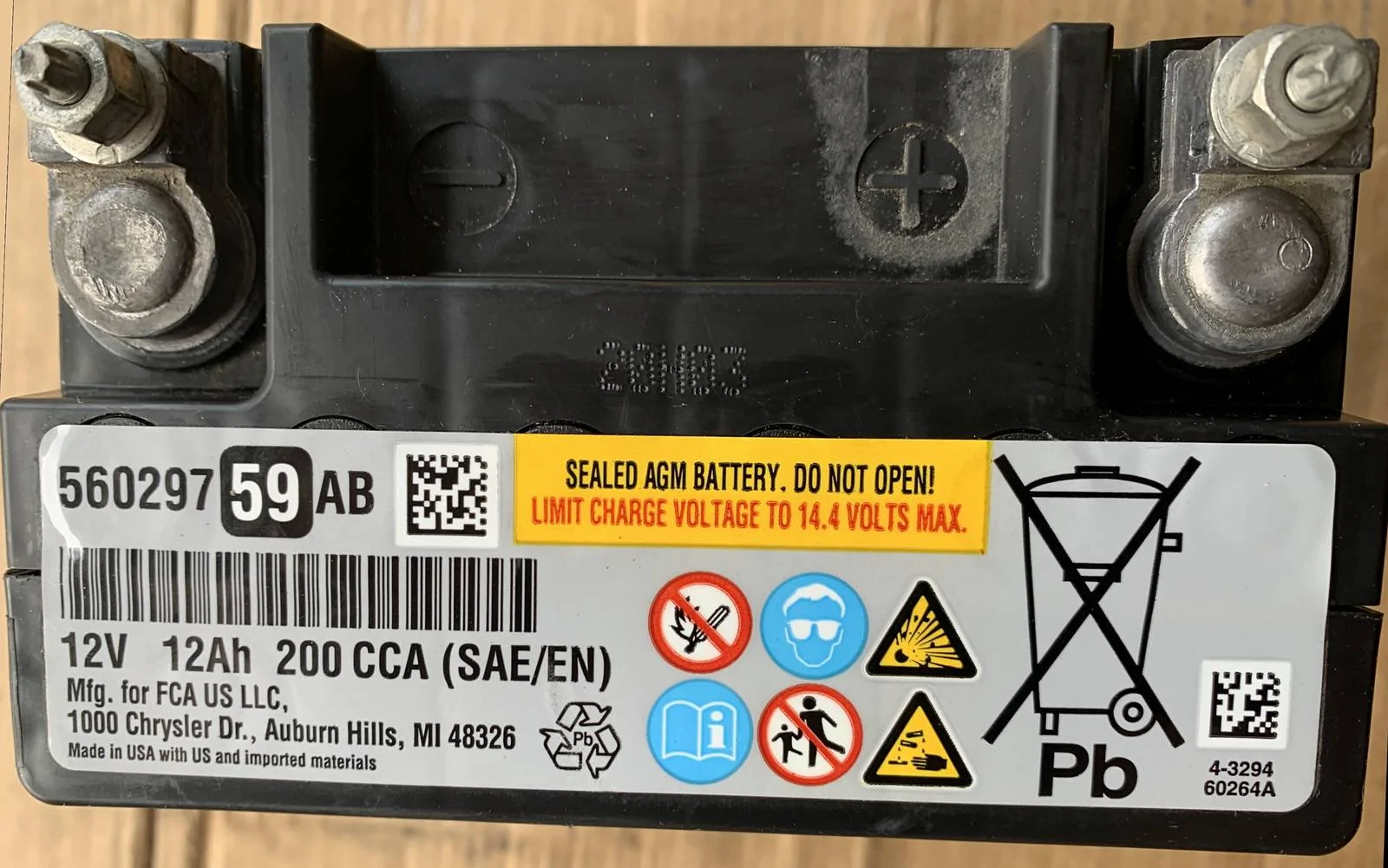
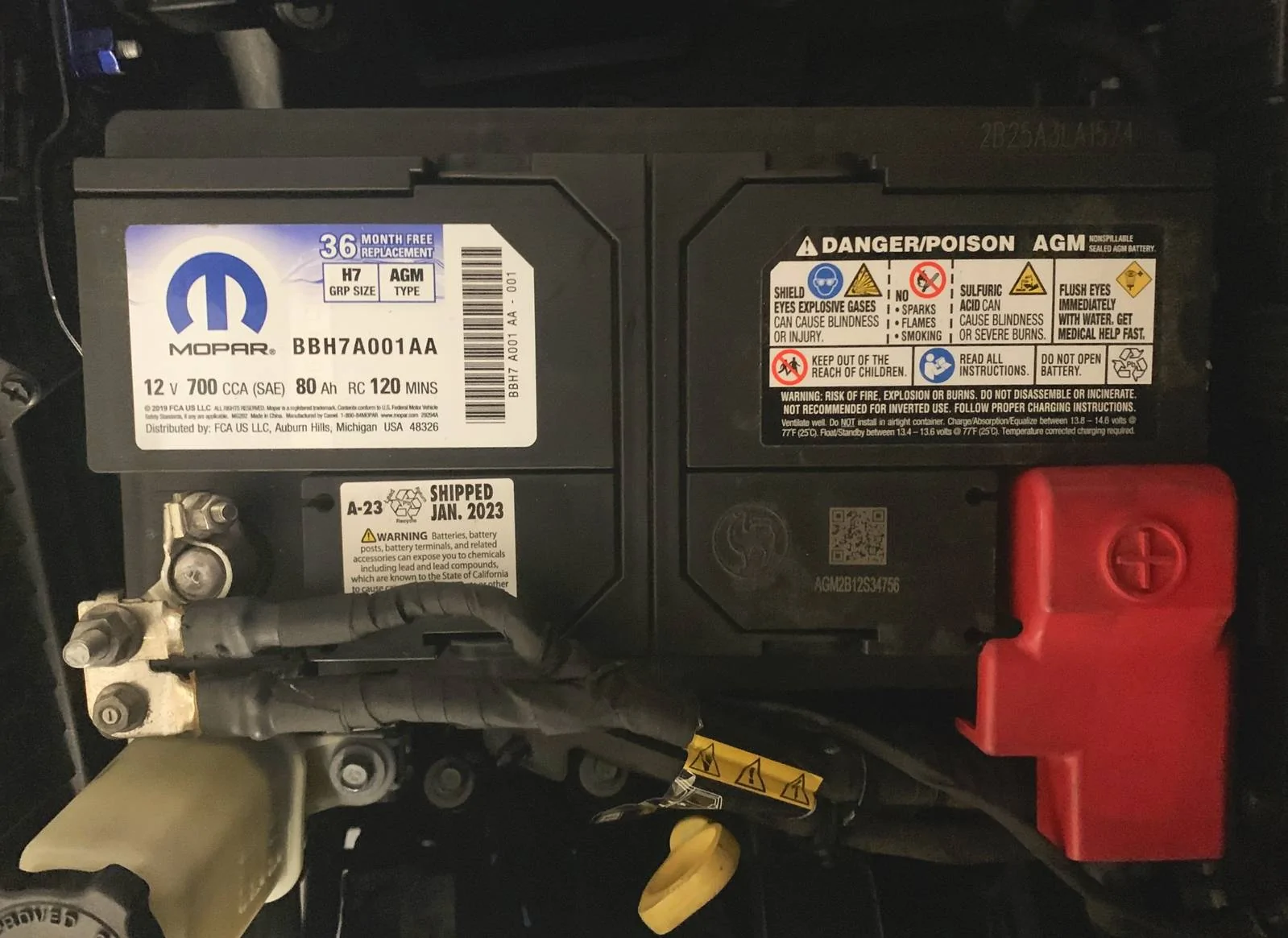
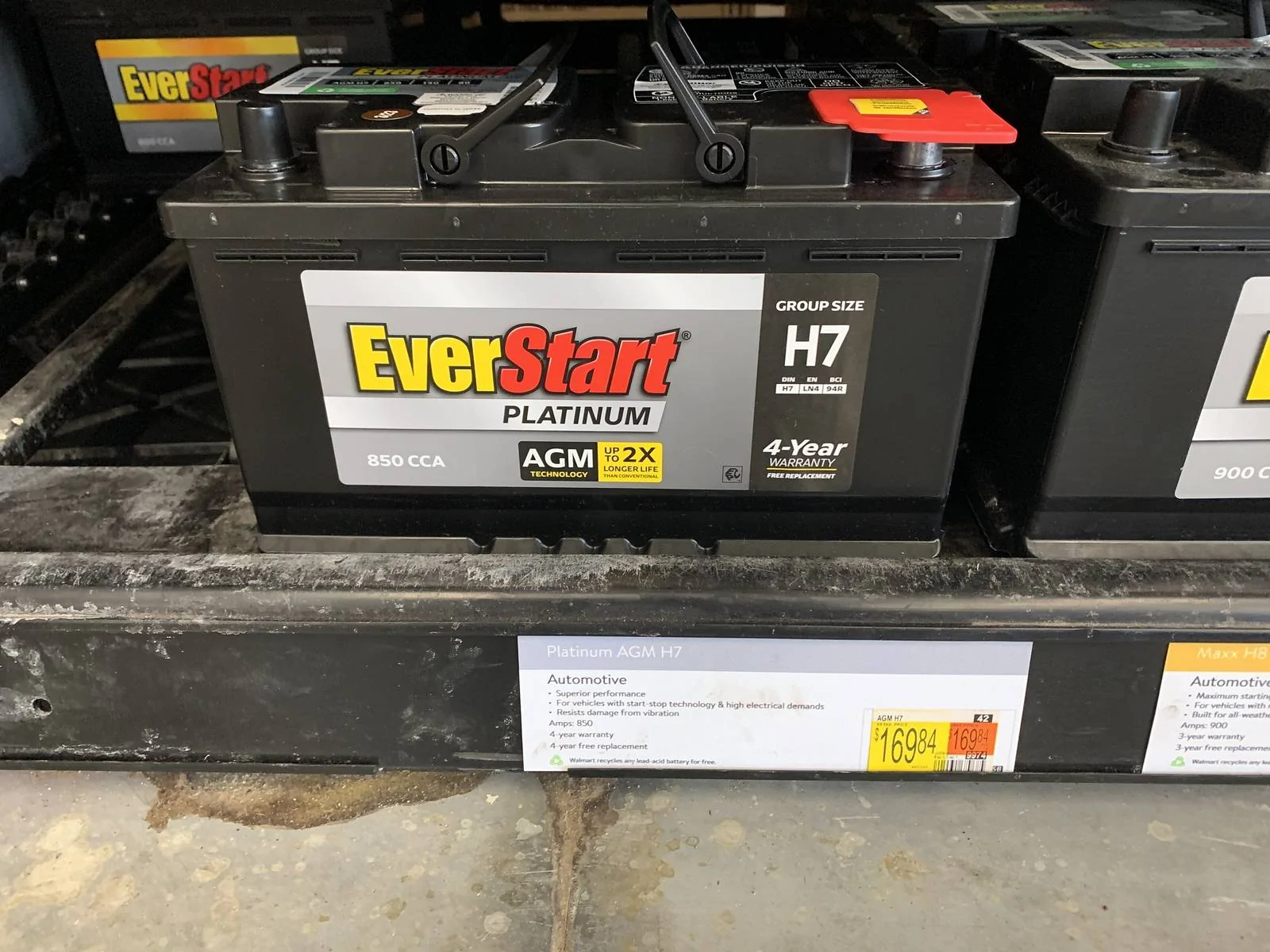
The sum of the power (Cold Cranking Amps) of the 2 Mopar batteries is somewhere between 800 and 900 CCA. A single H7 battery can be bought that is as powerful as the 2 Mopar batteries together.

Aux battery:
Jeep Wrangler JL This Confuses Me i-LLJV7dx-X3


Mopar main battery (this one is 700 CCA - some are delivered with lesser batteries):
Jeep Wrangler JL This Confuses Me i-H58dQk7-X3


Everstart battery from Walmart:
Jeep Wrangler JL This Confuses Me i-4rrpkhs-X3


https://www.jeepgladiatorforum.com/...teries-and-charging-system.75512/post-1231320
 

jeepoch

Well-Known Member
First Name
Jay
Joined
Nov 13, 2019
Threads
1
Messages
1,052
Reaction score
2,941
Location
Longmont, CO
Vehicle(s)
2019 JL Wrangler Sport S 3.6L Auto 2 door, 2.5" lift, 35s
Steve, have you ever tried to monitor your ESS state via the Cluster's Electronic Vehicle Information Center (EVIC)?

If you up or down arrow (the buttons on the left side of your steering wheel), it will come to a page showing the state of the ESS and why it's been disabled. There are dozens of reasons that are possible. Anything from too low of 'engine temperature' to 'battery charging' complaints. My favorite is "Battery Protection Mode", whatever the hell that is?

However, I'm the complete opposite of you. I play with my ESS all the time. It's sort of a different way to cope with red lights. Life is still being wasted while waiting at each and every one but at least now I play the silly Seven Second Rule (SSR) game predicting if I either should (or shouldn't) let the ESS shut the engine off when approaching the stop.

I find I'm way more situationally aware of the intersection dynamics were typically many are not so trivially or easily predictable. How long has the light been red? Are there left turn signals in all directions and if so are they favoring a particular traffic flow? How deep are the number of vehicles queued up? Are there any trucks or pedestrians to really slow things up even further? Does the traffic light cycles seemed to be computer monitored? Where am I at within the overall big picture?

So (for me) ESS provides less mind-numbingly intense boredom while wasting more of my accumulated lifetime doing nothing except just sitting in traffic watching other vehicles move? Have you ever noticed how many times the traffic cycles are timed such that the green is given to the flow with little to no traffic? Thus even stopping all vehicles that could otherwise naturally be moving?

If the gov't really wanted to save fuel and decrease emissions, they should put some effort into better traffic flow modeling. Granted, at high volumes during busy rush hours, fixed cycle times likely work better than predictive techniques. But either way when idling and going nowhere fast, I do enjoy the simple pleasure of a stopped engine at rest. No work being expended while waiting (other than my mind staying engaged with the flow pattern movement) is somehow a little more soothing, or at least much less frustrating.

ESS gives me something to be way more involved with during mundane commutes. Yet I tend to prefer route selection that minimizes the shear number of traffic lights vs shorter distance to destination. I'll chose much longer travel distance to bypass traffic congestion, sometimes by many dozens of miles, everytime. So ESS typically saves me little in my quest to avoid red lights altogether. Luckily living along the Colorado Front Range, my lifted JL on 35's gives me a lot more options to navigate around the chaotic urban rat race. Well, at least to some degree.

So I do everything I can to keep my ESS in good working order. I find typically that the only way to do that is to frequently charge my batts externally. There's just not enough joules available from the stock alternator to keep up with the ESS activity in anything near a typical commute. The charging cycle times are certainly diminished whenever the engine is stopped. And obviously the batteries are being further depleted on each and every ESS event. So the higher the ESS event frequency the worse the charging problem becomes.

I find that with ESS, I've become an EV driver without any electric motor. The only way to make it work reliably is to plug the batteries into an external 10 amp charger/maintainer. Worse, I find that to get it to really behave well, I have to charge each battery separately by disconnecting the negative terminals and charging each one independently. Even more work.

So in summary, you either have to work hard at either approach. You really have to do something to keep the ESS system from working at all, or even that much harder at keeping it working as intended. There is just no way where it will just work the way you want it too without performing some exceptional effort.

It is absolutely insanely impossible that ESS will ever work in your favor. Another grand bureaucratic idea were nothing but unintended consequences seem to prevail.

Jay
 

OldGuyNewJeep

Well-Known Member
First Name
Don
Joined
Sep 21, 2017
Threads
93
Messages
3,993
Reaction score
7,109
Location
CT
Vehicle(s)
2018 Wrangler JL, 2016 Yukon XL
Another AUX delete ESS thread.

Jeep Wrangler JL This Confuses Me 1703944517735
 

Sponsored

Shibadog

Well-Known Member
Joined
Dec 28, 2021
Threads
23
Messages
2,149
Reaction score
3,535
Location
Bowling Green, Ky
Vehicle(s)
2020 Wrangler Sport S hardtop
Occupation
Safety &Fire Protection Engineer (Retired)
And still wondering ”why” the rocket scientists as Stellantis though adding a motorcycle battery and extra electrical components made more sense than just simply putting in a more powerful main battery. (‘Course what do I know, I only worked as an engineer for 45 years?)
 

Old Jeeper

Banned
Banned
Banned
First Name
Don
Joined
Jul 7, 2022
Threads
43
Messages
2,841
Reaction score
4,211
Location
Port Charlotte, FL, Naples Fl, 17 Oaks Ranch, Tex
Vehicle(s)
2024 JLR-X 2023 JLR, 2021 JTR. 20 F 450 KR,
Occupation
US Army Infantry, IT Engineer
Dual battery JL owners: run factory with two batteries or disconnect the Aux battery and run with one. It's all good to me.

I will say though that if you have no desire to run ESS, yank the cable from the Aux battery's negative post that connects to the main battery's negative post, tape up the end of this cable you just detached, and take this problematic Aux battery out of the loop. As to keeping the Aux battery in place, or removing it: suit yourself, it's all good to me.

But here's what I don't get. Many an owner will yank Fuse 42 to prevent the vehicle from separating the batteries. Now all power's supplied by the main battery, unknown to the vehicle itself, and then many buy tech to turn ESS off automatically, so as to not run ESS on just the main battery.

Unless I misunderstand, barring some really early 2018's, if you keep Fuse 42 in place with a disconnected Aux battery and try to crank you'll fail the first time, but future cranks will occur off the main battery, and if successful, the vehicle will turn ESS off for you-- granted lighting up a light in the EVIC-- and crank on the first try thereafter.

So...while toys like the Tazer JL are great for other things, people are turning their ESS off by spending money on "ESS off tech" and pulling Fuse 42 so they don't see that ESS off idiot light in the dash: the very condition they seek?

What am missing, other than people don't like to see idiot lights in the dash so they're taking the Fuse 42 pull and ESS off tech purchase route?
It's a mess IMO and its the reason why the New JL does not qualify to be the best Jeep ever...that title goes to the TJ and it's all because of the electrical system.
 
OP
OP

AndySpill

Well-Known Member
First Name
Andy
Joined
Oct 24, 2023
Threads
71
Messages
1,654
Reaction score
1,270
Location
Pittsburgh
Vehicle(s)
2018 JL Sahara
I hate warning lights on the dash, would not accept it. And, the tech (Tazer mini) does more than turn ESS off for me. A LOT more.
That's an explanation, even if I might draw a different conclusion, I can respect. You bought tech to turn ESS off without seeing EVIC lights telling you that its off.
Sponsored


Top