47Jeepster
Well-Known Member
- First Name
- Tom
- Joined
- Jul 7, 2018
- Threads
- 25
- Messages
- 631
- Reaction score
- 710
- Location
- Queen Creek, Arizona
- Vehicle(s)
- 2025 JLUR X ... 2023 JLUR Diesel ... 2018 GC Summit
- Occupation
- Retired
- Thread starter
- #1
2023 JLRUD with a few regen problems. At ~9500 miles I had to limp in to the dealer for a forced regen ... dash lit up like a Christmas tree. Then at ~10,000 miles, while on the way to Moab, I limped into another dealer with a turbo controller code. They replaced the turbo. I found a number of mechanic mistakes with the repair, so have been running trails locally until I'm comfortable that all mistakes have been corrected.
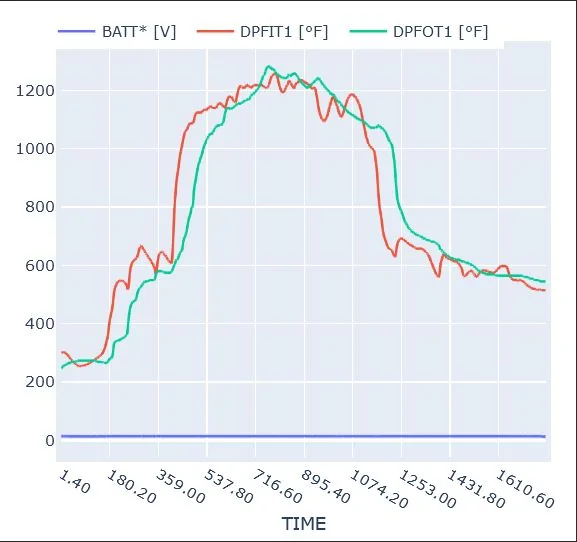
Bought an iDash Data Monster to follow the soot build-up and regen cycle. The Off/Pas/Act signal is useless because it's never steady ... keeps flashing back and forth between two ajacent stages. Thus, I use the DPF inlet temp, with an active alert set at 1000 degrees F, to signal when a regen cycle starts. My Jeep hits 1200 to 1250 degrees F when in the middle of a regen cycle.
My last four regens have averaged 110 miles between. That's a mix of 45mph in town with stop lights, trail riding, and expressway driving at 75mph. Even though the PID says average milage between regens, the Banks tech says it reports the mileage between the last regen and the one before that. Trying to figure out if it measures from the start-to-the-start of those regens or the finish-to-the-start of the current one. Banks isn't great about providing info on what is acturally being measured for many of the PIDs.
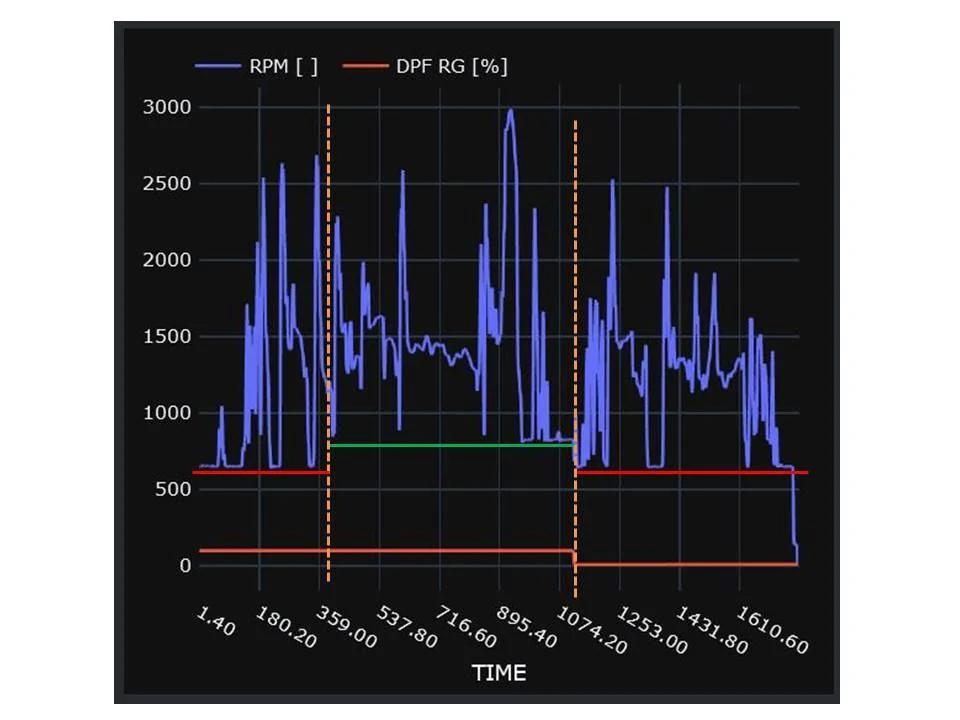
Caught a regen while in the 45mph, with stop lights, area of town and found that the data supports the idea that the idle RPM is raised during a regen. In fact, it goes up from a normal 650rpm to 850rpm. The attached graph shows the engine RPM in blue The start and stop (from another graph) of the regen cycle in orange vertical dashed lines. The red horizontal lines show the engine at 650rpm when stopped at a traffic light. And, the green horizontal line show the engine at 850rpm when stopped at a traffic light during the regen cycle.
So, if you don't have an add-on gauge and wonder if you're in a regen cycle, simply stop with the Jeep in gear and check out the engine RPM ... if it's at 850, then you're in a regen cycle.

Bought an iDash Data Monster to follow the soot build-up and regen cycle. The Off/Pas/Act signal is useless because it's never steady ... keeps flashing back and forth between two ajacent stages. Thus, I use the DPF inlet temp, with an active alert set at 1000 degrees F, to signal when a regen cycle starts. My Jeep hits 1200 to 1250 degrees F when in the middle of a regen cycle.
My last four regens have averaged 110 miles between. That's a mix of 45mph in town with stop lights, trail riding, and expressway driving at 75mph. Even though the PID says average milage between regens, the Banks tech says it reports the mileage between the last regen and the one before that. Trying to figure out if it measures from the start-to-the-start of those regens or the finish-to-the-start of the current one. Banks isn't great about providing info on what is acturally being measured for many of the PIDs.
Caught a regen while in the 45mph, with stop lights, area of town and found that the data supports the idea that the idle RPM is raised during a regen. In fact, it goes up from a normal 650rpm to 850rpm. The attached graph shows the engine RPM in blue The start and stop (from another graph) of the regen cycle in orange vertical dashed lines. The red horizontal lines show the engine at 650rpm when stopped at a traffic light. And, the green horizontal line show the engine at 850rpm when stopped at a traffic light during the regen cycle.
So, if you don't have an add-on gauge and wonder if you're in a regen cycle, simply stop with the Jeep in gear and check out the engine RPM ... if it's at 850, then you're in a regen cycle.
Sponsored
Last edited:

 ✅️
✅️