
Sponsored

Battery discharge at rest

alphawolff

Well-Known Member
Joined
Jul 31, 2023
Threads
1
Messages
3,386
Reaction score
5,689
Location
california
Vehicle(s)
2021 JLU
Shouldn't normal parasitic draw be in the 20 to 50 milliamp range? 3 amps over 12 hours would be in the 250 milliamp range.
Yeah, under 50 is spec IIRC. Normal is usually around 18-28. Service information says it may take up to 90 minutes for everything to fall asleep.

I don't think OP's calculations are correct here
Sponsored

 

THAW

Well-Known Member
First Name
Foster
Joined
Oct 28, 2022
Threads
4
Messages
2,236
Reaction score
3,084
Location
PNW - prefer Middle of Nowhere
Vehicle(s)
23 JL4DrRubicon
Indeed, those numbers are absurd. The service manual says all modules should be in sleep mode after one hour. Mine actually takes one minute longer.

The current falls rapidly. The entire discharge from the moment you stop molesting it to full sleep mode 61 minutes later is around 200mAh.
The number ranges referenced (mine) are from the IBS and are entirely normal.
 

KCSgtMaj

Well-Known Member
First Name
Andy
Joined
Jun 14, 2023
Threads
7
Messages
543
Reaction score
781
Location
KC
Vehicle(s)
MY24 Rubicon Unlimited, 3.6L
Occupation
Retired Marine, Master Plumber
Battery 101, which Stellantis engineers must have flunked. Paired batteries must be of the same voltage and size. the weaker battery will drawdown the paired battery. What I don’t understand is why there is no battery disconnect for the aux battery when vehicle ignition is off. A battery disconnect solenoid would separate the mismatched batteries allowing the batteries to reach a separated resting state after a charge.
 
Last edited:

Mguy

Well-Known Member
Joined
Nov 29, 2023
Threads
6
Messages
408
Reaction score
386
Location
Far Away
Vehicle(s)
2020 JLUR 6spd MT
Indeed, those numbers are absurd. The service manual says all modules should be in sleep mode after one hour. Mine actually takes one minute longer.

The current falls rapidly. The entire discharge from the moment you stop molesting it to full sleep mode 61 minutes later is around 200mAh.
The discussion about current draw after shut down is unnecessarily confused.

Apparently, not all are aware that Amp-Hours, a measurement of charge quantity designated as "Ah" or "mAh," is calculated by multiplying a constant current ("A" or "mA") by time. When a JL shuts down there is substantial current variation over the hour or so time period immediately following, so an Ah metric for that brief time period is not likely to be accurate or particularly useful.

Further, some confuse "Ah" with "A," and in one post, #13, @THAW actually miscalculates Ah with division instead of multiplication ("1000 mA / 36 hours = ~28 mAh").

[Edit 9/9/2025: @THAW has thankfully deleted his original post #13]

Further, @THAW apparently believes that JLs experience a constant Quiescent Current of 1000 mA or more after shut down. A JL with that constant would be in a serious state of malfunction. I doubt very many JLs experience post shut down loads of 1000 plus mA for more than a few minutes.
 
Last edited:

Sponsored

Joined
Sep 6, 2025
Threads
0
Messages
14
Reaction score
15
Location
Dyer, NV
Vehicle(s)
2023 JT
The discussion about current draw after shut down is unnecessarily confused.

Apparently, not all are aware that Amp-Hours, a measurement of charge quantity designated as "Ah" or "mAh," is calculated by multiplying a constant current ("A" or "mA") by time. When a JL shuts down there is substantial current variation over the hour or so time period immediately following, so an Ah metric for that brief time period is not likely to be accurate or particularly useful.
No. Just no.

Current doesn't have to be constant to measure charge or discharge. Lots of devices do this, including cell phones and the IBS on the Jeep. How do you think they know the % charge remaining?

No again, variation is not a problem and does not make the results inaccurate. A simple RC filter solves that problem.

The discharge for the first hour after driving it is perhaps 200mAh. After that, it's an average of about 13mA (for my JT) for however long it sits. Knowing this allows one to predict the discharge any number of hours later.

The OP's problem is an estimated 9Ah discharge within 4 hours of parking it. One guy claims that's totally normal. It's about 37 times what I would expect.

I doubt very many JLs experience post shut down loads of 1000 plus mA for more than a few minutes.
Agreed.
 

roaniecowpony

Well-Known Member
Joined
Dec 4, 2018
Threads
194
Messages
12,944
Reaction score
20,492
Location
SoCal
Vehicle(s)
2018 JLUR, 14 GMC 1500 CC All TERRAIN
Occupation
Retired Engineer

Mguy

Well-Known Member
Joined
Nov 29, 2023
Threads
6
Messages
408
Reaction score
386
Location
Far Away
Vehicle(s)
2020 JLUR 6spd MT
No. Just no.

Current doesn't have to be constant to measure charge or discharge. Lots of devices do this, including cell phones and the IBS on the Jeep. How do you think they know the % charge remaining?

No again, variation is not a problem and does not make the results inaccurate. A simple RC filter solves that problem.
Well, thanks for your point of view on the value of the "Ah metric" I referenced. I'll try to explain my view in terms helpful for understanding the posts in this thread.

First, as you say, of course "Current doesn't have to be constant to measure charge or discharge." Sorry you understood my post to the contrary. It was written for the context of this thread and the knowledge level of most JL owners. Perhaps you'll have a different reaction after reading my further explanation.

The issue here concerns analysis of the JL's engine off loads when there is a supposed change in battery resting State of Charge (SOC) measured as a percentage.

One amp-hour is, by definition, the amount of electrical charge resulting from a one amp steady current passing through a circuit for one hour. A prime example of amp-hour use is that for many years 12V battery manufacturers have published timed battery discharge tests, with a known load at a constant amperage (typically 25 amps), to describe their product's reserve capacity. So, by definition, timed testing by constant load is a very accurate method for measuring battery charge, or loss of battery charge.

Determining the amount of electricity actually discharged from a battery with a variable load is another story. Keeping track of variable current, to use as a multiplier for a small unit of time, and then adding to a total for an actual amp-hour computation, requires more advanced techniques. Modern electronics can count the number of charge units actually passing through a circuit using hardware and software. Such devices are called Coulomb Counters (one Coulomb equals the amount of electrical charge delivered by one steady amp of current in one second). Coulomb Counters require initial calibration, and periodic recalibration, to be reasonably accurate.This alone makes measurement of SOC change during variable loads more of a challenge.

Many battery monitoring devices for consumer products, such as the JL's Intelligent Battery Sensor (IBS), measure SOC and SOC changes using Coulomb Counter circuitry. Typically, these devices express their computations as percentages, which are estimates of battery SOC. These devices do not typically report charge quantity with the accuracy that would warrant Coulumb or Amp-hour measurement units. These units are typically reserved for more accurate devices not intended for consumer use.

So the concern here, as expressed by the original poster, is about the JL's engine off loads and change in battery SOC. My position is that SOC percentage estimates are not accurate enough to be helpful. Converting SOC estimates to Amp-hours, as done by the original poster and imprecisely referenced by me as an "Ah metric," does not improve the attempted analysis.

If an owner is concerned about engine off loads an ammeter should be used, as suggested by @roaniecowpony above, and there should be little or no attention paid to SOC percentage estimates reported by other devices. Not exactly surprising advice, but worth repeating given the discussion in this thread.
 
Last edited:
Joined
Sep 6, 2025
Threads
0
Messages
14
Reaction score
15
Location
Dyer, NV
Vehicle(s)
2023 JT
@Mguy

Amp-hour is a unit of charge. It boils down to a number of electrons. Counting the number of electrons that passes through a point in a circuit is a natural concept.

If you can sample current at regular intervals with mA accuracy then you can measure charge with mAh accuracy:

charge in mAh = (sum of current readings in mA / number of readings) * (hours as a decimal)

See how easy that is?

Devices with coulomb counters report percentages because that's all people understand, not because they can't report accurate charge. The Jeep's IBS is specified to 0.1mA accuracy IIRC.
 

Mguy

Well-Known Member
Joined
Nov 29, 2023
Threads
6
Messages
408
Reaction score
386
Location
Far Away
Vehicle(s)
2020 JLUR 6spd MT
@Mguy

Amp-hour is a unit of charge. It boils down to a number of electrons. Counting the number of electrons that passes through a point in a circuit is a natural concept.

If you can sample current at regular intervals with mA accuracy then you can measure charge with mAh accuracy:

charge in mAh = (sum of current readings in mA / number of readings) * (hours as a decimal)

See how easy that is?

Devices with coulomb counters report percentages because that's all people understand, not because they can't report accurate charge. The Jeep's IBS is specified to 0.1mA accuracy IIRC.
If only the math was that easy in real life situations. Fortunately, I've forgotten the calculus needed to integrate the infinite number of amp readings that are needed for truly accurate analysis of instantly varying loads.

I have found virtually no information about the Jeep IBS measurement of SOC, other than it reports percentages for ancillary functions. They include operating thresholds for options such as remote starting and the auxiliary switch bank. It is news to me if the IBS reports SOC non-percentage, more accurate, data that is used by JLs for other purposes. If you have more information, I'm all ears.

However, my point about consumer battery monitoring devices relevant to this thread is that their percentage reporting is of little or no value for analyzing post shut off loads. You don't disagree, right?
 

Sponsored

Joined
Sep 6, 2025
Threads
0
Messages
14
Reaction score
15
Location
Dyer, NV
Vehicle(s)
2023 JT
If only the math was that easy in real life situations.
I think you're in over your head here. Because it literally is that easy.

A problem would arise if the signal had a frequency component that was a multiple of the sampling frequency. In that case it's possible, for example, that we're sampling troughs and missing the peaks. This is solved with a low-pass filter. The filter doesn't change the average. Basic stuff.

Fortunately, I've forgotten the calculus needed to integrate the infinite number of amp readings that are needed for truly accurate analysis of instantly varying loads.
I have to laugh. They cover this stuff in the first week of the 101 course in electronics.

Just sum sampled current times delta t. This is not calculus.

There's an easy differential equation in the design of an RC filter to ensure that the samples are truly representative of the average over the sampling interval.

However, my point about consumer battery monitoring devices relevant to this thread is that their percentage reporting is of little or no value for analyzing post shut off loads. You don't disagree, right?
Agreed. Any device that doesn't know the capacity of the battery can't possibly know the percentage charge remaining.
 
OP
OP
Cartman

Cartman

Well-Known Member
First Name
ANDREW
Joined
Mar 30, 2025
Threads
30
Messages
333
Reaction score
131
Location
Slovakia
Vehicle(s)
Jeep JL Sport+ 2d 2023
Hello,

thanks everyone for the responses.
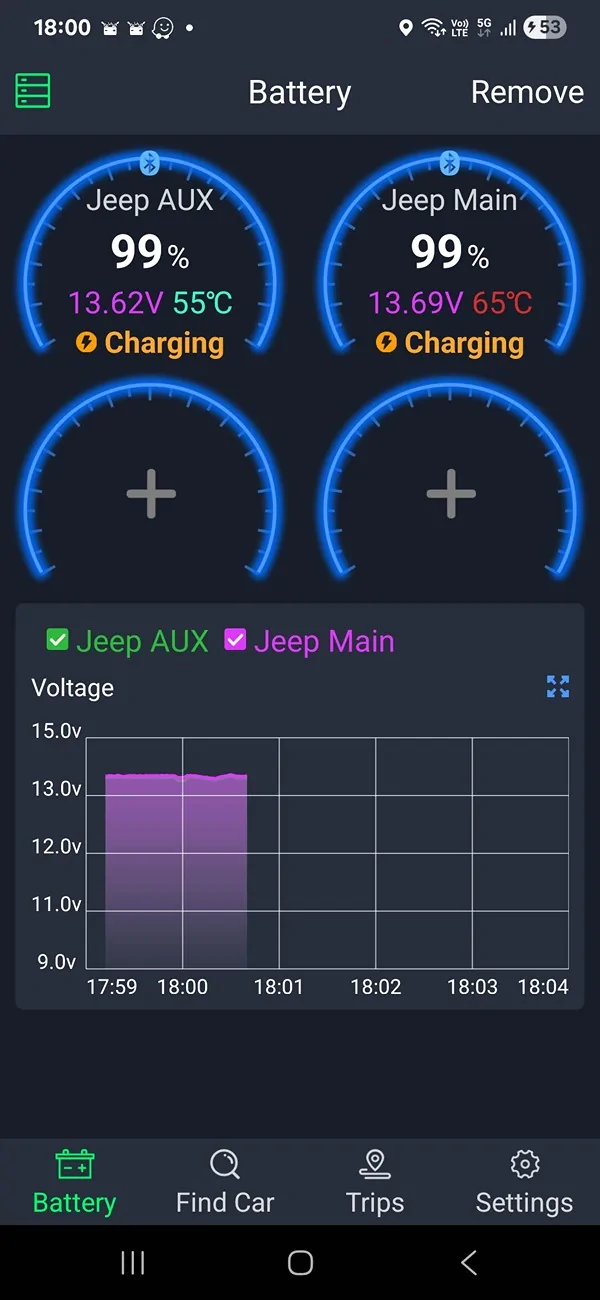
I have new observations. First, the SOC drops to 88% as I last observed probably about an hour after parking, but it does not drop lower even after 24 hours.
The car still has Start/Stop ready, which is new to me, because it has not worked since it was new. According to the measurements, my battery manages to charge during short drives and I park in the evening with 100%.
As for the meters, they are connected directly to the battery, they have a consumption of 1.5mAh, BT4.2.
I do not know exactly how those SOC meters measure. I can measure the voltage with a multimeter and that is accurate and I can also measure the battery temperature and this measurement is also accurate. I am quite surprised that the battery temperature rose to 65 degrees Celsius during the day at an outside temperature of 30 degrees, which surprised me. That was the highest temperature value, which was reached in the sun and with a longer stand, it drops quite significantly, with air cooling down to values around 40 at an outside temperature of 30.
According to observations, the main battery is primarily charged, but not to full capacity, the difference between AUX and main was never more than 10%.
Special thanks to @THAW for letting me check Live data in JScan.
Jeep Wrangler JL Battery discharge at rest unnamed (1)
 

Mguy

Well-Known Member
Joined
Nov 29, 2023
Threads
6
Messages
408
Reaction score
386
Location
Far Away
Vehicle(s)
2020 JLUR 6spd MT
Just sum sampled current times delta t. This is not calculus.
So an engineer and a theoretician walk into a bar . . . . .

The theoretician says to the engineer, "Your time delta is too large."

The engineer replies, "You're in over your head. The measurement is good enough."

The theoretician says, "Don't forget to recalibrate. Often. You're buying the drinks."
 

THAW

Well-Known Member
First Name
Foster
Joined
Oct 28, 2022
Threads
4
Messages
2,236
Reaction score
3,084
Location
PNW - prefer Middle of Nowhere
Vehicle(s)
23 JL4DrRubicon
I have found virtually no information about the Jeep IBS measurement of SOC, other than it reports percentages for ancillary functions. They include operating thresholds for options such as remote starting and the auxiliary switch bank. It is news to me if the IBS reports SOC non-percentage, more accurate, data that is used by JLs for other purposes. If you have more information, I'm all ears.
The Body Controller tracks about 15 IBS metrics (and about double that including status/error conditions). Importantly, it tracks real-time current and lifetime charge received/released.
Sponsored

 
Last edited:


Top