dstevens
Well-Known Member
- Thread starter
- #1
I'll post this information here in case someone else is crazy enough in reinvent the wheel like I did. And has the same skid.
Introduction
On my 2024 2.0T Wrangler Aux fuel tank I noticed that on the left side there was unused space running from the back of the transfer case to the rear axle between the drive shaft and the exhaust. I wanted more fuel range, so the space was perfect for an auxiliary fuel tank.
I was not the first to notice this space and think it could be used for an auxiliary fuel tank. Long Range America has a 17 gallon fuel tank for this space. The 'Long Ranger' has a 70 liter (18.5 gallons) tank. Roam had a 316 tank of 21 gallons but does not seem to be in business now.
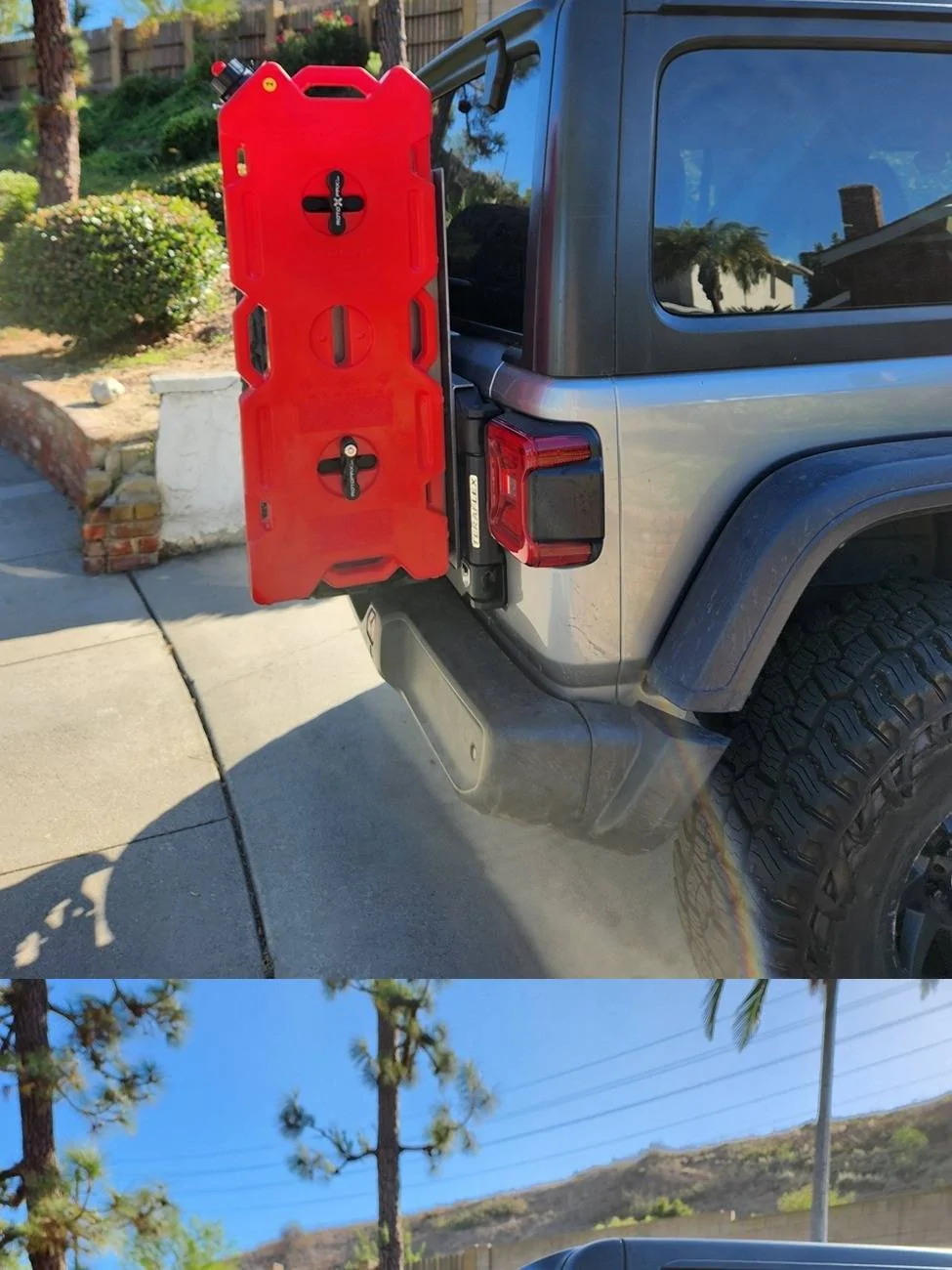
Other options existed for auxiliary fuel tanks - the Titan tailgate mounted plastic tank which holds 12 gallons on the rear tailgate.
Why make my own? For clearance, weight and compatibility. The LRA and LR tank take great pains to point out that they hang down no lower than any part of the stock vehicle. However I had replaced some of the factory cross members and the factory fuel tank skid, gaining around 1.5" of additional ground clearance over a factory wrangler. So either of those two tanks would hang down 1.5" lower than anything else on the Jeep. Plus I always would count on additional ground clearance on the left side of the Jeep where the fuel tank was not. Also with my skid system the tanks would not be compatible with the tank mounting. And finally, the LRA and LR are both around 100 lbs dry, which is more than double what I thought they should weigh. And they required an additional skid plate to protect the tank if rock crawling, which further reduced ground clearance and increase weight.
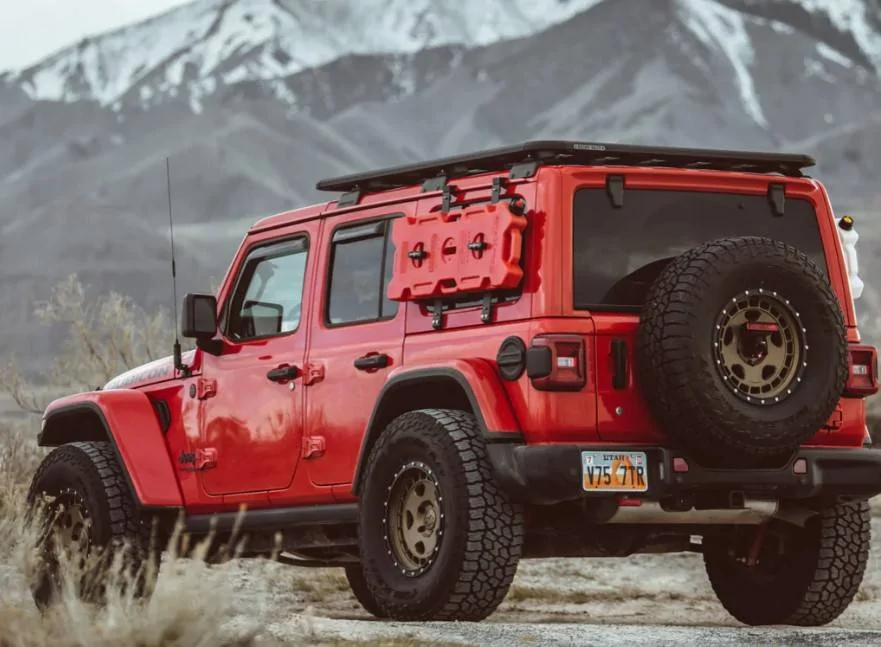
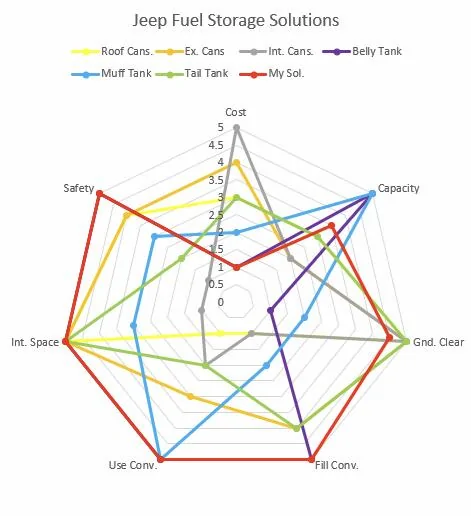
They are numerous other options carrying spare fuel and it comes down to use case. For emergency fuel plastic or metal cans carried either externally, inside or on a roof rack are the best compromise between weight and cost but not the best for convenience of use and space and possibly weight up high. Titan makes a 12 gallon plastic tank that sits between the spare and tailgate and is good for cost and space but not good for convenience of use and I don't like the idea of another 100 lbs of weight on a 3' lever arm when bouncing around off road, plus rear vision is reduced.
For emergency use plastic or metal cans are the best bang for the buck but for anything which you want to use regularly a permanently mounted auxiliary tank with transfer pump is the best solution.
Design
Criteria
I selected 304 stainless for the tank, which may have been the wrong choice - time will tell. The commercial tanks all used aluminized mild steel, presumably for cost and fatigue resistance. I wanted something that would handle higher ethanol concentrations but in hindsight aluminum probably would have been the best choice, being cheaper, easier to weld and probably just as good for fatigue and crack propagation. In research there were a lot of scary stories from the marine industry about not using stainless for any fuel tank with regards to crevice corrosion but I determined that the conditions were different for my use and this should not be a problem. Two advantages of using 304 is that I could integrate the skid plate into the bottom of the tank and also the heatshield on the exhaust side of the tank. Even a thin piece of 304 with an air gap would be enough to stop the radiant heat from the exhaust heating the tank.
Laser cutting made using stainless very easy but I would have tried much harder to get all lap welds rather than some lap and some corner welds. Also the amount of argon used was outrageous - around a full tank, but there were no oxidation on the inside of the welds. I tried using solarflux, which worked well, but in the end just a lot of argon worked and I did not have to worry about the glass like solarflux residue clogging up the fuel pick up over time. I tried using copper backing blocks, which did not work.
Filling / Draining
As an auxiliary tank, the tank would till with the main tank and then fuel would transfer at will with the use of a transfer pump. The aux tank filler was T'd into the main tank filler tube and my theory was that the fuel running into the main tank would bypass the aux tank until the main tank was full, at which point the aux tank would fill up. In practice about the aux tank would end up just under half fill when the main tank filled so I just pump some of the fuel over.
EVAP / Emissions
Fairly simple. Keep everything as a closed system. Use the emissions rated plastic lined hose (I purchased a junk yard fuel tank hose set for this). In the end the only plumbing was 1) fuel pump suction to fuel pump to fuel filler tube. 2) Fuel level vent valve to a Tee in the stock FLVV. 3) Fuel filler tube T to aux tank. All closed systems.
Mounting
I establish that the front of the tank could sit on the support than ran behind the transfer case. The rear of the tank bolts to the frame cross member above the rear axle. Fairly simple.
Measurement. (No photos to show).
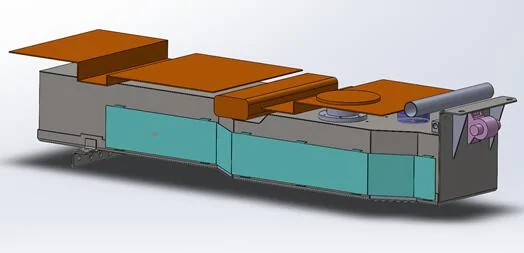
Solidworks modelling. Gross capacity 13 gallons usable capacity 11.8 gallons. Pump did not end up being mounted on back of tank. Above frame cross member was better.

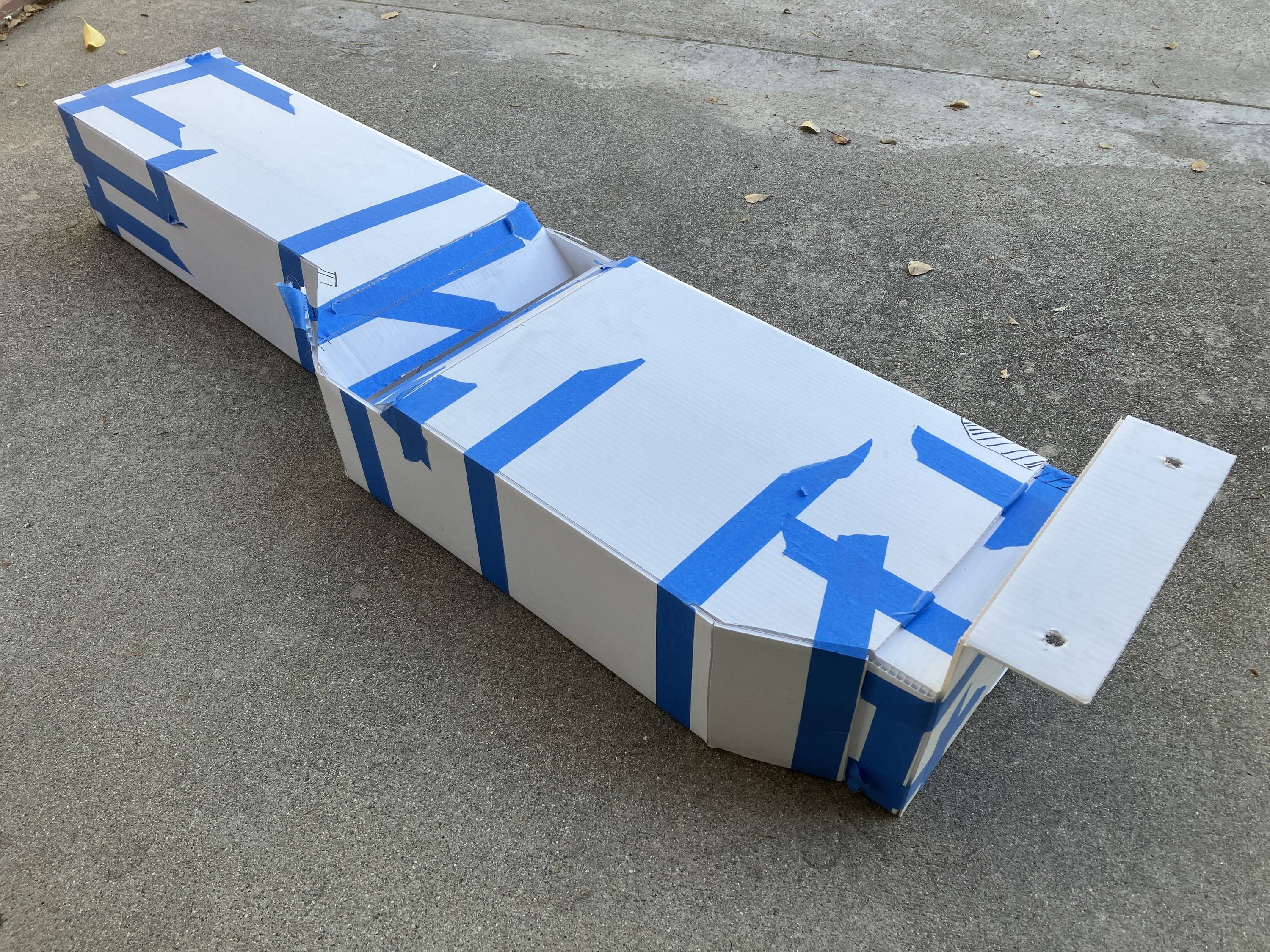
Mock up out of plastic board.

Laser cut parts. Baffles not shown.

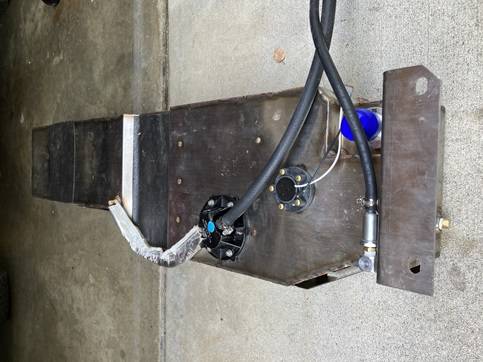
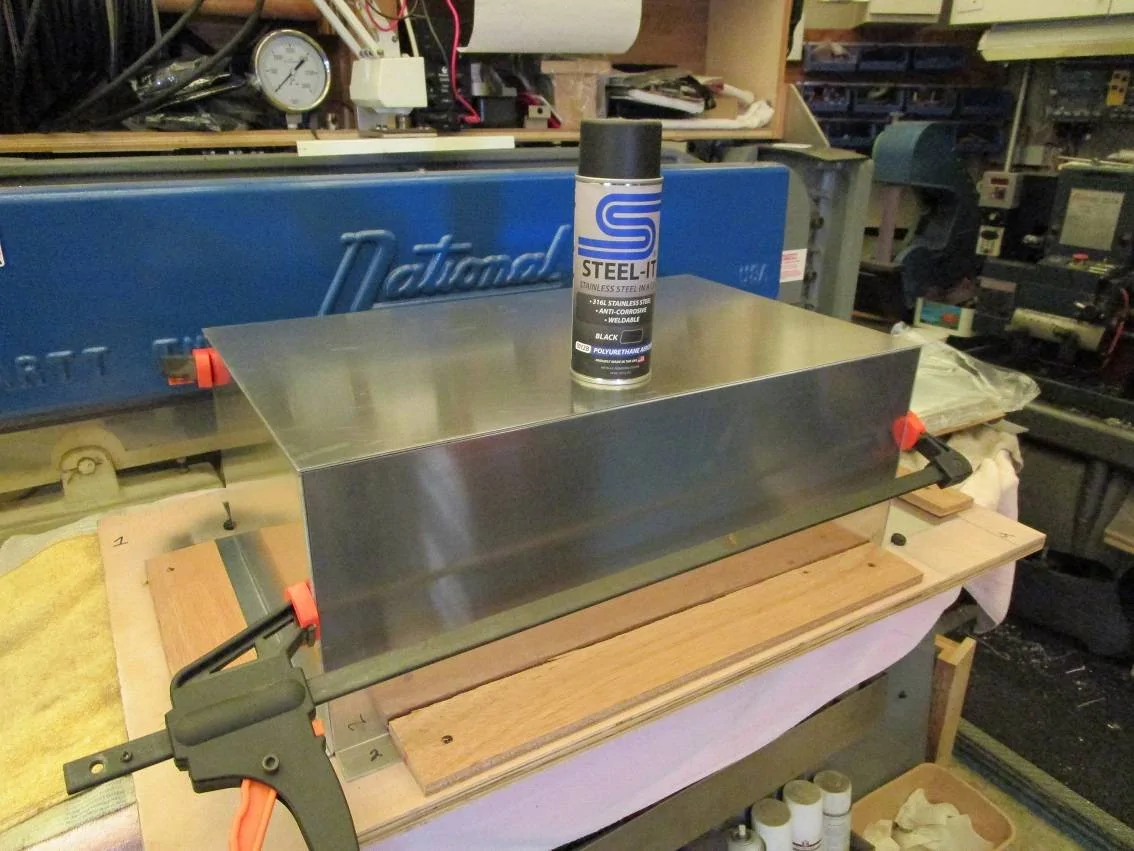
A lot of welding.
Testing for leaks
(no photos) Adapted a schrader valve and pressurized to 4 psi for a week. Also submerged in water for a bubble check.
Test fitment

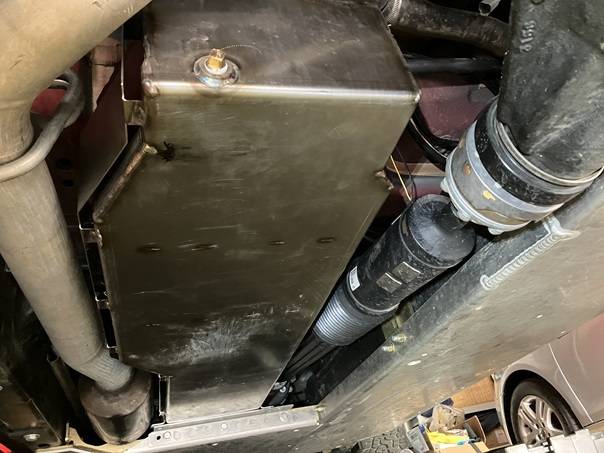
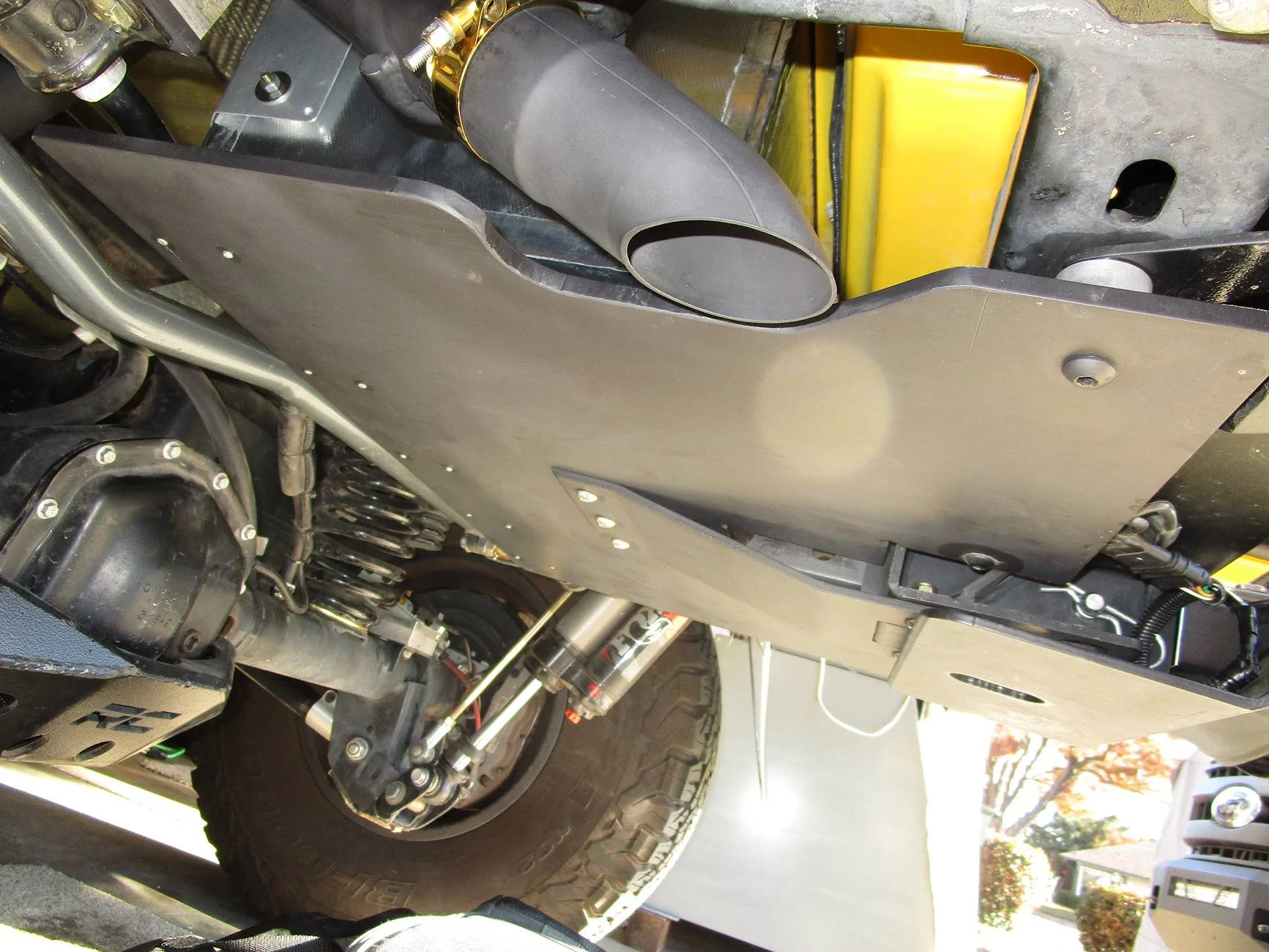
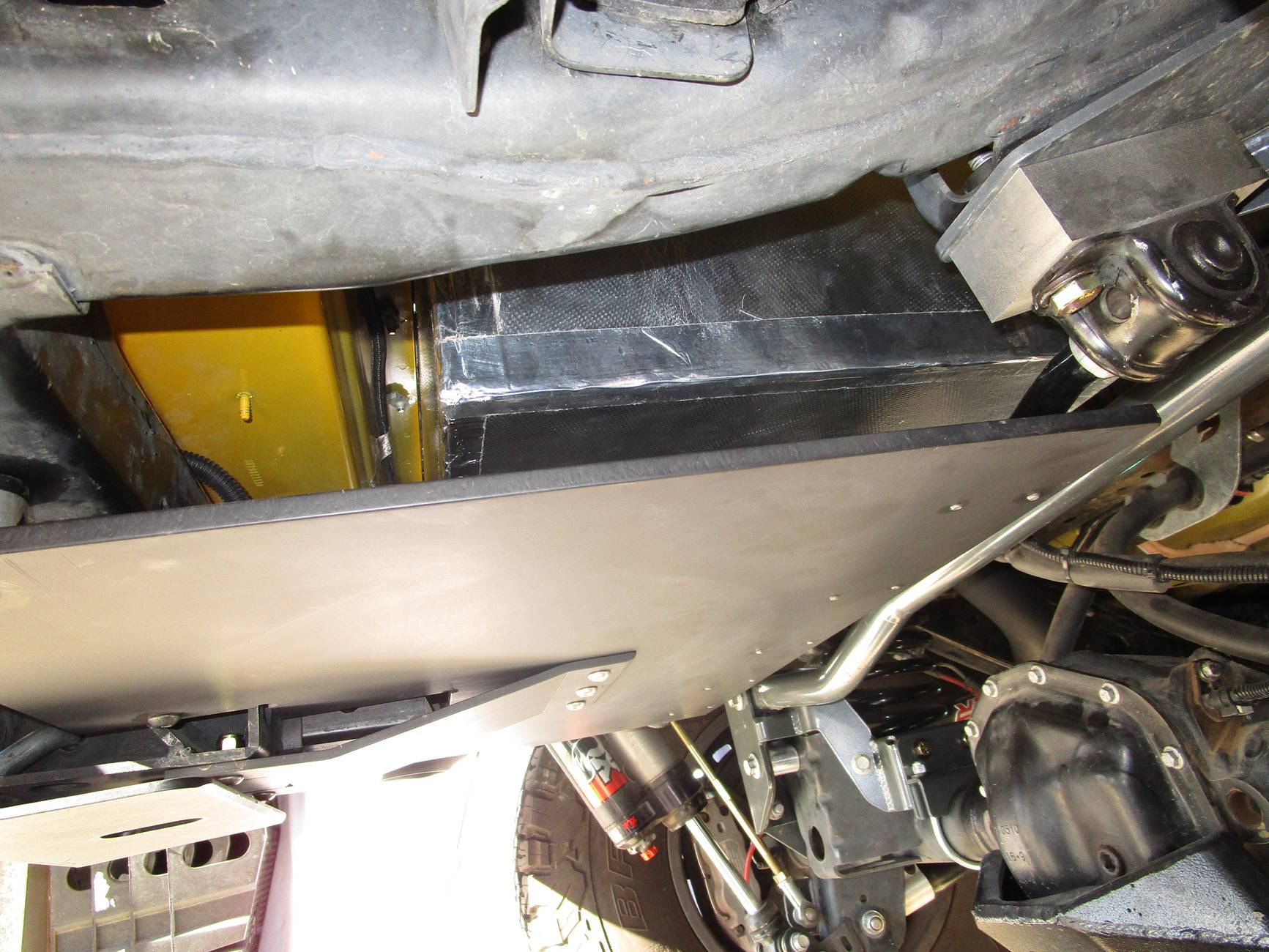
All installed
Components
Fuel Sender
0-90 ohm floatless tubular level sensor. $110, Tanks Inc. Screws are #10-32
Fuel Gauge
The Apexus model PG200-b is a combination gauge and pump controller. Part PG-210 for the 0-90 ohm gauge. $90 from Australia.
Transfer Pump
Facet FEP304SV Posi-Flo $66 Amazon Catalog. Specifications. Mounting holes are 1/4" on 2-1/2" centers. Pumps roughly 1 gallon every few minutes.
Suction Tube
There are several marine suction tubes that work well. $21 Amazon. $21 Ebay. 1/4" npt female outlet, 3/8" npt male fitting.
FLVV
The fuel limit vent valve shuts off the vent air from the tank when filling in order to maintain an air gap in the tank. Attwood makes two marine versions which are suitable. The difference between the A and B part numbers is that the B part number has an extra vent line which we connected to the top of the front of the tank so that that part of the tank vents when filling.
$80 Attwood 99FLB080-1
Screws are #10-32
Fill Tube
Dorman 577-106 fuel filler neck $116 Amazon This is designed to replace a broken plastic fuel filler, but works well. It has a rollover valve at the bottom. The top barbed fitting is 32.25mm with a 36.1mm barb.
Conclusion
It works, but I ran out of time and energy to finish the project to my satisfaction. The aux tank provides around 10 gallons of fuel, less than the design capacity of 11.5 gallons. To fix this would require removing the tank, then filling with fuel using a measure and seeing when the FLVV shuts off the vent air, then diagnosing how much air space is left and if that is what it should be. To be fair the stock Wrangler fuel tank does the same thing - if I fill up at the pump the fuel gauge never gets to full and the gauge moves down in the first couple of miles.
The pickup is at the extreme left rear of the tank, so will pick up fuel when level or going up a slight hill, otherwise you're going to have to wait until conditions improve. Multiple pickups would help but the simple solution is that I start to pump fuel once the main tank gets down to about 3/4 full. This leads to the next point.
The stock fuel gauge uses a combination of the level sensor and consumption information from the PCM to show the fuel level. If does not like the sudden appearance of mystery fuel and this causes the fuel gauge to go up and down 1/8 of a tank at a time over a 5-10 minute period. The logic only wants to see the fuel level go up when the engine is off and then it resets as it thinks you have refilled. The solution is to pump small amounts of fuel regularly. It's not critical, but if you do this then the fuel gauge and estimated range seems to work correctly.
Final weight with tank, pump, hoses etc is 55 lbs empty.
It's all a trade off between cost, weight, ground clearance, convenience of filling, convenience of transfer, storage space both interior and exterior, accident risk. This solution is great for ground clearance, convenience of filling and transfer, storage space, accident risk, not too bad for weight but at the high end for cost. However my use when towing a trailer is that I use the aux tank every time I fill up with gas. For someone who hits a long trail once per year then two 5 gallon containers strapped to the rear bumper would be a good solution.
3d Files
Solidworks
Introduction
On my 2024 2.0T Wrangler Aux fuel tank I noticed that on the left side there was unused space running from the back of the transfer case to the rear axle between the drive shaft and the exhaust. I wanted more fuel range, so the space was perfect for an auxiliary fuel tank.
I was not the first to notice this space and think it could be used for an auxiliary fuel tank. Long Range America has a 17 gallon fuel tank for this space. The 'Long Ranger' has a 70 liter (18.5 gallons) tank. Roam had a 316 tank of 21 gallons but does not seem to be in business now.
Other options existed for auxiliary fuel tanks - the Titan tailgate mounted plastic tank which holds 12 gallons on the rear tailgate.
Why make my own? For clearance, weight and compatibility. The LRA and LR tank take great pains to point out that they hang down no lower than any part of the stock vehicle. However I had replaced some of the factory cross members and the factory fuel tank skid, gaining around 1.5" of additional ground clearance over a factory wrangler. So either of those two tanks would hang down 1.5" lower than anything else on the Jeep. Plus I always would count on additional ground clearance on the left side of the Jeep where the fuel tank was not. Also with my skid system the tanks would not be compatible with the tank mounting. And finally, the LRA and LR are both around 100 lbs dry, which is more than double what I thought they should weigh. And they required an additional skid plate to protect the tank if rock crawling, which further reduced ground clearance and increase weight.
They are numerous other options carrying spare fuel and it comes down to use case. For emergency fuel plastic or metal cans carried either externally, inside or on a roof rack are the best compromise between weight and cost but not the best for convenience of use and space and possibly weight up high. Titan makes a 12 gallon plastic tank that sits between the spare and tailgate and is good for cost and space but not good for convenience of use and I don't like the idea of another 100 lbs of weight on a 3' lever arm when bouncing around off road, plus rear vision is reduced.
For emergency use plastic or metal cans are the best bang for the buck but for anything which you want to use regularly a permanently mounted auxiliary tank with transfer pump is the best solution.
Design
Criteria
I selected 304 stainless for the tank, which may have been the wrong choice - time will tell. The commercial tanks all used aluminized mild steel, presumably for cost and fatigue resistance. I wanted something that would handle higher ethanol concentrations but in hindsight aluminum probably would have been the best choice, being cheaper, easier to weld and probably just as good for fatigue and crack propagation. In research there were a lot of scary stories from the marine industry about not using stainless for any fuel tank with regards to crevice corrosion but I determined that the conditions were different for my use and this should not be a problem. Two advantages of using 304 is that I could integrate the skid plate into the bottom of the tank and also the heatshield on the exhaust side of the tank. Even a thin piece of 304 with an air gap would be enough to stop the radiant heat from the exhaust heating the tank.
Laser cutting made using stainless very easy but I would have tried much harder to get all lap welds rather than some lap and some corner welds. Also the amount of argon used was outrageous - around a full tank, but there were no oxidation on the inside of the welds. I tried using solarflux, which worked well, but in the end just a lot of argon worked and I did not have to worry about the glass like solarflux residue clogging up the fuel pick up over time. I tried using copper backing blocks, which did not work.
Filling / Draining
As an auxiliary tank, the tank would till with the main tank and then fuel would transfer at will with the use of a transfer pump. The aux tank filler was T'd into the main tank filler tube and my theory was that the fuel running into the main tank would bypass the aux tank until the main tank was full, at which point the aux tank would fill up. In practice about the aux tank would end up just under half fill when the main tank filled so I just pump some of the fuel over.
EVAP / Emissions
Fairly simple. Keep everything as a closed system. Use the emissions rated plastic lined hose (I purchased a junk yard fuel tank hose set for this). In the end the only plumbing was 1) fuel pump suction to fuel pump to fuel filler tube. 2) Fuel level vent valve to a Tee in the stock FLVV. 3) Fuel filler tube T to aux tank. All closed systems.
Mounting
I establish that the front of the tank could sit on the support than ran behind the transfer case. The rear of the tank bolts to the frame cross member above the rear axle. Fairly simple.
Measurement. (No photos to show).
Solidworks modelling. Gross capacity 13 gallons usable capacity 11.8 gallons. Pump did not end up being mounted on back of tank. Above frame cross member was better.
Mock up out of plastic board.
Laser cut parts. Baffles not shown.

A lot of welding.
Testing for leaks
(no photos) Adapted a schrader valve and pressurized to 4 psi for a week. Also submerged in water for a bubble check.
Test fitment

All installed
Components
Fuel Sender
0-90 ohm floatless tubular level sensor. $110, Tanks Inc. Screws are #10-32
Fuel Gauge
The Apexus model PG200-b is a combination gauge and pump controller. Part PG-210 for the 0-90 ohm gauge. $90 from Australia.
Transfer Pump
Facet FEP304SV Posi-Flo $66 Amazon Catalog. Specifications. Mounting holes are 1/4" on 2-1/2" centers. Pumps roughly 1 gallon every few minutes.
Suction Tube
There are several marine suction tubes that work well. $21 Amazon. $21 Ebay. 1/4" npt female outlet, 3/8" npt male fitting.
FLVV
The fuel limit vent valve shuts off the vent air from the tank when filling in order to maintain an air gap in the tank. Attwood makes two marine versions which are suitable. The difference between the A and B part numbers is that the B part number has an extra vent line which we connected to the top of the front of the tank so that that part of the tank vents when filling.
$80 Attwood 99FLB080-1
Screws are #10-32
Fill Tube
Dorman 577-106 fuel filler neck $116 Amazon This is designed to replace a broken plastic fuel filler, but works well. It has a rollover valve at the bottom. The top barbed fitting is 32.25mm with a 36.1mm barb.
Conclusion
It works, but I ran out of time and energy to finish the project to my satisfaction. The aux tank provides around 10 gallons of fuel, less than the design capacity of 11.5 gallons. To fix this would require removing the tank, then filling with fuel using a measure and seeing when the FLVV shuts off the vent air, then diagnosing how much air space is left and if that is what it should be. To be fair the stock Wrangler fuel tank does the same thing - if I fill up at the pump the fuel gauge never gets to full and the gauge moves down in the first couple of miles.
The pickup is at the extreme left rear of the tank, so will pick up fuel when level or going up a slight hill, otherwise you're going to have to wait until conditions improve. Multiple pickups would help but the simple solution is that I start to pump fuel once the main tank gets down to about 3/4 full. This leads to the next point.
The stock fuel gauge uses a combination of the level sensor and consumption information from the PCM to show the fuel level. If does not like the sudden appearance of mystery fuel and this causes the fuel gauge to go up and down 1/8 of a tank at a time over a 5-10 minute period. The logic only wants to see the fuel level go up when the engine is off and then it resets as it thinks you have refilled. The solution is to pump small amounts of fuel regularly. It's not critical, but if you do this then the fuel gauge and estimated range seems to work correctly.
Final weight with tank, pump, hoses etc is 55 lbs empty.
It's all a trade off between cost, weight, ground clearance, convenience of filling, convenience of transfer, storage space both interior and exterior, accident risk. This solution is great for ground clearance, convenience of filling and transfer, storage space, accident risk, not too bad for weight but at the high end for cost. However my use when towing a trailer is that I use the aux tank every time I fill up with gas. For someone who hits a long trail once per year then two 5 gallon containers strapped to the rear bumper would be a good solution.
3d Files
Solidworks
Sponsored
Last edited:




![Jeep Wrangler JL Auxiliary fuel tank DIY writeup 20241023_092653[1]](https://cdn.jlwranglerforums.com/attachments/943/943943-6e363d917bae72aeabdea3dff5be4a34.jpg)