Sponsored

Auxiliary battery bypass.

AndySpill

Well-Known Member
First Name
Andy
Joined
Oct 24, 2023
Threads
71
Messages
1,654
Reaction score
1,270
Location
Pittsburgh
Vehicle(s)
2018 JL Sahara
So then the purpose of doing what I did is too just eliminate the need to replace the auxiliary ever again? The YouTube videos on this all imply it fixes the problem....?
True Al, but not the complete story. Here's a more nuanced answer I hope.

If you are content to not run ESS events that Aux battery is of little if any use to you, and in fact can cause you issues. You see, when it ages out, given its parallel connection to the main battery (i.e. positive terminals connected by cables, negative terminals connected by separate cables) a bad battery in that connection can cannibalize a good one.

So effecting this bypass, yes, eliminates the need to replace the Aux battery, but more important may prevent the premature need to replace the more expensive main battery as well.

For owners running both batteries, and the only case I can make for that is people perhaps still under warranty or wishing to run (or have the capability to run) ESS events, the school of thought is when one battery goes, both require replacement.
Sponsored


 

AndySpill

Well-Known Member
First Name
Andy
Joined
Oct 24, 2023
Threads
71
Messages
1,654
Reaction score
1,270
Location
Pittsburgh
Vehicle(s)
2018 JL Sahara
Alright, here's the run down.

When you are engaged in a stop start event, both batteries are isolated from one another. The aux runs the interior electronics, and the primary is reserved for engine re-start.
@alphawolff some gear heads tested this https://www.jeepgladiatorforum.com/...eries-really-isolated-during-ess-stops.87524/ and found it wasn't that simple.

(@andy29847, on this thread did work on that thread and I think deserves credit.)

The issue is the aux battery is extremely weak, and has a tendency to die, especially with excessive stop start use.

By isolating the aux battery, you completely remove its failure point from the equation. By disabling stop start, either by pushing the button or installing a defeat device (all it does is turn the button off automatically on start), you effectively never drain the aux battery outside of normal battery drain, and it's constantly in parallel with your primary to help ease load.
I respectively believe, in slightly more nuanced opinion, that the Aux battery has no useful purpose for those not running ESS events, and given its tendency to develop problems, perhaps, yes, exacerbated by ESS runs--but even on its own...

...and given that when a battery that goes bad, when connected in parallel, like here, to another battery, can destroy the other battery as well, then for those choosing to opt out of ESS events, nothing but good can come from taking the Aux battery out of the vehicle's electrical connections.

I personally suggest the defeat device (im lazy), as both batteries should last 4-5 years if not longer if you do not use stop start. If you use stop start with both batteries in circuit, the aux battery WILL fail within a year or two, and subsequently kill your primary battery. It is strongly recommended to never use stop/start, and if the aux battery does eventually die, delete it.
I actually run both batteries and ESS events. Yeah, I'm one of the few. Call it some illogical response to trying to save gasoline all as I bought a box on wheels with all the aerodynamic flair of a brick (much as I love my JL..)

But I also trickle charge both batteries. I've never had issue with them, replacing both twice since purchase simply as a "every 3 years" event.

Then again I also have a roof rack for other reasons (and park outdoors) on which placing a solar panel to trickle charge is facilitated.
 

andy29847

Well-Known Member
First Name
Andy
Joined
Oct 22, 2022
Threads
15
Messages
440
Reaction score
714
Location
Trenton, SC
Vehicle(s)
2020 JLUR
Thanks for the complete explanation of the ESS (stop/start) and how it works. Above and beyond your description, when ESS is working and stops the engine while at a light, the fact remains that at that point, the A/C compressor is not working to generate "cold" air into the A/C system.
That is logical given that the compressor is belt (engine) driven.
 

WranglerSco

Member
First Name
Ross
Joined
Dec 6, 2024
Threads
0
Messages
6
Reaction score
4
Location
NorCal
Vehicle(s)
2021 JLURD, 2024 GMC 3500 AT4
This was the best discussion I’ve read on this topic. Thank you to the experts who have weighed in.

My situation: My ‘21 JLURD (purchased used 12 months ago but I had a JTRD prior with same status) cranks up every time no issues. I have had no other issues with my battery. I do not regularly press the disable button (practically never). The ESS almost never activates (once a month, maybe).

My question: Given the above, do the experts still recommend disabling the auxiliary battery? Is it a time bomb? Or should I leave well enough alone?
 
Last edited:

Sponsored

Cartman

Well-Known Member
First Name
ANDREW
Joined
Mar 30, 2025
Threads
30
Messages
333
Reaction score
130
Location
Slovakia
Vehicle(s)
Jeep JL Sport+ 2d 2023
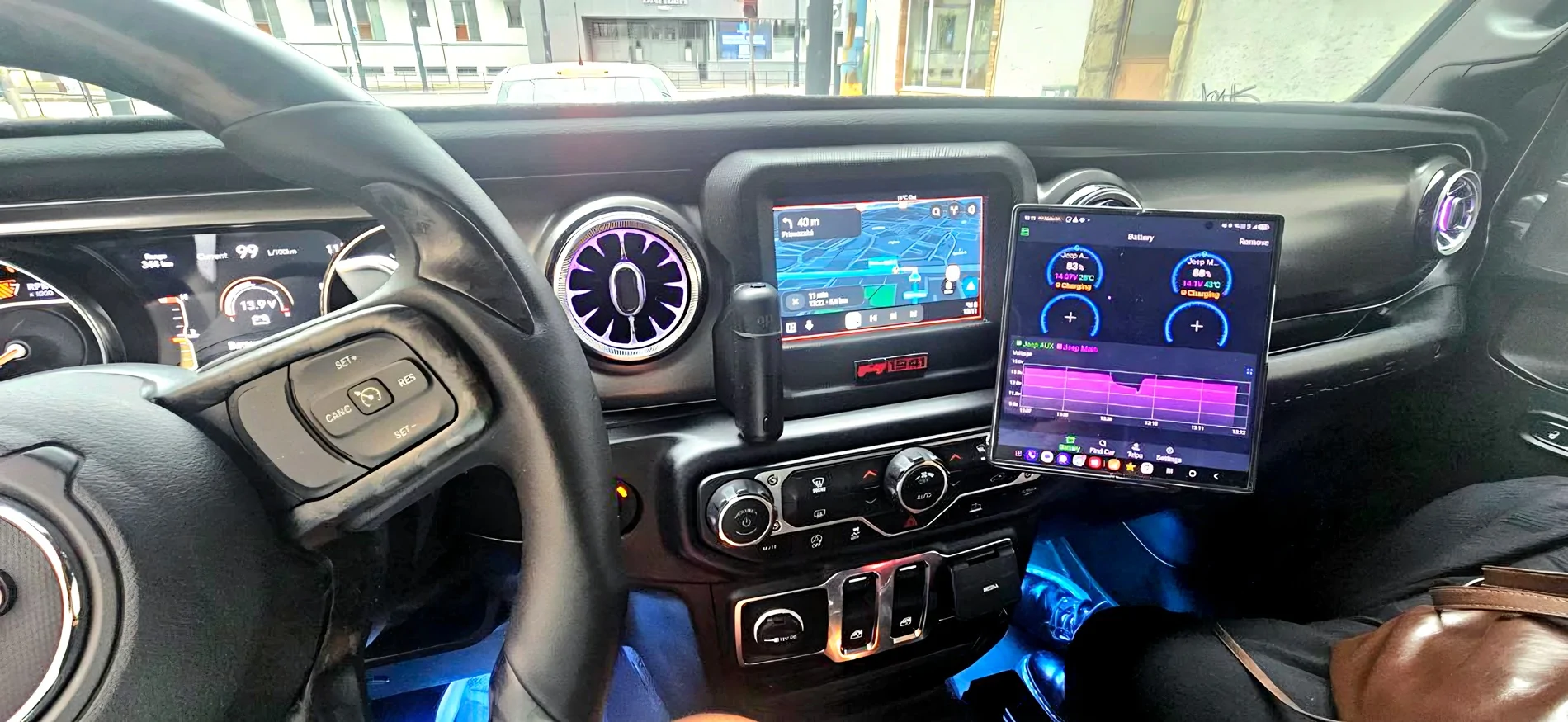
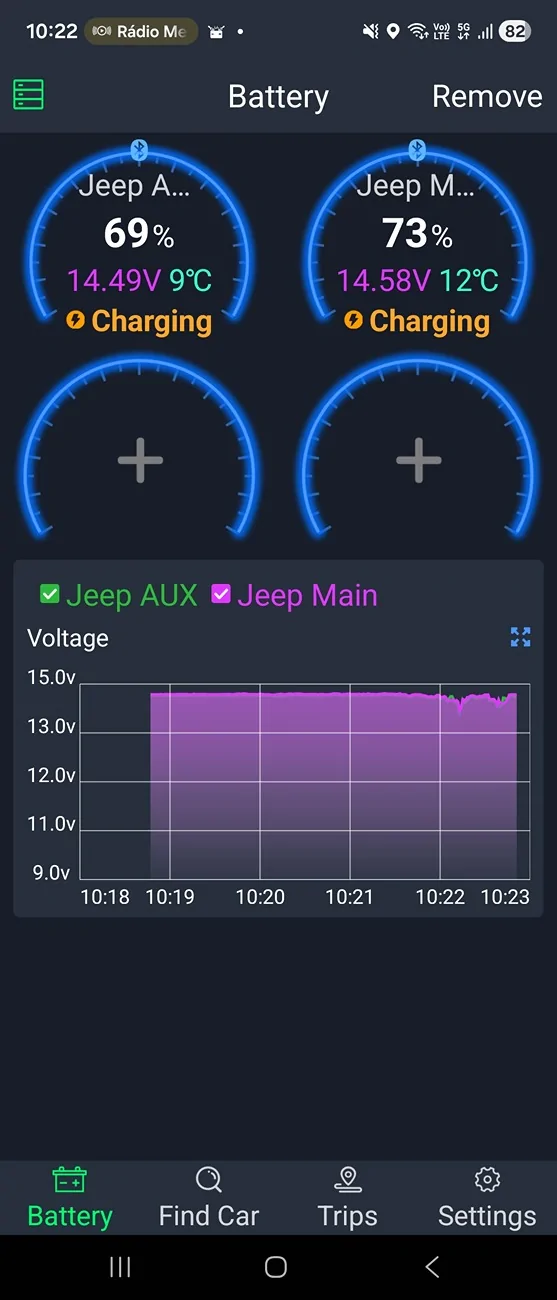
I disconnected the auxiliary battery first, but only for a few days until I replaced both batteries. In my opinion, it is the wrong procedure to simply disconnect the battery because I don't want to replace the auxiliary battery. After replacing both batteries 6 months ago, I monitor the charge level and charging of both batteries every time I drive and I can say that I can't say exactly how the system decides which battery to charge when. Sometimes it charges both simultaneously, sometimes the system prioritizes charging only the main battery up to almost 99% and only then starts charging the auxiliary battery. I noticed that when the rear window heating is on or when the "auto" temperature maintenance is turned on when the air conditioning is running, my batteries charge significantly slower. When I stop with the batteries at 100%, in about 24 hours, the capacity of both batteries drops to about 81% and after another week to about 69% and then it doesn't drop anymore. Charging to 100% then takes about 40km of driving or an hour of charging at idle. If I heat the rear window or have the car at temperature, charging takes twice as long. But as I say, in my opinion, the auxiliary battery has its own meaning and disconnecting it is a worse approach than replacing it.
 

andy29847

Well-Known Member
First Name
Andy
Joined
Oct 22, 2022
Threads
15
Messages
440
Reaction score
714
Location
Trenton, SC
Vehicle(s)
2020 JLUR
I disconnected the auxiliary battery first, but only for a few days until I replaced both batteries. In my opinion, it is the wrong procedure to simply disconnect the battery because I don't want to replace the auxiliary battery. After replacing both batteries 6 months ago, I monitor the charge level and charging of both batteries every time I drive and I can say that I can't say exactly how the system decides which battery to charge when. Sometimes it charges both simultaneously, sometimes the system prioritizes charging only the main battery up to almost 99% and only then starts charging the auxiliary battery. I noticed that when the rear window heating is on or when the "auto" temperature maintenance is turned on when the air conditioning is running, my batteries charge significantly slower. When I stop with the batteries at 100%, in about 24 hours, the capacity of both batteries drops to about 81% and after another week to about 69% and then it doesn't drop anymore. Charging to 100% then takes about 40km of driving or an hour of charging at idle. If I heat the rear window or have the car at temperature, charging takes twice as long. But as I say, in my opinion, the auxiliary battery has its own meaning and disconnecting it is a worse approach than replacing it.

The charging system is unable to see 2 batteries separately. Both batteries are charged at the same time. The batteries are always hooked together whenever the engine is running, effectively function as one battery.
 

Cartman

Well-Known Member
First Name
ANDREW
Joined
Mar 30, 2025
Threads
30
Messages
333
Reaction score
130
Location
Slovakia
Vehicle(s)
Jeep JL Sport+ 2d 2023
The charging system is unable to see 2 batteries separately. Both batteries are charged at the same time. The batteries are always hooked together whenever the engine is running, effectively function as one battery.
Not true. Sometimes system charge only main battery.
Ok to be precise. My battery monitor see two batteries, their temperature, voltage and status. Sometime only main battery is charging as I said till nearly full and then system start to charge also aux. But in most of the time they are charged simulatenously. The gap in the graf of main battery time/voltage showing Start/stop working.
Jeep Wrangler JL Auxiliary battery bypass. 1767554519310-a4

Jeep Wrangler JL Auxiliary battery bypass. 1767554666660-1k
 
Last edited:

andy29847

Well-Known Member
First Name
Andy
Joined
Oct 22, 2022
Threads
15
Messages
440
Reaction score
714
Location
Trenton, SC
Vehicle(s)
2020 JLUR
Not true. Sometimes system charge only main battery.
Ok to be precise. My battery monitor see two batteries, their temperature, voltage and status. Sometime only main battery is charging as I said till nearly full and then system start to charge also aux. But in most of the time they are charged simulatenously. The gap in the graf of main battery time/voltage showing Start/stop working.
1767554519310-a4.webp

1767554666660-1k.webp
Thanks for the reply. The only time the 2 batteries are not connected together during operations is a stop/start event. In that case, the engine is not running and the alternator is not charging. As far as I know, the charging system does not have a way to differentiate between the 2 batteries for testing. I believe the differences you are seeing on your test come from the differences in the batteries, or from your test set up, or both. I’ve been wrong plenty of times so I would be open to any documentation and discussion regarding your test.
 

Sponsored

THAW

Well-Known Member
First Name
Foster
Joined
Oct 28, 2022
Threads
4
Messages
2,206
Reaction score
3,039
Location
PNW - prefer Middle of Nowhere
Vehicle(s)
23 JL4DrRubicon
After replacing both batteries 6 months ago, I monitor the charge level and charging of both batteries every time I drive and I can say that I can't say exactly how the system decides which battery to charge when. Sometimes it charges both simultaneously, sometimes the system prioritizes charging only the main battery up to almost 99% and only then starts charging the auxiliary battery.
Sometimes system charge only main battery.
Ok to be precise. My battery monitor see two batteries, their temperature, voltage and status. Sometime only main battery is charging as I said till nearly full and then system start to charge also aux. But in most of the time they are charged simulatenously.
JL's can't and don't individually control AUX (ESS) battery charging.

It's possible for the batteries to accept charge at different relative rates for a particular system voltage and alternator output (especially if there's an actual battery temperature difference as great as the ones suggested in your photos of the monitoring app). However, your monitoring system is almost certainly not tracking current or capacity, so most of the charging difference you're observing is likely a result of estimation error in the SoC percentage.

Out of curiosity, is the unit monitoring the AUX (ESS) battery mounted on the AUX (ESS) battery?
 

zouch

Well-Known Member
Joined
Sep 17, 2020
Threads
39
Messages
3,726
Reaction score
3,811
Location
Berkeley, CA
Vehicle(s)
XJ, JLUWD
the vehicle will restart even during an ESS stop if it senses the cabin temp gets outside of a certain range from the target temp.


Thanks for the complete explanation of the ESS (stop/start) and how it works. Above and beyond your description, when ESS is working and stops the engine while at a light, the fact remains that at that point, the A/C compressor is not working to generate "cold" air into the A/C system.
 

AndySpill

Well-Known Member
First Name
Andy
Joined
Oct 24, 2023
Threads
71
Messages
1,654
Reaction score
1,270
Location
Pittsburgh
Vehicle(s)
2018 JL Sahara
I disconnected the auxiliary battery first, but only for a few days until I replaced both batteries. In my opinion, it is the wrong procedure to simply disconnect the battery because I don't want to replace the auxiliary battery. After replacing both batteries 6 months ago, I monitor the charge level and charging of both batteries every time I drive and I can say that I can't say exactly how the system decides which battery to charge when. Sometimes it charges both simultaneously, sometimes the system prioritizes charging only the main battery up to almost 99% and only then starts charging the auxiliary battery. I noticed that when the rear window heating is on or when the "auto" temperature maintenance is turned on when the air conditioning is running, my batteries charge significantly slower. When I stop with the batteries at 100%, in about 24 hours, the capacity of both batteries drops to about 81% and after another week to about 69% and then it doesn't drop anymore. Charging to 100% then takes about 40km of driving or an hour of charging at idle. If I heat the rear window or have the car at temperature, charging takes twice as long. But as I say, in my opinion, the auxiliary battery has its own meaning and disconnecting it is a worse approach than replacing it.
Hi Andrew:

I'd love to see an additional monitoring of circuit 42 with this finding.

I share Andy's @andy29847 humility in that what we thought happened in ESS events was challenged in the link from the gladiator forum he provided.

But if indeed the batteries are charged separately with the engine cranked I'd expect to see current on this circuit, as it powers the normally closed Power Control Relay (PCR), which when energized separates the batteries: something we believe to happen only for an instant pre cold-crank and during parts of an ESS event.
 

alphawolff

Well-Known Member
Joined
Jul 31, 2023
Threads
1
Messages
3,354
Reaction score
5,605
Location
california
Vehicle(s)
2021 JLU
the vehicle will restart even during an ESS stop if it senses the cabin temp gets outside of a certain range from the target temp.
it's important to note that the interior temp sensor, by your knee, isn't really near your person. heat rises, so it takes awhile before the increased cabin temperature is seen by the system
Sponsored


Top