Sponsored

2in Mopar lift concerns! (Solved)

Skander727

Member
First Name
Jameson
Joined
Feb 22, 2023
Threads
5
Messages
6
Reaction score
2
Location
TX, US
Vehicle(s)
2021 JLU Willys
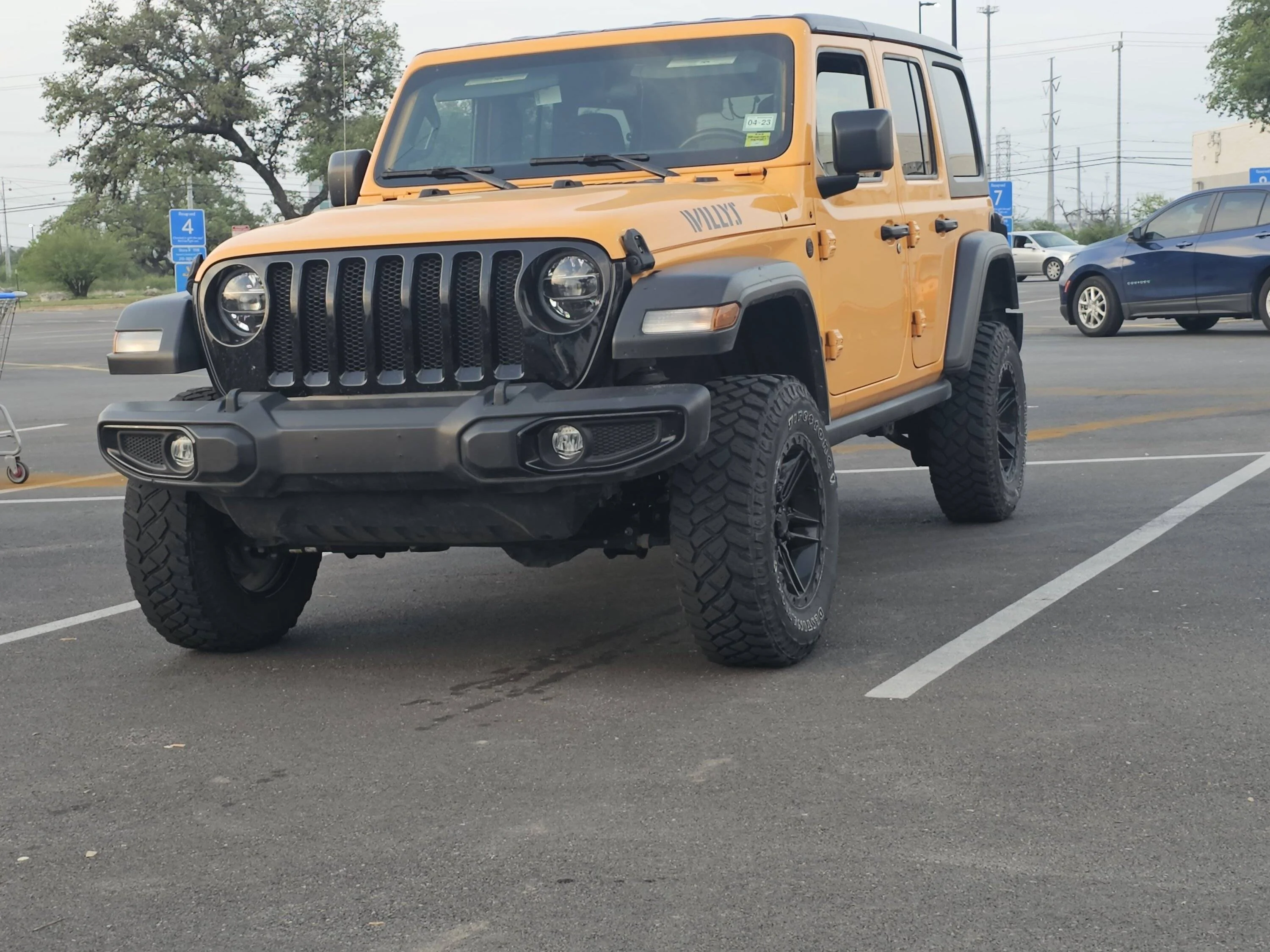
Just got the 2" Mopar lift on top of my 17×8.5 wheels.

Sometimes I'll hit a bump and the whole vehicle will shake and I can feel it in the steering wheel no biggie it's a rush it /feels/ dangerous but it's only momentary.

SOMETIMES though, hitting the same bump at lower speeds causes the jeep to shake and vibrate for extended periods, to where my smile goes away and I start eyeing the hazards button and the shoulder of the road. Genuinely feel like I'm in danger. But then, it will randomly just calm down like nothing happened.

Is this the infamous death wobble?
Or is that just the new suspension breaking in?

(edit: I called Mopar who installed it and they forgot to mention I need to bring it back after 500 miles to retighten everything. Geometry brackets are next on the list and before I get 35s I'll definitely upgrade the track bar and stabilizer)

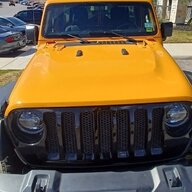
Jeep Wrangler JL 2in Mopar lift concerns! (Solved) IMG_20230403_193352
Sponsored

 
Last edited:

1Evil55

Well-Known Member
First Name
Jeff
Joined
Jan 5, 2022
Threads
1
Messages
607
Reaction score
1,020
Location
here
Vehicle(s)
2018 Sport
I'd google for a video of DW and see if that is what you're experiencing first. Could just be Jeep.
 

AcesandEights

Well-Known Member
First Name
Aces
Joined
Aug 19, 2021
Threads
35
Messages
3,869
Reaction score
7,601
Location
So. Oregon
Vehicle(s)
2024 Toyota 4Runner
Occupation
I'm often occupied, by many things, often at the same time
First thing to do is have an alignment done, and especially ask for a print out of before and after alignment specs. It may be identified, or fixed, in the alignment process. If it's not, you should be able to tell what is wrong based on the before/after specs. No need to buy parts until you have an idea of what is out of spec.
 

Spank

Well-Known Member
Joined
Mar 29, 2017
Threads
28
Messages
2,697
Reaction score
4,579
Location
Colorado
Vehicle(s)
2018 Jeep Wrangler Unlimited Rubicon, 2020 Dodge Challenger RT Scat Pack
Go through every nut and bolt that was originally removed when the lift was installed and make sure they're torqued EXACTLY to spec per the lift instructions on the ground. Not sorta kinda, not close enough, exact.
 

AcesandEights

Well-Known Member
First Name
Aces
Joined
Aug 19, 2021
Threads
35
Messages
3,869
Reaction score
7,601
Location
So. Oregon
Vehicle(s)
2024 Toyota 4Runner
Occupation
I'm often occupied, by many things, often at the same time
I am not a DW expert but does toe or castor being out of spec cause of DW ? news to me.
DW is caused by caster being out of spec, not adjustable on a stock JL. However, it is adjustable with adjustable control arms (the length of control arms determine, by rotating, the axle housing, changing caster).
 

Sponsored

Remorseless

Well-Known Member
Joined
May 10, 2022
Threads
4
Messages
34,487
Reaction score
193,260
Location
NC
Vehicle(s)
'22 JLR 2.0T, '24 JTR, '19 Charger R/T
Build Thread
Link
Occupation
Holier Than Thou Internet Bully, Part-Time Online Boy Scout, Full-Time Arson Enthusiast, Napalm Compatible, Guy Who Defines What A Jeep Guy Is
I am not a DW expert but does toe or castor being out of spec cause of DW ? news to me.
Can be caused by a multitude of things:

Worn bushings
Worn ball joints
Improperly torqued bolts through bushings
Improper caster setting
Improper toe setting
Worn out rod ends
Wallowed out frame/axle brackets
Wallowed out knuckles

I'm sure there's some I forgot in there too
 

Remorseless

Well-Known Member
Joined
May 10, 2022
Threads
4
Messages
34,487
Reaction score
193,260
Location
NC
Vehicle(s)
'22 JLR 2.0T, '24 JTR, '19 Charger R/T
Build Thread
Link
Occupation
Holier Than Thou Internet Bully, Part-Time Online Boy Scout, Full-Time Arson Enthusiast, Napalm Compatible, Guy Who Defines What A Jeep Guy Is
I agree but for toe and castor. Toe and castor only affects the steering feel/response/tracking in my mind.
Caster being too low causes steering to be flighty, which impacts how easy it is to get the steering to oscillate. Toe can impact how much reaction there is to bumps in the steering system which also provides an opportunity for oscillation.
 

Yogi

Well-Known Member
First Name
Michael
Joined
May 12, 2020
Threads
10
Messages
379
Reaction score
535
Location
Port Dover, Ontario, Canada
Vehicle(s)
2019 Jeep Wrangler Unlimited Rubicon
Occupation
GM, P.Log, CITT, 310T
That's not correct.
Toe determines whether your tires, and steering components, last 30 minutes, or 30 months, and that's about all.
Caster is the major influencer of DW and bump steer. Think of caster as the rake on the front wheels of a grocery cart. It's an exaggerated example, but a grocery cart will teach you everything you ever needed to know about caster.
If memory serves, the FA caster on a JL should be between 4 and 6 degrees.
 

Beachcomber72

Well-Known Member
Joined
Sep 14, 2022
Threads
16
Messages
1,413
Reaction score
2,661
Location
Texas
Vehicle(s)
2022 JLU High Tide
Just got the 2" Mopar lift on top of my 17×8.5 wheels.

Sometimes I'll hit a bump and the whole vehicle will shake and I can feel it in the steering wheel no biggie it's a rush it /feels/ dangerous but it's only momentary.

SOMETIMES though, hitting the same bump at lower speeds causes the jeep to shake and vibrate for extended periods, to where my smile goes away and I start eyeing the hazards button and the shoulder of the road. Genuinely feel like I'm in danger. But then, it will randomly just calm down like nothing happened.

Is this the infamous death wobble?
Or is that just the new suspension breaking in?

(I don't have any other aftermarket parts besides the wheels and lift so far)

IMG_20230403_193352.jpg
I’d definitely recommend returning to whoever installed the Mopar lift kit. Have them re-check all things installed and torque specs for each component.
 

Remorseless

Well-Known Member
Joined
May 10, 2022
Threads
4
Messages
34,487
Reaction score
193,260
Location
NC
Vehicle(s)
'22 JLR 2.0T, '24 JTR, '19 Charger R/T
Build Thread
Link
Occupation
Holier Than Thou Internet Bully, Part-Time Online Boy Scout, Full-Time Arson Enthusiast, Napalm Compatible, Guy Who Defines What A Jeep Guy Is
That's not correct.
Toe determines whether your tires, and steering components, last 30 minutes, or 30 months, and that's about all.
Caster is the major influencer of DW and bump steer. Think of caster as the rake on the front wheels of a grocery cart. It's an exaggerated example, but a grocery cart will teach you everything you ever needed to know about caster.
If memory serves, the FA caster on a JL should be between 4 and 6 degrees.
No, it's correct. Toe 100% has some impact on how the steering reacts to a bump event, a tire edge hit in particular. Example - toe way too far in, single tire impact on passenger side, outside of tire, such as catching the edge of a pothole or uneven road surface. The direction of force on the tire, and therefore steering too, is towards the driver's side. However, because the toe is in so far (improperly set in this scenario) the tire doesn't scrub off as much of the impulse as it otherwise would and transmits more of it into the steering. Effectively, it acts as though the tire is part-way into beginning a turn, making it easier for the energy to travel into the steering linkages, creating an opportunity for oscillation on the rebound. When toe is properly set, the tire is closer to neutral or, when slightly toe out (SteerSmarts for instance recommends slightly toe out), past neutral and the tire scrubs off some of the energy (remember, big chunk of vehicle weight is on the tires, so it takes a lot of energy to redirect them) of the hit as it has to be pushed from almost or past neutral before it can impart energy into the steering linkages.

Obviously I'm not stating that this is the entire reason to set toe properly, but rather that this is part of why there is a toe spec range, as it does have some impact to steering behavior, and DW is generally triggered by tire manipulation on an uneven road surface feeding into the steering linkages and causing oscillation, and having toe set properly mitigates some of the opportunities for oscillation that DW requires. Toe is also something that is easily adjustable without replacing hardware, so it is an easy recommendation to make.

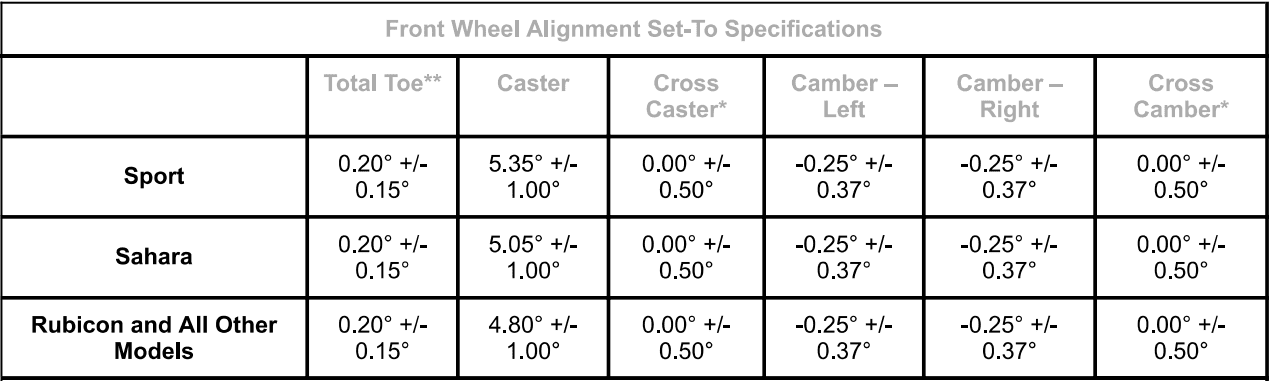
Caster is more likely to be involved with DW than toe, yes, but it is not the only factor to ensure is set correctly. Factory specs vary by model for caster, up 6.35* at the high end or down to 3.80* at the low end:

Jeep Wrangler JL 2in Mopar lift concerns! (Solved) 1680808408655


Most people report best results above 5 and below 6.5, especially if you delete your FAD or have an aftermarket front axle, caster above 6.5 can (not will) get sketchy with driveline vibrations.

Generally speaking, most folks' DW (true, honest-to-God "I'm gonna shit myself! This is terrifying!" DW, not just a frustrating shimmy) will come down to ball joints, trackbar bushings/trackbar brackets, improper torquing of suspension/steering components (all rubber bushings must be done on the ground), or really low caster. BUT, that does not mean that there are not other factors that can influence how easily DW manifests. Toe falls into that category.
 
Last edited:

Sponsored

Aonar

Well-Known Member
Joined
Jan 7, 2021
Threads
113
Messages
1,267
Reaction score
2,012
Location
N.W. Iowa
Vehicle(s)
2012 Rubi and Snazzy 2021 JLURD

Yogi

Well-Known Member
First Name
Michael
Joined
May 12, 2020
Threads
10
Messages
379
Reaction score
535
Location
Port Dover, Ontario, Canada
Vehicle(s)
2019 Jeep Wrangler Unlimited Rubicon
Occupation
GM, P.Log, CITT, 310T
No, it's correct. Toe 100% has some impact on how the steering reacts to a bump event, a tire edge hit in particular. Example - toe way too far in, single tire impact on passenger side, outside of tire, such as catching the edge of a pothole or uneven road surface. The direction of force on the tire, and therefore steering too, is towards the driver's side. However, because the toe is in so far (improperly set in this scenario) the tire doesn't scrub off as much of the impulse as it otherwise would and transmits more of it into the steering. Effectively, it acts as though the tire is part-way into beginning a turn, making it easier for the energy to travel into the steering linkages, creating an opportunity for oscillation on the rebound. When toe is properly set, the tire is closer to neutral or, when slightly toe out (SteerSmarts for instance recommends slightly toe out), the tire scrubs off some of the energy (remember, big chunk of vehicle weight is on the tires, so it takes a lot of energy to redirect them) of the hit as it has to be pushed from almost or past neutral before it can impart energy into the steering linkages.

Obviously I'm not stating that this is the entire reason to set toe properly, but rather that this is part of why there is a toe spec range, as it does have some impact to steering behavior, and DW is generally triggered by tire manipulation on an uneven road surface and having toe set properly mitigates some of the opportunities for oscillation that DW requires. Toe is also something that is easily adjustable without replacing hardware, so it is an easy recommendation to make.

Caster is more likely to be involved with DW than toe, yes, but it is not the only factor to ensure is set correctly. Factory specs vary by model for caster, up 6.35* at the high end or down to 3.80* at the low end:

1680808408655.png


Most people report best results above 5 and below 6.5, especially if you delete your FAD or have an aftermarket front axle, caster above 6.5 can (not will) get sketchy with driveline vibrations.

Generally speaking, most folks' DW (true, honest-to-God "I'm gonna shit myself! This is terrifying!" DW, not just a frustrating shimmy) will come down to ball joints, trackbar bushings/trackbar brackets, improper torquing of aftermarket components (all rubber bushings must be done on the ground), or really low caster. BUT, that does not mean that there are not other factors that can influence how easily DW manifests. Toe falls into that category.
<- <- <- see that where it says 310T?
That's a Red Seal Certified heavy duty truck mechanic, qualified to ply my trade anywhere in the world. I have spent my fair share of time on alignment racks.
I've no interest in getting into a pissing match over your assertions. To me it's not worth the time to argue about. Let's just hope no one gets injured following your train of thought.
 

kah.mun.rah

Well-Known Member
First Name
Merenkahre Jr.
Joined
May 16, 2022
Threads
41
Messages
4,586
Reaction score
9,592
Location
Duat
Vehicle(s)
2021 Wrangler Unlimited Rubicon
I would start with checking the track bar bolts to see if they are tightened to spec. and then measure the lower control arms to see if the shop actually put the longer ones on that came with the kit or just left the original shorter ones on.
 

Remorseless

Well-Known Member
Joined
May 10, 2022
Threads
4
Messages
34,487
Reaction score
193,260
Location
NC
Vehicle(s)
'22 JLR 2.0T, '24 JTR, '19 Charger R/T
Build Thread
Link
Occupation
Holier Than Thou Internet Bully, Part-Time Online Boy Scout, Full-Time Arson Enthusiast, Napalm Compatible, Guy Who Defines What A Jeep Guy Is
<- <- <- see that where it says 310T?
That's a Red Seal Certified heavy duty truck mechanic, qualified to ply my trade anywhere in the world. I have spent my fair share of time on alignment racks.
I've no interest in getting into a pissing match over your assertions. To me it's not worth the time to argue about. Let's just hope no one gets injured following your train of thought.
Wait, so you're insinuating that my train of thought (which, to be crystal clear, is ensuring toe, caster, bushings, brackets, rod ends, and ball joints are ALL squared away, within spec, and properly functioning) is going to get someone hurt? I'm not certain I think that's accurate.

As a certified heavy duty truck mechanic you should know that the front end is a system and that all components need to be within spec, not just a few, in order to ensure proper function. Nothing I said, at all, should be controversial, nor is it intended as a pissing match. Just that toe is a part of that system and is included in the long checklist when tracking down a front end malfunction, like DW.
 
Last edited:

Yogi

Well-Known Member
First Name
Michael
Joined
May 12, 2020
Threads
10
Messages
379
Reaction score
535
Location
Port Dover, Ontario, Canada
Vehicle(s)
2019 Jeep Wrangler Unlimited Rubicon
Occupation
GM, P.Log, CITT, 310T
The subject is DW, which is at the very end of line as far as failures go, as in it doesn't get any worse than that. Complete failure of a tie rod, although terrifying, is not as bad as DW.
The very first place you look when DW is in play is caster as it is the cause of DW.
Your assertion that excessive toe is somehow at fault is false. Toe in or out should be 1/16th of an inch, and it doesn't matter which, but it should never be zero.
To be clear control arms and wear on their related bushings and/or end joints will cause caster to go out of spec. However, nothing you can do in your garage can measure that unless you happen to have an alignment rack.
If you have adjustable control arms you can assure, via measuring tape, that the tops are the same length, and that the lowers are both the same length, but those measurements do not indicate caster, or account for discrepancies in the wheel ends.
Worn ball joints typically manifest themselves as camber problems, not caster problems. That's why checking ball joint wear is done by pushing and pulling the top or bottom of the tire, and not trying to make the knuckle move forwards and backwards. Really worn, as in almost worn out, ball joints will certainly lend themselves to caster error.
Furthermore, simply tightening up components without a means of measuring change as you do so has the potential to cause worse or additional problems.
A front end is not one system as you suggest. It is two systems. One makes it go straight, and one makes it turn. They are not mutually dependent on each other although they do work in concert with each other.
DW in a JK or JL Jeep comes down to one measurement that is not within spec. Caster.
Why caster is not within spec is a subsequent, yet different, discussion.
Bump steer can be a product of toe, camber, and/or caster, but bump steer is not DW.
Steering geometry is generally not a DIY project.
Sponsored


Top