
Tyler-98-W68
Well-Known Member
- Thread starter
- #1
FORM analysis report after a few months of cold weather in SK Canada. The time from I’m referencing in this post is from early November until now.
2021 Sahara 4xe
1. Approximately 17000kms on the vehicle.
2. Has been in FORM since Nov 11, Has come out of Step 1 of FORM a few times, went from Step 2 to Step 1, but now in Step 2 of FORM
3. Daily commute of 6 kms 1 way. 6kms 1 way back home, so a round trip of 12kms. Add in a few short trips here and there.
4. When parked at work it’s always plugged in to a L1 charger
5. When at home parked in a garage which is sometimes heated, but usually not. Average temperature in garage right around 0c
6. No attempts to preheat/precondition anything.
7. NO remote starts
8. No Front Cover
Basically the Sahara is being driven like a normal vehicle it just gets plugged in at work all the time.
2022 Rubicon 4xe.
1. Approximately 11000kms on the vehicle.
2. Has not been in FORM at all.
3. Commute is not daily but is 5kms 1 way 10kms round trip
4. A longer commute of 160kms happens 1-2 times per month
5. Vehicle is always plugged in when at work and can spend extended periods of time outside (36-48 hours)
6. Front Winter Cover
7. When at home parked in a garage which is sometimes heated, but usually not. Average temperature in garage right around 0c
So that sets of the stage of how my 4xes are being used. My wife drives the Sahara most days and doesn’t give a shit either way what happens, she just drives and the only thing is will select electric mode (if not in FORM) otherwise no special treatment.
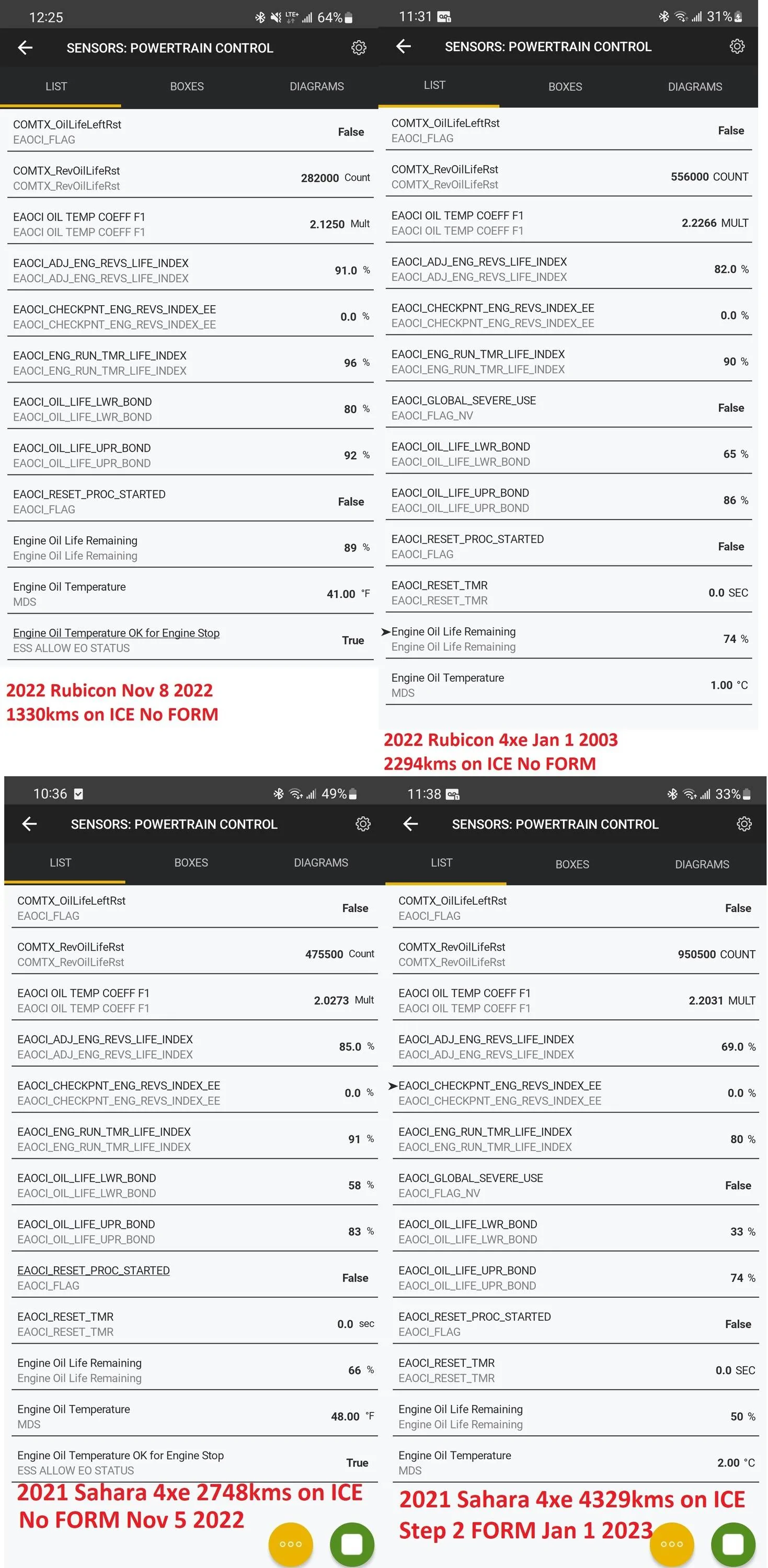
My Rubicon has got some “special” treatment but before I get in to that, I’ll mention the stats (referencing the picture posted)
The oil life stats are from just before it started to get “cold” and when I say “cold” I mean a few days of sustained temps -12c or below (more on this later because its important)

My Sahara had 2748kms on the ICE before cold weather set in. It’s oil life was 66%
My Rubicon had 1130kms on the ICE before cold weather set in. It’s oil life was 89%
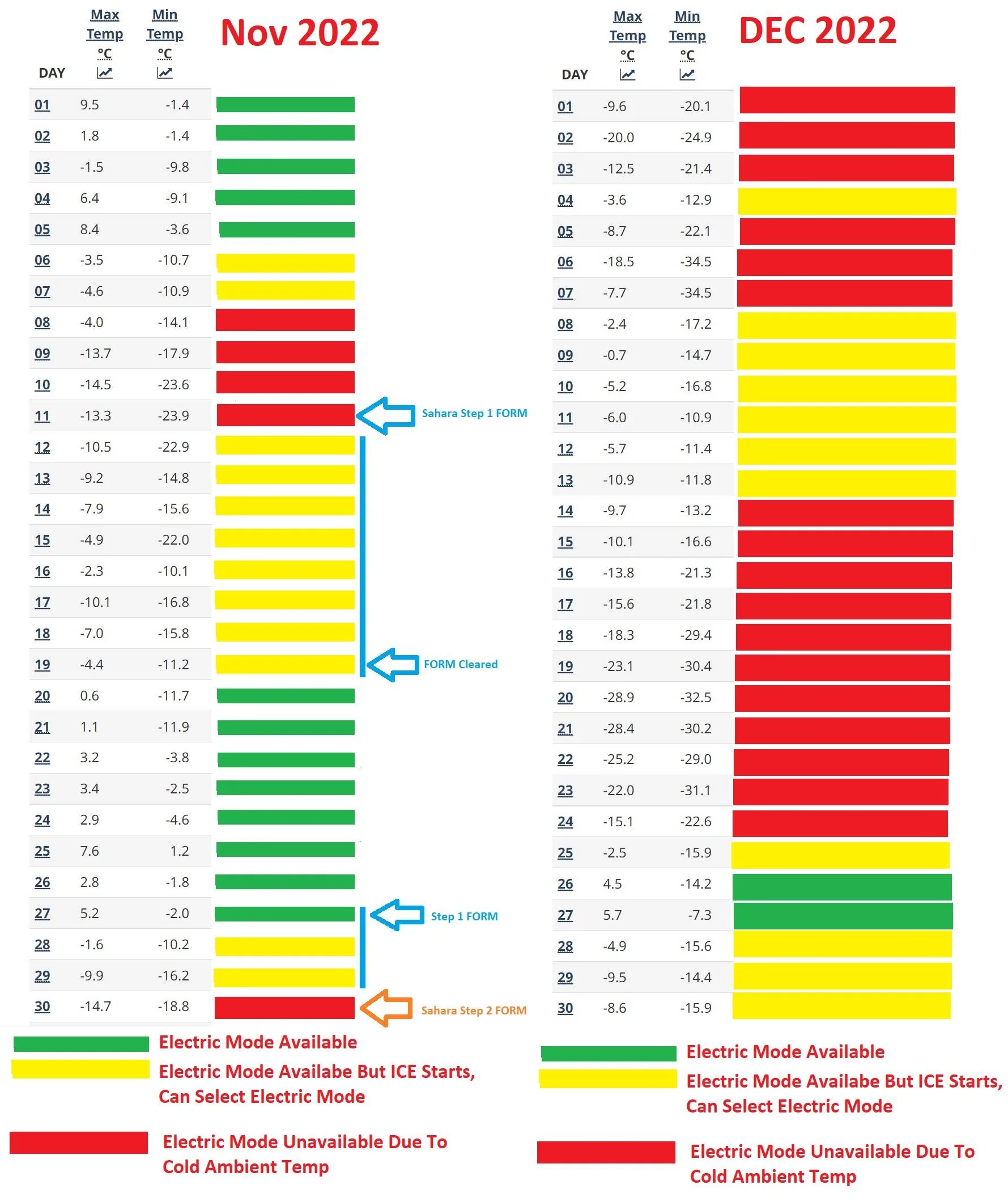
I’ve prepared a terrible picture that shows the temperatures where I live and color coded. Colors corresponding to whether or not the vehicle would go in to electric mode based on temperatures. This is for the previous 2 months.

Between Nov 5th and Nov 11th the temps started dropping and on Nov 11 My Sahara got Step 1 of FORM which is when the temps were cold enough to lock out electric only mode, which resulted in short trips without the engine oil getting warm enough. The days following (in yellow) show the vehicle in FORM. Step 1 of FORM was cleared by a longer drive done by my wife, but then came back when the temps dropped again and finally went in to Step 2 of FORM.
When in Step 1 of FORM the vehicle can operate in electric mode however if the ICE starts it will stay out of electric mode until the next key off event. Now on days where the temps are slightly below freezing the ICE will start but then allow you to turn the ICE off and run electric. But now you see the issue? The temps will allow you to select electric mode but because the vehicle is in Step 1 of FORM the ICE will start up and stay on. Now you can’t use electric only mode and this closely mirrors Step 2 of FORM. This is why when temps start to get below freezing FORM happens.
In the month of December you can see how most of the month electric only mode isn’t available even if you aren’t in FORM so the ICE is going to run and eventually cause FORM anyways
Hopefully people can have a better understanding that when the temperatures start to drop below the threshold of electric only operation it’s only a matter of time until FORM happens.
Now that brings me to my next point of conversation, my Sahara has been in in FORM most of the winter. My Rubicon has not. Well here is why.
I’ve done a few things to change the “environment” my Rubicon is operated in.
I do have a winter cover and that does play in to not being in FORM but not for the reason you think.
1. Before going to work or driving when I know its below the threshold of electric only operation I “heat up” my Rubicon. I have a forced air furnace in my garage. The way my Rubicon is parked the furnace blows directly on the front of the vehicle. I pop the hood and for 1-2 hours I have the heat blowing directly in the engine bay and front of the vehicle. This heats up the Engine oil to 10-20c and the engine coolant 20-30c. The temperature as reported by the screen is usually 30c or higher.
2. With the vehicle “warm” I then precondition the battery until the coolant heater backs off its power draw usually when the coolant is mid 70 Celsius
3. I start the vehicle up and select electric mode. Due to the ambient temp sensor being completely sealed behind the winter cover, it retains the heat and stays above the -12c threshold most days during my short commute (around 8-10 minutes). This method works and the ICE will not start up as long as the ambient temperature is -20c or warmer. On the extremely cold days the ICE starts up for 2 mins or so just before I get to work.
4. After being parked outside where temps allow electric only operation but the ICE starts up immediately, I select electric only mode and the ICE is only running for 1 minute or less.
5. On days where the vehicle has been parked outside and the temps won’t allow any electric operation I take a slight detour home and drive for about 20 minutes and get the oil in to mid 90 Celsius range, its not a long drive though (max 20 minutes total)
I’m well aware that from an economic standpoint what I’m doing for my Rubicon probably doesn’t make any sense but that’s not why I’m trying different things, it’s to highlight that in cold temperatures the 4xe system is going to enter FORM and its normal and there is no point to trying to clear it unless you are going to have periods of time where the temperatures will be ABOVE the thresholds for electric only operation.
So my Rubicon is staying out of FORM, a few points to consider:
1. Ambient Temperatures – This is the main one. My Rubicon is subjected to cold temps (below the thresholds) at least 50% less times than my Sahara is, even its artificially done
2. Engine Oil Temperature – The only time I’m doing a very cold start (with cold engine oil) is at work after my vehicle has sat outside for extended periods of time, which again is only 1 half of my commute, where as my Sahara is doing 2 cold engine starts each day. Related to this. There is a PID, EAOCI OIL TEMP COEFF F1 which is a ratio, the higher the oil temp the lower this number is, the lower the oil temp is the higher the ratio is. I believe that even when it’s cold out because I have my engine oil temperature warmer (from preheating in the garage) the engine starting and running for a short period of time isn’t tripping FORM. It’s like in the summer the oil temp drops to the mid teens when sitting overnight for example. I’ve done multiple “cold” starts in the summer and not had any FORM issues.
3. Short engine run time. As I mentioned earlier, on days when I can’t start up in electric mode and the ICE starts for a short period of time, I turn it off right away. With this extremely short engine run time I believe it’s also not long enough to trip anything related to FORM
4. HVAC settings. On days when I’m running in electric mode I keep the HVAC settings very conservative in order to not trip the ICE. Even with this method I have no problems staying warm and keeping the windows defrosted.
Depending on how the weather goes for the next few months I may only be 3 months away from not having to worry about FORM for both of my vehicles. Either way FORM is normal and it happens in cold temperatures, and there are ways to “beat” the FORM parameters however its not really worth it from an economic or practical standpoint.
2021 Sahara 4xe
1. Approximately 17000kms on the vehicle.
2. Has been in FORM since Nov 11, Has come out of Step 1 of FORM a few times, went from Step 2 to Step 1, but now in Step 2 of FORM
3. Daily commute of 6 kms 1 way. 6kms 1 way back home, so a round trip of 12kms. Add in a few short trips here and there.
4. When parked at work it’s always plugged in to a L1 charger
5. When at home parked in a garage which is sometimes heated, but usually not. Average temperature in garage right around 0c
6. No attempts to preheat/precondition anything.
7. NO remote starts
8. No Front Cover
Basically the Sahara is being driven like a normal vehicle it just gets plugged in at work all the time.
2022 Rubicon 4xe.
1. Approximately 11000kms on the vehicle.
2. Has not been in FORM at all.
3. Commute is not daily but is 5kms 1 way 10kms round trip
4. A longer commute of 160kms happens 1-2 times per month
5. Vehicle is always plugged in when at work and can spend extended periods of time outside (36-48 hours)
6. Front Winter Cover
7. When at home parked in a garage which is sometimes heated, but usually not. Average temperature in garage right around 0c
So that sets of the stage of how my 4xes are being used. My wife drives the Sahara most days and doesn’t give a shit either way what happens, she just drives and the only thing is will select electric mode (if not in FORM) otherwise no special treatment.
My Rubicon has got some “special” treatment but before I get in to that, I’ll mention the stats (referencing the picture posted)
The oil life stats are from just before it started to get “cold” and when I say “cold” I mean a few days of sustained temps -12c or below (more on this later because its important)
My Sahara had 2748kms on the ICE before cold weather set in. It’s oil life was 66%
My Rubicon had 1130kms on the ICE before cold weather set in. It’s oil life was 89%
I’ve prepared a terrible picture that shows the temperatures where I live and color coded. Colors corresponding to whether or not the vehicle would go in to electric mode based on temperatures. This is for the previous 2 months.
Between Nov 5th and Nov 11th the temps started dropping and on Nov 11 My Sahara got Step 1 of FORM which is when the temps were cold enough to lock out electric only mode, which resulted in short trips without the engine oil getting warm enough. The days following (in yellow) show the vehicle in FORM. Step 1 of FORM was cleared by a longer drive done by my wife, but then came back when the temps dropped again and finally went in to Step 2 of FORM.
When in Step 1 of FORM the vehicle can operate in electric mode however if the ICE starts it will stay out of electric mode until the next key off event. Now on days where the temps are slightly below freezing the ICE will start but then allow you to turn the ICE off and run electric. But now you see the issue? The temps will allow you to select electric mode but because the vehicle is in Step 1 of FORM the ICE will start up and stay on. Now you can’t use electric only mode and this closely mirrors Step 2 of FORM. This is why when temps start to get below freezing FORM happens.
In the month of December you can see how most of the month electric only mode isn’t available even if you aren’t in FORM so the ICE is going to run and eventually cause FORM anyways
Hopefully people can have a better understanding that when the temperatures start to drop below the threshold of electric only operation it’s only a matter of time until FORM happens.
Now that brings me to my next point of conversation, my Sahara has been in in FORM most of the winter. My Rubicon has not. Well here is why.
I’ve done a few things to change the “environment” my Rubicon is operated in.
I do have a winter cover and that does play in to not being in FORM but not for the reason you think.
1. Before going to work or driving when I know its below the threshold of electric only operation I “heat up” my Rubicon. I have a forced air furnace in my garage. The way my Rubicon is parked the furnace blows directly on the front of the vehicle. I pop the hood and for 1-2 hours I have the heat blowing directly in the engine bay and front of the vehicle. This heats up the Engine oil to 10-20c and the engine coolant 20-30c. The temperature as reported by the screen is usually 30c or higher.
2. With the vehicle “warm” I then precondition the battery until the coolant heater backs off its power draw usually when the coolant is mid 70 Celsius
3. I start the vehicle up and select electric mode. Due to the ambient temp sensor being completely sealed behind the winter cover, it retains the heat and stays above the -12c threshold most days during my short commute (around 8-10 minutes). This method works and the ICE will not start up as long as the ambient temperature is -20c or warmer. On the extremely cold days the ICE starts up for 2 mins or so just before I get to work.
4. After being parked outside where temps allow electric only operation but the ICE starts up immediately, I select electric only mode and the ICE is only running for 1 minute or less.
5. On days where the vehicle has been parked outside and the temps won’t allow any electric operation I take a slight detour home and drive for about 20 minutes and get the oil in to mid 90 Celsius range, its not a long drive though (max 20 minutes total)
I’m well aware that from an economic standpoint what I’m doing for my Rubicon probably doesn’t make any sense but that’s not why I’m trying different things, it’s to highlight that in cold temperatures the 4xe system is going to enter FORM and its normal and there is no point to trying to clear it unless you are going to have periods of time where the temperatures will be ABOVE the thresholds for electric only operation.
So my Rubicon is staying out of FORM, a few points to consider:
1. Ambient Temperatures – This is the main one. My Rubicon is subjected to cold temps (below the thresholds) at least 50% less times than my Sahara is, even its artificially done
2. Engine Oil Temperature – The only time I’m doing a very cold start (with cold engine oil) is at work after my vehicle has sat outside for extended periods of time, which again is only 1 half of my commute, where as my Sahara is doing 2 cold engine starts each day. Related to this. There is a PID, EAOCI OIL TEMP COEFF F1 which is a ratio, the higher the oil temp the lower this number is, the lower the oil temp is the higher the ratio is. I believe that even when it’s cold out because I have my engine oil temperature warmer (from preheating in the garage) the engine starting and running for a short period of time isn’t tripping FORM. It’s like in the summer the oil temp drops to the mid teens when sitting overnight for example. I’ve done multiple “cold” starts in the summer and not had any FORM issues.
3. Short engine run time. As I mentioned earlier, on days when I can’t start up in electric mode and the ICE starts for a short period of time, I turn it off right away. With this extremely short engine run time I believe it’s also not long enough to trip anything related to FORM
4. HVAC settings. On days when I’m running in electric mode I keep the HVAC settings very conservative in order to not trip the ICE. Even with this method I have no problems staying warm and keeping the windows defrosted.
Depending on how the weather goes for the next few months I may only be 3 months away from not having to worry about FORM for both of my vehicles. Either way FORM is normal and it happens in cold temperatures, and there are ways to “beat” the FORM parameters however its not really worth it from an economic or practical standpoint.
Sponsored

