
Sponsored

Changing charge voltage for Odyssey battery?

Gorpf

Well-Known Member
Joined
Apr 28, 2021
Threads
6
Messages
136
Reaction score
132
Location
SoCal
Vehicle(s)
‘21-392, AEV-JL370
Occupation
Retired/Caregiver
Here is the link to Odyssey's PDF on charging requirements. The pertinent page is page 10:Installation, Operation and Maintenance Manual
Shockingly, the optimum charging current should be at least 40% of the battery's C10 rating. The MINIMUM charge should be at least 10% of the battery's C10 rating, for a Odyssey Performance 94R H7 80ah battery the MINIMUM charging current is 8 amps, and optimum charging current when the battery is very low would be a whopping 32 amps!
Here's a direct quote (in italics) from page 10 of above linked PDF:
In order to recharge a battery that has been discharged, it is best to use an automatic charger with an
AGM setting that has the appropriate charge voltage and current per recommendations. For optimum
charging, the current output should at least 40% of the battery’s C10 rating. This means a battery that
has a 10-hour rating of 100 amp hours should be charged with 40 amps. Charge current should never
be less than 10% of the battery’s C10 rating. Voltages higher than 15.0 volts will cause irreversible
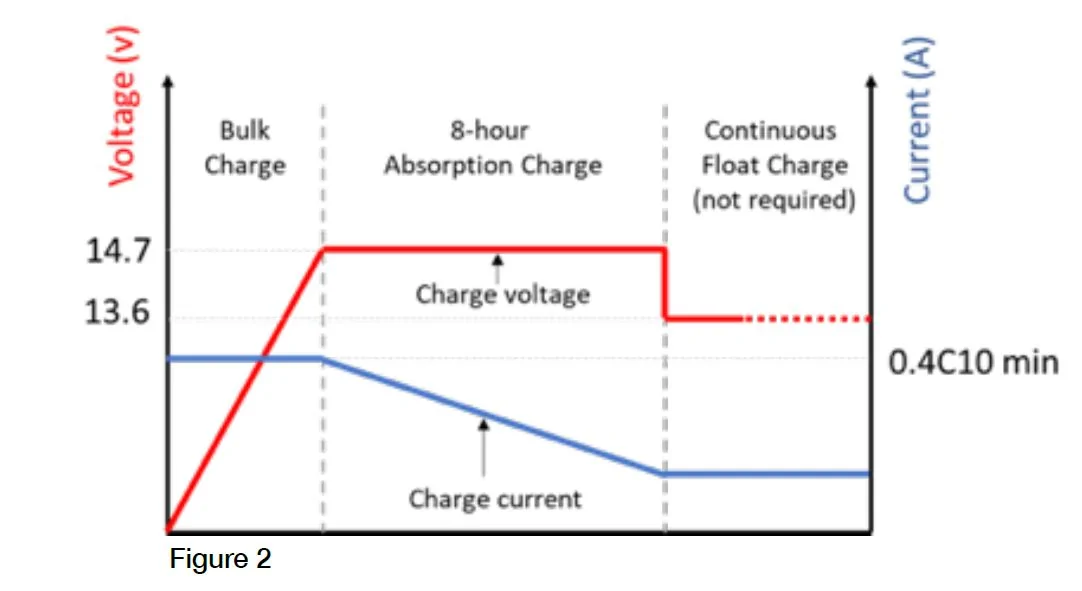
damage to the battery. Please refer to Figure 2 below for a graphical representation of the
recommended charge profile for ODYSSEY AGM2 batteries used in non-starting applications.


If you really want to understand the requirements of charging the Odyssey Performance AGM2 battery then the PDF above is a must read. These batteries require special chargers with an "AGM2 " mode to properly charge them. Unfortunately, Counter to what most people believe, the Noco 10 isn't appropriate for the Odyssey batteries since they don't charge with the correct amp profile. They also go up to 15 volts in float mode and don't maintain constant 13.6 v current (they shut completely off and then turn back on when a voltage drop is sensed).
A link to Odyssey-branded chargers by CTEK that have the necessary AGM2 mode: ODYSSEY BATTERY CHARGERS DIRECT
There may be a list of other approved battery chargers in the PDF. I will try to find that link and will come back and post it here when I find it.
After reading the manual, I think the statement about the minimum charge being at least 10% of the C10 rating applies specifically(not clearly stated in the manual) to severely depleted/discharged batteries.

A multi phase “trickle” charger that supplies a lower current should be fine to use to maintain state of charge.
Jeep Wrangler JL Changing charge voltage for Odyssey battery? IMG_0779
Sponsored

 
OP
OP
SIO2GA

SIO2GA

Member
First Name
RODNEY
Joined
Oct 5, 2023
Threads
2
Messages
18
Reaction score
6
Location
LOCUST GROVE, GEORGIA
Website
digforcrystals.com
Vehicle(s)
2023 JEEP GLADIATOR RUBICON DIESEL
Occupation
MINERAL SPECIMEN MINER
After reading the manual, I think the statement about the minimum charge being at least 10% of the C10 rating applies specifically(not clearly stated in the manual) to severely depleted/discharged batteries.

A multi phase “trickle” charger that supplies a lower current should be fine to use to maintain state of charge.

IMG_0779.webp
I initially thought that the 5 amp would be good enough to just top-off my battery once a month. Usually the battery is always at 80% soc because that's what the Jeep's charging system seems to be set for and I know that with most chargers that usually the current/amps tapers and especially at the end where the voltage is still 14.7v but the amps usually 3a or less.
What made me worry is where I finally found something from Odyssey saying exactly what the harm would be from not having the proper minimum amps : the top bar that runs to the terminals would be damaged. I've been unable to relocated that info but will post a link once I find it again. I started to worry that perhaps the 5 amp charger might be doing something that would end up causing my battery to not last for years and years -Something very slight that builds up and then the battery ends up dying at 3-5 years instead of 8 - 10 years.
The chart in the Odyssey pdf that I linked early that shows the charging diagram and the line between bulk charge and 8-hour absorption charge (the 80% soc line I think) shows the amps being at the start of the absorption phase being every bit as high as during the bulk charge initially and then tapering down gradually. Actually, if I am reading the chart correctly that would ideally be 32 amps (for 80 ah battery) at the start of the absorption charge and then probably 16 amps at the 4 hour mark of the 8 hour absorption phase according to this graph. Of course, the 15a charger I just bought isn't capable of such high amps but it is well higher than the 8amp absolute minimum before damage to the battery.
Again, I think the 5amp Odyssey charger that I initially got probably would be okay but since I spent $350 for the battery I want it to last as long as possible! I agree with you in that if the battery is deeply discharged then that is where the insufficient charger amps could really make a big difference and that just topping the battery off once a month with a weaker charger probably isn't doing much damage, if any.
I am going to ask the person that is the expert over Enersys factory quality control if she can share with me the CTEK regular AGM diagram so that I can compare the difference between it and the AGM2 diagram. That should tell me how much a difference it makes between the two chargers.
I usually have no trouble understanding diagrams and reading manuals but the Odyssey pdf is a bit confusing since it jumps between starting applications and float applications for the batteries. The performance batteries are dual use so I can understand why it's written the way it is but they could have done a lot better job of it. Below is the Odyssey AGM2 charging diagram.
Jeep Wrangler JL Changing charge voltage for Odyssey battery? charge-diagram-odyssey
 

THAW

Well-Known Member
First Name
Foster
Joined
Oct 28, 2022
Threads
4
Messages
2,240
Reaction score
3,089
Location
PNW - prefer Middle of Nowhere
Vehicle(s)
23 JL4DrRubicon
Someone did a review of the noco 10 on this forum's sister site a few months back that was very detailed noco 10 review on Jeep Gladiator forum and they mentioned that many times an hour that the noco 10 would come on and exceed 15v. While it was for a very short period and probably because of temperature compensation, I wouldn't want this for my Odyssey battery since they have a warning against that.
Thanks for the link, interesting thread. Those Gladiator guys are knowledgeable and do some good electrical analysis.

As much good information as there is in that thread, I'm not convinced it ever documented a NOCO Float phase, since none of the batteries were discharged enough to trigger anything near a complete charging routine. Seems like the experiment documented what NOCO would call "Analyzing" and "Maintenance" modes, with big assumptions about what it would do with a somewhat more discharged battery. And, maybe the flaw in the charger is that it diagnoses a very slightly discharged battery as fully charged. Anyway, it is somewhat surprising the intermittent "Maintenance" mode uses constant current instead of constant voltage.

While perhaps not ideal, the 15 Volts documented in those tests is very unlikely to damage an Odyssey battery, since it wasn't held for any meaningful time period. It may be due to temperature compensation, but whatever the case, it's essentially used to quickly confirm the battery won't take any more of the very low charge current.

Choosing a charger with a continuous constant-current Float (if that's what the CTEK does) may be wise, but I don't see good evidence a NOCO 10 is "not appropriate" for an Odyssey battery.
 
Last edited:

THAW

Well-Known Member
First Name
Foster
Joined
Oct 28, 2022
Threads
4
Messages
2,240
Reaction score
3,089
Location
PNW - prefer Middle of Nowhere
Vehicle(s)
23 JL4DrRubicon
Once I got home my Odyssey/CTEK 15 amp charger had arrived. I put the charger on the battery and it indicated less than 80% state of charge. 4 hours later it is still charging!
Does the Odyssey/CTEK OBC-15A have a SoC indicator? How did you determine your battery was less than 80%?

I based my statement on Noco 10 charger's primarily because Odyssey doesn't have them on their list of approved chargers. I think that if you spend the money on an expensive battery and want to get long life out of it that one should get a charger that's appropriate for it.
Don't you find it curious Odyssey recommends a 0.4C charge rate as "optimal", but doesn't sell or "approve" a single consumer 12V charger above 25 Amps?

I am going to ask the person that is the expert over Enersys factory quality control if she can share with me the CTEK regular AGM diagram so that I can compare the difference between it and the AGM2 diagram. That should tell me how much a difference it makes between the two chargers.
I'm very interested in the difference between AGM and AGM² modes. I couldn't find anything specific, and I dug around quite a bit. Hopefully, it's not "proprietary information", and you get a detailed answer.
 
Last edited:

Jebiruph

Well-Known Member
First Name
Jerry
Joined
Feb 18, 2018
Threads
57
Messages
2,404
Reaction score
3,003
Location
Iowa
Vehicle(s)
2018 JLU, 2020 JT, 2024 WL
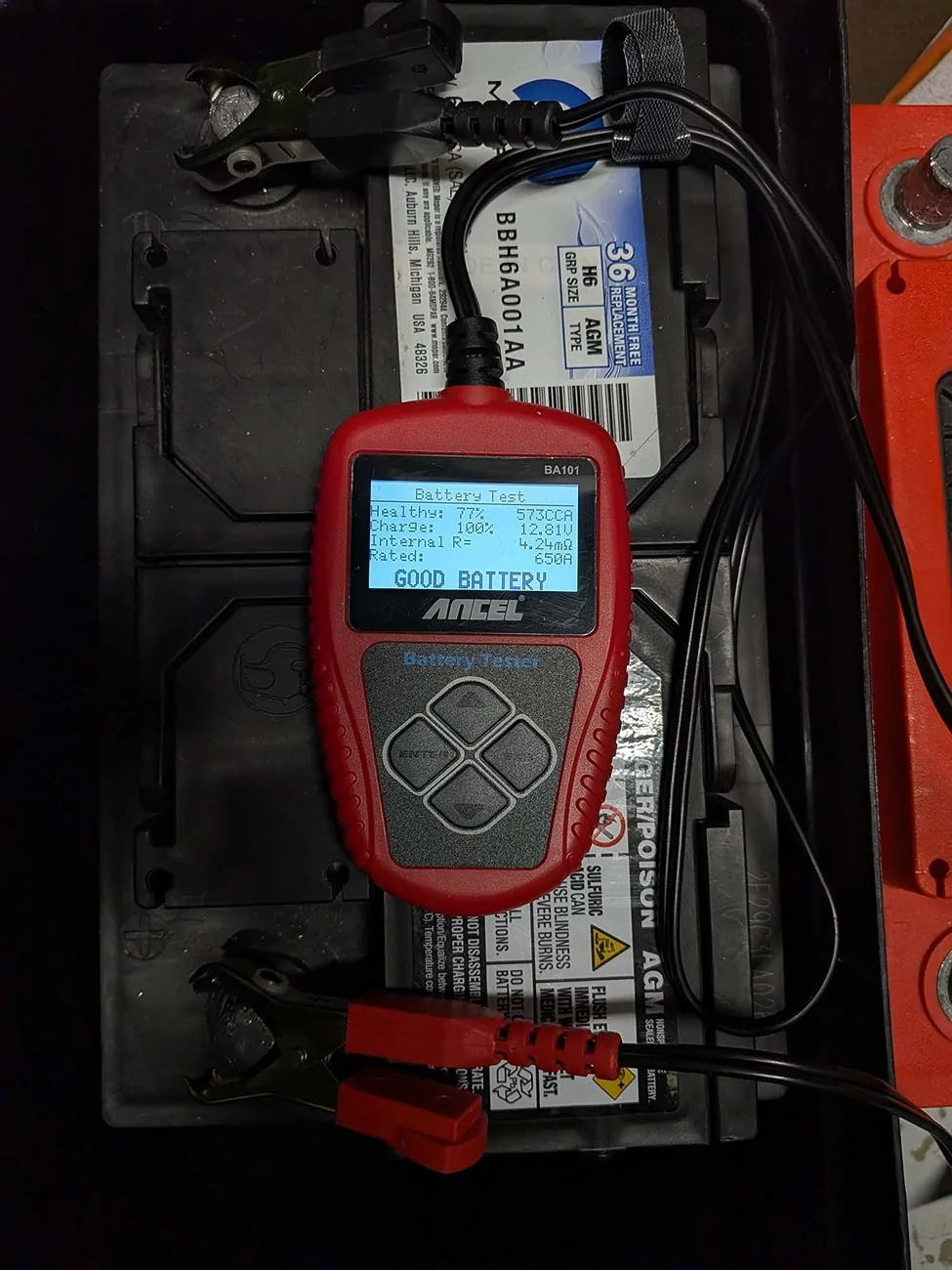
I have an unused Odyssey H6 on hand. I bought it around 3 years ago, but didn't install it after the dealer provided a warranty replacement. Several weeks ago I charged it and a used Mopar H6 with my Noco 10 charger. The Mopar charged to 12.8 V, but the Odyssey charged to less than 12.7 V.

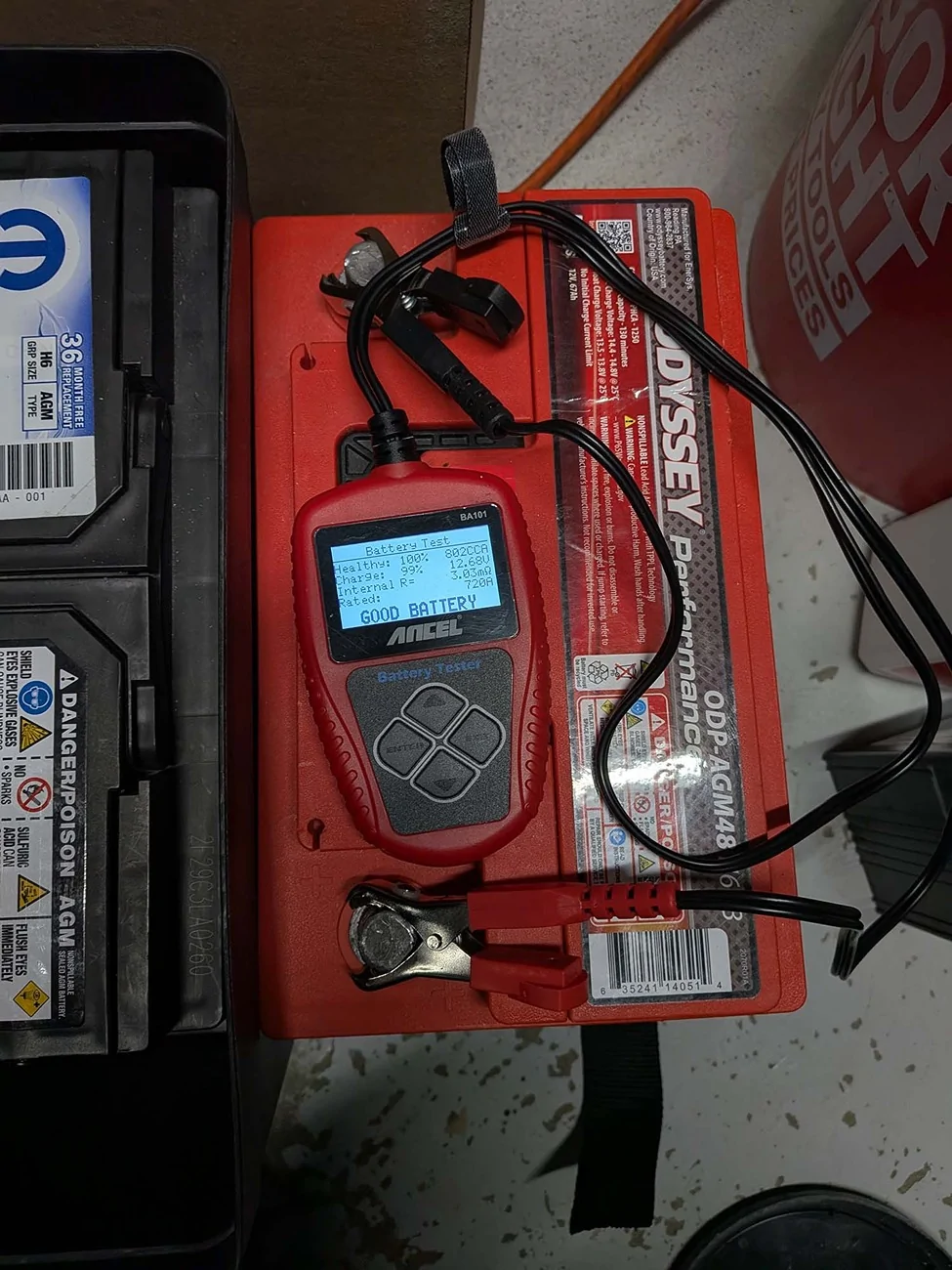
Here's the Mopar after charging.
Jeep Wrangler JL Changing charge voltage for Odyssey battery? batterytest mopar


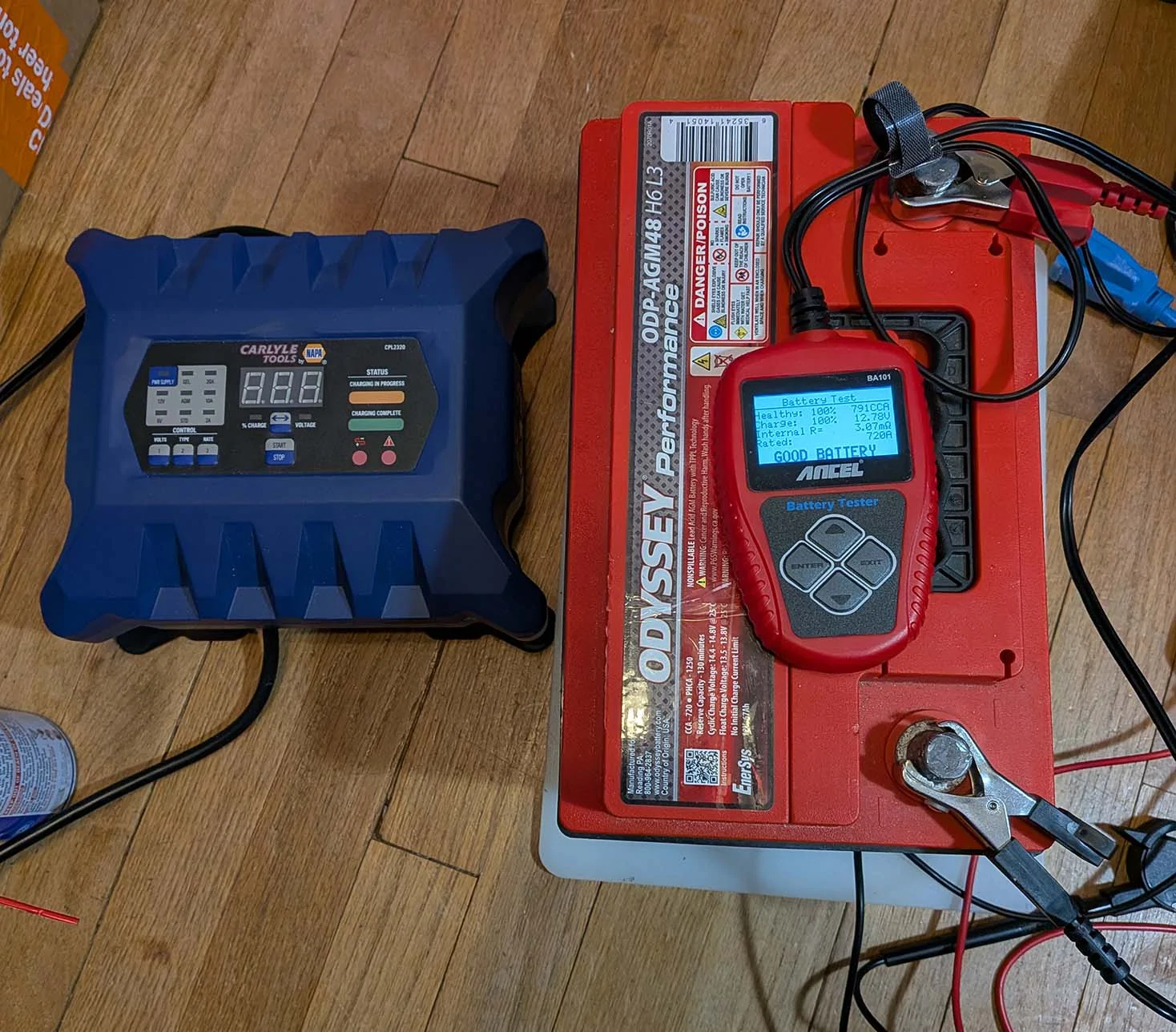
Here's the Odyssey after charging.
Jeep Wrangler JL Changing charge voltage for Odyssey battery? batterytest odessy


I charged the Odyssey twice with the Noco 10 with the same result. I assumed that sitting in the basement for 3 years affected it's capacity, but after reading this thread I decided to charge it with a different charger. My NAPA charger got it to 13 V before it settled to 12.78 V.
Jeep Wrangler JL Changing charge voltage for Odyssey battery? batterytest odessy 3


It looks like the issue was that the Noco 10 did not do a good job of topping off the Odyssey battery and the Odyssey battery is still good. In defense of the Noco 10, maybe it's designed more for safe in vehicle dual battery charging, which is what I'll keep using it for.
 

Sponsored

THAW

Well-Known Member
First Name
Foster
Joined
Oct 28, 2022
Threads
4
Messages
2,240
Reaction score
3,089
Location
PNW - prefer Middle of Nowhere
Vehicle(s)
23 JL4DrRubicon
I have an unused Odyssey H6 on hand. I bought it around 3 years ago, but didn't install it after the dealer provided a warranty replacement. Several weeks ago I charged it and a used Mopar H6 with my Noco 10 charger. The Mopar charged to 12.8 V, but the Odyssey charged to less than 12.7 V.

Here's the Mopar after charging.
batterytest mopar.webp


Here's the Odyssey after charging.
batterytest odessy.webp


I charged the Odyssey twice with the Noco 10 with the same result. I assumed that sitting in the basement for 3 years affected it's capacity, but after reading this thread I decided to charge it with a different charger. My NAPA charger got it to 13 V before it settled to 12.78 V.
batterytest odessy 3.webp


It looks like the issue was that the Noco 10 did not do a good job of topping off the Odyssey battery and the Odyssey battery is still good. In defense of the Noco 10, maybe it's designed more for safe in vehicle dual battery charging, which is what I'll keep using it for.
Interesting. How long after charging?

I just charged a 2.5 year-old, daily-used 59 Ah Odyssey Performance battery with a NOCO 5, and after a brief small load and resting for a couple hours at mid 40s F ambient its voltage was 12.76 via a multimeter, higher than brand new out of the box.

Edit: Just checked a 5-ish year-old Odyssey Extreme 68 Ah that's been on a NOCO 10 continuously for the past 2 or so months; 12.78 Volts at mid 40s F ambient a few hours after disconnecting the charger.
 
Last edited:

Mguy

Well-Known Member
Joined
Nov 29, 2023
Threads
6
Messages
408
Reaction score
386
Location
Far Away
Vehicle(s)
2020 JLUR 6spd MT
Amazing.

At least one poster, who has for years on this forum touted percentage SOC estimates with claimed technical expertise, is now citing resting voltage (also called "OCV," open circuit voltage) to make a point. Percentage estimates, which are typically associated with consumer use, are themselves a red flag that the reported value is quite "loose" and is not intended for diagnostic purposes.

It is important to understand that for accessing battery health resting voltage must stay steady for a few days at the measured full SOC for the battery to be considered good.
 

Jebiruph

Well-Known Member
First Name
Jerry
Joined
Feb 18, 2018
Threads
57
Messages
2,404
Reaction score
3,003
Location
Iowa
Vehicle(s)
2018 JLU, 2020 JT, 2024 WL
Interesting. How long after charging?

I just charged a 2.5 year-old, daily-used 59 Ah Odyssey Performance battery with a NOCO 5, and after a brief small load and resting for a couple hours at mid 40s F ambient its voltage was 12.76 via a multimeter, higher than brand new out of the box.

Edit: Just checked a 5-ish year-old Odyssey Extreme 68 Ah that's been on a NOCO 10 continuously for the past 2 or so months; 12.78 Volts at mid 40s F ambient a few hours after disconnecting the charger.
The 12.68 V was soon after charging. Once I get some of the power bled off with my battery load tester, I'll give it another shot.

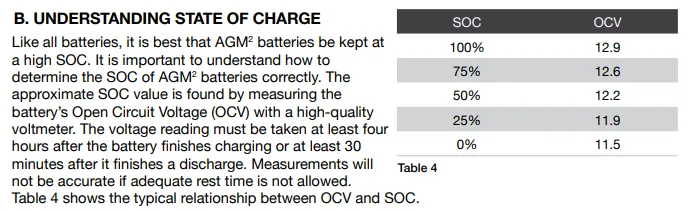
Here's SOC info from Odyssey.
Jeep Wrangler JL Changing charge voltage for Odyssey battery? odyssey SOC
 

THAW

Well-Known Member
First Name
Foster
Joined
Oct 28, 2022
Threads
4
Messages
2,240
Reaction score
3,089
Location
PNW - prefer Middle of Nowhere
Vehicle(s)
23 JL4DrRubicon
Amazing.

At least one poster, who has for years on this forum touted percentage SOC estimates with claimed technical expertise, is now citing resting voltage (also called "OCV," open circuit voltage) to make a point. Percentage estimates, which are typically associated with consumer use, are themselves a red flag that the reported value is quite "loose" and is not intended for diagnostic purposes.
After all this time, you still don't get it.

IBS SOC matters because it's what the JL uses.
 

Mguy

Well-Known Member
Joined
Nov 29, 2023
Threads
6
Messages
408
Reaction score
386
Location
Far Away
Vehicle(s)
2020 JLUR 6spd MT
After all this time, you still don't get it.

IBS SOC matters because it's what the JL uses.
Ridiculous.

Jeep apparently "uses" low percentage estimates of SOC to shut off some loads, aux switches, ESS, and remote start. I can't personally verify these secondary effects (or any others) because my Mopar battery has somehow, miraculously, stayed close to "100%" SOC for 5 years. Regardless, the shut offs have nothing to do with the JL charging routine.

Are you still claiming that percentage SOC estimates are a JL battery charging parameter?

Additional Edit,
So @THAW, the poster who constantly offers JScan SOC "data" as a reliable diagnostic tool for effective battery charging and maintaining battery health, either can't or won't answer a direct question. Does the JL charging routine include percentage SOC estimates or not?

It was just point out to me that in this thread, at post #10, @THAW authoritatively included percentage SOC estimates along with three known JL charging parameters,

"In any case, to get a better sense of CR[an]K battery condition and JL charging, JScan exposes IBS data including SoC percentage and real-time charge current under prevailing temperature and voltage conditions."

The guy should be straight with fellow Jeep owners and not be misleading.

To be clear, SOC percentage estimates, whether coming from JScan or a consumer device, are too loose to be of importance in solving battery and charging issues. I've not seen evidence on this forum (or elsewhere) that SOC percentage estimates are a JL charging parameter.
 
Last edited:

Sponsored

Pape

Well-Known Member
Joined
Jul 4, 2023
Threads
16
Messages
1,916
Reaction score
2,043
Location
Quebec
Vehicle(s)
JLU Sahara
I have an unused Odyssey H6 on hand. I bought it around 3 years ago, but didn't install it after the dealer provided a warranty replacement. Several weeks ago I charged it and a used Mopar H6 with my Noco 10 charger. The Mopar charged to 12.8 V, but the Odyssey charged to less than 12.7 V.

Here's the Mopar after charging.
batterytest mopar.webp


Here's the Odyssey after charging.
batterytest odessy.webp


I charged the Odyssey twice with the Noco 10 with the same result. I assumed that sitting in the basement for 3 years affected it's capacity, but after reading this thread I decided to charge it with a different charger. My NAPA charger got it to 13 V before it settled to 12.78 V.
batterytest odessy 3.webp


It looks like the issue was that the Noco 10 did not do a good job of topping off the Odyssey battery and the Odyssey battery is still good. In defense of the Noco 10, maybe it's designed more for safe in vehicle dual battery charging, which is what I'll keep using it for.
Did you leave the NAPA longer on the battery ?
From experience 100% / ok from a charger, especially NOCO, on a AGM is never the case.
Found out they will continue to absorb even if the charger say ok.

@THAW Depending on the version NOCO they can compensate a lot for the temperature. My NOCO 10 will go up to -20C in compensation.

@SIO2GA The JL have a tendency to not fully charge battery, I have a factory one and I can usually sneak some extra power it it via a external charger, especially in the winter.
My rule of thumb is anything over 14v is charging the battery and anything under is only maintaining. A other way to validate is the start/stop but this one is probably not a option for you because of the dual battery. I got a e-torq, therefore it will continue to charge even if in stop mode but if the battery is full I will drop to the start battery itself and see it real voltage.
 
OP
OP
SIO2GA

SIO2GA

Member
First Name
RODNEY
Joined
Oct 5, 2023
Threads
2
Messages
18
Reaction score
6
Location
LOCUST GROVE, GEORGIA
Website
digforcrystals.com
Vehicle(s)
2023 JEEP GLADIATOR RUBICON DIESEL
Occupation
MINERAL SPECIMEN MINER
Does the Odyssey/CTEK OBC-15A have a SoC indicator? How did you determine your battery was less than 80%?


Don't you find it curious Odyssey recommends a 0.4C charge rate as "optimal", but doesn't sell or "approve" a single consumer 12V charger above 25 Amps?


I'm very interested in the difference between AGM and AGM² modes. I couldn't find anything specific, and I dug around quite a bit. Hopefully, it's not "proprietary information", and you get a detailed answer.
 
OP
OP
SIO2GA

SIO2GA

Member
First Name
RODNEY
Joined
Oct 5, 2023
Threads
2
Messages
18
Reaction score
6
Location
LOCUST GROVE, GEORGIA
Website
digforcrystals.com
Vehicle(s)
2023 JEEP GLADIATOR RUBICON DIESEL
Occupation
MINERAL SPECIMEN MINER
Does the Odyssey/CTEK OBC-15A have a SoC indicator? How did you determine your battery was less than 80%? It in essence does have "80% SOC" indicator by virtue of the "Ready" light. According to the 15amp charger user manual this "Ready" light comes on to indicate it is 'ready to use' to start the engine and go on your way if you need to do so.
When I got back from my long trip to Arizona and back and connected the charger it stayed in bulk charge mode for almost an hour before the ready light came on. It was another 6-1/2 hours in absorption mode before the "maintain (float)" light came on.
Usually when I've connected the everstart maxx charger to charge the battery it almost always shows 80% soc. I'm pretty sure that is what my Jeep's system is set to maintain. That same voltage would be 100% on the smaller stock AGM that the Jeep came with.
Don't you find it curious Odyssey recommends a 0.4C charge rate as "optimal", but doesn't sell or "approve" a single consumer 12V charger above 25 Amps? The odyssey branded chargers by CTEK are terribly expensive. If the 15amp cost $275, what would the 'above 25 Amps cost? A bunch! That's probably why they don't have one, because not enough people would buy them. BUT! I think Odyssey DOES offer an approved 100amp wheeled charger for Autoshop use. I'm too tired to look it up but I've posted before in this thread a link to their battery page. It is either there or on the CTEK page but they do have a 100amp wheeled charger.
If you think their (Odyssey's)statement of 0.4C charge rate is "optimal" is bold, that's nothing compared to their statement that I've seen saying that "initially the battery doesn't have a set amp/current limit that is too high". I've seen that on one of their webpages for sure, but offhand I can't remember where that was. I've already thought beforehand that I need to bookmark the page when I see it again since it was so incredible and noteworthy. I don't think they meant it literally and they were just thinking of the typical autoshop 100amp max shop charger only. But they didn't specify that.
I'm very interested in the difference between AGM and AGM² modes....... The person at EnerSys that replied to my question has hellacious education and work experience credentials. She seemed friendly enough and I'm going to reach out to her with more questions and ask for the CTEK regular AGM charging diagram. If they released the AGM2 diagram publicly then surely the regular AGM diagram should be industry standard or close to it and not proprietary. So I'm going to reach out to her in a few days once I'm over the knee surgery's effects.
If anyone knows what the Jeep JL/JT charge setpoint is for AGM batteries that would be good if they would post here. Or if anyone knows someone working for Jeep it would be good if they could ask. Based on what i've seen on my Jeep with limited tools I think it is set to 12.6v whereas the Odyssey needs 12.85v to be fully charged. I'm not a battery scientist so perhaps I'm wrong but that seems to be what my Jeep is set to maintain it at.
 
OP
OP
SIO2GA

SIO2GA

Member
First Name
RODNEY
Joined
Oct 5, 2023
Threads
2
Messages
18
Reaction score
6
Location
LOCUST GROVE, GEORGIA
Website
digforcrystals.com
Vehicle(s)
2023 JEEP GLADIATOR RUBICON DIESEL
Occupation
MINERAL SPECIMEN MINER
I have an unused Odyssey H6 on hand. I bought it around 3 years ago, but didn't install it after the dealer provided a warranty replacement. Several weeks ago I charged it and a used Mopar H6 with my Noco 10 charger. The Mopar charged to 12.8 V, but the Odyssey charged to less than 12.7 V.

Here's the Mopar after charging.
batterytest mopar.webp


Here's the Odyssey after charging.
batterytest odessy.webp


I charged the Odyssey twice with the Noco 10 with the same result. I assumed that sitting in the basement for 3 years affected it's capacity, but after reading this thread I decided to charge it with a different charger. My NAPA charger got it to 13 V before it settled to 12.78 V.
batterytest odessy 3.webp


It looks like the issue was that the Noco 10 did not do a good job of topping off the Odyssey battery and the Odyssey battery is still good. In defense of the Noco 10, maybe it's designed more for safe in vehicle dual battery charging, which is what I'll keep using it for.
Thanks for posting this. Is your Napa charger a Carlyle? If so, the Carlyle charger from Napa has a similar charging pattern as the Odyssey-branded CTEK. As I've mentioned before, I don't think the NOCO 10 is good for charging Odyssey's because they don't have an AGM2 mode. It's interesting that the Noco 10 brought the smaller Mopar battery up to proper voltage but not the Odyssey, followed by the Napa charger successfully bringing the Odyssey charge up higher (If I read correctly, still not over surgery that I had Thursday).
 

THAW

Well-Known Member
First Name
Foster
Joined
Oct 28, 2022
Threads
4
Messages
2,240
Reaction score
3,089
Location
PNW - prefer Middle of Nowhere
Vehicle(s)
23 JL4DrRubicon
Did you leave the NAPA longer on the battery ?
From experience 100% / ok from a charger, especially NOCO, on a AGM is never the case.
Found out they will continue to absorb even if the charger say ok.
AGM charging routines typically use a current threshold at Absorption voltage (i.e. "tail current") to determine a battery is 100% charged. Commonly, it's 0.5-1% of capacity (e.g. 0.5 Amps for a 100 Ah battery). So, a "fully charged" by industry standards battery can usually absorb more current, but continuing to hold Absorption voltage can eventually damage the battery.
Sponsored


Top