Sponsored

Changing charge voltage for Odyssey battery?

Mguy

Well-Known Member
Joined
Nov 29, 2023
Threads
6
Messages
408
Reaction score
386
Location
Far Away
Vehicle(s)
2020 JLUR 6spd MT
. . . . First trip of the day will always show 14.4-14.6, even on a freshly charged (or even brand new) battery.

. . . . So long as I see it get to 13.1-13.4 I know my battery is healthy and adequately charged.
While I don't agree with all of your post, these two statements are essentially correct and are very important for understanding engine-on system voltage and start battery maintenance.

A 13.4V reading after several cumulative hours in a single day of reducing engine-on system voltage is a little high for concluding the start battery is fully charged, but is still pretty good, especially if temperature is relatively low. However, some forum regular posters, particularly those armed with very loose state of charge (SOC) estimates, fail to understand the JL's charging routine. Some, who don't understand charging parameters and basic battery science, even make silly claims about supposed actual SOC.
Sponsored

 
Last edited:
THAW

Well-Known Member
First Name
Foster
Joined
Oct 28, 2022
Threads
4
Messages
2,244
Reaction score
3,098
Location
PNW - prefer Middle of Nowhere
Vehicle(s)
23 JL4DrRubicon
. . . . First trip of the day will always show 14.4-14.6, even on a freshly charged (or even brand new) battery.

. . . . So long as I see it get to 13.1-13.4 I know my battery is healthy and adequately charged.
While I don't agree with all of your post, these two statements are essentially correct and are very important for understanding engine-on system voltage and start battery maintenance.

A 13.4V reading after several cumulative hours in a single day of reducing engine-on system voltage is a little high for concluding the start battery is fully charged, but is still pretty good, especially if temperature is relatively low. However, some forum regular posters, particularly those armed with very loose state of charge (SOC) estimates, fail to understand the JL's charging routine. Some, who don't understand charging parameters and basic battery science, even make silly claims about supposed actual SOC.
:facepalm:

Oh boy, another doozy; talk about "loose" estimates and not understanding the JL charging routine.

Dash voltage isn't even accurate with respect to other system/charging voltage measurements. It can easily be off by a quarter volt.

And, "relatively low" temperature (outdoor ambient?) isn't an accurate way to assess battery temperature for charging voltage temperature compensation - especially given engine bay heat during long drives. Temperature compensation could easily vary by half a volt.

If only there were a convenient way for an owner to observe actual charging data instead of relying on dash-voltage-based "loose" guesses...

But in the end, the bad theory does loosely reference a real phenomenon; the battery does obviously become more charged the longer the engine runs, and it should eventually become - at least for practical purposes - fully charged.
 
Last edited:

WranglerMan

Well-Known Member
First Name
Will
Joined
May 8, 2018
Threads
104
Messages
3,560
Reaction score
2,886
Location
Greenfield Indiana
Vehicle(s)
2018 Wrangler JLU Sahara
Occupation
Retired
Vehicle Showcase
1
After my Fullriver batteries gave up the ghost a year ago after (4) years I wanted to get a better way to determine battery health that just using a voltmeter so I purchased a Motpower battery tester and test monthly and charge accordingly, I have gone months without charging and so far it’s working out well.

Will it give me years more use from my batteries ? I doubt it but using better test methods should give me better info.

The Motopower tester give me lots of info like SOH, SOC, CCA, Resistance, Crank test and Charging test, how accurate these readings are Is subject to how the tester gets its info but it’s better than just a standard voltmeter
 

THAW

Well-Known Member
First Name
Foster
Joined
Oct 28, 2022
Threads
4
Messages
2,244
Reaction score
3,098
Location
PNW - prefer Middle of Nowhere
Vehicle(s)
23 JL4DrRubicon
After my Fullriver batteries gave up the ghost a year ago after (4) years I wanted to get a better way to determine battery health that just using a voltmeter so I purchased a Motpower battery tester and test monthly and charge accordingly, I have gone months without charging and so far it’s working out well.

Will it give me years more use from my batteries ? I doubt it but using better test methods should give me better info.

The Motopower tester give me lots of info like SOH, SOC, CCA, Resistance, Crank test and Charging test, how accurate these readings are Is subject to how the tester gets its info but it’s better than just a standard voltmeter
Good to hear your batteries are staying charged. I'm curious, how much do you drive and how much do you use the accessory battery when parked?
 

WranglerMan

Well-Known Member
First Name
Will
Joined
May 8, 2018
Threads
104
Messages
3,560
Reaction score
2,886
Location
Greenfield Indiana
Vehicle(s)
2018 Wrangler JLU Sahara
Occupation
Retired
Vehicle Showcase
1
Good to hear your batteries are staying charged. I'm curious, how much do you drive and how much do you use the accessory battery when parked?
I don’t use the aux while parked, I have my winch connected to it and run a portable compressor when needed. I just have it mostly as a jump start backup.

When I do charge I do them separately by disconnecting the relay, I don’t drive much since being retired but it also doesn’t stay parked for weeks on end.
 

Sponsored

Mguy

Well-Known Member
Joined
Nov 29, 2023
Threads
6
Messages
408
Reaction score
386
Location
Far Away
Vehicle(s)
2020 JLUR 6spd MT
:facepalm:

Oh boy, another doozy; talk about "loose" estimates and not understanding the JL charging routine.

Dash voltage isn't even accurate with respect to other system/charging voltage measurements. It can easily be off by a quarter volt.

And, "relatively low" temperature (outdoor ambient?) isn't an accurate way to assess battery temperature for charging voltage temperature compensation - especially given engine bay heat during long drives. Temperature compensation could easily vary by half a volt.

If only there were a convenient way for an owner to observe actual charging data instead of relying on dash-voltage-based "loose" guesses...

But in the end, the bad theory does loosely reference a real phenomenon; the battery does obviously become more charged the longer the engine runs, and it should eventually become - at least for practical purposes - fully charged.
More pedantic semantic antics from Lucy, no info. No interest.
 
OP
OP
SIO2GA

SIO2GA

Member
First Name
RODNEY
Joined
Oct 5, 2023
Threads
2
Messages
18
Reaction score
6
Location
LOCUST GROVE, GEORGIA
Website
digforcrystals.com
Vehicle(s)
2023 JEEP GLADIATOR RUBICON DIESEL
Occupation
MINERAL SPECIMEN MINER
An Update:
Initially when I got the new Odyssey battery I also got the $110 (OBC-5a) Odyssey-made-by-CTEK 5 amp battery charger. On the Odyssey battery charger page they state that the 5 amp is sufficient to charge 5-50ah batteries. Problem: my 94R H7 battery is 80ah. That's way over the maximum 50ah limit of the 5 amp charger. However, the next step up in Odyssey-made-by-CTEK battery chargers is the OBC-15-A which is a whopping $276! After paying roughly $350 (after tax and without core refund) I just didn't have the spare funds to buy the bigger charger. I emailed CTEk - who makes the chargers especially for Odyssey with a special "AGM2" mode for Odyssey batteries if I could actually get by using the 5 amp battery charger. They told me, in error, that the 5 amp obc-5 would be okay up to a 100ah battery. They had every incentive in the world to tell me to buy the next size up as it is money in their pocket as the manufacturer.
Someone earlier in the thread commented that the 5 amp battery would not be sufficient to charge my 80 amp battery and cited a link to a PDF about minimum charge amps for odyssey batteries. They were absolutely right and CTEK misinformed me. See link in next comment for Odyssey charging information PDF By my math, the minimum amps for an 80 ah battery is 8 amps according to Odyssey's PDF about battery chargers. I wondered: "just what would be the harm in using the 5 amp charger?" Wouldn't it just be slower to charger the bigger battery but not cause any harm? According to the Odyssey's PDF, using less than 10% of the batteries ah rating would result in damage to the bar that runs to the terminal posts (I'm paraphrasing and going by memory on that). So, as soon as I could I went ahead and ordered the $275 Odyssey/CTEK 15 Amp charger. I sure wish that Odyssey sold an 8 amp charger instead of the jump up to 15 amps because all of our regular Gladiator's will be using the 80ah 94R battery! Now, in theory, I can fully charge my battery once a month and it should last 8 to 10 years.
I think that many of the people that report their batteries dying in 2 years or well before 5 years perhaps were not charging their batteries with a charger that has AGM2 mode, and possibly with an underrated charger. The thing is, the Odyssey battery is different from most AGM's (like the stock AGM that comes in some Jeep's with Diesel engine or Tow Package) and requires a special charger for it to last the claimed "up to 10 years". Of course, manufacturer defects and special conditions probably led to some batteries failing early as that is inevitable.
On a different topic: I've read several comments stating that long drives will charge the Odyssey battery sufficiently but I do not think that is true at all. I just drove from Atlanta, Georgia to Tucson, Arizona via I-20 and I-10 in three days. After 4 days in Tucson on business I drove up to Holbrook, Arizona and back to Atlanta , Georgia via Hot Springs, Arkansas, then south on I-22 to I-20. The return leg was done in 3 days of driving. That's a total of 4,250 miles round trip and the return trip was about 2100 miles done in three days. You'd think my battery would be fully charged, right? Nope! The way our systems seem to work is that the Jeeps system keeps our Odyessey batteries at 80% charged or LOWER (note: this level would be 100% for stock AGM's that come with our Jeeps). I've mentioned this several times in my past comments. Once I got home my Odyssey/CTEK 15 amp charger had arrived. I put the charger on the battery and it indicated less than 80% state of charge. 4 hours later it is still charging!
I don't think there is anything at all wrong with my charging system and I'd bet that my Jeep is just like all the rest. Also, I keep my Jeep perfectly stock with nothing added aside from a GMRS radio wired to an Aux switched which hasn't been turned on in months.
I've been real busy lately with work and travel but I'm still looking for a way to change the voltage setpoint on my trucks system so that it would maintain the odyssey battery closer to 100% soc compared to 80% or less and without having other issues arise. That might not be possible (it looks that way), but if not I can just charge my battery once a month and hopefully have it last a really long time. See my next comment for Odyssey's unusual charging requirements in their PDF.
 
Last edited:
OP
OP
SIO2GA

SIO2GA

Member
First Name
RODNEY
Joined
Oct 5, 2023
Threads
2
Messages
18
Reaction score
6
Location
LOCUST GROVE, GEORGIA
Website
digforcrystals.com
Vehicle(s)
2023 JEEP GLADIATOR RUBICON DIESEL
Occupation
MINERAL SPECIMEN MINER
Here is the link to Odyssey's PDF on charging requirements. The pertinent page is page 10:Installation, Operation and Maintenance Manual
Shockingly, the optimum charging current should be at least 40% of the battery's C10 rating. The MINIMUM charge should be at least 10% of the battery's C10 rating, for a Odyssey Performance 94R H7 80ah battery the MINIMUM charging current is 8 amps, and optimum charging current when the battery is very low would be a whopping 32 amps!
Here's a direct quote (in italics) from page 10 of above linked PDF:
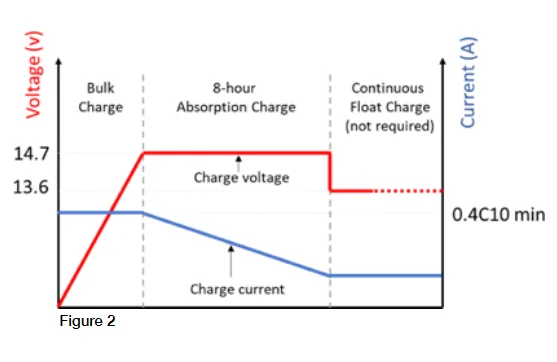
In order to recharge a battery that has been discharged, it is best to use an automatic charger with an
AGM setting that has the appropriate charge voltage and current per recommendations. For optimum
charging, the current output should at least 40% of the battery’s C10 rating. This means a battery that
has a 10-hour rating of 100 amp hours should be charged with 40 amps. Charge current should never
be less than 10% of the battery’s C10 rating. Voltages higher than 15.0 volts will cause irreversible
damage to the battery. Please refer to Figure 2 below for a graphical representation of the
recommended charge profile for ODYSSEY AGM2 batteries used in non-starting applications.


If you really want to understand the requirements of charging the Odyssey Performance AGM2 battery then the PDF above is a must read. These batteries require special chargers with an "AGM2 " mode to properly charge them. Unfortunately, Counter to what most people believe, the Noco 10 isn't appropriate for the Odyssey batteries since they don't charge with the correct amp profile. They also go up to 15 volts in float mode and don't maintain constant 13.6 v current (they shut completely off and then turn back on when a voltage drop is sensed).
A link to Odyssey-branded chargers by CTEK that have the necessary AGM2 mode: ODYSSEY BATTERY CHARGERS DIRECT
There may be a list of other approved battery chargers in the PDF. I will try to find that link and will come back and post it here when I find it.
 

THAW

Well-Known Member
First Name
Foster
Joined
Oct 28, 2022
Threads
4
Messages
2,244
Reaction score
3,098
Location
PNW - prefer Middle of Nowhere
Vehicle(s)
23 JL4DrRubicon
@SIO2GA, it's important to understand the first stage ("Bulk") of typical AGM charging routines is the only one for which the charger - not the battery - controls/limits the charge current.

If the AGM battery isn't below 80% or so SoC when a charger with an "optimal" amp rating is connected, the Bulk (constant current) phase is likely to be effectively skipped, meaning the charge current will never be as high as the "optimal" charger current rating. And, the closer the battery is to 100% SoC, the lower the battery's current acceptance rate, so the lower the charge current.

The above information can be seen in the graphic from the Odyssey manual (note the blue line):

Jeep Wrangler JL Changing charge voltage for Odyssey battery? OdysseyChargingStages


So, for a typical automotive battery charged by a modern alternator routine to near but perhaps not completely full, a charger with an amp rating closer to the recommended minimum than the maximum can do the job of occasionally topping off (i.e. Absorption and Float) the battery quite well.
 

THAW

Well-Known Member
First Name
Foster
Joined
Oct 28, 2022
Threads
4
Messages
2,244
Reaction score
3,098
Location
PNW - prefer Middle of Nowhere
Vehicle(s)
23 JL4DrRubicon
Unfortunately, Counter to what most people believe, the Noco 10 isn't appropriate for the Odyssey batteries since they don't charge with the correct amp profile. They also go up to 15 volts in float mode and don't maintain constant 13.6 v current (they shut completely off and then turn back on when a voltage drop is sensed).
I'm not sure where you got all of the above information, but it's not very accurate.

NOCO 10's might not be the best chargers, but their amp rating is within spec for an 80 Ah Oddyssey, and they don't Float at 15 Volts. I assume your concern is a NOCO might exceed 15 Volts during Absorption, but if a NOCO even does that it's only for temperature compensation (which wouldn't cause an Odyssey battery to vent).

As for the NOCO 10 not having a constant Float, according to Odyssey that is not required; per the graphic in the Odyssey manual I previously posted, "Continuous Float Charge (not required)". There's some confusing battery life information in the Odyssey manual that referes to "Float" applications, but that doesn't really apply to a battery that's routinely used (e.g. in a start/vehicle application).
 

Sponsored

Mguy

Well-Known Member
Joined
Nov 29, 2023
Threads
6
Messages
408
Reaction score
386
Location
Far Away
Vehicle(s)
2020 JLUR 6spd MT
On a different topic: I've read several comments stating that long drives will charge the Odyssey battery sufficiently but I do not think that is true at all. I just drove from Atlanta, Georgia to Tucson, Arizona via I-20 and I-10 in three days. After 4 days in Tucson on business I drove up to Holbrook, Arizona and back to Atlanta , Georgia via Hot Springs, Arkansas, then south on I-22 to I-20. The return leg was done in 3 days of driving. That's a total of 4,250 miles round trip and the return trip was about 2100 miles done in three days. You'd think my battery would be fully charged, right? Nope! The way our systems seem to work is that the Jeeps system keeps our Odyessey batteries at 80% charged or LOWER (note: this level would be 100% for stock AGM's that come with our Jeeps). I've mentioned this several times in my past comments. Once I got home my Odyssey/CTEK 15 amp charger had arrived. I put the charger on the battery and it indicated less than 80% state of charge. 4 hours later it is still charging!
I respect and appreciate your interest on the science and art of battery charging. It's not easy sorting through good and bad postings and manufacturers' information.

I have to disagree though, with your opening of the above paragraph. Assessing Jeep performance over several continuous days of extended engine charging is relevant for figuring out how to get the best performance out of a high capacity, high quality battery.

So I've got some questions regarding your trip,

1) what was typical initial post-start system (dash) voltage following overnight shut downs?

2) during operation how long would it take before system voltage was below 13.0? Exclude relatively short shut down periods for refueling, etc.

3) when, in regard to relatively constant system voltages, would system voltage vary with throttle activity, and what were those constant voltages?

4) how long would throttle varying voltage continue once beginning?

I hope to have some thoughts with your answers.
 
OP
OP
SIO2GA

SIO2GA

Member
First Name
RODNEY
Joined
Oct 5, 2023
Threads
2
Messages
18
Reaction score
6
Location
LOCUST GROVE, GEORGIA
Website
digforcrystals.com
Vehicle(s)
2023 JEEP GLADIATOR RUBICON DIESEL
Occupation
MINERAL SPECIMEN MINER
I'm not sure where you got all of the above information, but it's not very accurate.

NOCO 10's might not be the best chargers, but their amp rating is within spec for an 80 Ah Oddyssey, and they don't Float at 15 Volts. I assume your concern is a NOCO might exceed 15 Volts during Absorption, but if a NOCO even does that it's only for temperature compensation (which wouldn't cause an Odyssey battery to vent).

As for the NOCO 10 not having a constant Float, according to Odyssey that is not required; per the graphic in the Odyssey manual I previously posted, "Continuous Float Charge (not required)". There's some confusing battery life information in the Odyssey manual that referes to "Float" applications, but that doesn't really apply to a battery that's routinely used (e.g. in a start/vehicle application).
 
OP
OP
SIO2GA

SIO2GA

Member
First Name
RODNEY
Joined
Oct 5, 2023
Threads
2
Messages
18
Reaction score
6
Location
LOCUST GROVE, GEORGIA
Website
digforcrystals.com
Vehicle(s)
2023 JEEP GLADIATOR RUBICON DIESEL
Occupation
MINERAL SPECIMEN MINER
I based my statement on Noco 10 charger's primarily because Odyssey doesn't have them on their list of approved chargers. I think that if you spend the money on an expensive battery and want to get long life out of it that one should get a charger that's appropriate for it.
Someone did a review of the noco 10 on this forum's sister site a few months back that was very detailed noco 10 review on Jeep Gladiator forum and they mentioned that many times an hour that the noco 10 would come on and exceed 15v. While it was for a very short period and probably because of temperature compensation, I wouldn't want this for my Odyssey battery since they have a warning against that.
The CTEK chargers (whether branded Odyssey or not) provide a constant float of 13.6 - 13.8v and so does another "regular" AGM charger that I have. I do wonder how many battery chargers and battery minders take Noco 10's approach of not having a constant float charge. Since modern Jeeps have a constant (but minor) drain on our batteries it would seem to me that the constant float charge is a good thing.
I was about to buy a Noco 10 myself and even was at walmart looking right at it and debating on should I go ahead and get it right then. After some thought I decided I had better read up on it more before buying it. It seems that the Noco 10 is very popular on the Jeep forums and that is where I had heard of it. As you mentioned, the Noco 10 can indeed provide the minimum 8 amps needed to charge the Odyssey battery size that most Jeep owners are likely to get, the 94R H7 80ah. The Noco 10 doesn't have an agm2 mode and charges the odyssey the same way it would charge a regular AGM battery instead of the way the Odyssey says the battery should be charged for a long life. So I just feel like I should mention in my posts that the Noco 10 isn't the way to go if you have an Odyssey battery. I wouldn't want someone to spend a lot of money on an Odyssey battery and then buy a Noco 10 charger since it's always recommend on the forums only to find out later that it isn't recommended by Odyssey and that the Odyssey batteries should have an appropriate charger with an AGM2 mode.
 
OP
OP
SIO2GA

SIO2GA

Member
First Name
RODNEY
Joined
Oct 5, 2023
Threads
2
Messages
18
Reaction score
6
Location
LOCUST GROVE, GEORGIA
Website
digforcrystals.com
Vehicle(s)
2023 JEEP GLADIATOR RUBICON DIESEL
Occupation
MINERAL SPECIMEN MINER
I respect and appreciate your interest on the science and art of battery charging. It's not easy sorting through good and bad postings and manufacturers' information.

I have to disagree though, with your opening of the above paragraph. Assessing Jeep performance over several continuous days of extended engine charging is relevant for figuring out how to get the best performance out of a high capacity, high quality battery.

So I've got some questions regarding your trip,

1) what was typical initial post-start system (dash) voltage following overnight shut downs?

2) during operation how long would it take before system voltage was below 13.0? Exclude relatively short shut down periods for refueling, etc.

3) when, in regard to relatively constant system voltages, would system voltage vary with throttle activity, and what were those constant voltages?

4) how long would throttle varying voltage continue once beginning?

I hope to have some thoughts with your answers.
I had knee surgery two days ago and wasn't able to sleep much last night due to pain, so I won't be able to give thoughtful answers to your questions right now.
I charged my new Odyssey battery with a 15 amp regular agm charger the day before I left for my trip. When I got back a week later after driving 4,250 miles within 9 days my battery was showing at less than 80% soc when I connected a newly arrived 15 amp odyssey branded charger to it. All I did with the jeep was drive all day, then pull over at a hotel and sleep.
I think just the last leg of the trip, about 2100 miles in three days would have been sufficient to charge the battery as full as the system was going to. The return leg was driving about 700 miles a day. This was driving at 75mph for 2 hours at a time before a brief rest stop. I drove about 700 miles each day for three days. Since the battery was fully charged with a charger before leaving it seems pretty obvious to me that simply driving our jeeps long distances isn't ever going to keep them fully charged. My understanding is that the Odyssey battery has a higher capacity and that the voltage when fully charged is higher than what the system is ever going to charge it to. It seems that Jeep has configured the charging system for a regular battery with a lower resting voltage than what a Odyssey AGM battery should be when fully charged. I really don't think they have the Jeeps that come with AGMs from the factory (diesels and ones with Tow Package) even tuned to charging a regular factory-stock AGM battery, much less for a higher capacity Odyssey performance battery.
I've noticed prior with my jeep that on the weeks that I worked out of town and drove 2 hours to work and then 2 hours back home that when I checked the battery by connecting a charger that it was only at 80% soc after 4 days of 4-hour round trips. That's just what the jeep is set to do at the factory as far as I can tell. A question about this to an engineer at Jeep would be interesting and I bet they would confirm my observations.
My apologies for not answering your detailed questions after you took the time to respond. I had knee surgery the day before yesterday and having a tough time at the moment.
 

Mguy

Well-Known Member
Joined
Nov 29, 2023
Threads
6
Messages
408
Reaction score
386
Location
Far Away
Vehicle(s)
2020 JLUR 6spd MT
I had knee surgery two days ago and wasn't able to sleep much last night due to pain, so I won't be able to give thoughtful answers to your questions right now.
Looking forward to your recovery and answers!
Sponsored


Top