
Sponsored

Battery Voltage? Normal?

  • Thread starter JLsport2019
  • Start date
  • Watchers 5

JLsport2019

Guest
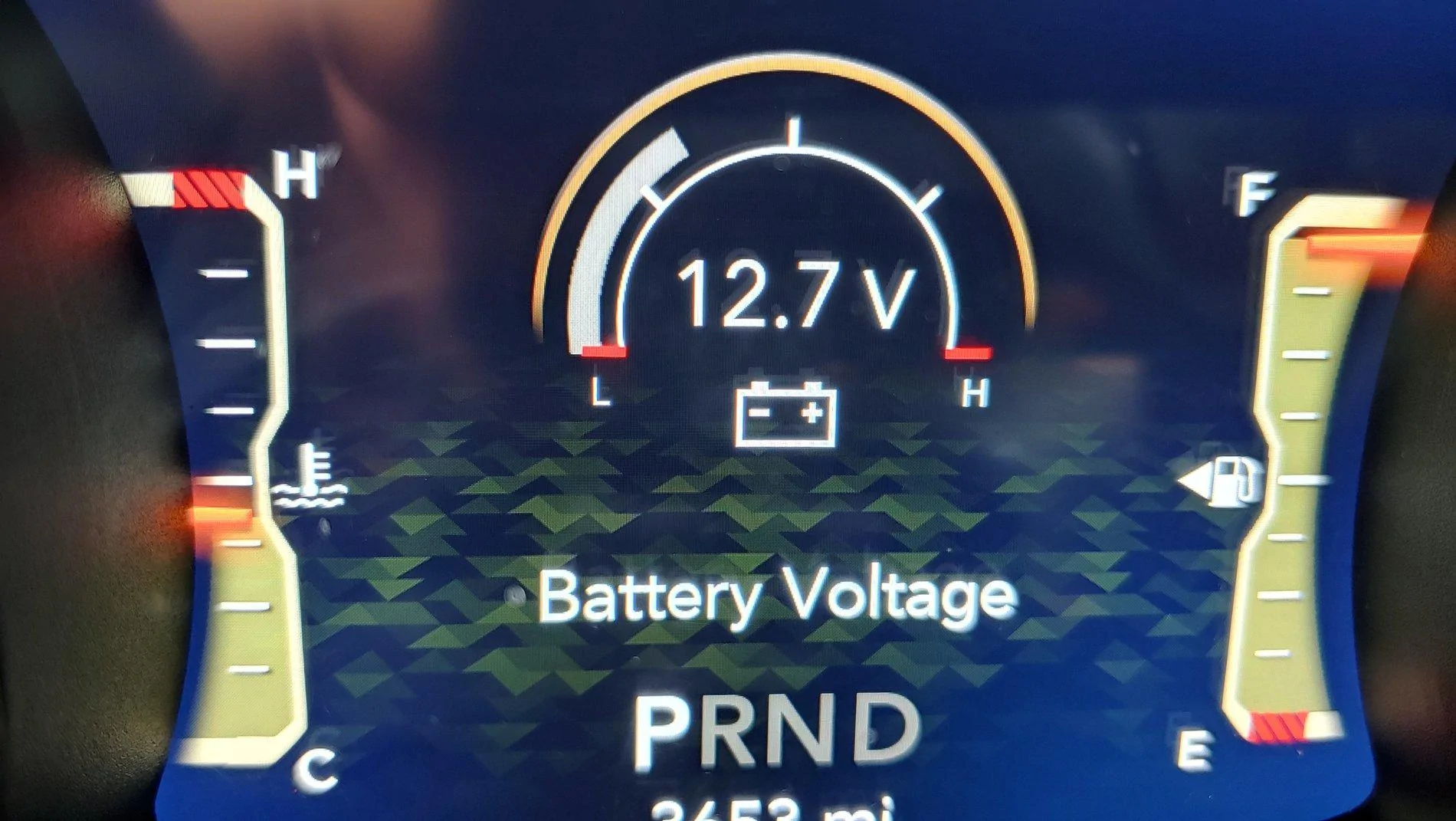
I just wanted to know, if my battery voltage is normal?
In the morning (1st start up, voltage is 13.5v-14.5v)

As im driving it dips to 12.5v-12.7v.

Is this the norm or shall I be concerned?
Jeep Wrangler JL Battery Voltage? Normal? 20190501_162804_HDR
Sponsored


shadowhunter22

Active Member
First Name
Julian
Joined
May 30, 2018
Threads
3
Messages
30
Reaction score
18
Location
Las Vegas
Vehicle(s)
JLU Sport
Once you get to a coasting speed, take your foot off the gas. If that voltage increases to the mid-13 range, you're good to go. Someone else explained it better, but it's something along the lines of the alternator only being active when necessary so it uses a little less fuel. While driving or parked, it will turn off until the battery voltage drops a certain amount below 12.5V.
 
OP
OP

JLsport2019

Guest
Shadowhunter,
thank you much for the reply.
I will check this test out coasting to see if it goes ~13.5v ish....
 

WranglerMan

Well-Known Member
First Name
Will
Joined
May 8, 2018
Threads
104
Messages
3,560
Reaction score
2,883
Location
Greenfield Indiana
Vehicle(s)
2018 Wrangler JLU Sahara
Occupation
Retired
Vehicle Showcase
1
Perfectly normal what you are seeing, the JL has an IBS ( intelligent battery sensor ) and it monitors the condition of both batteries and only allows the alternator to charge as needed, this by design is supposed to keep the batteries in better health by not constantly throwing 14+ volts at them all the time and as you have noticed when driving you may see 13+ but when you decelerate or brake the voltage will ramp up to over 14 then drop back down, this time is by design and throws a charge to the battery when the vehicle is not under a load so it’s supposed to help mileage but I honestly don’t know how much
 

INCRHULK

Well-Known Member
First Name
Lance
Joined
Jul 23, 2019
Threads
40
Messages
1,199
Reaction score
1,898
Location
Canada
Website
litwphoto.com
Vehicle(s)
2019 Wrangler Unlimited Sahara (retired), 2021 Gladiator Rubicon Diesel
Build Thread
Link
Occupation
Program Manager, Information Technology
Clubs
 
Good to know, I'd seen a message on the ESS screen about ESS disabled for battery protection mode, and started monitoring the battery voltage on a couple of hour drive. I was concerned with the voltage only showing 12.6-12.8V. Any auto before this showed something in the 13V range.
 

Sponsored

jiwooncc

Active Member
First Name
Chris
Joined
Sep 17, 2022
Threads
10
Messages
38
Reaction score
10
Location
Los Angeles, CA
Vehicle(s)
2018 Jeep Wrangler JL Sport S Unlimited
I just wanted to know, if my battery voltage is normal?
In the morning (1st start up, voltage is 13.5v-14.5v)

As im driving it dips to 12.5v-12.7v.

Is this the norm or shall I be concerned?
20190501_162804_HDR.webp
my vehicle sets at 12.2-12.5 when on Auto Stop Start and once engine turns back on it goes up to 13.8 - 14.4. Usually in the morning when I start the engine its at 14.2 - 14.5. A buddy of mine who works at FCA says 12 range when engine is ON and running could be low.... but should work fine.
 

Fuel Fire Desire

Well-Known Member
Joined
Feb 17, 2018
Threads
33
Messages
543
Reaction score
583
Location
Michigan
Vehicle(s)
2018 JLU Sport S, 2020 JT Sport
I have a 2017 build date 2018 3.8. I was on the original batteries until a few days ago (they had been on their way out for a year). Over the last year or two, voltage stayed steady between 13.8-14.3. After the battery swap, it’s a constant 12.8 unless the vehicle is coasting, where it jumps to 13.8-14.3 until stopped. It’s just the IBS doing its job. If voltage is at a steady 13.8-14.3 like an older vehicle, the batteries are on their way out and IBS is trying to keep them charged. New healthy batteries won’t need anything more than a few tenths over static voltage after the starting drain is recovered.

As for IBS being beneficial……not sure. I really should have changed my batteries a year or two ago with the weird symptoms I was getting, and a no start situation forced my hand. But I can’t think of a single vehicle I’ve owned where I needed to change a battery (or batteries in this case) after just a few years. I’ve owned used cars that were a decade old and had only done one battery swap on the back half of that decade.

An article I read put out by an IBS supplier said that the system helped to reduce carbon (engine load) and ozone (generator emissions) by only charging when necessary…….but nothing about prolonging battery life. My guess it’s a system that’s good for EPA compliance, but not for the end user….like ESS and FAD.
 

mwilk012

Well-Known Member
Joined
Mar 10, 2018
Threads
14
Messages
10,926
Reaction score
11,241
Location
Oklahoma
Vehicle(s)
2018 Ocean Blue JLU Rubicon
Occupation
Service
I have a 2017 build date 2018 3.8. I was on the original batteries until a few days ago (they had been on their way out for a year). Over the last year or two, voltage stayed steady between 13.8-14.3. After the battery swap, it’s a constant 12.8 unless the vehicle is coasting, where it jumps to 13.8-14.3 until stopped. It’s just the IBS doing its job. If voltage is at a steady 13.8-14.3 like an older vehicle, the batteries are on their way out and IBS is trying to keep them charged. New healthy batteries won’t need anything more than a few tenths over static voltage after the starting drain is recovered.

As for IBS being beneficial……not sure. I really should have changed my batteries a year or two ago with the weird symptoms I was getting, and a no start situation forced my hand. But I can’t think of a single vehicle I’ve owned where I needed to change a battery (or batteries in this case) after just a few years. I’ve owned used cars that were a decade old and had only done one battery swap on the back half of that decade.

An article I read put out by an IBS supplier said that the system helped to reduce carbon (engine load) and ozone (generator emissions) by only charging when necessary…….but nothing about prolonging battery life. My guess it’s a system that’s good for EPA compliance, but not for the end user….like ESS and FAD.
It is much better for battery life. This is not new technology.
Sponsored


Top