
Sponsored

Mguy
Well-Known Member
Quite a statement. If true, how does the the IBS (Intelligent Battery Sensor) determine or estimate SOC (battery State Of Charge)? Specifically, what metric(s) does the IBS use for SOC?In my experience, IBS SOC isn't directly correlated with voltage . . . .

Operative73
Well-Known Member
- First Name
- Christian
- Joined
- Aug 3, 2024
- Threads
- 11
- Messages
- 160
- Reaction score
- 316
- Location
- Pittsburgh PA
- Vehicle(s)
- 2020 Wrangler Sport S/2017 Softail Breakout
so testing voltage won't necessarily help you properly assess whether remote start non-function is a result of the Jeep's estimate of battery condition.
To properly test a battery, you need to load test it, not just pull a voltage.Quite a statement. If true, how does the the IBS (Intelligent Battery Sensor) determine or estimate SOC (battery State Of Charge)? Specifically, what metric(s) does the IBS use for SOC?
I can't speak for what the Jeep sensors do to assess the battery condition.

mwilk012
Well-Known Member
It assesses voltage drop on a normal cold start cranking event following 8 hours of non-operation.To properly test a battery, you need to load test it, not just pull a voltage.
I can't speak for what the Jeep sensors do to assess the battery condition.

THAW
Well-Known Member
- First Name
- Foster
- Joined
- Oct 28, 2022
- Threads
- 4
- Messages
- 2,193
- Reaction score
- 3,028
- Location
- PNW - prefer Middle of Nowhere
- Vehicle(s)
- 23 JL4DrRubicon
Quite obviously, other than voltage, the IBS metric most relevant to its SOC calculation is current.Quite a statement. If true, how does the the IBS (Intelligent Battery Sensor) determine or estimate SOC (battery State Of Charge)? Specifically, what metric(s) does the IBS use for SOC?
IBS SOC is updated in real time based on current, it's not calculated solely from a voltage snapshot.
Sponsored
THAW
Well-Known Member
- First Name
- Foster
- Joined
- Oct 28, 2022
- Threads
- 4
- Messages
- 2,193
- Reaction score
- 3,028
- Location
- PNW - prefer Middle of Nowhere
- Vehicle(s)
- 23 JL4DrRubicon
Undoubtedly true, but that "SOH" measurement doesn't appear to me to have a direct/immediate impact on the IBS SOC calculation used for thresholds to enable/disable some vehicle functions.It assesses voltage drop on a normal cold start cranking event following 8 hours of non-operation.
mwilk012
Well-Known Member
It certainly does, this data is stored and monitored, I believe you can see the past 5 days worth of measurements in the data. Current versus voltage is exactly what is measured to determine battery health. Starter current is a known load, and voltage drop on cranking is exactly how you measure a battery’s capacity.Undoubtedly true, but that "SOH" measurement doesn't appear to me to have a direct/immediate impact on the IBS SOC calculation used for thresholds to enable/disable some vehicle functions.
THAW
Well-Known Member
- First Name
- Foster
- Joined
- Oct 28, 2022
- Threads
- 4
- Messages
- 2,193
- Reaction score
- 3,028
- Location
- PNW - prefer Middle of Nowhere
- Vehicle(s)
- 23 JL4DrRubicon
You're correct, but appear to be referring essentially to State of Health; I'm referring specifically to IBS State of Charge, because the Remote Start criteria posted earlier in the thread stated a requirement that " 7. Battery has sufficient charge".It certainly does, this data is stored and monitored, I believe you can see the past 5 days worth of measurements in the data. Current versus voltage is exactly what is measured to determine battery health. Starter current is a known load, and voltage drop on cranking is exactly how you measure a battery’s capacity.
SOH and SOC are related, but distinct. That is, a battery with less than full SOH (e.g. reduced capacity relative to new) can still have 100% SOC (i.e. fully charged at it's diminished capacity). I believe both SOH and SOC are used for Jeep function thresholds, but I have confirmed 65% SOC for ESS.
The IBS stores values for Calculated Battery Resistance, Residual Charge in Ah, and Resistance at 100% SOC and 25 DegC. These measurements are the closest I've found in JScan to what I'd consider SOH calculations in the IBS data, and the resistance values do adjust with cold starts.
IBS SOC, on the other hand, doesn't generally change at startup. The SOC algorithm may factor in cold start data, but as I stated earlier it does not appear to occur immediately or have a direct impact. For the most part SOC changes slowly and consistently with real time IBS Current data.
Mguy
Well-Known Member
If you're still having a problem with remote start, @Operative73's item #7, that your battery has a sufficient charge, is still a good candidate for fault finding. Your thought to check voltage makes very good sense, provided you were planning on using an external voltmeter for an open circuit resting test. Because your battery is just a few months old, you should be at the top of any manufacturer's AGM SOC-voltage chart.I changed to a H7 battery a few months ago. I can check voltage in a bit.
Also, and again because of the battery's young age, you may be able to "cheat" a little. After your Jeep rests overnight, leave the key fob away, open the hood and take a voltage reading at the battery studs. There may be some inherent or parasitic loads still reducing the reading, but a young, near or fully charged battery should still read 12.6v or above--directly correlating to an acceptable SOC on any AGM chart. While a reading of 12.6v or above eliminates item #7, a reading below, because loads could be a factor, does not necessarily mean that your battery fails.
I'll later reply to "IBS SOC" discussion on this thread, which may or may not be of interest to you. In the mean time, good luck getting your Jeep remotely started.
THAW
Well-Known Member
- First Name
- Foster
- Joined
- Oct 28, 2022
- Threads
- 4
- Messages
- 2,193
- Reaction score
- 3,028
- Location
- PNW - prefer Middle of Nowhere
- Vehicle(s)
- 23 JL4DrRubicon
False....a reading of 12.6v or above eliminates item #7..
Based on actual experience checking IBS SOC, I can tell you for a fact the battery can show 12.6V on a multimeter with the Jeep asleep when the IBS SOC value is near the 65% SOC ESS threshold.
At this point, it borders on ridiculous for you to continue to give advice related to the IBS and the JL charging system, apparently having never bothered to use JScan to read actual IBS data.I'll later reply to "IBS SOC" discussion on this thread, which may or may not be of interest to you.
Last edited:
Sponsored

Cartman
Well-Known Member
wait if you turn off ASS as I decoded as automatic start stop system, remote start will not woork. try to activate start stop system and wait 24 hours.
THAW
Well-Known Member
- First Name
- Foster
- Joined
- Oct 28, 2022
- Threads
- 4
- Messages
- 2,193
- Reaction score
- 3,028
- Location
- PNW - prefer Middle of Nowhere
- Vehicle(s)
- 23 JL4DrRubicon
Remote Start is only disabled due to ESS if ESS is disabled via the hood sensor method or JScan (which disables ESS via the hood sensor electronics).wait if you turn off ASS as I decoded as automatic start stop system, remote start will not woork. try to activate start stop system and wait 24 hours.
I believe the OP uses a Tazer; my ESS is fixed to off using a Tazer and my Remote Start works. The Tazer simulates an Auto Stop/Start dash button push after startup, so as far as a shut down JL with a Live Function Tazer knows, there's nothing ESS-related to prevent a Remote Start.
Operative73
Well-Known Member
- First Name
- Christian
- Joined
- Aug 3, 2024
- Threads
- 11
- Messages
- 160
- Reaction score
- 316
- Location
- Pittsburgh PA
- Vehicle(s)
- 2020 Wrangler Sport S/2017 Softail Breakout
It works. My ASS is off through Tazer and remote start works fine.wait if you turn off ASS as I decoded as automatic start stop system, remote start will not woork. try to activate start stop system and wait 24 hours.
Mguy
Well-Known Member
Seems like @THAW isn't interested in what I have to say. I suppose he could have been more emphatic with something like a forecast that my contribution to the discussion would be "forum malpractice" or some other silly expression. Or, maybe his abnormal aversion to what is numerous manufactures' recommended method for SOC estimation will eventually be revealed.Mguy said:
I'll later reply to "IBS SOC" discussion on this thread, which may or may not be of interest to you.
At this point, it borders on ridiculous for you to continue to give advice related to the IBS and the JL charging system, apparently having never bothered to use JScan to read actual IBS data.
This "IBS SOC" discussion is really a thread drift, so I'll try to be brief. First, for a good, simple, explanation of SOC, here's what the engineers at Odyssey say:
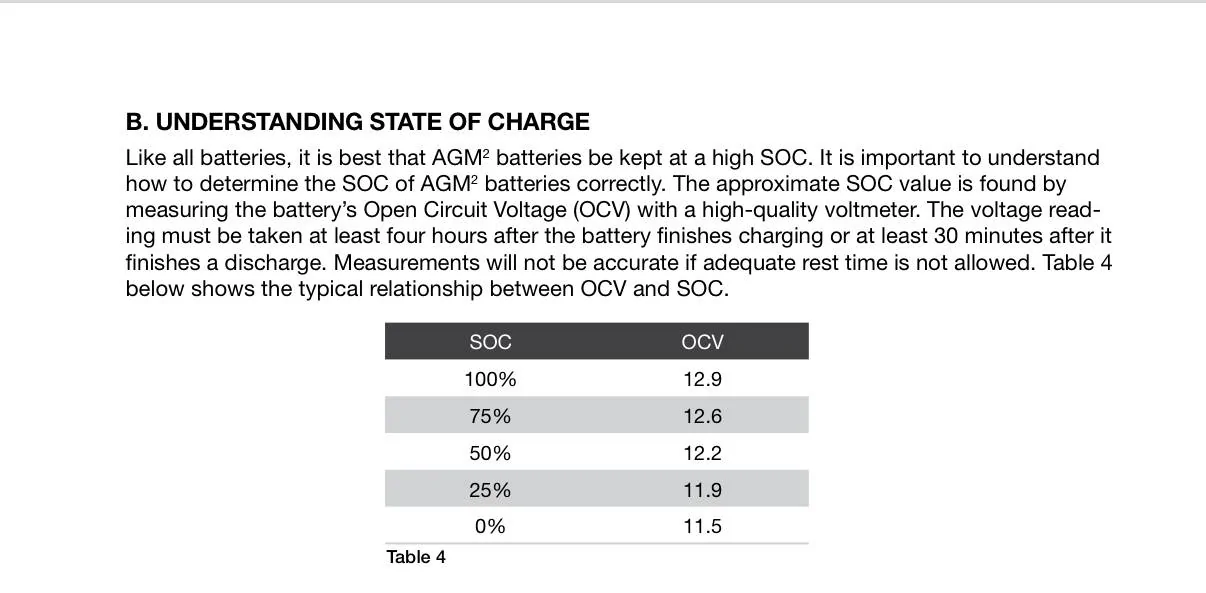
(Note, I believe virtually all $20 digital voltmeters will be sufficient for Jeep owners).
Next, here's what Jeep engineers have to say about the IBS and SOC that is relevant to this discussion:
"IBS SOC Adaptation (Learning)
Learning needs 1 crank and 2-4 hours of quiescent/sleep time. Quiescent/Sleep time is defined as Quiescent phase: [-500mA, 50mA] battery current."
Now ask yourself, what might the Jeep computer brain/IBS be doing ("adopting," "learning") as the "Quiescent phase" ends that relates to the voltage test following the "rest time" that the Odyssey engineers emphasize?
Since this discussion is pretty much a thread drift, and OP @Aonarch hasn't even indicated his remote starting problem has been solved, I won't go further--except to mention that those interested should research "Coulomb Counting" and other non-exclusive methods for estimating SOC, and assume that Jeep engineers know what you just learned.
THAW
Well-Known Member
- First Name
- Foster
- Joined
- Oct 28, 2022
- Threads
- 4
- Messages
- 2,193
- Reaction score
- 3,028
- Location
- PNW - prefer Middle of Nowhere
- Vehicle(s)
- 23 JL4DrRubicon
You've confused initial IBS learning meant to occur with a new/fully charged battery with the persistent SOC estimate.Seems like @THAW isn't interested in what I have to say. I suppose he could have been more emphatic with something like a forecast that my contribution to the discussion would be "forum malpractice" or some other silly expression. Or, maybe his abnormal aversion to what is numerous manufactures' recommended method for SOC estimation will eventually be revealed.
This "IBS SOC" discussion is really a thread drift, so I'll try to be brief. First, for a good, simple, explanation of SOC, here's what the engineers at Odyssey say:

(Note, I believe virtually all $20 digital voltmeters will be sufficient for Jeep owners).
Next, here's what Jeep engineers have to say about the IBS and SOC that is relevant to this discussion:
"IBS SOC Adaptation (Learning)
Learning needs 1 crank and 2-4 hours of quiescent/sleep time. Quiescent/Sleep time is defined as Quiescent phase: [-500mA, 50mA] battery current."
Now ask yourself, what might the Jeep computer brain/IBS be doing ("adopting," "learning") as the "Quiescent phase" ends that relates to the voltage test following the "rest time" that the Odyssey engineers emphasize?
Since this discussion is pretty much a thread drift, and OP @Aonarch hasn't even indicated his remote starting problem has been solved, I won't go further--except to mention that those interested should research "Coulomb Counting" and other non-exclusive methods for estimating SOC, and assume that Jeep engineers know what you just learned.
But kudos for the mention of Coulomb counting; it appears you've realized voltage is not the primary metric for battery SOC monitors.
In the context of this thread, it's important to note Coulomb counting can quickly become out-of-sync with a battery's actual charge state during Partial State Of Charge cycling (which passenger vehicle alternator charging is, almost universally). That's why it's possible for the IBS SOC (used by a JL for enabling/disabling functionality) to deviate from multimeter voltage extrapolated SOC- the original fact that preceded and is victim of the much dreaded "thread drift".
A few quick last notes:
A quiescent-state, voltage-based SOC reset programmed into the IBS could easily exacerbate out-of-sync Coulomb counting.
Resetting the IBS for an aged battery is not a good solution for out-of-sync SOC. It's better to avoid the associated data loss by sufficiently charging the battery through the IBS, especially while driving.
@Mguy, get JScan. You're exactly the kind of JL owner who would use and enjoy it. Before posting, you could've used it to test your theory about how the IBS uses quiescent voltage to track SOC - which, as outlined in previous posts, I've done and found inconsistent with extensive observational data.
Sponsored
Last edited:
Similar threads


- Replies
- 4
- Views
- 477
