
Sponsored

Jumperless Aux Battery Bypass

OldGuyNewJeep

Well-Known Member
First Name
Don
Joined
Sep 21, 2017
Threads
93
Messages
3,995
Reaction score
7,113
Location
CT
Vehicle(s)
2018 Wrangler JL, 2016 Yukon XL
I first thought Tazer but its crazy.
Yes I only drive 14 miles per day. Its a 2020 with 28,000 on it. Really though not driving it more is an issue ? 5 days a week 14 miles per day or so ? Plus my wife will drive it say 4-5 miles every so often.
Not enough driving. Invest in a charger and use it bi-weekly.
Sponsored


stingGreyNJ

Well-Known Member
First Name
Scott
Joined
May 6, 2018
Threads
9
Messages
91
Reaction score
90
Location
NJ
Vehicle(s)
2018 JL Rubicon, 2013 JK (gone)
That’s almost 8 weeks, and these things have parasitic draw. Need to put a charger/maintainer on there at least every other week unless you do serious commuting. Noco-10 or better. Anything less than 7a will do more harm than good.
I don't drive my 2018 JL with bypassed aux and a Tazer JL Mini for weeks at a time. Maybe months and I've never had that issue.

Make sure all of your aux switches are configured to not work unless car is running (I'm unsure if having them run when car is off is even an option but just in case).

Do you have a dashcam plugged in or some other device that would draw when the car is off.

Best...
 

sweet88gt

Well-Known Member
Joined
May 23, 2020
Threads
17
Messages
195
Reaction score
65
Location
FL
Vehicle(s)
20 JLUR 24 VW Tiguan Rline 20+21 Tacoma TRD
Not enough driving. Invest in a charger and use it bi-weekly.
Well I have had battery issues since the beginning. So at one point I was told by the dealer I didn't drive it enough. I racked that up as crazy talk.
I plan on going through the fuse box and checking for draw soon regardless now.
 

sweet88gt

Well-Known Member
Joined
May 23, 2020
Threads
17
Messages
195
Reaction score
65
Location
FL
Vehicle(s)
20 JLUR 24 VW Tiguan Rline 20+21 Tacoma TRD
I don't drive my 2018 JL with bypassed aux and a Tazer JL Mini for weeks at a time. Maybe months and I've never had that issue.

Make sure all of your aux switches are configured to not work unless car is running (I'm unsure if having them run when car is off is even an option but just in case).

Do you have a dashcam plugged in or some other device that would draw when the car is off.

Best...
Tazer is plugged in. I thought that my be the culprit. I thought you could leave it installed. maybe not. But I have had issues from the start. No battery I have has lasted more than 1.5
I don't drive my 2018 JL with bypassed aux and a Tazer JL Mini for weeks at a time. Maybe months and I've never had that issue.

Make sure all of your aux switches are configured to not work unless car is running (I'm unsure if having them run when car is off is even an option but just in case).

Do you have a dashcam plugged in or some other device that would draw when the car is off.

Best...
Tazer lite plugged in and I just leave it. Maybe thats an issue but since 2021 every 6 months regardless of Tazer I have had issues of some type.
 

ecidiego

Well-Known Member
First Name
Chris
Joined
Apr 4, 2022
Threads
2
Messages
253
Reaction score
286
Location
San Diego
Vehicle(s)
2021 Gladiator Mojave
Clubs
 
Not checking 40 pages so probably mentioned already, but if you do this while in warranty UNDO IT if you ever need to take your truck in. They'll void any electrical warranty issues in a heartbeat from this. It isn't protected under Moss - you've meddled with the electrical design.
 

Sponsored

THAW

Well-Known Member
First Name
Foster
Joined
Oct 28, 2022
Threads
4
Messages
2,260
Reaction score
3,119
Location
PNW - prefer Middle of Nowhere
Vehicle(s)
23 JL4DrRubicon
I do not like the idea of heavy battery leads laying unconnected, even if wrapped, and I did not want to leave the old aux battery installed. So I removed the aux negative lead entirely and rerouted the positive back to the main battery lug.
One thing to note:

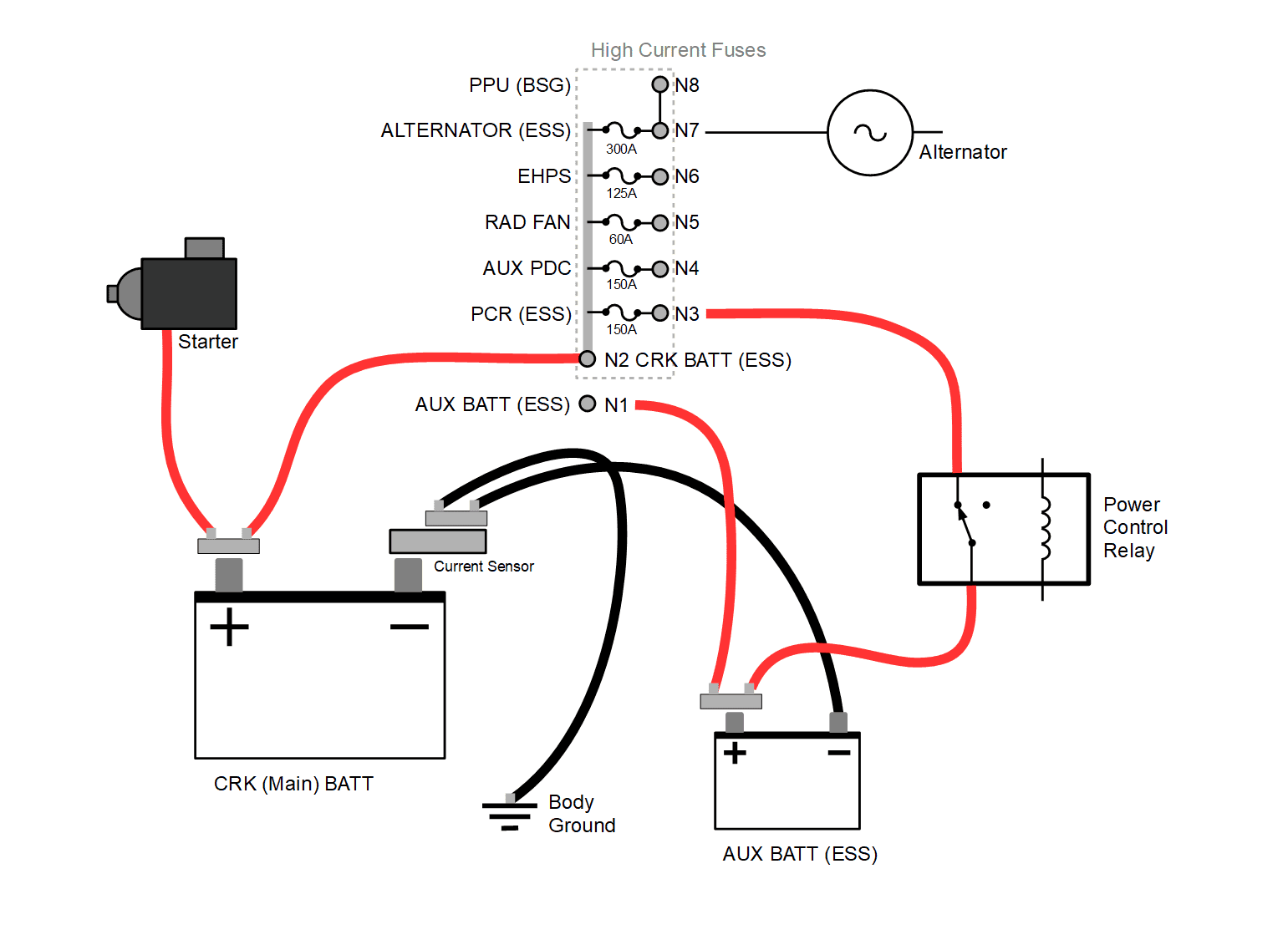
Connecting the ESS/Aux battery positive cable terminal connector to the main battery positive post bypasses the 150A PCR (ESS) fuse.

I can't say for sure that in the factory configuration the fuse is designed to protect anything other than the cables, PCR and ESS/Aux battery, but it does sit upstream of some system electronics.

I wonder if it's possible to safely attach the ESS/Aux battery positive terminal connector to N1 on the PDC.
 
Last edited:

AndySpill

Well-Known Member
First Name
Andy
Joined
Oct 24, 2023
Threads
72
Messages
1,659
Reaction score
1,273
Location
Pittsburgh
Vehicle(s)
2018 JL Sahara
One thing to note:

Connecting the ESS/Aux battery positive cable terminal connector to the main battery positive post bypasses the 150A PCR (ESS) fuse.

I can't say for sure that in the factory configuration the fuse is designed to protect anything other than the cables, PCR and ESS/Aux battery, but it does sit upstream of some system electronics.

I wonder if it's possible to safely attach the ESS/Aux battery positive terminal connector to N1 on the PDC.
...and you'll think that I'm picking on you yet I am legitimately confused.

Doesn't the the ESS/Aux battery positive terminal connector, with its two cables, already--when the PCR is not energized--connect N1 and N3?

I do agree with your questioning above why a 10 amp charger is necessary.

Jeep Wrangler JL Jumperless Aux Battery Bypass 1707526959206


THAW

Well-Known Member
First Name
Foster
Joined
Oct 28, 2022
Threads
4
Messages
2,260
Reaction score
3,119
Location
PNW - prefer Middle of Nowhere
Vehicle(s)
23 JL4DrRubicon
...and you'll think that I'm picking on you yet I am legitimately confused.

Doesn't the the ESS/Aux battery positive terminal connector, with its two cables, already--when the PCR is not energized--connect N1 and N3?
I don't think you're picking on me. You'll think I'm picking on you... I wonder why you don't seem to understand the concept of quoting and replying.

Yes, Andy, connecting the loose ESS/Aux positive cable terminal connector along the original path is exactly the point! Instead of connecting it to the main battery terminal and changing the path, which bypasses the N3 fuse.

I do agree with your questioning above why a 10 amp charger is necessary.
Once again, you've completely missed the point. I want to know how the minimum was derived, I don't think there isn't a practical minimum in that neighborhood.
 
Last edited:

azwjowner

Well-Known Member
Joined
Oct 8, 2020
Threads
13
Messages
2,287
Reaction score
3,986
Location
Phoenix
Vehicle(s)
2022 JL; 2004 WJ (sold but never forgotten)
I don't think you're picking on me. You'll think I'm picking on you... I wonder why you don't seem to understand the concept of quoting and replying.

Yes, Andy, connecting the loose ESS/Aux positive cable terminal connector along the original path is exactly the point! Instead of connecting it to the main battery terminal and changing the path, which bypasses the N3 fuse.
That wouldn't bypass the fuse though. Connection would go from N3 to the main battery positive.
 

Sponsored

THAW

Well-Known Member
First Name
Foster
Joined
Oct 28, 2022
Threads
4
Messages
2,260
Reaction score
3,119
Location
PNW - prefer Middle of Nowhere
Vehicle(s)
23 JL4DrRubicon
That wouldn't bypass the fuse though. Connection would go from N3 to the main battery positive.
Attaching the ESS/Aux battery positive battery cable terminal connector to the main battery positive post creates a direct connection between the main battery and N1, bypassing the N3 fuse.

Yes, technically, N3 and the ESS/Aux positive battery cable terminal connector are still physically connected through the PCR. But, current would likely flow through the shorter connection (without the PCR resistance), and if not there'd still be a current path between the main battery and N1 if the N3 fuse blows.

I suppose I should say "creating a bypass" rather than "bypassing"?
 
Last edited:

azwjowner

Well-Known Member
Joined
Oct 8, 2020
Threads
13
Messages
2,287
Reaction score
3,986
Location
Phoenix
Vehicle(s)
2022 JL; 2004 WJ (sold but never forgotten)
Attaching the ESS/Aux battery positive battery cable terminal connector to the main battery positive post creates a direct connection between the main battery and N1, bypassing the N3 fuse.
N1 and N3 are directly connected at all times under normal operation, except during start stop events. So clearly the fuse on N3 is not protecting any current from the aux battery into any electronic devices.

The N3 fuse would only come into play when the ESS reconnects the two batteries together. At that point power would flow through the N3 fuse into the aux battery to recharge it. Presumably it exists to ensure no more than 150 amps flows through the cables.

If you remove the aux battery, you have no drain on an aux battery during a start stop event, and no current flowing from the main battery system into the aux battery when the batteries are reconnected. Thus it does not matter that nothing flows through the N3 fuse; there is no longer any different potential for current to flow, nor need for the fuse. Am I missing something? That's how I read the diagram.
 

azwjowner

Well-Known Member
Joined
Oct 8, 2020
Threads
13
Messages
2,287
Reaction score
3,986
Location
Phoenix
Vehicle(s)
2022 JL; 2004 WJ (sold but never forgotten)
Attaching the ESS/Aux battery positive battery cable terminal connector to the main battery positive post creates a direct connection between the main battery and N1, bypassing the N3 fuse.

Yes, technically, N3 and the ESS/Aux positive battery cable terminal connector are still physically connected. But, current would likely flow through the shorter connection, and if not there'd still be a current path between the main battery and N1 if the N3 fuse blows.

I suppose I should say "creating a bypass" rather than "bypassing"?
I see what you mean, but I disagree. The devices powered by the aux battery off of N1 must have their own fuses downstream because under the stock setup, there's a direct connection from aux positive to N1. No fuse.

So attaching N1 to the main battery, versus the aux, isn't eliminating any protection. There was already no fuse there.

I think you're ignoring that the main battery is on the left side of the N3 fuse to begin with. That's how the aux battery is recharged. When the relay closes, current flows from the main battery through the N3 fuse and into the aux battery. The only thing the N3 fuse can be protecting is that current flowing between the two batteries, not current to any devices. When you remove the aux battery, there's no need for N3 anymore.
 

THAW

Well-Known Member
First Name
Foster
Joined
Oct 28, 2022
Threads
4
Messages
2,260
Reaction score
3,119
Location
PNW - prefer Middle of Nowhere
Vehicle(s)
23 JL4DrRubicon
So clearly the fuse on N3 is not protecting any current from the aux battery into any electronic devices.
True, but the ESS battery is ~200 CCA compared to 800 CCA of the main. So bypassing the N3 fuse might have some implication for those electronics. That's the part I don't know.
 

THAW

Well-Known Member
First Name
Foster
Joined
Oct 28, 2022
Threads
4
Messages
2,260
Reaction score
3,119
Location
PNW - prefer Middle of Nowhere
Vehicle(s)
23 JL4DrRubicon
I see what you mean, but I disagree. The devices powered by the aux battery off of N1 must have their own fuses downstream because under the stock setup, there's a direct connection from aux positive to N1. No fuse.
I agree with you. I just don't know for sure about any downstream fuse protection. So why not retain the factory connections? That is, what's the advantage in taking the risk of connecting the ESS/Aux positive battery cable terminal connector to the main battery positive post?
Sponsored


Top